Page 213 of 256
Celica_U
2122000 CELICA (OM20735U)
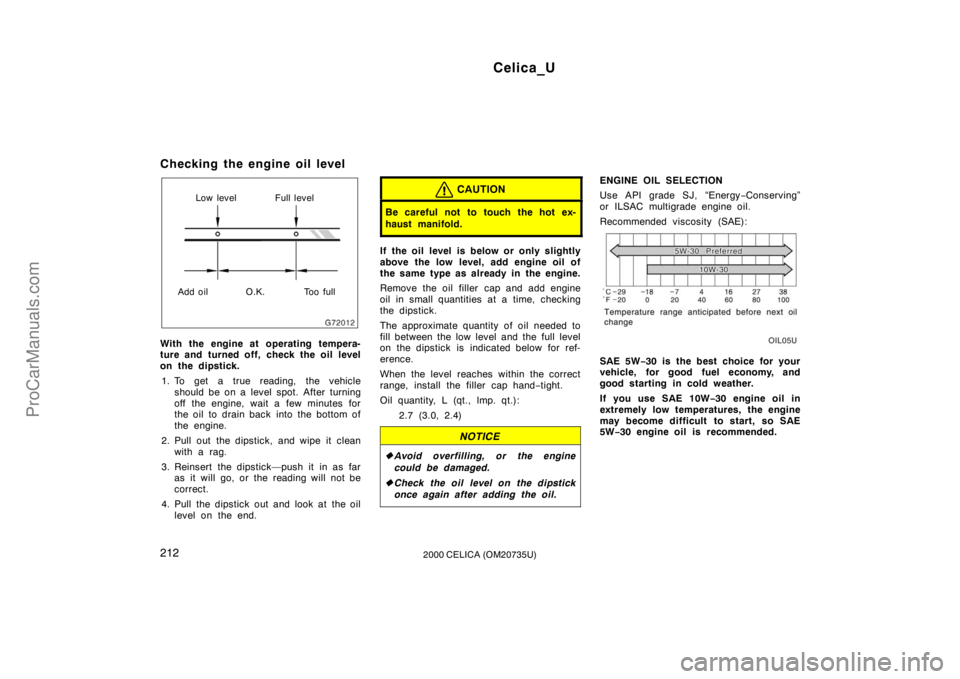
Checking the engine oil level
Low level Full level
Add oil O.K. Too full
With the engine at operating tempera-
ture and turned off, check the oil level
on the dipstick. 1. To get a true reading, the vehicle should be on a level spot. After turning
off the engine, wait a few minutes for
the oil to drain back into the bottom of
the engine.
2. Pull out the dipstick, and wipe it clean with a rag.
3. Reinsert the dipstick—push it in as far as it will go, or the reading will not be
correct.
4. Pull the dipstick out and look at the oil level on the end.
CAUTION
Be careful not to touch the hot ex-
haust manifold.
If the oil level is below or only slightly
above the low level, add engine oil of
the same type as already in the engine.
Remove the oil filler cap and add engine
oil in small quantities at a time, checking
the dipstick.
The approximate quantity of oil needed to
fill between the low level and the full level
on the dipstick is indicated below for ref-
erence.
When the level reaches within the correct
range, install the filler cap hand− tight.
Oil quantity, L (qt., lmp. qt.): 2.7 (3.0, 2.4)
NOTICE
�Avoid overfilling, or the engine
could be damaged.
� Check the oil level on the dipstick
once again after adding the oil.
ENGINE OIL SELECTION
Use API grade SJ, “Energy −Conserving”
or ILSAC multigrade engine oil.
Recommended viscosity (SAE):
SAE 5W −30 is the best choice for your
vehicle, for good fuel economy, and
good starting in cold weather.
If you use SAE 10W −30 engine oil in
extremely low temperatures, the engine
may become difficult to start, so SAE
5W −30 engine oil is recommended.
ProCarManuals.com
Page 214 of 256

Celica_U
2132000 CELICA (OM20735U)
API service symbol
ILSAC certification mark
Oil identification marks
Either or both API registered marks are
added to some oil containers to help
you select the oil you should use.
The API Service Symbol is located any-
where on the outside of the container.
The top portion of the label shows the oil
quality by API (American Petroleum
Institute) designations such as SJ. The
center portion of the label shows the SAE
viscosity grade such as SAE 5W−30.
“Energy −Conserving” shown in the lower
portion, indicates that the oil has
fuel −saving capab ilities.
The ILSAC (International Lubricant Stan-
dardization and Approval Committee) Certi-
fication Mark is displayed on the front of
the container. Look at the see
−through coolant reser-
voir when the engine is cold. The cool-
ant level is satisfactory if it is between
the “FULL” and “LOW” lines on the
reservoir. If the level is low, add ethyl-
ene −glycol type coolant for a proper
corrosion protection of aluminum com-
ponents.
Before adding coolant, remove the cover.
For instructions, see “Replacing light
bulbs—” in Section 7 −3.
The coolant level in the reservoir will vary
with engine temperature. However, if the
level is on or below the “LOW” line, add
coolant. Bring the level up to the “FULL”
line.
Always use ethylene −glycol type coolant
for a proper corrosion protection of alumi-
num components. See information in the
next column.
If the coolant level drops within a short
time after replenishing, there may be a
leak in the system. Visually check the
radiator, hoses, drain cock and water
pump.
If you can find no leak, have your Toyota
dealer test the cap pressure and check
for leaks in the cooling system.
Checking the engine coolant
level
ProCarManuals.com
Page 217 of 256
Celica_U
2162000 CELICA (OM20735U)
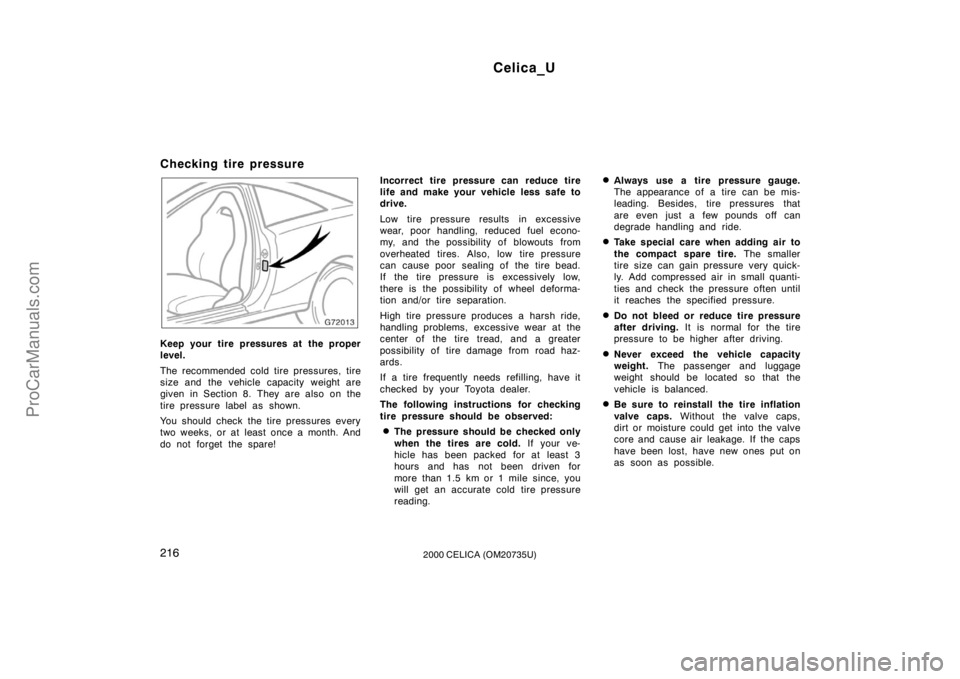
Checking tire pressure
Keep your tire pressures at the proper
level.
The recommended cold tire pressures, tire
size and the vehicle capacity weight are
given in Section 8. They are also on the
tire pressure label as shown.
You should check the tire pressures every
two weeks, or at least once a month. And
do not forget the spare!Incorrect tire pressure can reduce tire
life and make your vehicle less safe to
drive.
Low tire pressure results in excessive
wear, poor handling, reduced fuel econo-
my, and the possibility of blowouts from
overheated tires. Also, low tire pressure
can cause poor sealing of the tire bead.
If the tire pressure is excessively low,
there is the possibility of wheel deforma-
tion and/or tire separation.
High tire pressure produces a harsh ride,
handling problems, excessive wear at the
center of the tire tread, and a greater
possibility of tire damage from road haz-
ards.
If a tire frequently needs refilling, have it
checked by your Toyota dealer.
The following instructions for checking
tire pressure should be observed:
�The pressure should be checked only
when the tires are cold.
If your ve-
hicle has been packed for at least 3
hours and has not been driven for
more than 1.5 km or 1 mile since, you
will get an accurate cold tire pressure
reading.
�Always use a tire pressure gauge.
The appearance of a tire can be mis-
leading. Besides, tire pressures that
are even just a few pounds off can
degrade handling and ride.
�Take special care when adding air to
the compact spare tire. The smaller
tire size can gain pressure very quick-
ly. Add compressed air in small quanti-
ties and check the pressure often until
it reaches the specified pressure.
�Do not bleed or reduce tire pressure
after driving. It is normal for the tire
pressure to be higher after driving.
�Never exceed the vehicle capacity
weight. The passenger and luggage
weight should be located so that the
vehicle is balanced.
�Be sure to reinstall the tire inflation
valve caps. Without the valve caps,
dirt or moisture could get into the valve
core and cause air leakage. If the caps
have been lost, have new ones put on
as soon as possible.
ProCarManuals.com
Page 246 of 256
Celica_U
2452000 CELICA (OM20735U)
Dimensions and weight
Overall length mm (in.) 4330 (170.5)
Overall width mm (in.) 1735 (68.3)
Overall height mm (in.) 1305 (51.8)
∗
Wheelbase mm (in.) 2600 (102.4)
Front tread mm (in.) 1490 (58.7)
Rear tread mm (in.) 1480 (58.3)
Vehicle capacity weight
(occupants + luggage)kg (lb.) 329 (725)
∗:Unladen vehicle
Engine
Model: 1ZZ −FE and 2ZZ −GE
Type: 4 cylinder in line, 4 cycle, gasoline
Bore and stroke, mm (in.): 1ZZ −FE engine
79.0 � 91.5 (3.11 � 3.60)
2ZZ −GE engine
82.0 � 85.0 (3.23 � 3.35)
Displacement, cm
3 (cu. in.):
1ZZ −FE engine 1794 (109.5)
2ZZ −GE engine 1796 (109.6)
Fuel
Fuel type:
1ZZ −FE engine
Unleaded gasoline, Octane Rating 87
(Research Octane Number 91) or
higher
2ZZ −GE engine
Select premium unleaded gasoline with
an Octane Rating of 95 (Research Oc-
tane Number 96) or higher for opti-
mum engine performance
Fuel tank capacity, L (gal., Imp. gal.): 55 (14.5, 12.1)
ProCarManuals.com