Page 206 of 256
Celica_U
2052000 CELICA (OM20735U)
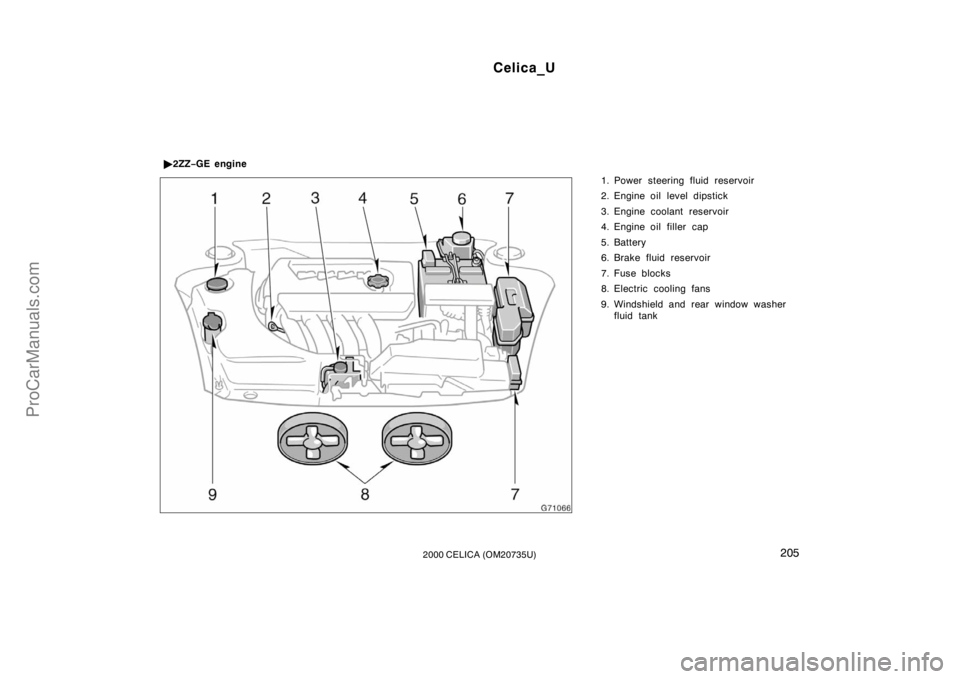
1. Power steering fluid reservoir
2. Engine oil level dipstick
3. Engine coolant reservoir
4. Engine oil filler cap
5. Battery
6. Brake fluid reservoir
7. Fuse blocks
8. Electric cooling fans
9. Windshield and rear window washer fluid tank
�
2ZZ −GE engine
ProCarManuals.com
Page 209 of 256
Celica_U
2082000 CELICA (OM20735U)
NOTICE
�Remember that battery and ignition
cables carry high currents or volt-
ages. Be careful of accidentally
causing a short circuit.
� Add only demineralized or distilled
water to fill the radiator. And if you
spill some of the coolant, be sure
to wash it off with water to prevent
it from damaging the parts or paint.
� Do not allow dirt or anything else
to fall through the spark plug holes.
� Do not pry the outer electrode of a
spark plug against the center elec-
trode.
� Use only spark plugs of the speci-
fied type. Using other types will
cause engine damage, loss of per-
formance or radio noise.
� Do not reuse iridium −tipped spark
plugs by cleaning or regapping.
� Do not overfill automatic transmis-
sion fluid, or the transmission
could be damaged.
�Do not drive with the air cleaner
filter removed, or excessive engine
wear could result. Also backfiring
could cause a fire in the engine
compartment.
� Be careful not to scratch the glass
surface with the wiper frame.
� When closing the engine hood,
check to see that you have not for-
gotten any tools, rags, etc.
Parts and tools
Here is a list of parts and tools you will
need on performing do −it−yourself mainte-
nance. Remember all Toyota parts are de-
signed in metric sizes, so your tools must
be metric.
Checking the engine oil level
Parts (if level is low):
�Engine oil API grade SJ,
“Energy −Conserving” or ILSAC
multigrade having viscosity proper for
your climate
Tools:
�Rag or paper towel
�Funnel (only for adding oil)
Checking the engine coolant level
Parts (if level is low):
�“TOYOTA Long Life Coolant” or equiva-
lent
See Section 7 −2 for details about cool-
ant type selection.
�Demineralized or distilled water
Tools:
�Funnel (only for adding coolant)
Checking brake fluid
Parts (if level is low):
�SAE J1703 or FMVSS No.116 DOT 3
brake fluid
ProCarManuals.com
Page 212 of 256
Celica_U
2112000 CELICA (OM20735U)
DO−IT −YOURSELF MAINTENANCE
Engine and Chassis
Checking the engine oil level 212
. . . . . . . . . . . . . . . . . . . . . . . . . . . . . . . . .
Checking the engine coolant leve l213
. . . . . . . . . . . . . . . . . . . . . . . . . . . .
Checking brake fluid 214
. . . . . . . . . . . . . . . . . . . . . . . . . . . . . . . . . . . . \
. . . .
Checking power steering fluid 215
. . . . . . . . . . . . . . . . . . . . . . . . . . . . . . . .
Checking tire pressure 216
. . . . . . . . . . . . . . . . . . . . . . . . . . . . . . . . . . . . \
. .
Checking and replacing tires 217
. . . . . . . . . . . . . . . . . . . . . . . . . . . . . . . . .
Rotating tires 218
. . . . . . . . . . . . . . . . . . . . . . . . . . . . . . . . . . . . \
. . . . . . . . . . .
Installing snow tires and chains 220
. . . . . . . . . . . . . . . . . . . . . . . . . . . . . .
Replacing wheels 221
. . . . . . . . . . . . . . . . . . . . . . . . . . . . . . . . . . . . \
. . . . . . .
Aluminum wheel precautions 221
. . . . . . . . . . . . . . . . . . . . . . . . . . . . . . . .
SECTION 7− 2
ProCarManuals.com
Page 215 of 256
Celica_U
2142000 CELICA (OM20735U)
CAUTION
To prevent burning yourself, do not
remove the coolant reservoir cap or
air release valve when the engine is
hot.
Coolant type selection
Use of improper coolants may damage
your engine cooling system. Your coolant
must contain ethylene−glycol type coolant
for a proper corrosion protection of your
engine that contains aluminum compo-
nents. Use “TOYOTA Long Life Coolant”
or equivalent.
In addition to preventing freezing and sub-
sequent damage to the engine, this type
of coolant will also prevent corrosion. Fur-
ther supplemental inhibitors or additives
are neither needed nor recommended.
Read the coolant container for information
on freeze protection. Follow the manufac-
turer’s directions for how much to mix
with plain water (preferably demineralized
water or distilled water). The total capacity
of the cooling system is given in Section
8. We recommend to use 50% solution for
your Toyota, to provide protection down to
about
−35 �C ( −31 �F). When it is extreme-
ly cold, to provide protection down to
about −50 �C ( −58 �F), 60% solution is rec-
ommended. Do not use more than 70%
solution for better coolant performance.NOTICE
Do not use alcohol type antifreeze or
plain water alone.
Checking brake fluid
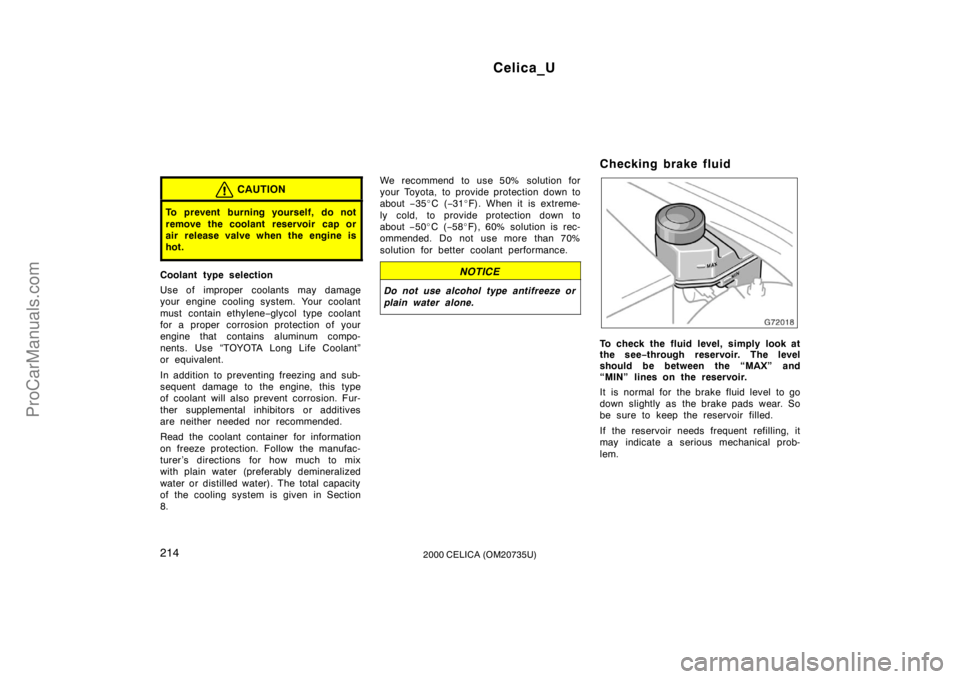
To check the fluid level, simply look at
the see −through reservoir. The level
should be between the “MAX” and
“MIN” lines on the reservoir.
It is normal for the brake fluid level to go
down slightly as the brake pads wear. So
be sure to keep the reservoir filled.
If the reservoir needs frequent refi lling, it
may indicate a serious mechanical prob-
lem.
ProCarManuals.com
Page 216 of 256
Celica_U
2152000 CELICA (OM20735U)
If the level is low, add SAE J1703 or
FMVSS No.116 DOT 3 brake fluid to the
brake reservoir.
Remove and replace the reservoir cap by
hand. Fill the brake fluid to the dotted
line. This brings the fluid to the correct
level when you put the cap back on.
Use only newly opened brake fluid. Once
opened, brake fluid absorbs moisture from
the air, and excess moisture can cause a
dangerous loss of braking.
CAUTION
Take care when filling the reservoir
because brake fluid can harm your
eyes and damage painted surfaces. If
fluid gets in your eyes, flush your
eyes with clean water.
NOTICE
If you spill the fluid, be sure to wash
it off with water to prevent it from
damaging the parts or paint.
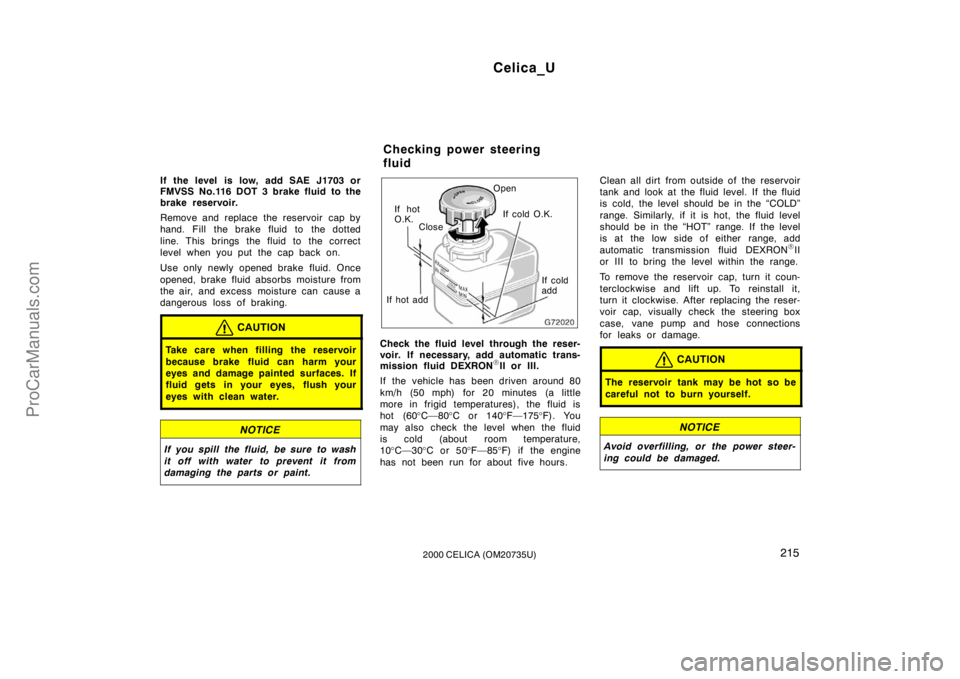
If hot
O.K.Close Open
If hot add If cold
add
If cold O.K.
Check the fluid level through the reser-
voir. If necessary, add automatic trans-
mission fluid DEXRON
�II or III.
If the vehicle has been driven around 80
km/h (50 mph) for 20 minutes (a little
more in frigid temperatures), the fluid is
hot (60 °C—80 °C or 140 °F—175 °F). You
may also check the level when the fluid
is cold (about room temperature,
10 °C—30 °C or 50 °F—85 °F) if the engine
has not been run for about five hours. Clean all dirt from outside of the reservoir
tank and look at the fluid level. If the fluid
is cold, the level should be in the “COLD”
range. Similarly, if it is hot, the fluid level
should be in the “HOT” range. If the level
is at the low side of either range, add
automatic transmission fluid DEXRON
�II
or III to bring the level within the range.
To remove the reservoir cap, turn it coun-
terclockwise and lift up. To reinstall it,
turn it clockwise. After replacing the reser-
voir cap, visually check the steering box
case, vane pump and hose connections
for leaks or damage.
CAUTION
The reservoir tank may be hot so be
careful not to burn yourself.
NOTICE
Avoid overfilling, or the power steer-
ing could be damaged.
Checking power steering
fluid
ProCarManuals.com
Page 248 of 256

Celica_U
2472000 CELICA (OM20735U)
CLUTCH
Pedal free play, mm (in.):5—15 (0.2—0.6)
Fluid type: SAE J1703 or FMVSS No.116 DOT 3
MANUAL TRANSAXLE
Oil capacity, L (qt., Imp. qt.): 1ZZ −FE engine
1.9 (2.0, 1.7)
2ZZ −GE engine
2.3 (2.4 2.0)
Oil type: Gear oil API GL −4 or GL −5
Recommended oil viscosity: SAE 75W −90
AUTOMATIC TRANSAXLE
Fluid capacity (drain and refill),
L (qt., Imp. qt.): 1ZZ −FE engine
Up to 2.1 (2.2, 1.8)
2ZZ −GE engine
Up to 4.0 (4.2, 3.5)
Fluid type: Automatic transmission fluid Type T −IV
Change automatic transmission fluid only
as necessary. Generally, it is necessary to change auto-
matic transmission fluid only if your ve-
hicle is driven under one of the Special
Operating Conditions listed in your
“Scheduled Maintenance Guide” or “Own-
er ’s Manual Supplement”. When changing
the automatic transmission fluid, use only
Toyota Genuine ATF Type T
−IV (ATF
JWS3309) to aid in assuring optimum
transaxle performance.
Notice: Using automatic transmission
fluid other than Toyota Genuine ATF
Ty p e T −IV may cause deterioration in
shift quality, locking up of your trans-
mission accompanied by vibration, and
ultimately damage the automatic trans-
mission of your vehicle. BRAKES
Minimum pedal clearance when depressed
with the pressure of 490 N (50 kgf, 110
lbf) with the engine running, mm (in.):
85 (3.4)
Pedal free play, mm (in.): 1—6 (0.04—0.24)
Pad wear limit, mm (in.): 1.0 (0.04)
Lining wear limit, mm (in.): 1.0 (0.04)
Parking brake adjustment when pulled with
the force of 196 N (20 kgf, 44 lbf): 5—8 clicks
Fluid type: SAE J1703 or FMVSS No.116 DOT 3
STEERING
Wheel free play: Less than 30 mm (1.2 in.)
Power steering fluid type: Automatic transmission fluid DEXRON
®II
or III
ProCarManuals.com