2000 SUBARU IMPREZA transmission
[x] Cancel search: transmissionPage 224 of 320

7-54c lutc h at mod erate eng ine rp m.
Avoid uneven steering , sharp turns and rap id lane c
hang es.
Slow d own b efore turning . Make a long er than normal turning rad ius
b ec ause the trailer wheels will b e c loser than the vehic le wheels to
the insid e of the turn. In a tig ht turn, the traile r c ould hit your vehic le.
Crosswind s will ad versely affec t the hand ling of yo ur vehic le and trail-
er, c ausing sway. Crosswind s c an b e d ue to weather c ond itions or the
p assing of larg e truc ks or b uses. If swaying oc c urs , firmly g rip the
steering wheel and immed iately slow d own g rad ually.
When p assing other vehic les, c onsid erab le d istanc e is req uired b e-
c ause of the ad d ed weig ht and leng th c aused b y atta c hing a trailer to
your vehic le.
Before g oing d own a steep hill, slow d own and shift into low g ear in
ord er to utilize the eng ine b raking effec t and p rev ent overheating of
your vehic le ’s b rakes. Do not make sud d en d ownshifts.
When g oing up hill on hot d ays, turn off your air c o nd itioner to red uc e
the p ossib ility of eng ine overheating c aused b y the ad d ed load of the
trailer.
Pay attention to your water temp erature g aug e.
If your vehic le has an automatic transmission, avoi d using the ac c el-
erator p ed al to stay stationary on an up hill slop e instead of using the
p arking b rake or foot b rake. This may c ause the tra nsmission fluid to
overheat.
Always b loc k the wheels und er b oth vehic le and trai ler when p arking .
Ap p ly the p arking b rake firmly. You should not p ark on a hill or slop e.
But if p arking on a hill or slop e c annot b e avoid ed , you should take
the following step s:
1. Ap p ly the b rakes and hold the p ed al d own.
2. Have someone p lac e wheel b loc ks und er b oth the ve hic le and
trailer wheels.
3. When the wheel b loc ks are in p lac e, release the r eg ular b rakes
slowly until the b loc ks ab sorb the load .
Page 225 of 320

Starting and operating7-55
–
CONTINUED –
4. Ap p ly the reg ular b rakes and then ap p ly the p arki
ng b rake; slowly
release the reg ular b rakes.
5. Shift into 1st or reverse g ear (manual transmissi on) or “P ” (auto-
matic transmission) and shut off the eng ine.
If the ABS warning lig ht illuminates while the vehi c le is in motion, stop
towing the trailer and have rep airs c arried out imm ed iately b y the
nearest SUBARU d ealer.
Page 231 of 320
8-6mod erate sp eed . Then start the eng ine of the vehic l
e that has the d is-
c harg ed b attery.
6. When finished , c arefully d isc onnec t the c ab les in exac tly the re-
verse ord er.
Flat tires
WARNING
Do not jack up the vehicle on an incline or a loose road sur-
face. The jack can come out of the jacking point or sink into theground and this can result in a severe accident. Use only the jack provided with your vehicle. The jack sup-
plied with the vehicle is designed only for changing a tire. Neverget under the vehicle while supporting the vehicle with this jack. Always turn the engine off before raising the flat tire off the
ground using the jack. Never swing or push the vehicle sup-ported with the jack. The jack can come out of the jacking pointdue to a jolt and this can result in a severe accident. Do not use oil or grease on the wheel studs or nuts when the
spare tire is installed. This could cause the nuts to become looseand lead to an accident. Never place a tire or tire changing tools in the passenger
compartment after changing wheels. In a sudden stop or colli-
sions, loose equipment could strike occupants and cause injury.Store the tire and all tools in the proper place.
If you have a flat tire while d riving , never b rake sud d enly; keep d riving
straig ht ahead while g rad ually red uc ing sp eed . Then slowly p ull off the
road to a safe p lac e.
1. Park on a hard , level surfac e, whenever p ossib le, then stop the en-
g ine.
2. Set the p arking b rake sec urely and shift a manual transmission ve-
hic le in reverse or an automatic transmission vehic le in the “P ” (Park)
p osition.
Page 237 of 320

8-12
HG0350
Indicator location mark
Tread wear indicator barHG0106
HG0349
FWD socket Spare fuse
(If your vehicle is AWD with automatic transmission) Before
driving your vehicle with the temporary spare tire, put a spare fuse inside the FWD connector in the main fuse box located inthe engine compartment and confirm that the Front-wheel drivewarning light comes on. The all wheel drive capability of the ve-
hicle has now deactivated. After re-installing the conventionaltire, remove the spare fuse from the FWD connector in order to
reactivate all wheel drive.
Page 239 of 320
8-14Towing
If towing is nec essary, it is b est d one b y your SUB
ARU d ealer or a c om-
merc ial towing servic e. Ob serve the following p roc e d ures for safety.
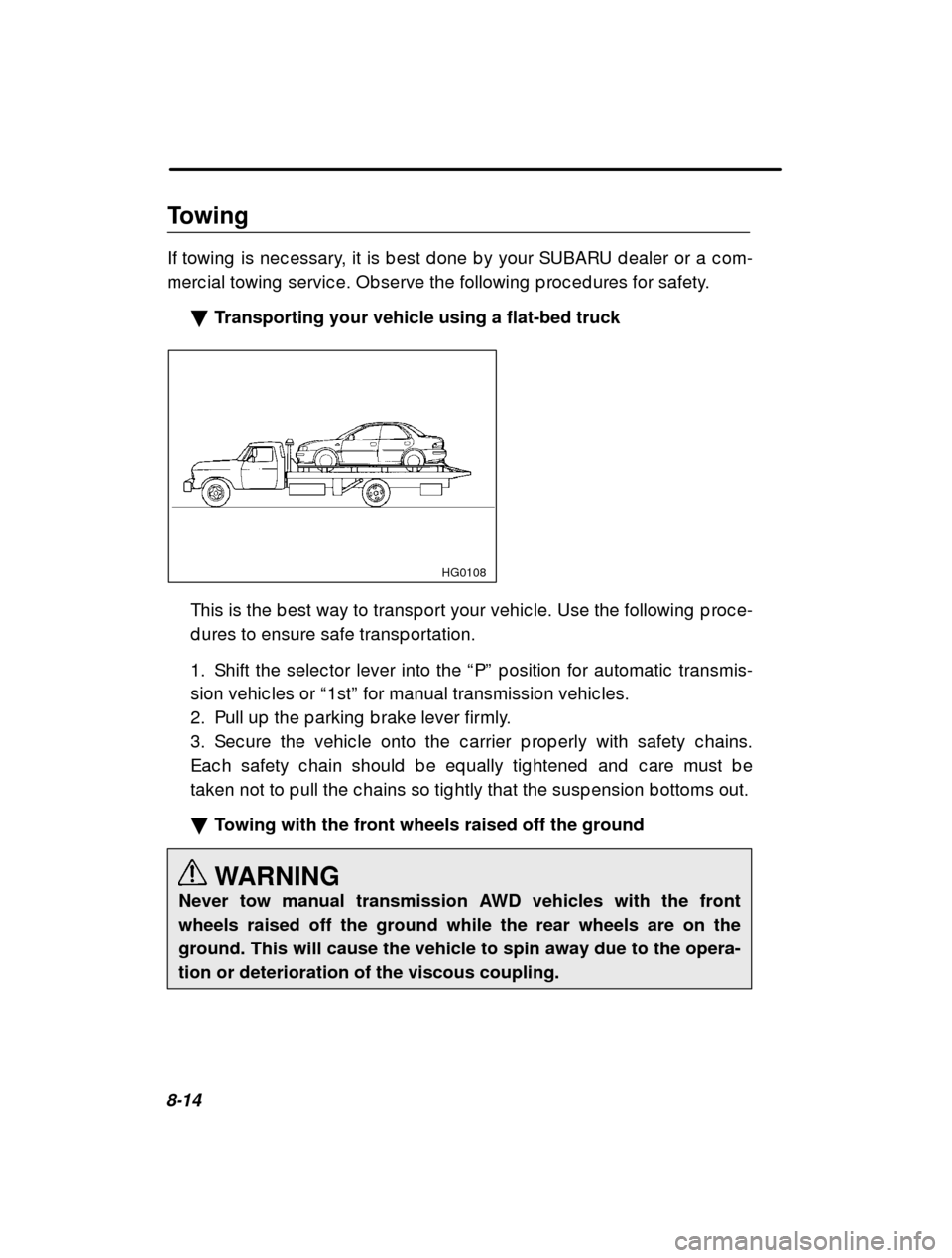
Transporting your vehicle using a flat-bed truck
HG0108
This is the b est way to transp ort your vehic le. Use the following p roc e-
d ures to ensure safe transp ortation.
1. Shift the selec tor lever into the “P ” p osition for automatic transmis-
sion vehic les or “1st ” for manual transmission vehic les.
2. Pull up the p arking b rake lever firmly.
3. Sec ure the vehic le onto the c arrier p rop erly with safety c hains.
Eac h safety c hain should b e eq ually tig htened and c are must b e
taken not to p ull the c hains so tig htly that the su sp ension b ottoms out.
Towing with the front wheels raised off the ground
WARNING
Never tow manual transmission AWD vehicles with the front wheels raised off the ground while the rear wheels are on theground. This will cause the vehicle to spin away due to the opera-tion or deterioration of the viscous coupling.
Page 240 of 320
In case of emergency8-15
–
CONTINUED –
CAUTION
When transmission failure occurs, transport your vehicle on a flat-bed truck.
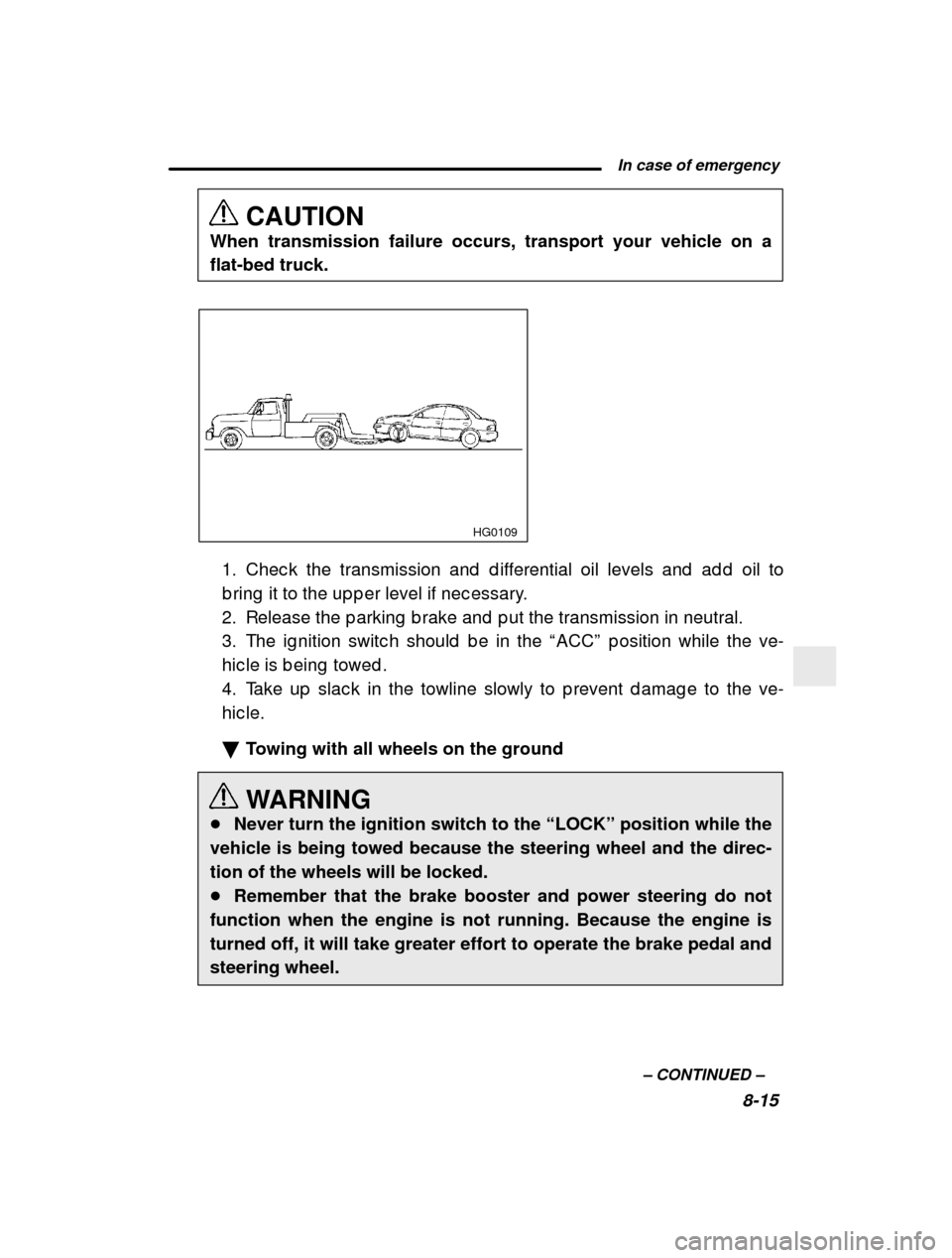
HG0109
1. Chec k the transmission and d ifferential oil level s and ad d oil to
b ring it to the up p er level if nec essary.
2. Release the p arking b rake and p ut the transmissio n in neutral.
3. The ig nition switc h should b e in the “ACC ” p osition while the ve-
hic le is b eing towed .
4. Take up slac k in the towline slowly to p revent d a mag e to the ve-
hic le. Towing with all wheels on the ground
WARNING
Never turn the ignition switch to the “LOCK” position while the
vehicle is being towed because the steering wheel and the direc- tion of the wheels will be locked. Remember that the brake booster and power steering do not
function when the engine is not running. Because the engine isturned off, it will take greater effort to operate the brake pedal andsteering wheel.
Page 241 of 320

8-16CAUTION
If transmission failure occurs, transport your vehicle on a flat-
bed truck. For AWD vehicles or FWD vehicles with automatic transmis-
sion, the traveling speed must be limited to less than 20 mph (30km/h) and the traveling distance to less than 31 miles (50 km). Forgreater speeds and distances, transport your vehicle on a flat-bed truck. For OUTBACK models, be sure to use a flexible cable for tow-
ing purpose and wrap the towing cable with cloth to prevent dam-
age to the bumper.
OM-H0180
We d o not rec ommend this method of towing . Use this method only
when towing servic e b y a SUBARU d ealer or a c ommerc ial towing
servic e is not availab le.
1. Chec k the transmission and d ifferential oil level s and ad d oil to
b ring it to the up p er level if nec essary.
2. Release the p arking b rake and p ut the transmissio n in neutral.
3. The ig nition switc h should b e in the “ACC ” p osition while the ve-
hic le is b eing towed .
4. Take up slac k in the towline slowly to p revent d a mag e to the ve-
hic le.
Page 249 of 320

10
Maintenance and service
Maintenance schedule 10-3
. . . . . . . . . . . . . . . . . . . . . . . . . . . . . . . . . . . . . . . . . . . . . . . . . .
Maintenance precautions 10-3
. . . . . . . . . . . . . . . . . . . . . . . . . . . . . . . . . . . . . . . . . . . . . .
Engine compartment overview 10-6 . . . . . . . . . . . . . . . . . . . . . . . . . . . . . . . . . . . . . . .
Engine oil 10-7
. . . . . . . . . . . . . . . . . . . . . . . . . . . . . . . . . . . . . . . . . . . . . . . . . . . . . . . . . . . . . . . . . . . .
Cooling system 10-12
. . . . . . . . . . . . . . . . . . . . . . . . . . . . . . . . . . . . . . . . . . . . . . . . . . . . . . . . . . . .
Engine coolant 10-13
. . . . . . . . . . . . . . . . . . . . . . . . . . . . . . . . . . . . . . . . . . . . . . . . . . . . . . . . . . .
Air cleaner element 10-16
. . . . . . . . . . . . . . . . . . . . . . . . . . . . . . . . . . . . . . . . . . . . . . . . . . . . . .
Spark plugs 10-17
. . . . . . . . . . . . . . . . . . . . . . . . . . . . . . . . . . . . . . . . . . . . . . . . . . . . . . . . . . . . . . . . .
Drive belts 10-18
. . . . . . . . . . . . . . . . . . . . . . . . . . . . . . . . . . . . . . . . . . . . . . . . . . . . . . . . . . . . . . . . . . .
Manual transmission oil 10-19
. . . . . . . . . . . . . . . . . . . . . . . . . . . . . . . . . . . . . . . . . . . . . . . .
Automatic transmission fluid 10-20 . . . . . . . . . . . . . . . . . . . . . . . . . . . . . . . . . . . . . . . . .
Front differential gear oil (Automatic transmission vehicles) 10-22 . . . . . . . . . . . . . . . . . . . . . . . . . . . . . . . . . . . . . . . . . . . . . . . . . . . . . . . . . . . . . . . . . .
Rear differential gear oil 10-23
. . . . . . . . . . . . . . . . . . . . . . . . . . . . . . . . . . . . . . . . . . . . . . . .
Power steering fluid 10-25
. . . . . . . . . . . . . . . . . . . . . . . . . . . . . . . . . . . . . . . . . . . . . . . . . . . . .
Brake fluid 10-26
. . . . . . . . . . . . . . . . . . . . . . . . . . . . . . . . . . . . . . . . . . . . . . . . . . . . . . . . . . . . . . . . . . .
Clutch fluid (2.5 liter MT models) 10-28 . . . . . . . . . . . . . . . . . . . . . . . . . . . . . . . . . . . .
Brake booster 10-29
. . . . . . . . . . . . . . . . . . . . . . . . . . . . . . . . . . . . . . . . . . . . . . . . . . . . . . . . . . . . . .
Battery 10-29
. . . . . . . . . . . . . . . . . . . . . . . . . . . . . . . . . . . . . . . . . . . . . . . . . . . . . . . . . . . . . . . . . . . . . . . .
Windshield washer fluid 10-31
. . . . . . . . . . . . . . . . . . . . . . . . . . . . . . . . . . . . . . . . . . . . . . . .
Replacement of windshield wiper blades 10-32 . . . . . . . . . . . . . . . . . . . . . . . .
Brake pedal 10-34
. . . . . . . . . . . . . . . . . . . . . . . . . . . . . . . . . . . . . . . . . . . . . . . . . . . . . . . . . . . . . . . . .
Clutch pedal (Manual transmission vehicles) 10-36 . . . . . . . . . . . . . . . . . . .
Replacement of brake pad and lining 10-37 . . . . . . . . . . . . . . . . . . . . . . . . . . . . . .
Parking brake stroke 10-38
. . . . . . . . . . . . . . . . . . . . . . . . . . . . . . . . . . . . . . . . . . . . . . . . . . . .
Tires and wheels 10-39
. . . . . . . . . . . . . . . . . . . . . . . . . . . . . . . . . . . . . . . . . . . . . . . . . . . . . . . . . .
Tire pressure 10-39
. . . . . . . . . . . . . . . . . . . . . . . . . . . . . . . . . . . . . . . . . . . . . . . . . . . . . . . . . . . . .
Tire rotation 10-40
. . . . . . . . . . . . . . . . . . . . . . . . . . . . . . . . . . . . . . . . . . . . . . . . . . . . . . . . . . . . . . .
Aluminum wheels (if equipped) 10-44 . . . . . . . . . . . . . . . . . . . . . . . . . . . . . . . . . . . . . .
Fuses 10-44
. . . . . . . . . . . . . . . . . . . . . . . . . . . . . . . . . . . . . . . . . . . . . . . . . . . . . . . . . . . . . . . . . . . . . . . . .
Main fuse and fusible link 10-47 . . . . . . . . . . . . . . . . . . . . . . . . . . . . . . . . . . . . . . . . . . . . . .
Installation of accessories 10-48 . . . . . . . . . . . . . . . . . . . . . . . . . . . . . . . . . . . . . . . . . . . . .
Replacing bulbs 10-49
. . . . . . . . . . . . . . . . . . . . . . . . . . . . . . . . . . . . . . . . . . . . . . . . . . . . . . . . . . .
Headlight 10-49
. . . . . . . . . . . . . . . . . . . . . . . . . . . . . . . . . . . . . . . . . . . . . . . . . . . . . . . . . . . . . . . . . .