2000 SUBARU IMPREZA engine oil
[x] Cancel search: engine oilPage 227 of 320
8-2
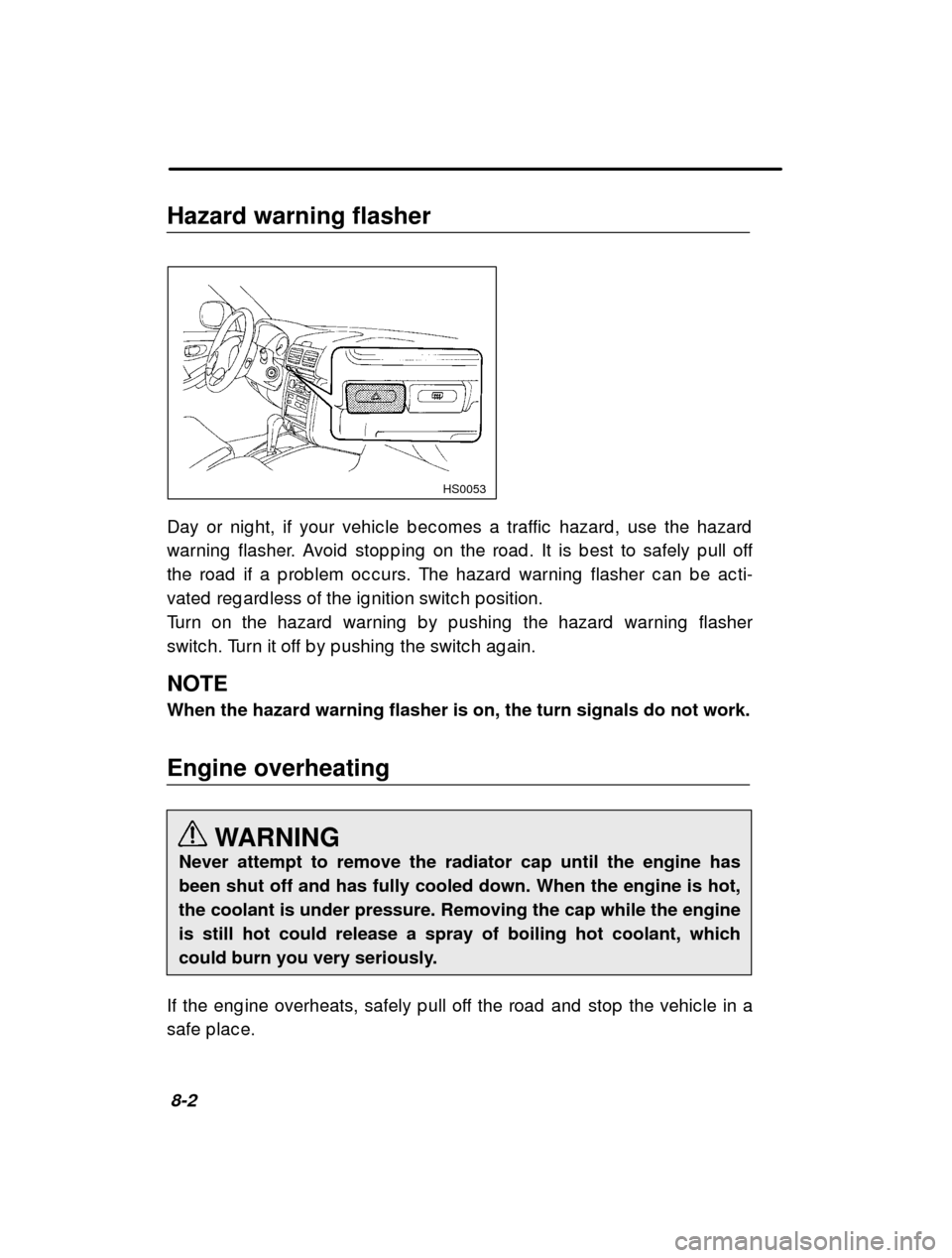
Hazard warning flasher
HS0053
Day or nig ht, if your vehic le b ec omes a traffic haz
ard , use the hazard
warning flasher. Avoid stop p ing on the road . It is b est to safely p ull off
the road if a p rob lem oc c urs. The hazard warning fl asher c an b e ac ti-
vated reg ard less of the ig nition switc h p osition.
Turn on the hazard warning b y p ushing the hazard wa rning flasher
switc h. Turn it off b y p ushing the switc h ag ain. NOTE When the hazard warning flasher is on, the turn signals do not work.
Engine overheating
WARNING
Never attempt to remove the radiator cap until the engine has been shut off and has fully cooled down. When the engine is hot,the coolant is under pressure. Removing the cap while the engineis still hot could release a spray of boiling hot coolant, which
could burn you very seriously.
If the eng ine overheats, safely p ull off the road a nd stop the vehic le in a
safe p lac e.
Page 231 of 320
8-6mod erate sp eed . Then start the eng ine of the vehic l
e that has the d is-
c harg ed b attery.
6. When finished , c arefully d isc onnec t the c ab les in exac tly the re-
verse ord er.
Flat tires
WARNING
Do not jack up the vehicle on an incline or a loose road sur-
face. The jack can come out of the jacking point or sink into theground and this can result in a severe accident. Use only the jack provided with your vehicle. The jack sup-
plied with the vehicle is designed only for changing a tire. Neverget under the vehicle while supporting the vehicle with this jack. Always turn the engine off before raising the flat tire off the
ground using the jack. Never swing or push the vehicle sup-ported with the jack. The jack can come out of the jacking pointdue to a jolt and this can result in a severe accident. Do not use oil or grease on the wheel studs or nuts when the
spare tire is installed. This could cause the nuts to become looseand lead to an accident. Never place a tire or tire changing tools in the passenger
compartment after changing wheels. In a sudden stop or colli-
sions, loose equipment could strike occupants and cause injury.Store the tire and all tools in the proper place.
If you have a flat tire while d riving , never b rake sud d enly; keep d riving
straig ht ahead while g rad ually red uc ing sp eed . Then slowly p ull off the
road to a safe p lac e.
1. Park on a hard , level surfac e, whenever p ossib le, then stop the en-
g ine.
2. Set the p arking b rake sec urely and shift a manual transmission ve-
hic le in reverse or an automatic transmission vehic le in the “P ” (Park)
p osition.
Page 240 of 320
In case of emergency8-15
–
CONTINUED –
CAUTION
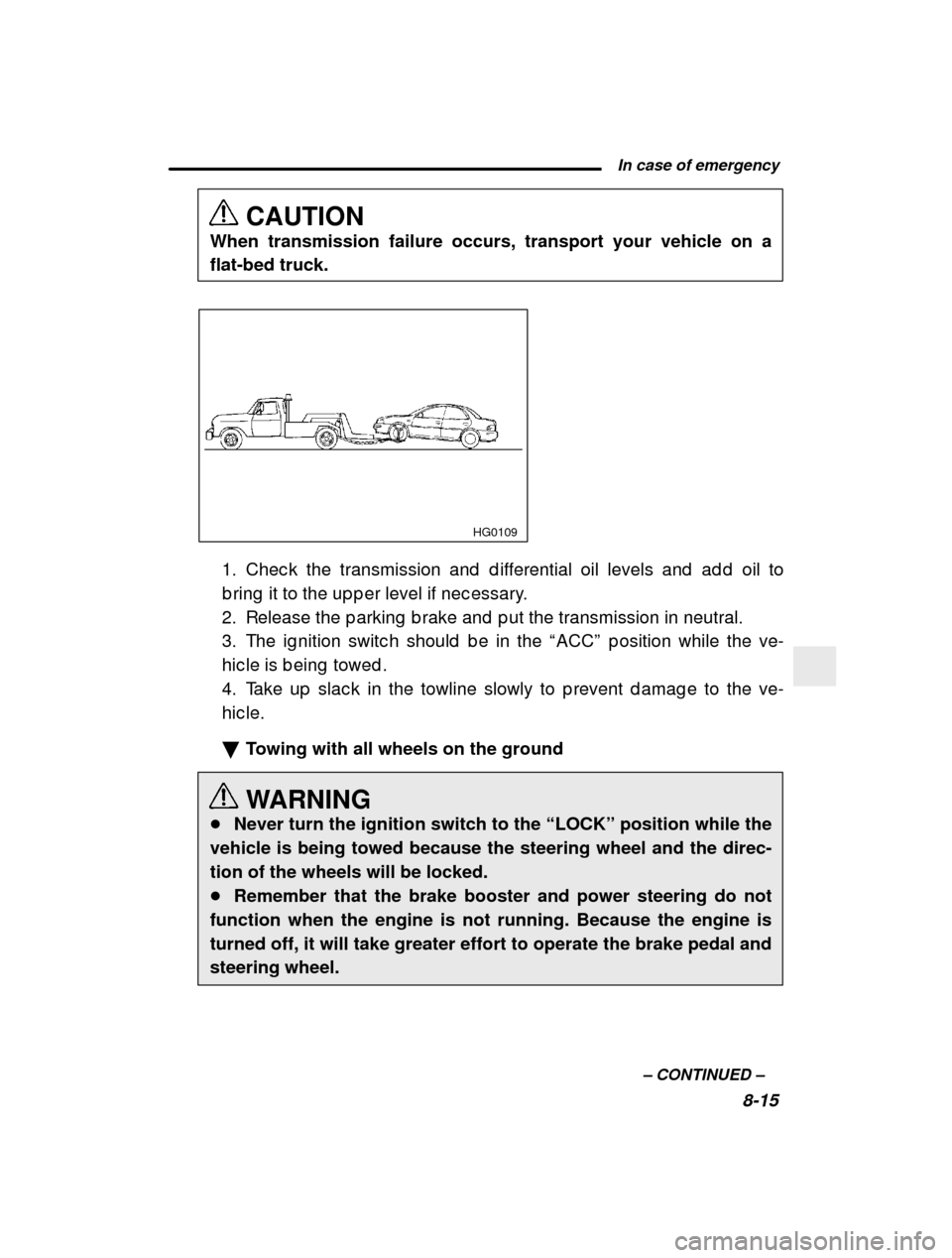
When transmission failure occurs, transport your vehicle on a flat-bed truck.
HG0109
1. Chec k the transmission and d ifferential oil level s and ad d oil to
b ring it to the up p er level if nec essary.
2. Release the p arking b rake and p ut the transmissio n in neutral.
3. The ig nition switc h should b e in the “ACC ” p osition while the ve-
hic le is b eing towed .
4. Take up slac k in the towline slowly to p revent d a mag e to the ve-
hic le. Towing with all wheels on the ground
WARNING
Never turn the ignition switch to the “LOCK” position while the
vehicle is being towed because the steering wheel and the direc- tion of the wheels will be locked. Remember that the brake booster and power steering do not
function when the engine is not running. Because the engine isturned off, it will take greater effort to operate the brake pedal andsteering wheel.
Page 244 of 320

9-2
Exterior care
Washing
CAUTION
When washing the vehicle, the brakes may get wet. As a result,
the brake stopping distance will be longer. To dry the brakes, drive the vehicle at a safe speed while lightly pressing the brakepedal to heat up the brakes. Do not wash the engine compartment and areas adjacent to it.
If water enters electrical parts or the power steering fluid reser-
voir, it will cause engine trouble or faulty power steering respec-
tively.
The b est way to p reserve your vehic le ’s b eauty is freq uent washing .
Wash the vehic le at least onc e a month to avoid c on tamination b y road
g rime.
Wash d irt off with a wet sp ong e and p lenty of lukew arm or c old water. Do
not wash the vehic le with hot water and in d irec t s unlig ht.
Salt, c hemic als, insec ts, tar, soot and b ird d rop p i ng s should b e washed
off b y using a lig ht d eterg ent, as req uired . If you use a lig ht d eterg ent,
make c ertain that it is a neutral d eterg ent. Do not use strong soap or
c hemic al d eterg ents. All c leaning ag ents should b e p romp tly flushed
from the surfac e and not allowed to d ry there. Rins e the vehic le thor-
oug hly with p lenty of lukewarm water. Wip e the rema ining water off with a
c hamois or soft c loth. NOTE When having your vehicle washed in an automatic car wash, make
sure beforehand that the car wash is of suitable type. If the vehicle
is equipped with a rear spoiler, it may be damaged by the brush, etc.
Washing the underbody
Chemic als, salts, and g ravel used for d eic ing road surfac es are ex-
tremely c orrosive, ac c elerating the c orrosion of un d erb od y c omp o-
nents, suc h as the exhaust system, fuel and b rake l ines, b rake
Page 249 of 320

10
Maintenance and service
Maintenance schedule 10-3
. . . . . . . . . . . . . . . . . . . . . . . . . . . . . . . . . . . . . . . . . . . . . . . . . .
Maintenance precautions 10-3
. . . . . . . . . . . . . . . . . . . . . . . . . . . . . . . . . . . . . . . . . . . . . .
Engine compartment overview 10-6 . . . . . . . . . . . . . . . . . . . . . . . . . . . . . . . . . . . . . . .
Engine oil 10-7
. . . . . . . . . . . . . . . . . . . . . . . . . . . . . . . . . . . . . . . . . . . . . . . . . . . . . . . . . . . . . . . . . . . .
Cooling system 10-12
. . . . . . . . . . . . . . . . . . . . . . . . . . . . . . . . . . . . . . . . . . . . . . . . . . . . . . . . . . . .
Engine coolant 10-13
. . . . . . . . . . . . . . . . . . . . . . . . . . . . . . . . . . . . . . . . . . . . . . . . . . . . . . . . . . .
Air cleaner element 10-16
. . . . . . . . . . . . . . . . . . . . . . . . . . . . . . . . . . . . . . . . . . . . . . . . . . . . . .
Spark plugs 10-17
. . . . . . . . . . . . . . . . . . . . . . . . . . . . . . . . . . . . . . . . . . . . . . . . . . . . . . . . . . . . . . . . .
Drive belts 10-18
. . . . . . . . . . . . . . . . . . . . . . . . . . . . . . . . . . . . . . . . . . . . . . . . . . . . . . . . . . . . . . . . . . .
Manual transmission oil 10-19
. . . . . . . . . . . . . . . . . . . . . . . . . . . . . . . . . . . . . . . . . . . . . . . .
Automatic transmission fluid 10-20 . . . . . . . . . . . . . . . . . . . . . . . . . . . . . . . . . . . . . . . . .
Front differential gear oil (Automatic transmission vehicles) 10-22 . . . . . . . . . . . . . . . . . . . . . . . . . . . . . . . . . . . . . . . . . . . . . . . . . . . . . . . . . . . . . . . . . .
Rear differential gear oil 10-23
. . . . . . . . . . . . . . . . . . . . . . . . . . . . . . . . . . . . . . . . . . . . . . . .
Power steering fluid 10-25
. . . . . . . . . . . . . . . . . . . . . . . . . . . . . . . . . . . . . . . . . . . . . . . . . . . . .
Brake fluid 10-26
. . . . . . . . . . . . . . . . . . . . . . . . . . . . . . . . . . . . . . . . . . . . . . . . . . . . . . . . . . . . . . . . . . .
Clutch fluid (2.5 liter MT models) 10-28 . . . . . . . . . . . . . . . . . . . . . . . . . . . . . . . . . . . .
Brake booster 10-29
. . . . . . . . . . . . . . . . . . . . . . . . . . . . . . . . . . . . . . . . . . . . . . . . . . . . . . . . . . . . . .
Battery 10-29
. . . . . . . . . . . . . . . . . . . . . . . . . . . . . . . . . . . . . . . . . . . . . . . . . . . . . . . . . . . . . . . . . . . . . . . .
Windshield washer fluid 10-31
. . . . . . . . . . . . . . . . . . . . . . . . . . . . . . . . . . . . . . . . . . . . . . . .
Replacement of windshield wiper blades 10-32 . . . . . . . . . . . . . . . . . . . . . . . .
Brake pedal 10-34
. . . . . . . . . . . . . . . . . . . . . . . . . . . . . . . . . . . . . . . . . . . . . . . . . . . . . . . . . . . . . . . . .
Clutch pedal (Manual transmission vehicles) 10-36 . . . . . . . . . . . . . . . . . . .
Replacement of brake pad and lining 10-37 . . . . . . . . . . . . . . . . . . . . . . . . . . . . . .
Parking brake stroke 10-38
. . . . . . . . . . . . . . . . . . . . . . . . . . . . . . . . . . . . . . . . . . . . . . . . . . . .
Tires and wheels 10-39
. . . . . . . . . . . . . . . . . . . . . . . . . . . . . . . . . . . . . . . . . . . . . . . . . . . . . . . . . .
Tire pressure 10-39
. . . . . . . . . . . . . . . . . . . . . . . . . . . . . . . . . . . . . . . . . . . . . . . . . . . . . . . . . . . . .
Tire rotation 10-40
. . . . . . . . . . . . . . . . . . . . . . . . . . . . . . . . . . . . . . . . . . . . . . . . . . . . . . . . . . . . . . .
Aluminum wheels (if equipped) 10-44 . . . . . . . . . . . . . . . . . . . . . . . . . . . . . . . . . . . . . .
Fuses 10-44
. . . . . . . . . . . . . . . . . . . . . . . . . . . . . . . . . . . . . . . . . . . . . . . . . . . . . . . . . . . . . . . . . . . . . . . . .
Main fuse and fusible link 10-47 . . . . . . . . . . . . . . . . . . . . . . . . . . . . . . . . . . . . . . . . . . . . . .
Installation of accessories 10-48 . . . . . . . . . . . . . . . . . . . . . . . . . . . . . . . . . . . . . . . . . . . . .
Replacing bulbs 10-49
. . . . . . . . . . . . . . . . . . . . . . . . . . . . . . . . . . . . . . . . . . . . . . . . . . . . . . . . . . .
Headlight 10-49
. . . . . . . . . . . . . . . . . . . . . . . . . . . . . . . . . . . . . . . . . . . . . . . . . . . . . . . . . . . . . . . . . .
Page 252 of 320
10-4
Always use the proper tools and make certain that they are
well maintained. Never get under the vehicle supported only by jack. Always
use a safety stands to support the vehicle. Never keep the engine running in a poorly ventilated area,
such as a garage or other closed areas. Do not smoke or allow open flames around the fuel or battery.
This will cause a fire. Wear adequate eye protection to guard against getting oil or
other fluids in your eyes. If something does get in your eyes,
thoroughly wash it out with clean water. Because the fuel system is under pressure, replacement of the
fuel filter should be performed only by your SUBARU dealer. The SRS airbag has no user-serviceable parts. Tampering with
or disconnecting the system ’s wiring could result in accidental
inflation of the airbag or could make the system inoperative,
which may result in serious injury. The wiring harnesses of theSRS airbag system are covered with yellow insulation and the
connectors of the system are yellow, for easy identification. Donot use electrical test equipment on any circuit related to the SRSairbag system. For required servicing of the SRS airbag, see your
nearest SUBARU dealer. Before checking or servicing in the engine compart- ment
Always stop the engine and set the parking brake firmly to pre-
vent the vehicle from moving. Always let the engine cool down. Engine parts become very
hot when the engine is running and remain hot for some time af-ter the engine is stopped. Do not spill engine oil, engine coolant, brake fluid or any other
fluid on hot engine components. This may cause a fire. Always remove the key from the ignition switch. When the
ignition switch is in the “ON” position, the cooling fan may oper-
ate suddenly even when the engine is stopped.
Page 254 of 320

10-6Engine compartment overview
1 Manual transmission oil level
g aug e (MT) (p ag e 10-19) or
Differential g ear oil level
g aug e (AT) (p ag e 10-22)
2 Air c leaner element
(p ag e 10-16)
3 Clutc h fluid reservoir
(p ag e 10-28)
4 Automatic transmission fluid
level g aug e (p ag e 10-20)
5 Brake fluid reservoir
(p ag e 10-26)
6 Fuel filter 7
Wind shield washer tank
(p ag e 10-31)
8 Fuse b ox (p ag e 10-44)
9 Battery (p ag e 10-29)
Q Eng ine oil filler c ap
(p ag e 10-7)
W Eng ine c oolant reservoir
(p ag e 10-13)
E Eng ine oil level g aug e
(p ag e 10-7)
R Power steering fluid reservoir
(p ag e 10-25)
T Rad iator c ap (p ag e 10-13) HGA017BB
Page 255 of 320

Maintenance and service10-7
–
CONTINUED –
Engine oil
Checking the oil level
Chec k the eng ine oil level at eac h fuel stop .
OM-H0189
HG0351
Upper level Lower levelNotch
1. Park the vehic le on a level surfac e and stop the eng ine.
2. Pull out the d ip stic k, wip e it c lean, and insert it ag ain.
3. Be sure the d ip stic k is c orrec tly inserted until it stop s with the
g rap hic symb ol on its top ap p earing as shown in the illustra-
tion.
4. Pull out the d ip stic k ag ain and c hec k the oil lev el on it. If it is b elow
the lower level, ad d oil to b ring the level up to t he up p er level.
CAUTION
Use only engine oil with the recommended grade and viscosity.
If you c hec k the oil level just after stop p ing the eng ine, wait a few min-
utes for the oil to d rain b ac k into the oil p an b ef ore c hec king the level.
Just after d riving or while the eng ine is warm, the eng ine oil level
read ing may b e in a rang e b etween the up p er level a nd the notc h
mark. This is c aused b y thermal exp ansion of the en g ine oil.
To p revent overfilling the eng ine oil, d o not ad d a ny ad d itional oil
ab ove the up p er level when the eng ine is c old .