2000 SUBARU IMPREZA brake
[x] Cancel search: brakePage 188 of 320
7-18n
Maximum allowable speeds
WARNING
When shifting down a gear, ensure that the vehicle is not travel- ling at a speed exceeding the Maximum Allowable Speed for thegear which is about to be selected. Failure to observe this pre-caution can lead to engine over-revving and this in turn canresult in engine damage.In addition, sudden application of engine brakes when the vehicleis travelling on a slippery surface can lead to wheel locking; as a
consequence, control of the vehicle may be lost and the risk ofan accident increased.
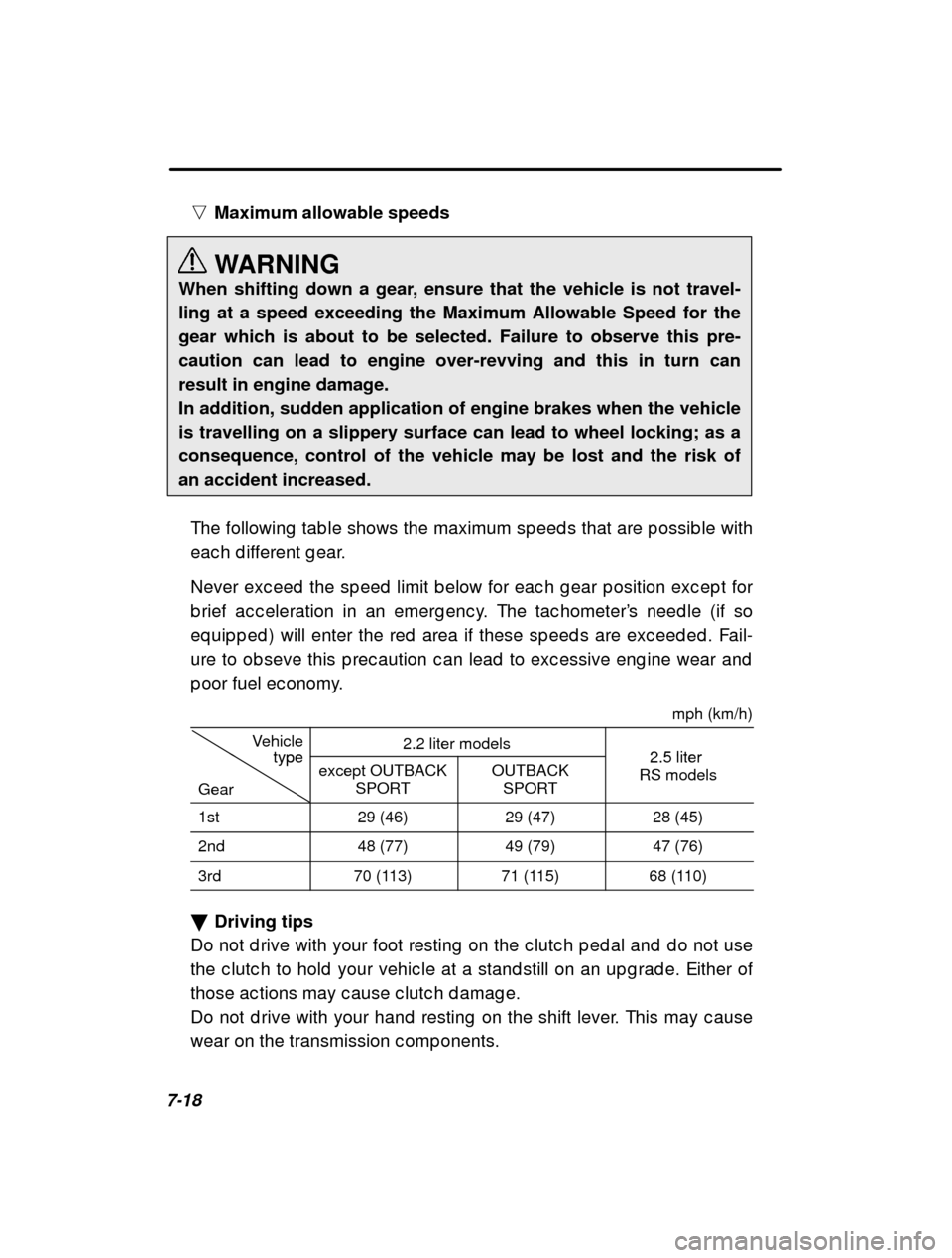
The following tab le shows the maximum sp eed s that a re p ossib le with
eac h d ifferent g ear.
Never exc eed the sp eed limit b elow for eac h g ear p o sition exc ep t for
b rief ac c eleration in an emerg enc y. The tac hometer ’s need le (if so
eq uip p ed ) will enter the red area if these sp eed s a re exc eed ed . Fail-
ure to ob seve this p rec aution c an lead to exc essive eng ine wear and
p oor fuel ec onomy.
mph (km/h)
Vehicle
type2.2 liter models2 5 litertype
Gear except OUTBACK
SPORTOUTBACKSPORT2.5 liter
RS models
1st29 (46)29 (47)28 (45)
2nd48 (77)49 (79)47 (76)
3rd70 (113)71 (115)68 (110)
Driving tips
Do not d rive with your foot resting on the c lutc h p ed al and d o not use
the c lutc h to hold your vehic le at a stand still on an up g rad e. Either of
those ac tions may c ause c lutc h d amag e.
Do not d rive with your hand resting on the shift le ver. This may c ause
wear on the transmission c omp onents.
Page 189 of 320
Starting and operating7-19
–
CONTINUED –
When it is nec essary to red uc e vehic le sp eed d ue to
slow traffic , turn-
ing c orners, or d riving up steep hills, d ownshift t o a lower g ear b efore
the eng ine starts to lab or.
On steep d owng rad es, d ownshift the transmission to 4th, 3rd or 2nd
g ear as nec essary; this help s to maintain a safe sp eed and to extend
b rake p ad life.
In this way, the eng ine p rovid es a b raking effec t. Rememb er, if you
“ rid e ” (over use) the b rakes while d esc end ing a hill, the y may over-
heat and not work p rop erly.
Automatic transmission
WARNING
Do not shift from the “P” or “N” position into the “D”, “3”, “2”,
“1” or “R” position while depressing the accelerator pedal. This
may cause the vehicle to jump forward or backward.
CAUTION
Shift into the “P” or “R” position only after the vehicle is com-
pletely stopped. Shifting while the vehicle is moving may cause
damage to the transmission. Do not race the engine for more than five seconds in any posi-
tion except the “N” or “P” position when the brake is set or the
tires are on blocks. This may cause the automatic transmissionfluid to overheat. Avoid shifting from one of the forward driving positions into
the “R” position or vice versa until the vehicle has completely
stopped. Such shifting may cause damage to the transmission.
The automatic transmission is elec tronic ally c ontro lled with 4-forward
sp eed s and 1-reverse sp eed .
Page 190 of 320

7-20NOTE
Immediately after a disconnected battery is reconnected or ATF (au- tomatic transmission fluid) is replaced, you may feel that the auto-matic transmission operation is somewhat unusual.This results from erasure or invalidation of data the on-board com-puter has collected and stored in memory to allow the transmissionto shift at the most appropriate times for the current condition ofyour vehicle. Optimized shifting will be restored as the vehicle con-tinues to be driven for a while.
Selector lever
OM-H0149
Release button With the brake pedal depressed, shift while pressing the button in Shift while pressing the button in Shift without pressing the button
HS0129
The selec tor lever has seven p ositions.
The release b utton must b e p ushed to selec t the “P ”, “R ”, or “2 ” p osi-
tions.
P (Park)
This p osition is for p arking the vehic le and starti ng the eng ine.
In this p osition, the transmission is mec hanic ally loc ked to p revent the
vehic le from rolling freely.
When you p ark the vehic le, first set the p arking b r ake fully, then shift
into the “P ” p osition. Do not hold the vehic le with only the tr ansmis-
sion.
A shift interloc k func tion is emp loyed in the autom atic transmission
system to ensure safe starting of the vehic le.
Page 192 of 320

7-22the p ed al, the transmission will return to the orig
inal g ear p osition.
n While climbing a grade
When d riving up a hill, und esired up shift to 4th g e ar is p revented from
taking p lac e when the ac c elerator is released . This minimizes the
c hanc e of sub seq uent d ownshifting to a lower g ear w hen ac c elerat-
ing ag ain. This p revents rep eated up shifting and d o wnshifting result-
ing in a smoother op eration of the vehic le. NOTE
The transmission may downshift to 2nd or 1st gear, depending on the way the accelerator pedal is pressed to accelerate the vehicleagain. n While going down a hill
When d esc end ing a steep hill, d ep ressing the b rake p ed al will c ause
the transmission to d ownshift to 3rd g ear, thus ap p lying eng ine b rak-
ing . Reac c eleration for a short time will c ause the transmission to up -
shift normally. NOTE In some cases, depressing the brake pedal on a downhill grade
does not result in an automatic downshift to 3rd gear. This canhappen when the automatic transmission fluid temperature is
very low, for example, during driving shortly after the vehicle has
been parked for an extended period of time. When the ATF tem-perature has risen to a certain level, automatic downshift normal-ly takes place. In the meantime, downshift manually for enginebraking as required.Also, downshifting when braking downhill will not occur at
speeds above approximately 50 mph (80 km/h). 3 (Third)
This p osition is for using eng ine b raking when g oin g d own a hill or for
c limb ing a g rad e.
The transmission automatic ally shifts into a suitab le g ear from 1st to
3rd ac c ord ing to the vehic le sp eed and the ac c elera tion you req uire.
Page 193 of 320
Starting and operating7-23
–
CONTINUED –
When more ac c eleration is req uired in this p osition
, p ress the ac c eler-
ator p ed al fully to the floor and hold that p ositio n. The transmission
will automatic ally d ownshift to 2nd or 1st g ear. Wh en you release the
p ed al, the transmission will return to the orig inal g ear p osition.
2 (Second)
To shift from the “3 ” p osition, p ush the release b utton.
This p osition is for using eng ine b raking when g oin g d own a hill or for
c limb ing a steep g rad e.
In this p osition, the transmission hold s in the 2nd g ear.
Use this p osition when starting off form a stand sti ll on slip p ery road
surfac es suc h as mud or snow. It will ensure g reate r trac tion.
1 (First)
This p osition is for d riving up or d own very steep g rad es, or d riving
throug h mud or sand , or on slip p ery surfac es. In th is p osition, the
transmission hold s in the 1st g ear. Maximum speeds
WARNING
When shifting down a gear, ensure that the vehicle is not travel- ling at a speed exceeding the Maximum Allowable Speed for thegear which is about to be selected. Failure to observe this pre-caution can lead to engine over-revving and this in turn canresult in engine damage.In addition, sudden application of engine brakes when the vehicleis travelling on a slippery surface can lead to wheel locking; as a
consequence, control of the vehicle may be lost and the risk ofan accident increased.
The following tab les show the maximum sp eed s that a re p ossib le with
eac h d ifferent g ear. The tac hometer ’s (if so eq uip p ed ) need le will
enter the red area if these sp eed s are exc eed ed .
When shifting d own a g ear, it is imp ortant to c onfi rm that the c urrent
vehic le sp eed is not in exc ess of the Maximum Allow ab le Sp eed of
Page 201 of 320

Starting and operating7-31
–
CONTINUED –
CAUTION
Never drive while the parking brake is set because this will cause
unnecessary wear on the brake linings. Before starting to drive,always make sure that the parking brake has been fully released.
To set the p arking b rake, p ress the b rake p ed al fir mly and hold it d own
while fully p ulling up the p arking b rake lever.
HG0313
Release button
To release the p arking b rake, p ull the lever up sli g htly, p ress the release
b utton, then lower the lever while keep ing the b utt on p ressed .
When the p arking b rake is set while the eng ine is r unning , the p arking
b rake warning lig ht c omes on. After starting the ve hic le, b e sure that the
warning lig ht has g one out b efore the vehic le is d r iven. Refer to the “War-
ning and ind ic ator lig hts ” sec tion (c hap ter 3).
When p arking your vehic le, always set the p arking b rake firmly and p ut
the shift lever in the “1 ” (1st) for an up g rad e or “R ” (Reverse) for a d own
g rad e for manual transmission vehic les, or in the “P ” (Park) p osition for
automatic transmission vehic les.
Always set the p arking b rake firmly when p arking yo ur vehic le. Never
rely on the transmission alone to hold the vehic le.
For b etter p arking b rake p ower, d ep ress the b rake p ed al firmly while set-
ting the p arking b rake (Drum b rake only).
Page 202 of 320
7-32
OM-H0162OM-H0161
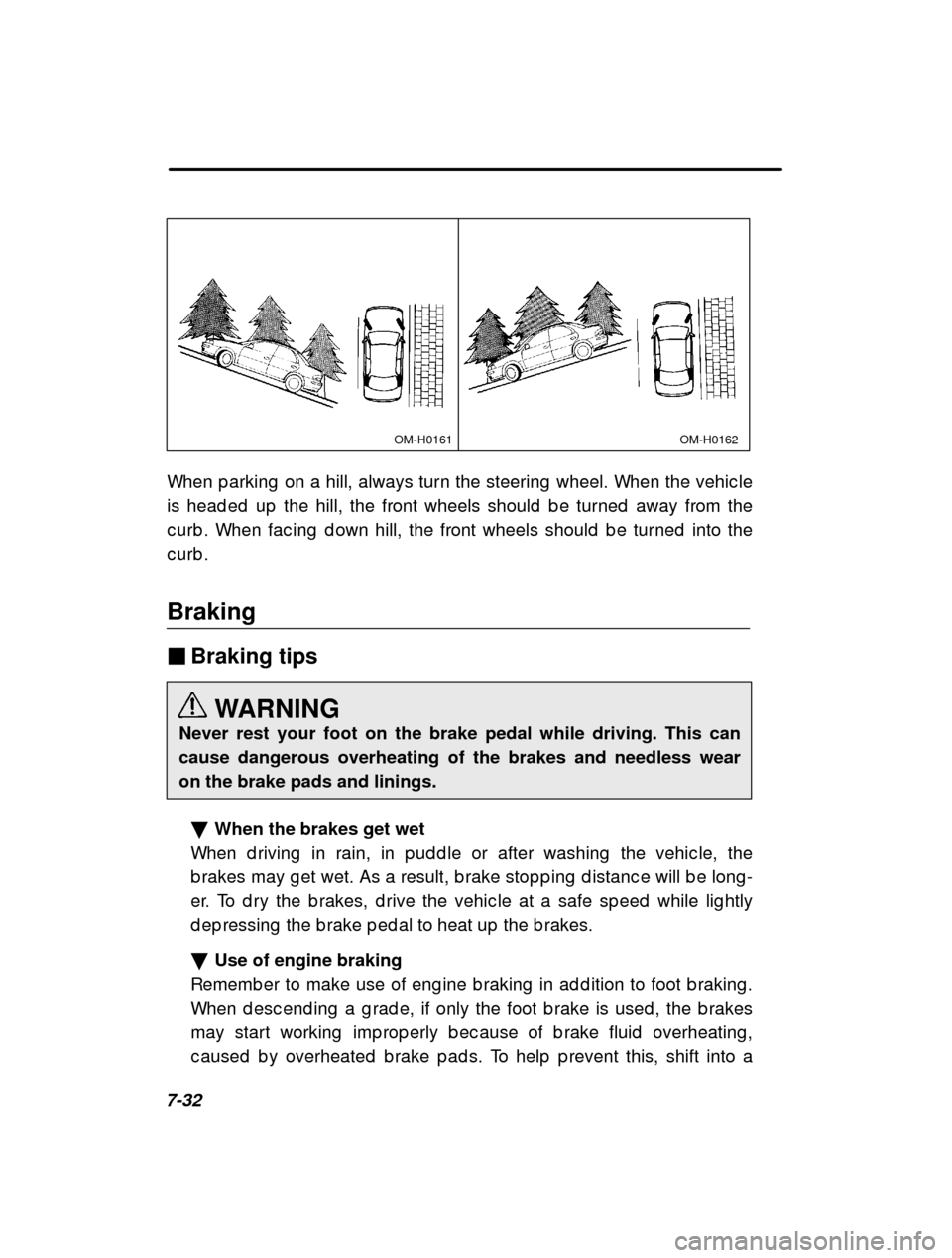
When p arking on a hill, always turn the steering wh eel. When the vehic le
is head ed up the hill, the front wheels should b e t urned away from the
c urb . When fac ing d own hill, the front wheels shoul d b e turned into the
c urb . Braking Braking tips
WARNING
Never rest your foot on the brake pedal while driving. This can
cause dangerous overheating of the brakes and needless wearon the brake pads and linings.
When the brakes get wet
When d riving in rain, in p ud d le or after washing th e vehic le, the
b rakes may g et wet. As a result, b rake stop p ing d is tanc e will b e long -
er. To d ry the b rakes, d rive the vehic le at a safe sp eed while lig htly
d ep ressing the b rake p ed al to heat up the b rakes. Use of engine braking
Rememb er to make use of eng ine b raking in ad d ition to foot b raking .
When d esc end ing a g rad e, if only the foot b rake is used , the b rakes
may start working imp rop erly b ec ause of b rake fluid overheating ,
c aused b y overheated b rake p ad s. To help p revent th is, shift into a
Page 203 of 320

Starting and operating7-33
–
CONTINUED –
lower g ear to g et strong er eng ine b raking .
Braking when a tire is punctured
Do not d ep ress the b rake p ed al sud d enly when a tire is p unc tured .
This c ould c ause a loss of c ontrol of the vehic le. Keep d riving straig ht
ahead while g rad ually red uc ing sp eed . Then slowly p ull off the road
to a safe p lac e.
Brake system Two separate circuits
Your vehic le has two sep arate c irc uit b rake systems . Eac h c irc uit
works d iag onally ac ross the vehic le. If one c irc uit of the b rake system
should fail, the other half of the system still wor ks. If one c irc uit fails,
the b rake p ed al will g oes d own muc h c loser to the f loor than usual
and you will need to p ress it d own muc h hard er. And a muc h long er
d istanc e will b e need ed to stop the vehic le. Brake booster
The b rake b ooster uses eng ine manifold vac uum to as sist b raking
forc e. Do not turn off the eng ine while d riving b ec ause that will turn off
the b rake b ooster, resulting in p oor b raking p ower.
The b rakes will c ontinue to work even when the b rak e b ooster c om-
p letely stop s func tioning . If this hap p ens, however , you will have to
p ush the p ed al muc h hard er than normal and the b rak ing d istanc e
will inc rease.