2000 SAAB 9-5 warning
[x] Cancel search: warningPage 37 of 256

37 Security
Locking
The tailgate is locked in the following ways:
By locking all the car doors with the
button on the remote control.
With the button on the centre con-
sole.
With the key in the driver’s door.
Safety lock The tailgate has a safety lock which is acti-
vated with a button to the right of the tailgate
lock.
When the button is moved to the left, the tail-
gate can only be opened from the outside,
assuming that the locking button (LOCK) by
the inside opening handle has not been
pushed in.
Some central locking functions can
be adjusted to better fit your individ-
ual needs, see page 237.
WARNING
If small children are carried in the rear
seat, the safety locks on the tailgate and
rear doors should be activated to prevent
unintentional opening from the inside.
IB1225
Safety lock
IB1223
Locking button by the tailgate inside open-
ing handle.
The tailgate is locked when closed if the
button LOCK is pushed in before the tail-
gate is closed.
ProCarManuals.com
Page 38 of 256
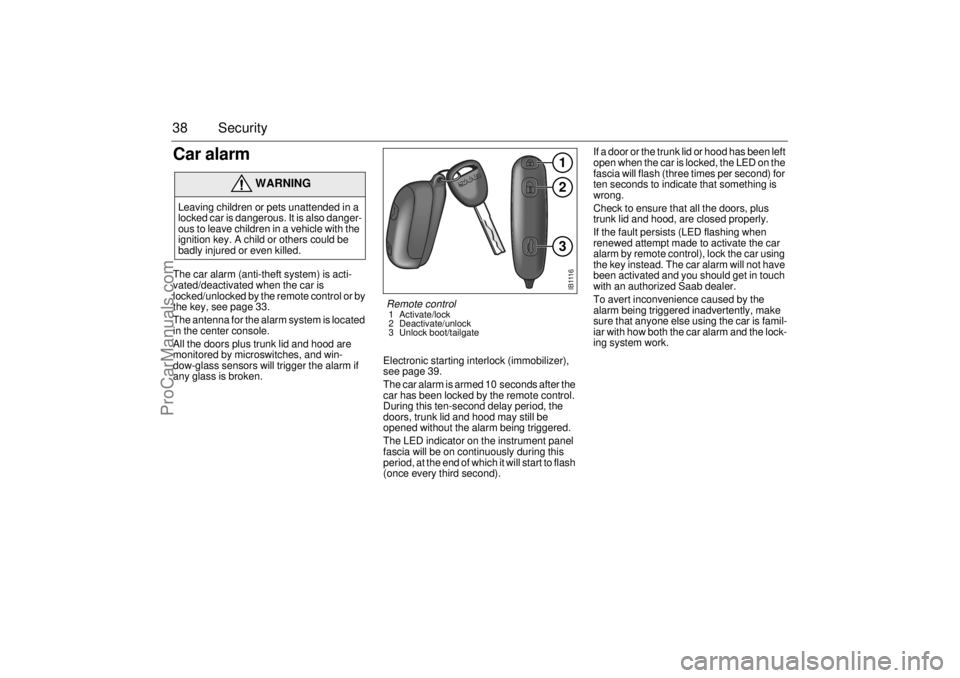
38 SecurityCar alarm The car alarm (anti-theft system) is acti-
vated/deactivated when the car is
locked/unlocked by the remote control or by
the key, see page 33.
The antenna for the alarm system is located
in the center console.
All the doors plus trunk lid and hood are
monitored by microswitches, and win-
dow-glass sensors will trigger the alarm if
any glass is broken. Electronic starting interlock (immobilizer),
see page 39.
The car alarm is armed 10 seconds after the
car has been locked by the remote control.
During this ten-second delay period, the
doors, trunk lid and hood may still be
opened without the alarm being triggered.
The LED indicator on the instrument panel
fascia will be on continuously during this
period, at the end of which it will start to flash
(once every third second). If a door or the trunk lid or hood has been left
open when the car is locked, the LED on the
fascia will flash (three times per second) for
ten seconds to indicate that something is
wrong.
Check to ensure that all the doors, plus
trunk lid and hood, are closed properly.
If the fault persists (LED flashing when
renewed attempt made to activate the car
alarm by remote control), lock the car using
the key instead. The car alarm will not have
been activated and you should get in touch
with an authorized Saab dealer.
To avert inconvenience caused by the
alarm being triggered inadvertently, make
sure that anyone else using the car is famil-
iar with how both the car alarm and the lock-
ing system work.
WARNING
Leaving children or pets unattended in a
locked car is dangerous. It is also danger-
ous to leave children in a vehicle with the
ignition key. A child or others could be
badly injured or even killed.
I B 111 6
123
Remote control 1 Activate/lock
2 Deactivate/unlock
3 Unlock boot/tailgate
ProCarManuals.com
Page 40 of 256

40 SecurityAlarm signals When the car alarm is armed, it will be trig-
gered if any door, or the trunk lid or hood, is
opened or if a window is broken.
The alarm will also be triggered if an attempt
is made to bypass or short-circuit the igni-
tion switch, or to disconnect the battery.
If the alarm is triggered, the following alarm
signals will be set off:
Flashing of hazard warning lights for five
minutes.
Siren wailing for 30 seconds.
The alarm signals will stop if the alarm is
deactivated (car unlocked) during the alarm
period.
The alarm siren has a long-life battery
(approx. 10 years), see "SERVICE THEFT
ALARM", on page 42. When the battery
goes dead, the siren must be replaced: it is
not possible to change the batteries.
Panic-functionIn the car alarm system is a function called
"Panic-function".
To activate panic function:
Push and hold one of the buttons on the
remote control for 2 seconds, or if you are
sitting inside the car
Push the LOCK-switch on the center con-
sole for 2 seconds.
These actions will trigger the alarm (hazard
warning lights and siren).
To deactivate panic function:
Push one of the buttons on the remote
control, push the LOCK-switch in the
center console, turn the key in one of the
doors or turn the ignition to ON.
When the panic-function is activated the car
will be locked/unlocked depending upon
which button was pushed.
When the ignition is ON the panic-function
cannot be activated.
NOTE It is possible to inadvertently deacti-
vate the car alarm and at the same
time unlock the car, if the button on the
remote control is pressed by mistake
when the control is still within range of
the car.
When locking the car by remote con-
trol in extremely cold weather, it is
advisable to check that the lock
system has operated properly. To do
so, check that the interior locking but-
tons are all down.
If not, unlock and relock the car again.
ProCarManuals.com
Page 41 of 256

41 Security
Overview of functions
Alarm signals may differ between model variants for different coun-
tries.
Some of the car-alarm functions can be reprogrammed – con-
sult your Saab dealer for further details (see page 237). Locking/
activation Hazard warning lights flash once and the horn
chirps once.
The LED will come on for 10 seconds.
Unlocking/
deactivation Hazard warning lights flash twice and the horn
chirps twice.
The LED will come on for two seconds.
Unlocking/
deactivation of
trunk lid/tailgate
alarm Hazard warning lights flash three times and the
horn chirps three times.
The LED will flash three times per second for 10
seconds.
Alarm triggered Hazard warning lights flash for 5 min.
Siren wails for 30 seconds.
To switch off the alarm, deactivate the system in
the normal way (unlocking).
Window-glass
sensor The sensor detects if any window is broken and
triggers the alarm.
To disable the sensor, see page 39.
Remote control The range of the remote control is normally
5-10 yds. (5-10 metres), although it can be sub-
stantially more than this in ideal conditions.
If a remote control or key is lost, the new one will
have to be programmed from one of the remain-
ing remote controls to match the car’s unique
security code. Get in touch with an authorized
Saab dealer.Battery for
remote control The battery for the remote control will normally
have a life of 3-4 years. When the battery needs
changing, ”REPLACE KEY BATTERY” will
appear on the SID.
After fitting a new battery, press the unlock but-
ton on the remote control at least 5 times in suc-
cession while the car is within the range of the
remote control, so that the car alarm can recog-
nize the signals from the control.
If the remote control has been exposed to very
low temperatures, it may not function properly. If
this happens, warm it in your hands for a few
minutes.
If the remote control is not working, it may be
because the code signal has not been synchro-
nized with that in the control module for the car
alarm. To rectify this, press the unlock button on
the remote control 4-5 times in quick succession.
Car-battery
voltage If the battery is disconnected while the alarm is
active (car is locked), for example during an
attempt to steal the car, the alarm will be trig-
gered.
ProCarManuals.com
Page 45 of 256
45 Instruments and controls
Instruments and
controls Indicator and warning
lights ................................. 46
Instruments ........................ 52
Trip computer SID .............. 54
Switches ............................. 61
Automatic climate control
(ACC) ................................. 67
ECON OFF
ºF
ºC
ECON OFF
CLEAR
SET
IB1082
VOL
TREBAL ON
FA D BAS
PULL PUSH
RADIO BAND
WB AS
SEARCH
2 13
5 46
DOLBY B NR
ProCarManuals.com
Page 46 of 256

46 Instruments and controls
Indicator and warning
lights A number of indicator and warning lights will
come on when the ignition is switched on
prior to starting. Under normal conditions,
these should go out a few seconds after the
engine has started (see page 52).
Warning, oil pressure
(engine oil)
This light will come on together with if
the engine oil pressure is dangerously low.
If the light flashes or comes on while you are
driving, stop the car, switch off the engine
and check the engine oil level (see page
171). NOTEUnder no circumstances must the car be
driven when the warning light is on. Low
oil pressure can result in serious engine
damage.
Main instrument panel 1 Tachometer
2 Indicator and warning lights
3 Speedometer
4 Indicator and warning lights
5 Fuel gauge 6 Engine temperature gauge
7 Trip meter reset button
8 Odometer and trip meter
IB1339
2030405060 70
80
90
100
11 0
120
130
140
150
240220200180 160 140 120 100
80
60
40
20
10
8
4
3
2
6
7
5
1
ProCarManuals.com
Page 47 of 256

47 Instruments and controls
Warning, charging
This light will come on together with if
the battery is not charging. If it comes on
while you are driving, stop the car as soon
as possible and switch off the engine.
Check the alternator drive belt (see page
179). If the belt has broken, the engine may
overheat (cooling system will not function
properly), the battery will not be charged,
the A/C compressor will not run and power
assistance for the steering will be lost.
Brake warning light
This light will come on together with if
there is insufficient brake fluid in the reser-
voir (see pages 175 / 176).
If the ABS warning light is on at the same
time, the ABS system may be inoperative
because of a fault (see “Anti-lock brake
warning”, page 48).
Parking brake warning
light
This light will show when the parking brake
is on (see page 162).
If the car is driven with the parking brake still
on, will also come on and a chime will
sound.
The parking brake is mechanical and oper-
ates on the rear wheels.
WARNING
Never drive the car when these warning
lights are on. Danger of brake failure!
Have the brake system checked by an
authorized Saab dealer.
WARNING
Always apply the parking brake when
parking.
Always apply the parking brake before
removing the ignition key.
ProCarManuals.com
Page 48 of 256

48 Instruments and controls
Anti-lock brake warning
This light together with and indi-
cates that a fault has occurred in the ABS
system. Conventional braking without the
ABS function will still be available.
For safety reasons, stop the car and check
the level of the brake fluid (see page 175).
If the level is normal, depress the brake
pedal firmly two or three times. Now check
the level again. If the level is still normal, you
may drive the car, with considerable cau-
tion, to the nearest authorized Saab dealer
to have the brake system checked.
Airbag warning light
This light together with will come on if
a potentially serious fault has occurred in
the airbag system.
The light will come on for about three sec-
onds when the ignition switch is turned to
the Start or Drive position. It should go out
after the engine has started.
CHECK message indicator
This light indicates that there is a message
in the SID. A chime will also sound
(see page 58).
Central warning light
This light will come on and a chime will
sound if a fault has been detected in any
system that is critical to safety. Any of the
following can activate the central warning
light and alarm:
Airbag system.
Low oil pressure in engine.
Parking brake is on (when car is moving).
Brake fluid level low.
Fault detected in ABS system.
Engine overheating.
Alternator not charging properly.
The symbol and audible alarm are also acti-
vated if the ignition key is turned to the ON
position and the engine is not started within
10 seconds.
WARNING
If the ABS is inoperative, there is a
danger of the rear wheels locking up
on hard braking.
If the level of brake fluid in the reser-
voir is below the MIN mark, the car
should be towed to an authorized
Saab dealer.
WARNING
If the airbag readiness light stays on
after you start your vehicle, it means
the airbag system may not be working
properly.
The airbags in your vehicle may not
inflate in a crash, or they could even
inflate without a crash.
To help avoid injury to yourself or
others, have your vehicle serviced
right away if the airbag readiness light
stays on after you start your vehicle.
ProCarManuals.com