2000 SAAB 9-3 warning
[x] Cancel search: warningPage 123 of 236

123 Interior equipment, trunk
Ashtrays (accessory)The car is equipped with two ashtrays. One
is positioned low down on the dash and the
other on the back of the center console.
Open the front ashtray by lightly pressing on
the front. Remove it by depressing the catch
on the underside. You do not need to open
it in order to take it out. To replace it, just
push it straight in. Open the rear ashtray by lightly pulling its
upper edge rearward. Remove it by
depressing the catch and opening it past the
catch point.
To put it back, align it with the two locating
pins on either side of the opening, then push
it closed.
The cigarette lighter socket can also be
used as a power supply for a mobile phone
or other electrical accessory.
Glove compartmentThere are additional storage pockets on the
front edges of the front seats and on the
passenger side of the center console.
WARNING
The maximum output that can be taken
from the cigarette lighter socket is 240 W
(20 A).
WARNING
The glove compartment must be closed
while travelling. An open glove-compart-
ment door could cause leg injuries in the
event of a collision.
IB835
Glove compartment 1 To unlock
2To lock
IB836
Rear ashtray
IB834
Front ashtray
ProCarManuals.com
Page 125 of 236

125 Interior equipment, trunk
Trunk, Coupé and 5-doorTrunk lid lockUnlock the trunk lid by pressing the lower button on the remote trans-
mitter, by pressing the remote release button on the driver’s door or
by using the key. The alarm horn sounds three times and the lights
flash when the trunk is released with the remote control.
Programming features, see page 231.
Lowering the entire rear seatTo lower the rear seat, the front seats must be moved forward if they
are in the most rearward position. The seat back must be almost ver-
tical.
1 Flip up the seat bottom by pulling the loops located between the
backrest cushions and seat cushions.
2 Rest the seat cushions on edge just behind the front seats.
3 Release the entire backrest cushion, including the belt beam, by
pressing in the latch in the handle on the left (driver’s) side. After
this has been done, the fact that the belt beam has been
released is indicated by the red "warning tabs" popping up on the
right and left sides of the beam. For increased load capacity with
the backrest cushion down, remove the rear seat head restraints
(5).
WARNING
When the back seat has been put back in place, make certain that
the belt beam is locked firmly on both sides (the red warning tabs
must go down). This is vital since the upper anchorages for the
safety belts are located in the belt beam. The belts will not
restrain a rear seat occupant if the belt beam is not properly
latched.
When the entire rear seat has been lowered, you must remove the
rear window shelf. Otherwise it could come loose and cause per-
sonal injury during a collision.
IB850
ProCarManuals.com
Page 126 of 236

126 Interior equipment, trunk4 Lower the entire backrest cushion by pulling this same handle
(item 3) forward. At the same time, pivot the beam backwards.
IMPORTANT: When you replace the belt beam using the handle
(item 3), you must verify that it is properly locked and that the two
red "warning tabs" go down (thereby indicating that locking has
taken place properly).
5 To increase the volume, the rear head restraints can be removed
before the backrest cushion is lowered.
Lowering the right-hand part of the rear seat
WARNING
Never leave a child or animal unattended in the car. During sunny
weather the temperature in the cabin/luggage compartment can
climb to 160-180°F (70-80°C). Small children are very susceptible
to heat stroke.
WARNING
If the head restraints have been removed, they must be stored
safely so that they cannot be thrown about and injure someone
while braking or in a collision.
Do not ride in the rear seat without having remounted the head
restraints, and making sure they are properly locked in place.
Whenever you handle any system containing moving parts,
such as the belt beam, always be careful not to get pinched.
Never keep objects on the rear window shelf since they can be
thrown forward and cause personal injury during heavy brak-
ing or in the event of a collision.
When the back seat has been put back in place, make certain
that the belt beam is locked firmly on both sides (the red warn-
ing tabs must go down). This is vital since the upper anchor-
ages for the safety belts are located in the belt beam.
The
belts will not restrain a rear seat occupant if the belt beam is
not properly latched
ProCarManuals.com
Page 127 of 236

127 Interior equipment, trunk
To provide more flexibility, the rear seat is divided so that you can
lower the narrower (right) part separately.
1 Tilt the seat cushion forward by pulling the loop located between
the backrest and the seat cushion.
2 Stand the seat cushion on end behind the front seats.
3 Release the right backrest cushion by means of the latch on the
belt beam’s right side just behind the head restraint.
4 Lower the right backrest cushion.
IMPORTANT: When you replace the right backrest cushion, make
certain that it is properly locked.
IB1308IB852
Warning tabs
ProCarManuals.com
Page 129 of 236

129 Interior equipment, trunk
Tie downsFour tie downs for securing the load are
fitted inside the trunk. Place the load as far
in as possible.Trunk lightingTo the left in the trunk is a light which goes
on and off when the trunk lid is opened and
closed.
The lighting can also be turned on and off
using the button on the light housing. If the
trunk lid is left open, the lighting will go off
after 20 minutes to prevent the battery from
being drained.
WARNING
Load opening:
Always secure a load properly. You can,
for example, use the hip strap in the
center rear safety belt. This will reduce
the risk of having the load thrown about
during a collision and causing personal
injury.
Trunk:
Lay heavy suitcases flat on the floor.
Then place smaller and lighter items of
luggage on top.
Always secure heavy, bulky loads to the
four tie downs in the trunk. This will
reduce risk of having them thrown about
during heavy braking or during a collision
and causing personal injury. When the
backrest is lowered, narrow objects can
also be thrown around and cause injury.
You should thus secure them well.
To retain the car’s safe normal handling
characteristics, you must be careful not to
exceed its maximum load capacity, (see
page 220).
WARNING
Never place any objects on top of the
rear parcel shelf. In the event of a col-
lision, unsecured cargo may present a
safety hazard and cause personal
injuries to vehicle occupants.
Do not obstruct outward vision or the
ability to exit the vehicle when loading
the vehicle.
When the rear seat backrest is placed
upright after having been folded for-
ward, ensure that all rear safety belts
are accessible and properly routed.
Make sure that tire pressures are
properly adjusted in accordance with
altered vehicle weight (refer to tire
pressures in the Specifications sec-
tion of this manual).
IB854
ProCarManuals.com
Page 130 of 236

130 Interior equipment, trunkTools and spare wheelThe tool kit and compact spare wheel are
kept beneath the carpeting in the trunk.
WARNING
Saab 9-3 Viggen Coupé and 5-door:
Avoid placing your hands on the upper
part of the rear fender when the tailgate is
to be closed because of the risk of getting
finger caught between the spoiler and the
fender.
IB858
IB1259
Rear spoiler, Saab 9-3 Viggen Coupé and
5-door
ProCarManuals.com
Page 134 of 236
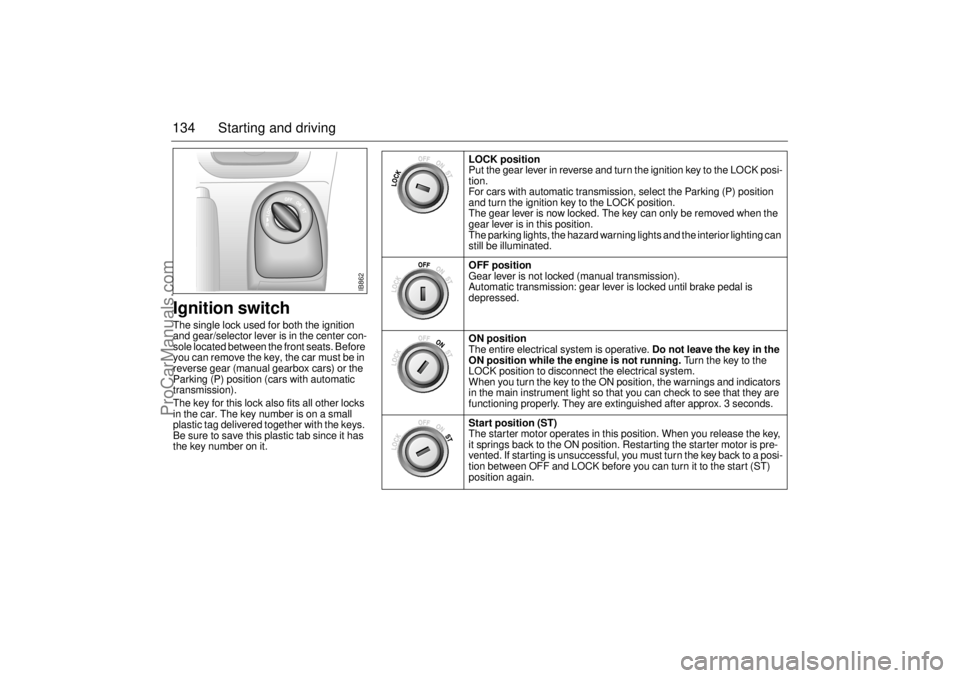
134 Starting and drivingIgnition switchThe single lock used for both the ignition
and gear/selector lever is in the center con-
sole located between the front seats. Before
you can remove the key, the car must be in
reverse gear (manual gearbox cars) or the
Parking (P) position (cars with automatic
transmission).
The key for this lock also fits all other locks
in the car. The key number is on a small
plastic tag delivered together with the keys.
Be sure to save this plastic tab since it has
the key number on it.
IB862
LOCK position
Put the gear lever in reverse and turn the ignition key to the LOCK posi-
tion.
For cars with automatic transmission, select the Parking (P) position
and turn the ignition key to the LOCK position.
The gear lever is now locked. The key can only be removed when the
gear lever is in this position.
The parking lights, the hazard warning lights and the interior lighting can
still be illuminated.
OFF position
Gear lever is not locked (manual transmission).
Automatic transmission: gear lever is locked until brake pedal is
depressed.
ON position
The entire electrical system is operative. Do not leave the key in the
ON position while the engine is not running. Turn the key to the
LOCK position to disconnect the electrical system.
When you turn the key to the ON position, the warnings and indicators
in the main instrument light so that you can check to see that they are
functioning properly. They are extinguished after approx. 3 seconds.
Start position (ST)
The starter motor operates in this position. When you release the key,
it springs back to the ON position. Restarting the starter motor is pre-
vented. If starting is unsuccessful, you must turn the key back to a posi-
tion between OFF and LOCK before you can turn it to the start (ST)
position again.
ProCarManuals.com
Page 135 of 236

135 Starting and driving
If the car does not startIf the text "KEY NOT ACCEPTED" appears
on the SID when the engine refuses to start,
the trouble may be a fault in the transponder
of the key or in the receiver of the ignition
switch. Proceed as follows:
• Turn the key back to the LOCK position.
Turn the key to the ON position.
Press one of the buttons on the remote
control (the LED on top of the dash stops
flashing).
Start the engine.
Try the other key. If it works, the trouble is in
the first key.
Call on an authorized Saab dealer for
inspection and correction.
Starting the engineDo not run the starter motor for more than
25 seconds at a time. Wait 20-30 seconds
before running the starter again, to give the
battery time to recover.
Avoid racing the engine or putting a heavy
load on it before it has warmed up. Let the
engine idle for at least 10 seconds and then
drive away as long as the engine oil warning
light has gone out to enable the engine to
attain its normal temperature as quickly as
possible.
It is possible for air to enter the lubricating
system in conjunction with an oil or oil-filter
change, or if the car has been stored for
some time. This air can cause the hydraulic
cam followers to emit a ticking noise, which
can persist for up to 15 minutes after start-
ing. Although this is quite normal and does
not indicate any malfunction, it is advisable
not to exceed 3,000 rpm before the noise
has disappeared. The hydraulic cam lifters are completely
service free; the valve clearance is set up at
the factory and will not need any subse-
quent adjustment.
Starting the engine The engine has an automatic choke and
should be started as follows:
Cars with manual gearbox
To start the engine the clutch pedal must
be fully depressed.
1 Depress the clutch pedal but do not
touch the accelerator.
2 Start the engine. Let the ignition key
spring back as soon as the engine has
started and is running smoothly – at very
low temperatures, you may need to run
the starter for up to 50 seconds.
Let the engine idle for about 10 seconds. Do
not open the throttle wide for at least
2-3 minutes after starting.
Cars with automatic transmission
The selector lever must be in the P or N
position.
1 Keep your foot on the brake pedal.
2 Start the engine. Let the ignition key
spring back as soon as the engine has
started and is running smoothly – at very
low temperatures, you may need to run
the starter for up to 50 seconds.
Let the engine idle for about 10 seconds. Do
not open the throttle wide for at least
2–3 minutes after starting.
WARNING
Always remove the key before leaving
the car.
Always apply the parking brake before
removing the ignition key.NOTETake care not to spill drinks or to drop
crumbs over the ignition switch. If dirt or
liquid gets into it, the switch may not
operate properly.
WARNING
Carbon monoxide (CO) is a colorless,
odorless, poisonous gas. Be alert to
the danger of CO – always open the
garage doors before starting the
engine in the garage.
There is also a danger of CO poison-
ing if the exhaust system is leaking.
ProCarManuals.com