Page 286 of 376

6-19
How to Reset the GM Oil Life System�
To reset the oil life monitor after the oil has
been changed:
Driver Information Center (DIC) (If Equipped)
1. With the ignition key to RUN but the engine off,
fully push and release the accelerator pedal slowly
three times within five seconds.
2. If the CHANGE OIL SOON light flashes, the system
is resetting.
3. Turn the key to OFF after the light has finished
flashing, then start the vehicle.
NOTE: If the CHANGE OIL SOON light comes
back on, the engine oil life monitor has not reset.
Repeat the procedure.
Trip Computer (If Equipped)
1. Press the MODE button until the light appears lit
next to OIL LIFE.
2. Press and hold the RESET button for three seconds.
The oil life percentage should change to 100%.What to Do with Used Oil
Did you know that used engine oil contains certain
elements that may be unhealthy for your skin and could
even cause cancer? Don't let used oil stay on your skin
for very long. Clean your skin and nails with soap and
water, or a good hand cleaner. Wash or properly throw
away clothing or rags containing used engine oil. (See
the manufacturer's warnings about the use and disposal
of oil products.)
Used oil can be a real threat to the environment. If you
change your own oil, be sure to drain all free
-flowing oil
from the filter before disposal. Don't ever dispose of oil
by putting it in the trash, pouring it on the ground, into
sewers, or into streams or bodies of water. Instead,
recycle it by taking it to a place that collects used oil.
If you have a problem properly disposing of your used
oil, ask your dealer, a service station or a local recycling
center for help.
Page 297 of 376
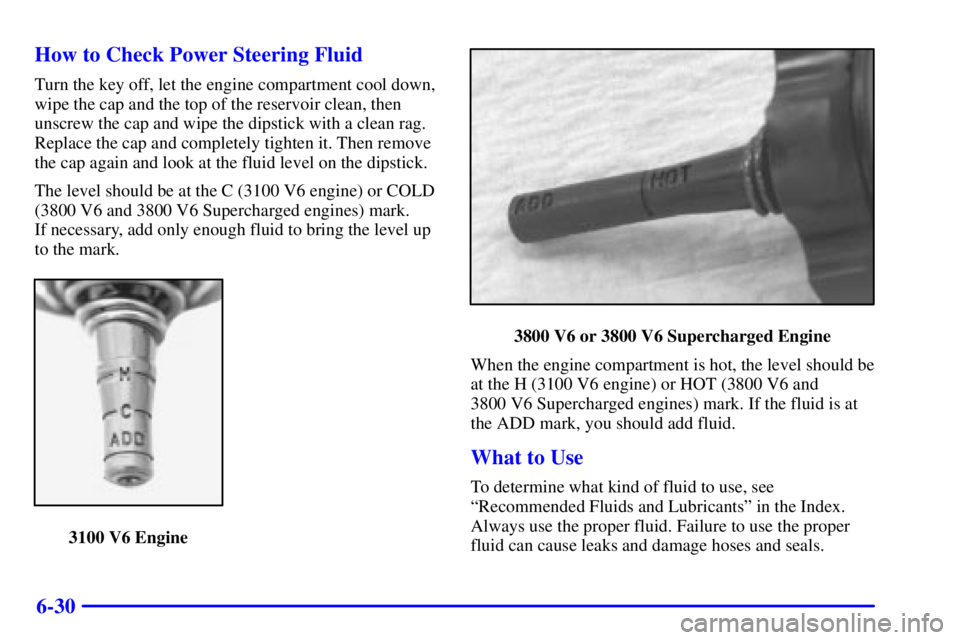
6-30 How to Check Power Steering Fluid
Turn the key off, let the engine compartment cool down,
wipe the cap and the top of the reservoir clean, then
unscrew the cap and wipe the dipstick with a clean rag.
Replace the cap and completely tighten it. Then remove
the cap again and look at the fluid level on the dipstick.
The level should be at the C (3100 V6 engine) or COLD
(3800 V6 and 3800 V6 Supercharged engines) mark.
If necessary, add only enough fluid to bring the level up
to the mark.
3100 V6 Engine
3800 V6 or 3800 V6 Supercharged Engine
When the engine compartment is hot, the level should be
at the H (3100 V6 engine) or HOT (3800 V6 and
3800 V6 Supercharged engines) mark. If the fluid is at
the ADD mark, you should add fluid.
What to Use
To determine what kind of fluid to use, see
ªRecommended Fluids and Lubricantsº in the Index.
Always use the proper fluid. Failure to use the proper
fluid can cause leaks and damage hoses and seals.
Page 302 of 376

6-35 Replacing Brake System Parts
The braking system on a vehicle is complex. Its many
parts have to be of top quality and work well together if
the vehicle is to have really good braking. Your vehicle
was designed and tested with top
-quality GM brake parts.
When you replace parts of your braking system
-- for
example, when your brake linings wear down and you
have to have new ones put in
-- be sure you get new
approved GM replacement parts. If you don't, your
brakes may no longer work properly. For example, if
someone puts in brake linings that are wrong for your
vehicle, the balance between your front and rear brakes
can change
-- for the worse. The braking performance
you've come to expect can change in many other ways if
someone puts in the wrong replacement brake parts.
Battery
Your new vehicle comes with a maintenance free
ACDelco� battery. When it's time for a new battery,
get one that has the replacement number shown on
the original battery's label. We recommend an
ACDelco battery.
If your battery has a very low charge or is dead, you
may not be able to remove the ignition key from the
ignition switch or shift out of PARK (P). Refer to
ªShifting Out of PARK(P)º in the Index.
Vehicle Storage
If you're not going to drive your vehicle for 25 days or
more, remove the black, negative (
-) cable from the
battery. This will help keep your battery from
running down.
CAUTION:
Batteries have acid that can burn you and gas
that can explode. You can be badly hurt if you
aren't careful. See ªJump Startingº in the Index
for tips on working around a battery without
getting hurt.
Contact your dealer to learn how to prepare your vehicle
for longer storage periods.
Also, for your audio system, see ªTheft
-Deterrent
Featureº in the Index.
Page 331 of 376
6-64
Fuse Description
BLANK Blank
BLANK Blank
MALL PGM Mall Module
-- Program
MALL Mall Module
WIPER Wipers
STR WHL
ILLUMSteering Wheel Illumination
BLANK Blank
STR WHL
CTRLSteering Wheel Control
SUNROOF Sunroof
RADIO Radio, Antenna
BLANK Blank
RADIO AMP Bose Amplifier
PWR LOCK Mall Module
-- Power Locks
HSEAT/LUM Heated Seats, Power LumbarFuse Description
R DEFOG Rear Defog
PASSKEY III PASS
-Key� III Security System
RAP Retained Accessory Power
HAZARD Hazard Flashers
PWR MIR Power Mirrors
HVAC HI HVAC Blower
-- Hi
CIG LTR Cigarette Lighter, ALDL, Floor
Console Accessory Outlet
INT LAMP Mall Module
-- Interior lamps
STOP LAMP Stoplamp
AUX/CNSL Accessory Power,
Overhead Console
CD CHG CD Changer
ECM Electronic Control Module
CRUISE Cruise Control
Page 334 of 376
6-67
Fuse Description
19 Spare
20 Spare
21 Mass Air Flow (MAF), Heated Sensors,
Canister Purge, Boost Solenoid
22 Spare
23 Spare
24 Spare
25 Ignition Module
26 Spare
27 Trunk Release, Back
-Up Lamps
28 AC Clutch, ABS Ignition
29 Remote Keyless Entry, Theft
-Deterrent,
Shock Sensor, Trip Computer, HVAC
Module, Security LED
30 Alt Sense
31 Torque Converter Clutch (TCC)
32 Fuel Pump
33 Electronic Control Module/Powertrain
Control Module
34 SpareFuse Description
35 Fog Lamps
36 Horn
37 Chime/Mall Module, Taillamps,
Parking Lamps, Sidemarker Lamps,
Dimmable Lamps
38 Spare Fuse
39 Air Pump
40 Spare
Diode Description
Air Conditioning Clutch Diode
Relay Description
9 Cooling Fan
10 Cooling Fan 2
11 Ignition Main
12 Cooling Fan 1
13 Air Conditioning Clutch
14 Fuel Pump
15 Fuel Pump Speed Cont
16 Horn
17 Fog Lamp
Page 353 of 376

7-16 At Least Twice a Year
Restraint System Check
Make sure the safety belt reminder light and all your
belts, buckles, latch plates, retractors and anchorages are
working properly. Look for any other loose or damaged
safety belt system parts. If you see anything that might
keep a safety belt system from doing its job, have it
repaired. Have any torn or frayed safety belts replaced.
Also look for any opened or broken air bag coverings,
and have them repaired or replaced. (The air bag system
does not need regular maintenance.)
Wiper Blade Check
Inspect wiper blades for wear or cracking. Replace blade
inserts that appear worn or damaged or that streak or
miss areas of the windshield. Also see ªWiper Blades,
Cleaningº in the Index.
Weatherstrip Lubrication
Silicone grease on weatherstrips will make them last
longer, seal better, and not stick or squeak. Apply
silicone grease with a clean cloth. During very cold,
damp weather more frequent application may be
required. (See ªRecommended Fluids and Lubricantsº
in the Index.)Automatic Transaxle Check
Check the transaxle fluid level; add if needed. See
ªAutomatic Transaxle Fluidº in the Index. A fluid loss
may indicate a problem. Check the system and repair
if needed.
At Least Once a Year
Key Lock Cylinders Service
Lubricate the key lock cylinders with the lubricant
specified in Part D.
Body Lubrication Service
Lubricate all hood hinges, hood latch assembly,
secondary latch, pivots, spring anchor, release pawl,
door hinges, rear compartment, glove box door, console
door and any folding seat hardware. Part D tells you
what to use. More frequent lubrication may be required
when exposed to a corrosive environment.
Page 354 of 376
7-17
Starter Switch Check
CAUTION:
When you are doing this check, the vehicle could
move suddenly. If it does, you or others could be
injured. Follow the steps below.
1. Before you start, be sure you have enough room
around the vehicle.
2. Firmly apply both the parking brake (see ªParking
Brakeº in the Index if necessary) and the
regular brake.
NOTE: Do not use the accelerator pedal, and be
ready to turn off the engine immediately if it starts.
3. Try to start the engine in each gear. The starter
should work only in PARK (P) or NEUTRAL (N).
If the starter works in any other position, your
vehicle needs service.Automatic Transaxle Shift Lock Control
System Check
CAUTION:
When you are doing this check, the vehicle could
move suddenly. If it does, you or others could be
injured. Follow the steps below.
1. Before you start, be sure you have enough room
around the vehicle. It should be parked on a
level surface.
2. Firmly apply the parking brake (see ªParking Brakeº
in the Index if necessary).
NOTE: Be ready to apply the regular brake
immediately if the vehicle begins to move.
3. With the engine off, turn the key to the RUN
position, but don't start the engine. Without applying
the regular brake, try to move the shift lever out of
PARK (P) with normal effort. If the shift lever
moves out of PARK (P), your vehicle needs service.
Page 355 of 376
7-18
Ignition Transaxle Lock Check
While parked, and with the parking brake set, try to turn
the ignition key to LOCK in each shift lever position.
�The key should turn to LOCK only when the shift
lever is in PARK (P).
�The key should come out only in LOCK.
Parking Brake and Automatic Transaxle PARK (P)
Mechanism Check
CAUTION:
When you are doing this check, your vehicle
could begin to move. You or others could be
injured and property could be damaged. Make
sure there is room in front of your vehicle in case
it begins to roll. Be ready to apply the regular
brake at once should the vehicle begin to move.
Park on a fairly steep hill, with the vehicle facing
downhill. Keeping your foot on the regular brake,
set the parking brake.
�To check the parking brake's holding ability: With
the engine running and transaxle in NEUTRAL (N),
slowly remove foot pressure from the regular brake
pedal. Do this until the vehicle is held by the parking
brake only.
�To check the PARK (P) mechanism's holding ability:
With the engine running, shift to PARK (P).
Then release the parking brake followed by the
regular brake.
Underbody Flushing Service
At least every spring, use plain water to flush any
corrosive materials from the underbody. Take care to
clean thoroughly any areas where mud and other debris
can collect.