Page 5 of 318
iii
Section
3
Comfort Controls and Audio Systems
Section
4
Your Driving and the Road
Section
5
Table of Contents (cont'd)
Defensive Driving
Drunken Driving
Control of a Vehicle
Braking
Enhanced Traction SystemSteering
Driving Tips for Various Road Conditions
Recreational Vehicle Towing
Loading Your Vehicle
Towing a Trailer Heating and Air Conditioning
Setting the Radio Clock
Radio/Cassette Player/CD PlayerRadio Theft-Deterrent Feature
Steering Wheel Controls (If Equipped)
Hazard Warning Flashers
Jump Starting
Towing Your VehicleEngine Overheating
Changing a Flat Tire
If You're Stuck
Problems on the Road
Page 116 of 318
2-51
The main components of your instrument panel are:
A. Fog Lamp Switch
B. Instrument Panel Intensity Control
C. Turn Signal/Multifunction Lever
D. Horn
E. Instrument Cluster
F. Windshield Wiper/Washer Lever
G. Ignition Switch
H. Enhanced Traction System
I. Hazard SwitchJ. Audio System
K. Climate Control System
L. Cigarette Lighter
M. Gear Shift Lever
N. Cruise Control Switches (If Equipped)
O. Steering Wheel Audio System (If Equipped)
P. Tilt Wheel Lever
Q. Hood Release Handle
R. Fuse Panel
Page 123 of 318

2-58 Enhanced Traction System Warning Light
With the Enhanced Traction
System (ETS), this warning
light should come on briefly
as you start the engine. If
the warning light doesn't
come on then, have it fixed
so it will be ready to warn
you if there's a problem.
If the warning light stays on, or comes on when you're
driving, there may be a problem with your Enhanced
Traction System and your vehicle may need service.
When this warning light is on, the system will not limit
wheel spin. Adjust your driving accordingly.The Enhanced Traction System warning light may come
on for the following reasons:
�If you turn the system off by pressing the ETS button
located on the instrument panel above the audio
system, the warning light will come on and stay on.
To turn the system back on, press the button again.
The warning light should go off. (See ªEnhanced
Traction Systemº in the Index for more information.)
�The warning light will come on when you set your
parking brake with the engine running, and it will
stay on if your parking brake doesn't release fully.
If the system is turned on and the warning light stays
on after your parking brake is fully released, it
means there's a problem with the system.
�If the traction control system is affected by an
engine
-related problem, the system will turn off and
the warning light will come on.
If the Enhanced Traction System warning light comes
on and stays on for an extended period of time when the
system is turned on and the parking brake is fully
released, your vehicle needs service.
Page 133 of 318
3-
3-1
Section 3 Comfort Controls and Audio Systems
In this section, you'll find out how to operate the comfort control and audio systems offered with your vehicle.
Be sure to read about the particular systems supplied with your vehicle.
3
-2 Comfort Controls
3
-2 Climate Control System with Air Conditioning
3
-3 Air Conditioning
3
-4 Heating
3
-4 Defogging and Defrosting Windows
3
-5 Rear Window Defogger
3
-5 Ventilation System
3
-6 Audio Systems
3
-6 Setting the Clock for All Systems Except
AM
-FM Stereo
3
-7AM-FM Stereo with Cassette Tape Player3
-10 AM-FM Stereo with Compact Disc Player
and Equalizer (If Equipped)
3
-13 Remote Cassette Tape Player (If Equipped)
3
-14 Theft-Deterrent Feature (If Equipped)
3
-17 Audio Steering Wheel Controls (If Equipped)
3
-18 Understanding Radio Reception
3
-18 Tips About Your Audio System
3
-19 Care of Your Cassette Tape Player
3
-20 Care of Your Compact Discs
3
-20 Care of Your Compact Disc Player
3
-20 Fixed Mast Antenna
Page 138 of 318

3-6
Ventilation Tips
�Keep the hood and front air inlet free of ice, snow or
any other obstruction, such as leaves. The heater and
defroster will work far better, reducing the chance of
fogging the inside of your windows.
�When you enter a vehicle in cold weather, adjust the
mode knob to FLOOR and the fan to the highest
speed for a few moments before driving off. This
helps clear the intake ducts of snow and moisture
and reduces the chance of fogging the inside of
your windows.
�Keep the air path under the front seats clear
of objects. This helps air circulate throughout
your vehicle.Audio Systems
Your audio system has been designed to operate easily
and give years of listening pleasure. You will get the
most enjoyment out of it if you acquaint yourself with it
first. Find out what your audio system can do and how
to operate all its controls, to be sure you're getting the
most out of the advanced engineering that went into it.
Setting the Clock for All Systems
Except AM-FM Stereo
Press and hold HR until the correct hour appears.
Press and hold MIN until the correct minute appears.
There will be a two
-second delay before the clock goes
into time
-set mode, and the colon on the display will
blink while in this mode.
Page 143 of 318
3-11
Finding a Station
AM/FM: Press this button to switch between AM,
FM1 and FM2. The display shows your selection.
TUNE: Press this knob lightly so it extends. Turn it to
choose radio stations. Push the knob back into its stored
position when you're not using it.
SEEK: Press the up or down arrow to go to the next
higher or lower station and stay there.
PUSHBUTTONS: The six numbered pushbuttons let
you return to your favorite stations. You can set up to
18 stations (six AM, six FM1 and six FM2). Just:
1. Turn the radio on.
2. Press AM
-FM to select the band.
3. Tune in the desired station.
4. Press and hold one of the six numbered buttons until
SET appears on the display. Whenever you press that
numbered button, the station you set will return.
5. Repeat the steps for each pushbutton.Setting the Tone
EQUALIZER: A seven
-band equalizer is part of your
audio system. Slide the levers up to boost or down to
reduce frequency range.
Adjusting the Speakers
BAL: Press this knob lightly so it extends. Turn it to
move the sound to the left or right speakers. The middle
position balances the sound between the speakers.
FADE: Press this knob lightly so it extends. Turn it to
move the sound to the front or rear speakers. The middle
position balances the sound between the speakers.
Push these knobs back into their stored positions when
you're not using them.
Playing a Compact Disc
Insert a disc partway into the slot, label side up. The
player will pull it in. If the ignition and the radio are on,
the disc will begin playing. If you want to insert a disc
when the ignition is off, first press EJECT.
Page 149 of 318
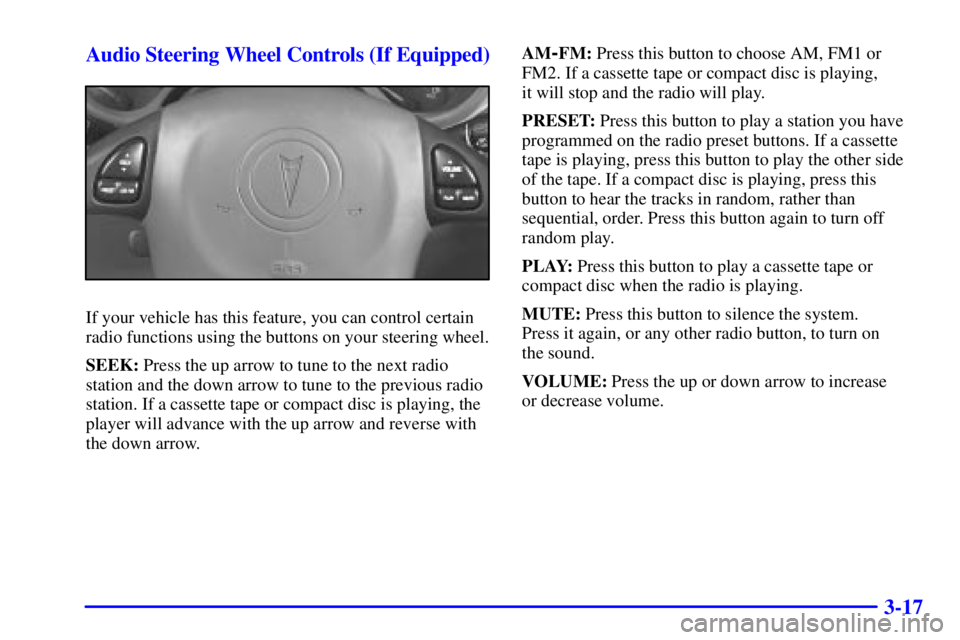
3-17 Audio Steering Wheel Controls (If Equipped)
If your vehicle has this feature, you can control certain
radio functions using the buttons on your steering wheel.
SEEK: Press the up arrow to tune to the next radio
station and the down arrow to tune to the previous radio
station. If a cassette tape or compact disc is playing, the
player will advance with the up arrow and reverse with
the down arrow.AM
-FM: Press this button to choose AM, FM1 or
FM2. If a cassette tape or compact disc is playing,
it will stop and the radio will play.
PRESET: Press this button to play a station you have
programmed on the radio preset buttons. If a cassette
tape is playing, press this button to play the other side
of the tape. If a compact disc is playing, press this
button to hear the tracks in random, rather than
sequential, order. Press this button again to turn off
random play.
PLAY: Press this button to play a cassette tape or
compact disc when the radio is playing.
MUTE: Press this button to silence the system.
Press it again, or any other radio button, to turn on
the sound.
VOLUME: Press the up or down arrow to increase
or decrease volume.
Page 150 of 318
3-18 Understanding Radio Reception
AM
The range for most AM stations is greater than for FM,
especially at night. The longer range, however, can
cause stations to interfere with each other. AM can pick
up noise from things like storms and power lines. Try
reducing the treble to reduce this noise if you ever get it.
FM Stereo
FM stereo will give you the best sound, but FM signals
will reach only about 10 to 40 miles (16 to 65 km).
Tall buildings or hills can interfere with FM signals,
causing the sound to come and go.
Tips About Your Audio System
Hearing damage from loud noise is almost undetectable
until it is too late. Your hearing can adapt to higher
volumes of sound. Sound that seems normal can be
loud and harmful to your hearing. Take precautions by
adjusting the volume control on your radio to a safe
sound level before your hearing adapts to it.To help avoid hearing loss or damage:
�Adjust the volume control to the lowest setting.
�Increase volume slowly until you hear comfortably
and clearly.
NOTICE:
Before you add any sound equipment to your
vehicle
-- like a tape player, CB radio, mobile
telephone or two
-way radio -- be sure you
can add what you want. If you can, it's very
important to do it properly. Added sound
equipment may interfere with the operation of
your vehicle's engine, Delphi Delco Electronics
radio or other systems, and even damage them.
Your vehicle's systems may interfere with the
operation of sound equipment that has been
added improperly.
So, before adding sound equipment, check with
your dealer and be sure to check Federal rules
covering mobile radio and telephone units.