Page 208 of 318
5-16
1. You can remove the coolant surge tank pressure
cap when the cooling system, including the coolant
surge tank pressure cap and upper radiator hose,
is no longer hot. Turn the pressure cap slowly
counterclockwise (left) about two or two and
one
-half turns. If you hear a hiss, wait for that to
stop. This will allow any pressure still left to be
vented out the discharge hose.
2. Then keep turning the pressure cap slowly, and
remove it.
Page 211 of 318
5-19
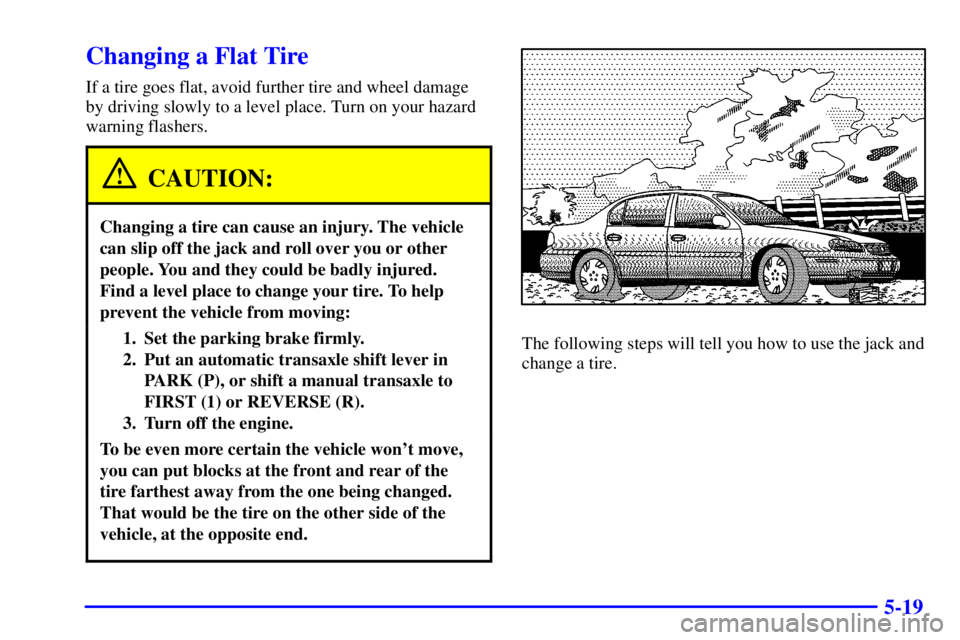
Changing a Flat Tire
If a tire goes flat, avoid further tire and wheel damage
by driving slowly to a level place. Turn on your hazard
warning flashers.
CAUTION:
Changing a tire can cause an injury. The vehicle
can slip off the jack and roll over you or other
people. You and they could be badly injured.
Find a level place to change your tire. To help
prevent the vehicle from moving:
1. Set the parking brake firmly.
2. Put an automatic transaxle shift lever in
PARK (P), or shift a manual transaxle to
FIRST (1) or REVERSE (R).
3. Turn off the engine.
To be even more certain the vehicle won't move,
you can put blocks at the front and rear of the
tire farthest away from the one being changed.
That would be the tire on the other side of the
vehicle, at the opposite end.
The following steps will tell you how to use the jack and
change a tire.
Page 212 of 318
5-20 Removing the Spare Tire and Tools
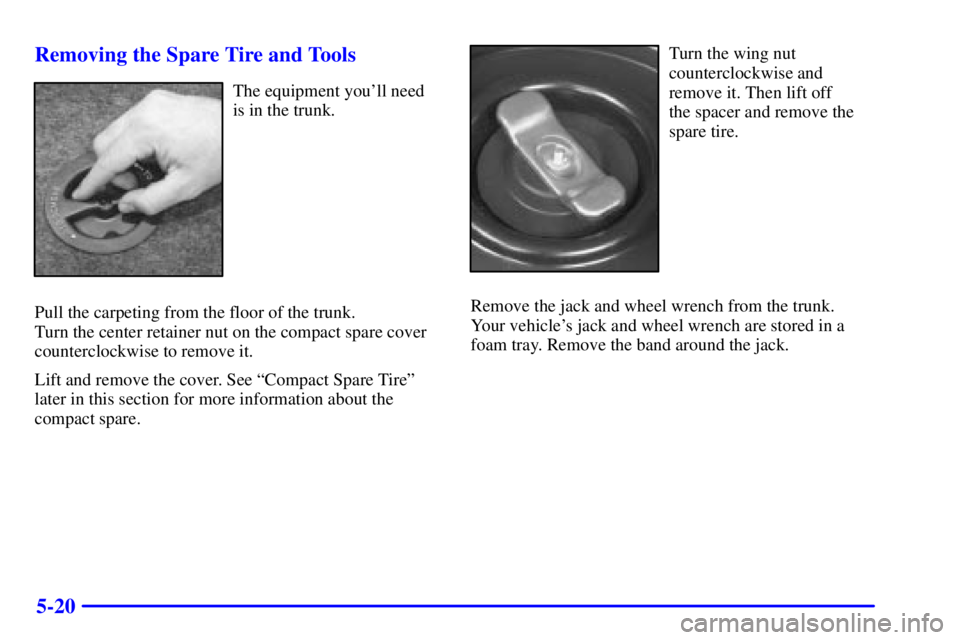
The equipment you'll need
is in the trunk.
Pull the carpeting from the floor of the trunk.
Turn the center retainer nut on the compact spare cover
counterclockwise to remove it.
Lift and remove the cover. See ªCompact Spare Tireº
later in this section for more information about the
compact spare.
Turn the wing nut
counterclockwise and
remove it. Then lift off
the spacer and remove the
spare tire.
Remove the jack and wheel wrench from the trunk.
Your vehicle's jack and wheel wrench are stored in a
foam tray. Remove the band around the jack.
Page 215 of 318
5-23
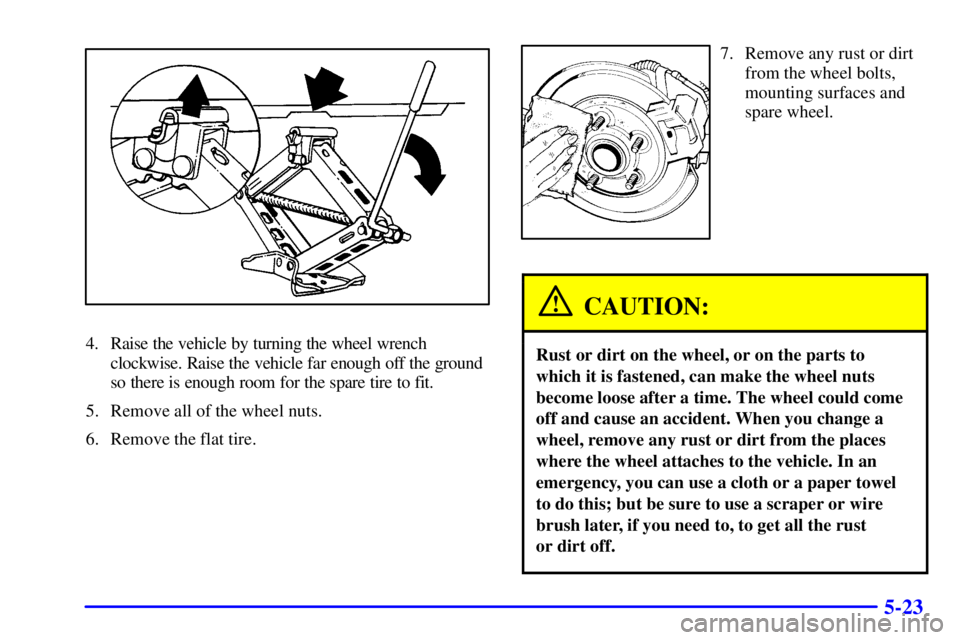
4. Raise the vehicle by turning the wheel wrench
clockwise. Raise the vehicle far enough off the ground
so there is enough room for the spare tire to fit.
5. Remove all of the wheel nuts.
6. Remove the flat tire.
7. Remove any rust or dirt
from the wheel bolts,
mounting surfaces and
spare wheel.
CAUTION:
Rust or dirt on the wheel, or on the parts to
which it is fastened, can make the wheel nuts
become loose after a time. The wheel could come
off and cause an accident. When you change a
wheel, remove any rust or dirt from the places
where the wheel attaches to the vehicle. In an
emergency, you can use a cloth or a paper towel
to do this; but be sure to use a scraper or wire
brush later, if you need to, to get all the rust
or dirt off.
Page 216 of 318
5-24
CAUTION:
Never use oil or grease on studs or nuts. If you
do, the nuts might come loose. Your wheel could
fall off, causing a serious accident.
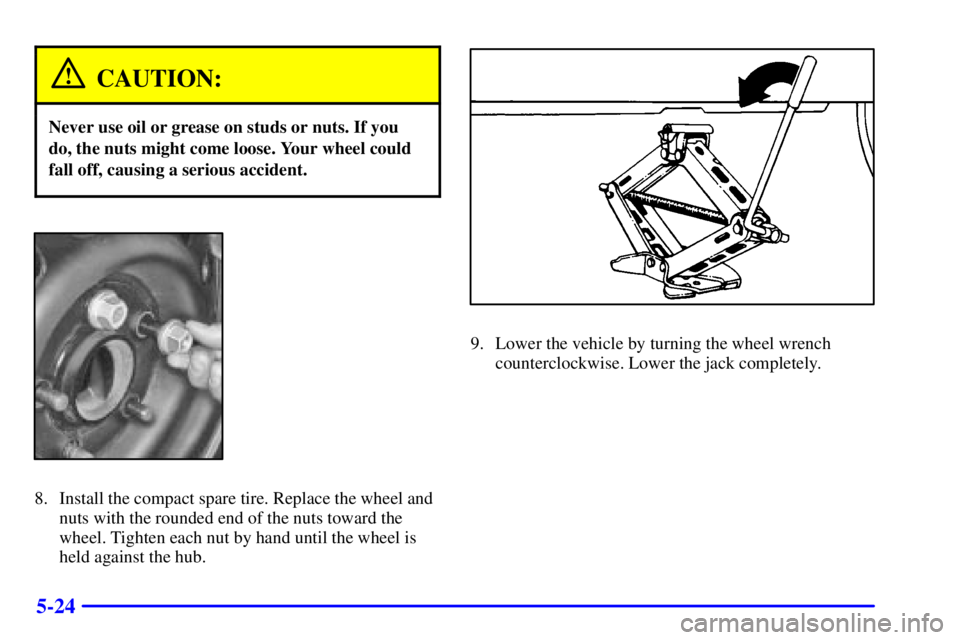
8. Install the compact spare tire. Replace the wheel and
nuts with the rounded end of the nuts toward the
wheel. Tighten each nut by hand until the wheel is
held against the hub.
9. Lower the vehicle by turning the wheel wrench
counterclockwise. Lower the jack completely.
Page 227 of 318
6-6
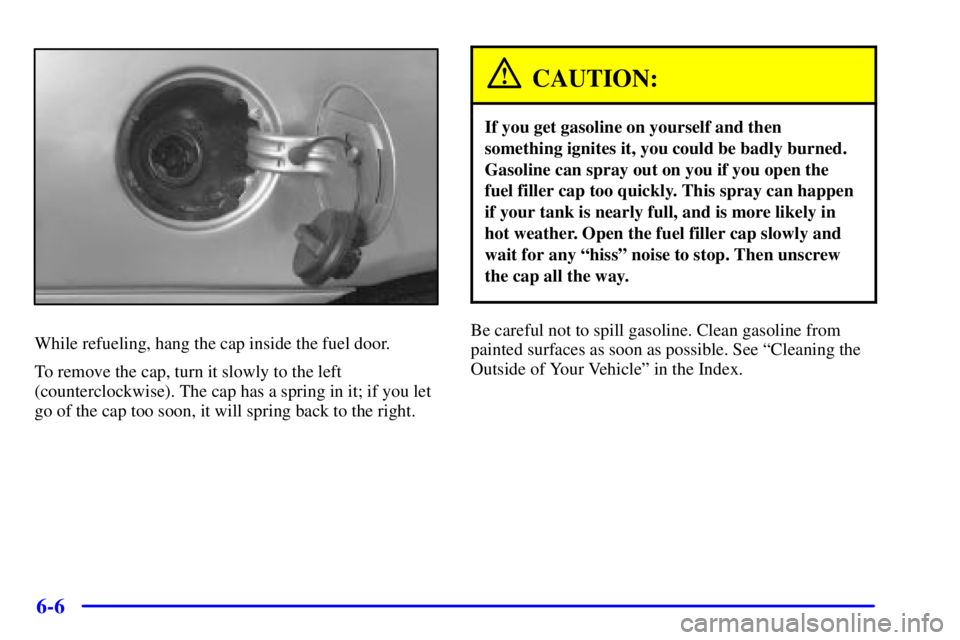
While refueling, hang the cap inside the fuel door.
To remove the cap, turn it slowly to the left
(counterclockwise). The cap has a spring in it; if you let
go of the cap too soon, it will spring back to the right.
CAUTION:
If you get gasoline on yourself and then
something ignites it, you could be badly burned.
Gasoline can spray out on you if you open the
fuel filler cap too quickly. This spray can happen
if your tank is nearly full, and is more likely in
hot weather. Open the fuel filler cap slowly and
wait for any ªhissº noise to stop. Then unscrew
the cap all the way.
Be careful not to spill gasoline. Clean gasoline from
painted surfaces as soon as possible. See ªCleaning the
Outside of Your Vehicleº in the Index.
Page 228 of 318
6-7
When you put the cap back on, turn it to the right
(clockwise) until you hear a clicking sound. Make sure
you fully install the cap. The diagnostic system can
determine if the fuel cap has been left off or improperly
installed. This would allow fuel to evaporate into the
atmosphere. See ªMalfunction Indicator Lampº in
the Index.
NOTICE:
If you need a new cap, be sure to get the right
type. Your dealer can get one for you. If you get
the wrong type, it may not fit properly. This may
cause your malfunction indicator lamp to light
and your fuel tank and emissions system may be
damaged. See ªMalfunction Indicator Lampº in
the Index.
Filling a Portable Fuel Container
CAUTION:
Never fill a portable fuel container while it is in
your vehicle. Static electricity discharge from the
container can ignite the gasoline vapor. You can
be badly burned and your vehicle damaged if this
occurs. To help avoid injury to you and others:
�Dispense gasoline only into
approved containers.
�Do not fill a container while it is inside a
vehicle, in a vehicle's trunk, pickup bed or
on any surface other than the ground.
�Bring the fill nozzle in contact with the
inside of the fill opening before operating
the nozzle. Contact should be maintained
until the filling is complete.
�Don't smoke while pumping gasoline.
Page 238 of 318

6-17 Engine Oil Additives
Don't add anything to your oil. The recommended oils
with the starburst symbol are all you will need for good
performance and engine protection.
When to Change Engine Oil
Your vehicle has a computer that lets you know when to
change your engine oil. This is not based on mileage, but
on engine revolutions and engine operating temperature.
When the computer has calculated that the oil needs
changing, the GM Oil Life System� will indicate that a
change is necessary. The mileage between oil and filter
changes will vary depending on how you drive your
vehicle
-- usually between 3,000 miles (5 000 km) and
7,500 miles (12 500 km) since your last oil and filter
change. Under severe conditions, the system may come on
before 3,000 miles (5 000 km). Never drive your vehicle
more than 7,500 miles (12 500 km) or 12 months
(whichever occurs first) without an oil change.
The system won't detect dust in the oil. So, if you drive in
a dusty area, be sure to change your oil and filter every
3,000 miles (5 000 km) or sooner. Remember to reset the
CHANGE OIL light whenever the oil is changed.How to Reset the Change Oil Light
After changing the engine oil, the system must be reset.
With the ignition key to ON (engine not running), push
the RESET button located in the driver's side instrument
panel fuse block. The CHANGE OIL light will start to
flash, press and hold the RESET button again. The reset
is complete when you hear the chimes and the
CHANGE OIL light goes out.
What to Do with Used Oil
Did you know that used engine oil contains certain
elements that may be unhealthy for your skin and could
even cause cancer? Don't let used oil stay on your skin
for very long. Clean your skin and nails with soap and
water, or a good hand cleaner. Wash or properly throw
away clothing or rags containing used engine oil.
(See the manufacturer's warnings about the use and
disposal of oil products.)
Used oil can be a real threat to the environment. If you
change your own oil, be sure to drain all free
-flowing oil
from the filter before disposal. Don't ever dispose of oil
by putting it in the trash, pouring it on the ground, into
sewers, or into streams or bodies of water. Instead, recycle
it by taking it to a place that collects used oil. If you have
a problem properly disposing of your used oil, ask your
dealer, a service station or a local recycling center for help.