6-20
Hydraulic Clutch
The hydraulic clutch linkage in your vehicle is
self
-adjusting. The clutch master cylinder reservoir is
filled with hydraulic clutch fluid.
It is not necessary to regularly check clutch fluid unless
you suspect there is a leak in the system. Adding fluid
won't correct a leak.
A fluid loss in this system could indicate a problem.
Have the system inspected and repaired.
When to Check and What to Use
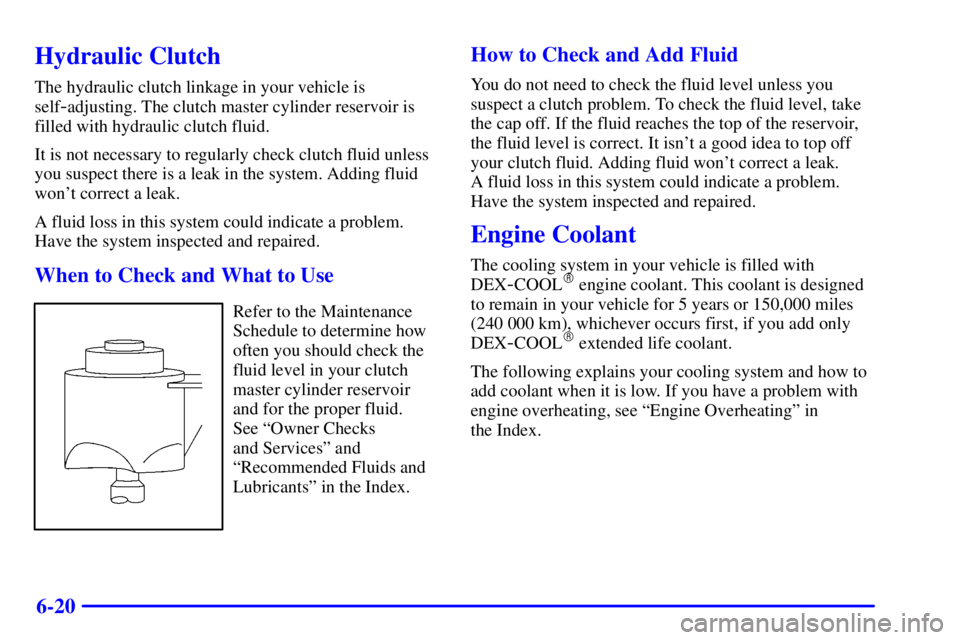
Refer to the Maintenance
Schedule to determine how
often you should check the
fluid level in your clutch
master cylinder reservoir
and for the proper fluid.
See ªOwner Checks
and Servicesº and
ªRecommended Fluids and
Lubricantsº in the Index.
How to Check and Add Fluid
You do not need to check the fluid level unless you
suspect a clutch problem. To check the fluid level, take
the cap off. If the fluid reaches the top of the reservoir,
the fluid level is correct. It isn't a good idea to top off
your clutch fluid. Adding fluid won't correct a leak.
A fluid loss in this system could indicate a problem.
Have the system inspected and repaired.
Engine Coolant
The cooling system in your vehicle is filled with
DEX
-COOL� engine coolant. This coolant is designed
to remain in your vehicle for 5 years or 150,000 miles
(240 000 km), whichever occurs first, if you add only
DEX
-COOL� extended life coolant.
The following explains your cooling system and how to
add coolant when it is low. If you have a problem with
engine overheating, see ªEngine Overheatingº in
the Index.
6-34
Replacement blades come in different types and are
removed in different ways. Here's how to remove the
type with a Shepherd's Hook:
1. Pull the windshield wiper arm away from
the windshield.
2. Push the release lever and slide the wiper assembly
toward the driver's side of the vehicle.
3. Install a new blade by reversing Steps 1 and 2.
For the proper type and size, see ªCapacities and
Specificationsº in the Index.
Tires
Your new vehicle comes with high-quality tires made by
a leading tire manufacturer. If you ever have questions
about your tire warranty and where to obtain service, see
your Pontiac Warranty booklet for details.
CAUTION:
Poorly maintained and improperly used tires
are dangerous.
�Overloading your tires can cause
overheating as a result of too much friction.
You could have an air
-out and a serious
accident. See ªLoading Your Vehicleº in
the Index.
�Underinflated tires pose the same danger as
overloaded tires. The resulting accident
could cause serious injury. Check all tires
frequently to maintain the recommended
pressure. Tire pressure should be checked
when your tires are cold.
�Overinflated tires are more likely to be
cut, punctured or broken by a sudden
impact
-- such as when you hit a pothole.
Keep tires at the recommended pressure.
�Worn, old tires can cause accidents. If your
tread is badly worn, or if your tires have
been damaged, replace them.