Page 228 of 348
5-19
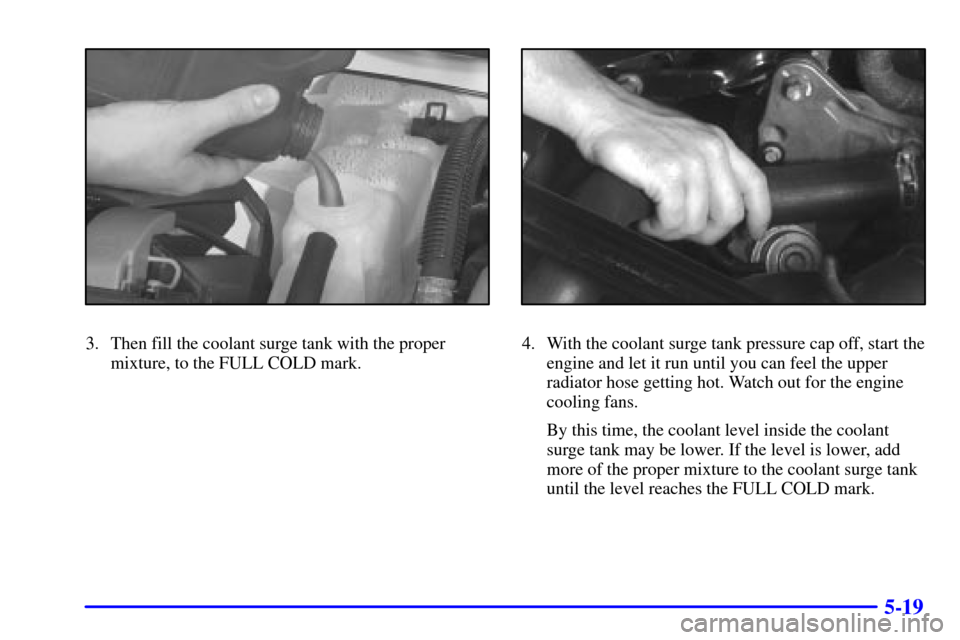
3. Then fill the coolant surge tank with the proper
mixture, to the FULL COLD mark.4. With the coolant surge tank pressure cap off, start the
engine and let it run until you can feel the upper
radiator hose getting hot. Watch out for the engine
cooling fans.
By this time, the coolant level inside the coolant
surge tank may be lower. If the level is lower, add
more of the proper mixture to the coolant surge tank
until the level reaches the FULL COLD mark.
Page 243 of 348

6-
6-1
Section 6 Service and Appearance Care
Here you will find information about the care of your vehicle. This section begins with service and fuel information,
and then it shows how to check important fluid and lubricant levels. There is also technical information about your
vehicle, and a part devoted to its appearance care.
6
-2 Service
6
-3 Fuel
6
-5 Fuels in Foreign Countries
6
-6 Filling Your Tank
6
-9 Filling a Portable Fuel Container
6
-9 Checking Things Under the Hood
6
-12 Engine Oil
6
-17 Engine Air Cleaner/Filter
6
-19 Passenger Compartment Air Filter
(If Equipped)
6
-20 Automatic Transaxle Fluid
6
-23 Engine Coolant
6
-26 Cooling System Pressure Cap
6
-27 Power Steering Fluid
6
-28 Windshield Washer Fluid
6
-29 Brakes
6
-33 Battery6
-33 Bulb Replacement
6
-41 Windshield Wiper Blade Replacement
6
-42 Tires
6
-49 Appearance Care
6
-50 Cleaning the Inside of Your Vehicle
6
-52 Care of Safety Belts
6
-53 Cleaning the Outside of Your Vehicle
6
-55 Cleaning Aluminum or Chrome-Plated
Wheels (If Equipped)
6
-56 Finish Damage
6
-57 GM Vehicle Care/Appearance Materials
6
-58 Vehicle Identification Number (VIN)
6
-58 Service Parts Identification Label
6
-58 Electrical System
6
-66 Replacement Bulbs
6
-66 Capacities and Specifications
6
-67 Normal Maintenance Replacement Parts
Page 265 of 348

6-23
Engine Coolant
The cooling system in your vehicle is filled with
DEX
-COOL� engine coolant. This coolant is designed
to remain in your vehicle for 5 years or 150,000 miles
(240 000 km), whichever occurs first, if you add only
DEX
-COOL� extended life coolant.
The following explains your cooling system and how to
add coolant when it is low. If you have a problem with
engine overheating or if you need to add coolant to your
radiator, see ªEngine Overheatingº in the Index.
A 50/50 mixture of clean, drinkable water and
DEX
-COOL� coolant will:
�Give freezing protection down to
-34�F (-37�C).
�Give boiling protection up to 265�F (129�C).
�Protect against rust and corrosion.
�Help keep the proper engine temperature.
�Let the warning lights and gages work as
they should.
NOTICE:
When adding coolant, it is important that
you use only DEX
-COOL� (silicate-free) coolant.
If coolant other than DEX-COOL is added to the
system, premature engine, heater core or
radiator corrosion may result. In addition, the
engine coolant will require change sooner
-- at
30,000 miles (50 000 km) or 24 months,
whichever occurs first. Damage caused by the
use of coolant other than DEX
-COOL� is not
covered by your new vehicle warranty.
Page 266 of 348

6-24 What to Use
Use a mixture of one-half clean, drinkable water and
one
-half DEX-COOL� coolant which won't damage
aluminum parts. If you use this coolant mixture, you
don't need to add anything else.
CAUTION:
Adding only plain water to your cooling system
can be dangerous. Plain water, or some other
liquid like alcohol, can boil before the proper
coolant mixture will. Your vehicle's coolant
warning system is set for the proper coolant
mixture. With plain water or the wrong mixture,
your engine could get too hot but you wouldn't
get the overheat warning. Your engine could
catch fire and you or others could be burned.
Use a 50/50 mixture of clean, drinkable water
and DEX
-COOL� coolant.
NOTICE:
If you use an improper coolant mixture, your
engine could overheat and be badly damaged.
The repair cost wouldn't be covered by your
warranty. Too much water in the mixture can
freeze and crack the engine, radiator, heater core
and other parts.
If you have to add coolant more than four times a year,
have your dealer check your cooling system.
NOTICE:
If you use the proper coolant, you don't have to
add extra inhibitors or additives which claim to
improve the system. These can be harmful.
Page 268 of 348
6-26
Adding Coolant
If you need more coolant, add the proper DEX
-COOL�
coolant mixture at the surge tank, but only when the
engine is cool.
CAUTION:
You can be burned if you spill coolant on hot
engine parts. Coolant contains ethylene glycol,
and it will burn if the engine parts are hot
enough. Don't spill coolant on a hot engine.
When replacing the pressure cap, make sure it
is hand
-tight.
Cooling System Pressure Cap
The cooling system pressure cap is located on the
surge tank.
NOTICE:
Your cooling system pressure cap is a 15 psi
(105 kPa) pressure
-type cap and must be tightly
installed to prevent coolant loss and possible
engine damage from overheating.
Page 290 of 348

6-48 Wheel Alignment and Tire Balance
The wheels on your vehicle were aligned and balanced
carefully at the factory to give you the longest tire life
and best overall performance.
Scheduled wheel alignment and wheel balancing are not
needed. However, if you notice unusual tire wear or
your vehicle pulling one way or the other, the alignment
may need to be reset. If you notice your vehicle
vibrating when driving on a smooth road, your wheels
may need to be rebalanced.
Wheel Replacement
Replace any wheel that is bent, cracked, or badly rusted
or corroded. If wheel nuts keep coming loose, the wheel,
wheel bolts and wheel nuts should be replaced. If the
wheel leaks air, replace it (except some aluminum
wheels, which can sometimes be repaired).
See your dealer if any of these conditions exist.
Your dealer will know the kind of wheel you need.
Each new wheel should have the same load
-carrying
capacity, diameter, width, offset and be mounted the
same way as the one it replaces.
If you need to replace any of your wheels, wheel bolts
or wheel nuts, replace them only with new GM original
equipment parts. This way, you will be sure to have the
right wheel, wheel bolts and wheel nuts for your vehicle.
CAUTION:
Using the wrong replacement wheels, wheel bolts
or wheel nuts on your vehicle can be dangerous.
It could affect the braking and handling of your
vehicle, make your tires lose air and make you lose
control. You could have a collision in which you or
others could be injured. Always use the correct
wheel, wheel bolts and wheel nuts for replacement.
NOTICE:
The wrong wheel can also cause problems with
bearing life, brake cooling, speedometer or
odometer calibration, headlamp aim, bumper
height, vehicle ground clearance and tire or tire
chain tire clearance to the body and chassis.
See ªChanging a Flat Tireº in the Index for
more information.
Page 305 of 348
6-63
Maxi Fuses Description
1 Cooling Fans
2 Crank
3 Power Seats, Rear Defog,
Trunk Release
4 HVAC Controls, Hazard Flasher,
CHMSL, Body Control Module,
Stoplamp, Power Mirrors
5 HVAC Controls, Compass Mirror,
Cruise Control, PRNDL Lamp,
Powertrain Control Module (PCM)Maxi Fuses Description
6 Cooling Fans
7 Body Control Module, Cigar
Lighter, Accessory Power Outlet,
Trunk CD Changer, Audio
Systems, Keyless Entry System,
I/P Cluster, HVAC Controls
8 Turn Signals, Air Bag System,
I/P Cluster, Body Control Module,
Windshield Wipers
Mini Relays Description
9 Cooling Fans
10 Cooling Fans
11 Crank
12 Cooling Fans
13 Ignition Main
14 Blank
Micro Relays Description
15 Air Conditioning Compressor
16 Horn
17 Fog Lamps
18 Blank
19 Fuel Pump
Page 308 of 348

6-66
Replacement Bulbs
Center High-Mounted Stop Lamp (CHMSL) 1141. .
Fog Lamp 893. . . . . . . . . . . . . . . . . . . . . . . . . . . . . . .
Front Parking/Turn Signal 4157 NAK. . . . . . . . . . . . .
Headlamp
High Beam 9005. . . . . . . . . . . . . . . . . . . . . . . . . . .
Low Beam 9006. . . . . . . . . . . . . . . . . . . . . . . . . . . .
License Plate Lamp 194. . . . . . . . . . . . . . . . . . . . . . .
Sidemarker (Front/Rear) 194. . . . . . . . . . . . . . . . . . .
Stop/Tail/Turn Signal (Rear) 3057. . . . . . . . . . . . . . .
Cornering 3156. . . . . . . . . . . . . . . . . . . . . . . . . . . . . .
Capacities and Specifications
Please refer to ªRecommended Fluids and Lubricantsº
in the Index for more information.
Automatic Transaxle
After Complete Overhaul 10.0 quarts (9.5 L). . . . . . .
Pan Removal
and Replacement 7.4 quarts (7.0 L). . . . . . . . . . . . .
When draining/replacing the converter, more fluid
may be needed.Cooling System Including Reservoir
10.0 quarts (9.5 L)
A/C Refrigerant1.9 lbs. (0.85 kg) . . . . . . . . . . . . . . .
Engine Crankcase (Oil and Filter Change)
6.0 quarts (5.7 L)
Fuel Tank17 gallons (64 L) . . . . . . . . . . . . . . . . . . . .
NOTE: All capacities are approximate. When adding, be
sure to fill to the appropriate level, as recommended in
this manual. Recheck fluid level after filling.
Engine Specifications
Type V6. . . . . . . . . . . . . . . . . . . . . . . . . . . . . . . . . . . .
Displacement 212 cubic inches (3.5 L). . . . . . . . . . . .
Compression Ratio 9.3:1. . . . . . . . . . . . . . . . . . . . . . .
Firing Order 1
-2-3-4-5-6 . . . . . . . . . . . . . . . . . . . . . .
Thermostat Temperature 180�F (82�C) . . . . . . . . . . .
Horsepower 215. . . . . . . . . . . . . . . . . . . . . . . . . . . . .