2000 NISSAN XTERRA steering wheel
[x] Cancel search: steering wheelPage 220 of 263
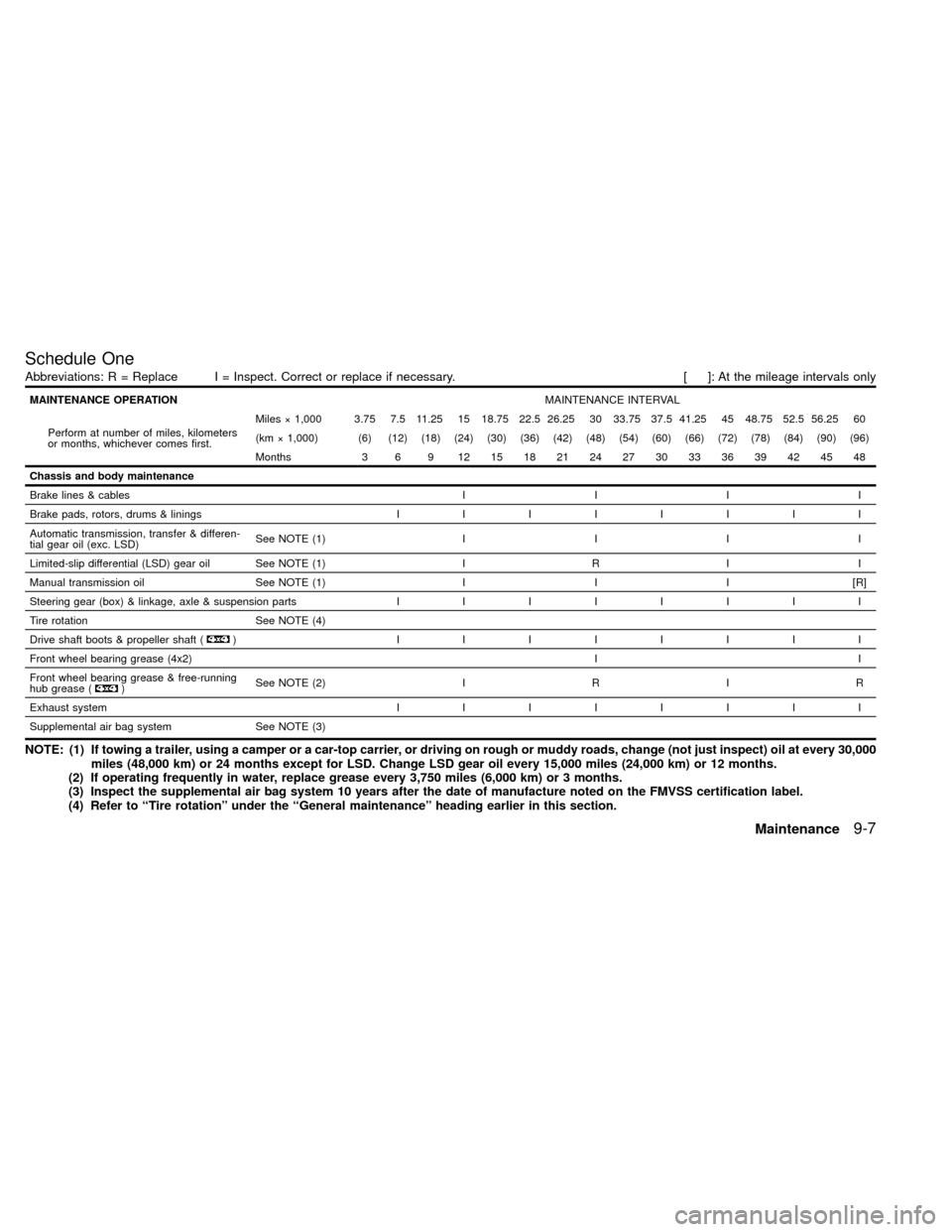
Schedule One
Abbreviations: R = Replace I = Inspect. Correct or replace if necessary. [ ]: At the mileage intervals only
MAINTENANCE OPERATIONMAINTENANCE INTERVAL
Perform at number of miles, kilometers
or months, whichever comes first.Miles ý 1,000 3.75 7.5 11.25 15 18.75 22.5 26.25 30 33.75 37.5 41.25 45 48.75 52.5 56.25 60
(km ý 1,000) (6) (12) (18) (24) (30) (36) (42) (48) (54) (60) (66) (72) (78) (84) (90) (96)
Months 3 6 9 12 15 18 21 24 27 30 33 36 39 42 45 48
Chassis and body maintenance
Brake lines & cablesIIII
Brake pads, rotors, drums & liningsIIIIIIII
Automatic transmission, transfer & differen-
tial gear oil (exc. LSD)See NOTE (1)IIII
Limited-slip differential (LSD) gear oil See NOTE (1) I R I I
Manual transmission oil See NOTE (1) I I I [R]
Steering gear (box) & linkage, axle & suspension partsIIIIIIII
Tire rotation See NOTE (4)
Drive shaft boots & propeller shaft (
) IIIIIIII
Front wheel bearing grease (4x2)II
Front wheel bearing grease & free-running
hub grease (
)See NOTE (2)IRIR
Exhaust systemIIIIIIII
Supplemental air bag system See NOTE (3)
NOTE: (1) If towing a trailer, using a camper or a car-top carrier, or driving on rough or muddy roads, change (not just inspect) oil at every 30,000
miles (48,000 km) or 24 months except for LSD. Change LSD gear oil every 15,000 miles (24,000 km) or 12 months.
(2) If operating frequently in water, replace grease every 3,750 miles (6,000 km) or 3 months.
(3) Inspect the supplemental air bag system 10 years after the date of manufacture noted on the FMVSS certification label.
(4) Refer to ``Tire rotation'' under the ``General maintenance'' heading earlier in this section.
Maintenance9-7
ZX
Page 222 of 263
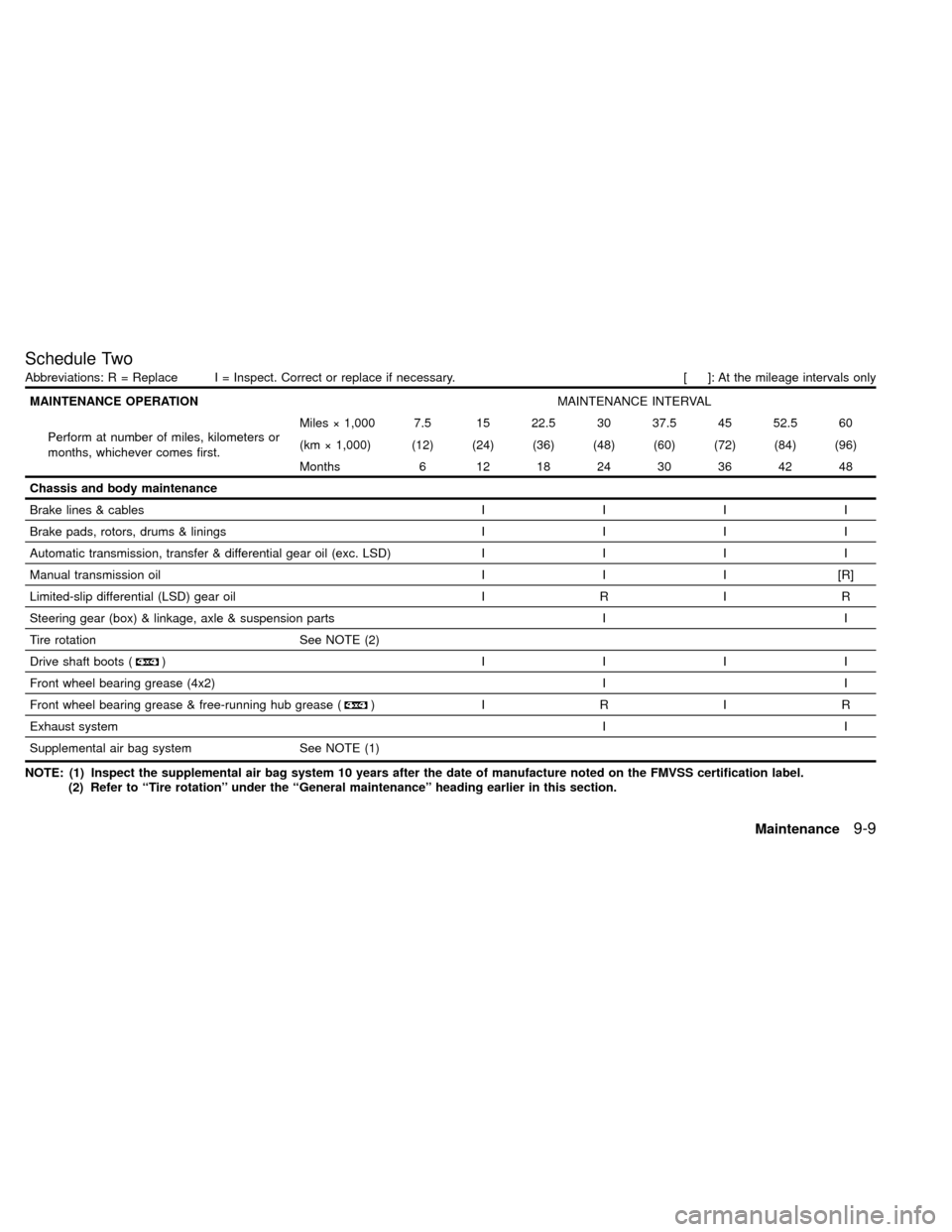
Schedule Two
Abbreviations: R = Replace I = Inspect. Correct or replace if necessary. [ ]: At the mileage intervals only
MAINTENANCE OPERATIONMAINTENANCE INTERVAL
Perform at number of miles, kilometers or
months, whichever comes first.Miles ý 1,000 7.5 15 22.5 30 37.5 45 52.5 60
(km ý 1,000) (12) (24) (36) (48) (60) (72) (84) (96)
Months 6 12 18 24 30 36 42 48
Chassis and body maintenance
Brake lines & cablesIIII
Brake pads, rotors, drums & liningsIIII
Automatic transmission, transfer & differential gear oil (exc. LSD)IIII
Manual transmission oil I I I [R]
Limited-slip differential (LSD) gear oil I R I R
Steering gear (box) & linkage, axle & suspension parts I I
Tire rotation See NOTE (2)
Drive shaft boots (
) IIII
Front wheel bearing grease (4x2) I I
Front wheel bearing grease & free-running hub grease (
)I R I R
Exhaust systemII
Supplemental air bag system See NOTE (1)
NOTE: (1) Inspect the supplemental air bag system 10 years after the date of manufacture noted on the FMVSS certification label.
(2) Refer to ``Tire rotation'' under the ``General maintenance'' heading earlier in this section.
Maintenance9-9
ZX
Page 249 of 263
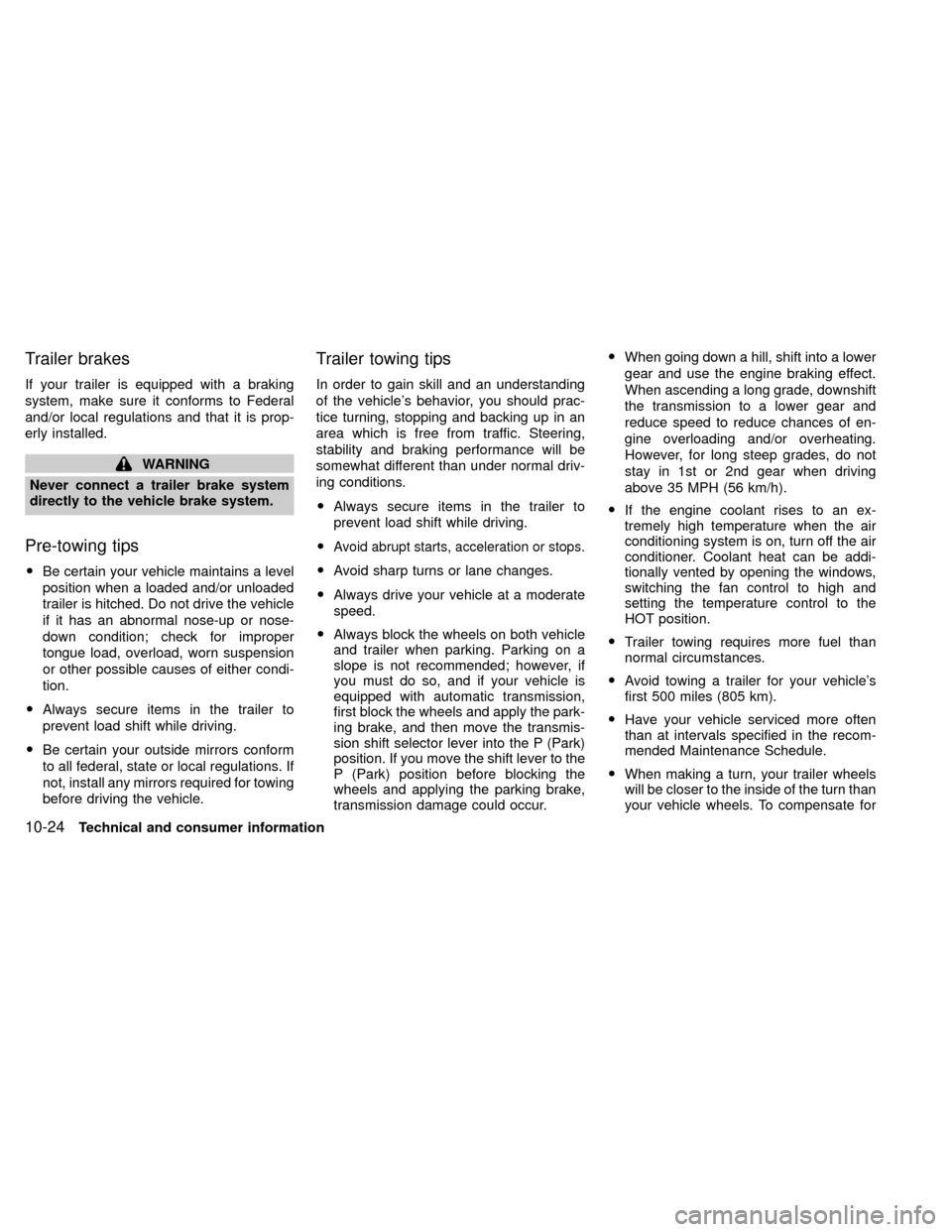
Trailer brakes
If your trailer is equipped with a braking
system, make sure it conforms to Federal
and/or local regulations and that it is prop-
erly installed.
WARNING
Never connect a trailer brake system
directly to the vehicle brake system.
Pre-towing tips
OBe certain your vehicle maintains a level
position when a loaded and/or unloaded
trailer is hitched. Do not drive the vehicle
if it has an abnormal nose-up or nose-
down condition; check for improper
tongue load, overload, worn suspension
or other possible causes of either condi-
tion.
OAlways secure items in the trailer to
prevent load shift while driving.
OBe certain your outside mirrors conform
to all federal, state or local regulations. If
not, install any mirrors required for towing
before driving the vehicle.
Trailer towing tips
In order to gain skill and an understanding
of the vehicle's behavior, you should prac-
tice turning, stopping and backing up in an
area which is free from traffic. Steering,
stability and braking performance will be
somewhat different than under normal driv-
ing conditions.
OAlways secure items in the trailer to
prevent load shift while driving.
O
Avoid abrupt starts, acceleration or stops.
OAvoid sharp turns or lane changes.
OAlways drive your vehicle at a moderate
speed.
OAlways block the wheels on both vehicle
and trailer when parking. Parking on a
slope is not recommended; however, if
you must do so, and if your vehicle is
equipped with automatic transmission,
first block the wheels and apply the park-
ing brake, and then move the transmis-
sion shift selector lever into the P (Park)
position. If you move the shift lever to the
P (Park) position before blocking the
wheels and applying the parking brake,
transmission damage could occur.OWhen going down a hill, shift into a lower
gear and use the engine braking effect.
When ascending a long grade, downshift
the transmission to a lower gear and
reduce speed to reduce chances of en-
gine overloading and/or overheating.
However, for long steep grades, do not
stay in 1st or 2nd gear when driving
above 35 MPH (56 km/h).
OIf the engine coolant rises to an ex-
tremely high temperature when the air
conditioning system is on, turn off the air
conditioner. Coolant heat can be addi-
tionally vented by opening the windows,
switching the fan control to high and
setting the temperature control to the
HOT position.
OTrailer towing requires more fuel than
normal circumstances.
OAvoid towing a trailer for your vehicle's
first 500 miles (805 km).
OHave your vehicle serviced more often
than at intervals specified in the recom-
mended Maintenance Schedule.
OWhen making a turn, your trailer wheels
will be closer to the inside of the turn than
your vehicle wheels. To compensate for
10-24Technical and consumer information
ZX
Page 250 of 263
this, make a larger than normal turning
radius during the turn.
OCrosswinds and rough roads adversely
affect vehicle/trailer handling, possibly
causing vehicle sway. When being
passed by larger vehicles, be prepared
for possible changes in crosswinds that
could affect vehicle handling. If swaying
does occur, firmly grip the steering
wheel, steer straight ahead, and immedi-
ately (but gradually) reduce vehicle
speed. This combination helps to stabi-
lize the vehicle. Never increase speed.
OBe careful when passing other vehicles.
Passing while towing a trailer requires
considerably more distance than normal
passing. Remember the length of the
trailer must also pass the other vehicle
before you can safely change lanes.
OTo maintain engine braking efficiency
and electrical charging performance, do
not use fifth gear (manual transmission)
or overdrive (automatic transmission).
OAvoid holding the brake pedal down too
long or too frequently. This could cause
the brakes to overheat, resulting in re-
duced braking efficiency.When towing a trailer, change oil in the
transmission more frequently. For addi-
tional information see the ``Mainte-
nance'' section earlier in this manual.DOT (Department of Transportation) Quality
Grades: All passenger car tires must con-
form to Federal Safety Requirements in
addition to these grades.
Quality grades can be found where appli-
cable on the tire sidewall between tread
shoulder and maximum section width. For
example:
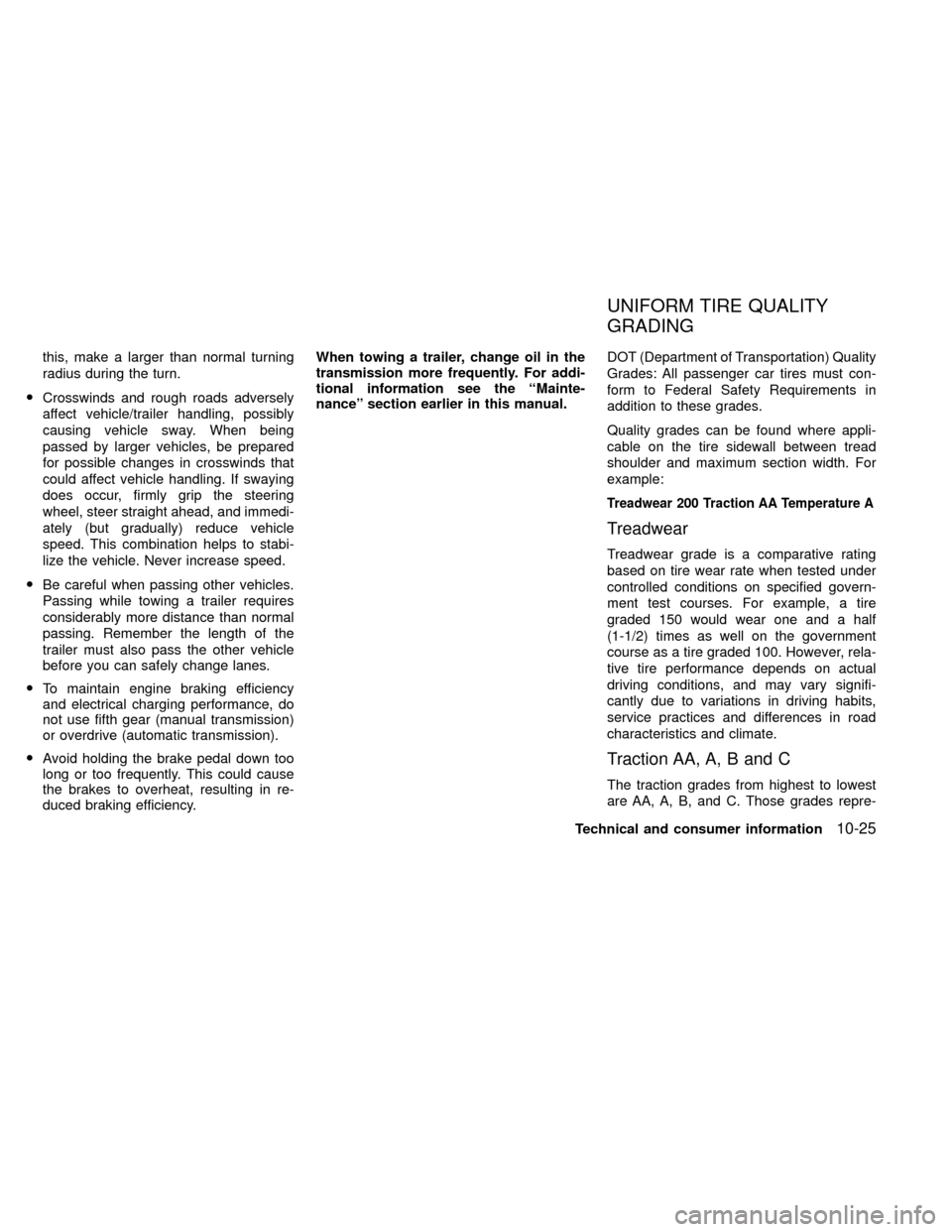
Treadwear 200 Traction AA Temperature A
Treadwear
Treadwear grade is a comparative rating
based on tire wear rate when tested under
controlled conditions on specified govern-
ment test courses. For example, a tire
graded 150 would wear one and a half
(1-1/2) times as well on the government
course as a tire graded 100. However, rela-
tive tire performance depends on actual
driving conditions, and may vary signifi-
cantly due to variations in driving habits,
service practices and differences in road
characteristics and climate.
Traction AA, A, B and C
The traction grades from highest to lowest
are AA, A, B, and C. Those grades repre-
UNIFORM TIRE QUALITY
GRADING
Technical and consumer information10-25
ZX
Page 260 of 263
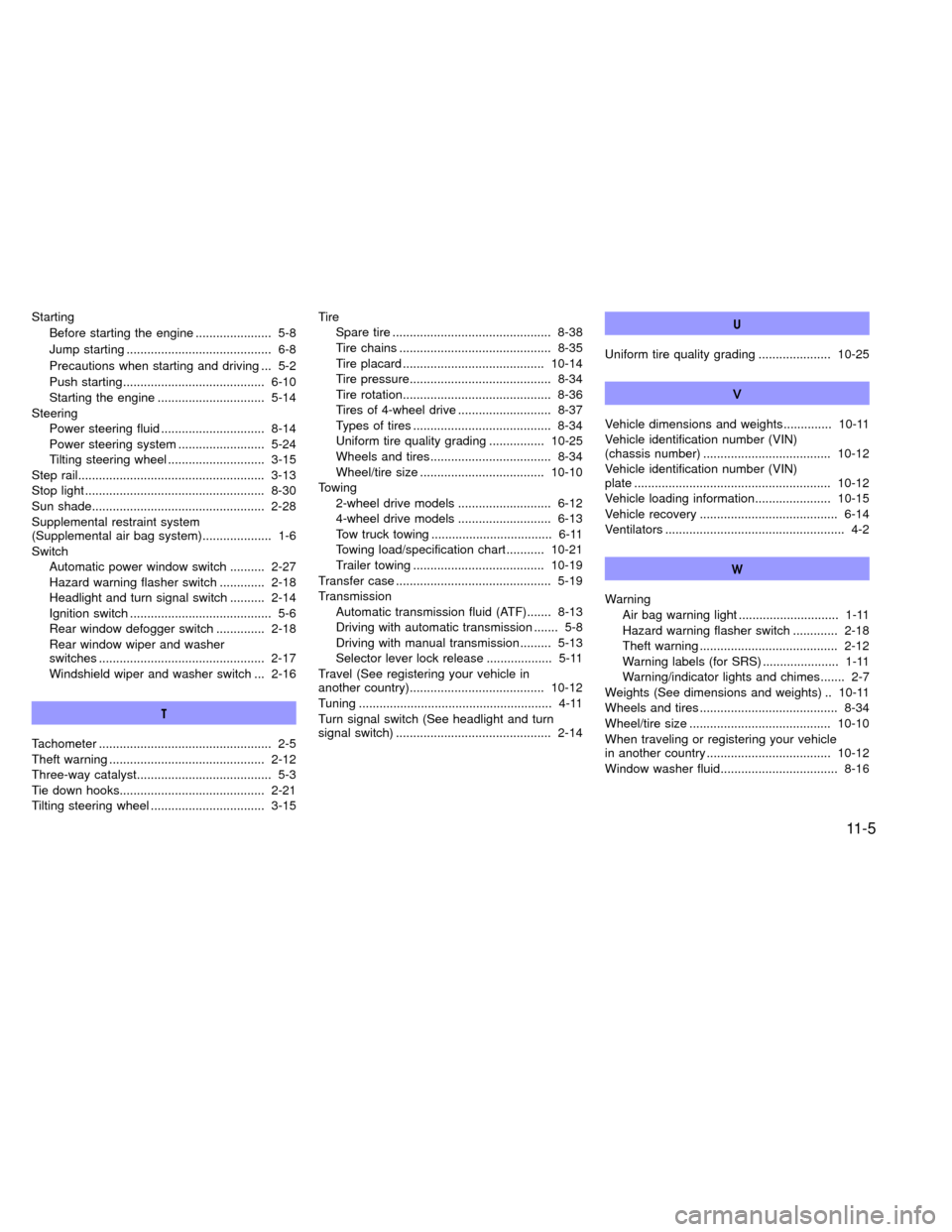
Starting
Before starting the engine ...................... 5-8
Jump starting .......................................... 6-8
Precautions when starting and driving ... 5-2
Push starting......................................... 6-10
Starting the engine ............................... 5-14
Steering
Power steering fluid .............................. 8-14
Power steering system ......................... 5-24
Tilting steering wheel ............................ 3-15
Step rail...................................................... 3-13
Stop light .................................................... 8-30
Sun shade.................................................. 2-28
Supplemental restraint system
(Supplemental air bag system).................... 1-6
Switch
Automatic power window switch .......... 2-27
Hazard warning flasher switch ............. 2-18
Headlight and turn signal switch .......... 2-14
Ignition switch ......................................... 5-6
Rear window defogger switch .............. 2-18
Rear window wiper and washer
switches ................................................ 2-17
Windshield wiper and washer switch ... 2-16
T
Tachometer .................................................. 2-5
Theft warning ............................................. 2-12
Three-way catalyst....................................... 5-3
Tie down hooks.......................................... 2-21
Tilting steering wheel ................................. 3-15Tire
Spare tire .............................................. 8-38
Tire chains ............................................ 8-35
Tire placard ......................................... 10-14
Tire pressure......................................... 8-34
Tire rotation........................................... 8-36
Tires of 4-wheel drive ........................... 8-37
Types of tires ........................................ 8-34
Uniform tire quality grading ................ 10-25
Wheels and tires................................... 8-34
Wheel/tire size .................................... 10-10
Towing
2-wheel drive models ........................... 6-12
4-wheel drive models ........................... 6-13
Tow truck towing ................................... 6-11
Towing load/specification chart ........... 10-21
Trailer towing ...................................... 10-19
Transfer case ............................................. 5-19
Transmission
Automatic transmission fluid (ATF)....... 8-13
Driving with automatic transmission ....... 5-8
Driving with manual transmission ......... 5-13
Selector lever lock release ................... 5-11
Travel (See registering your vehicle in
another country)....................................... 10-12
Tuning ........................................................ 4-11
Turn signal switch (See headlight and turn
signal switch) ............................................. 2-14U
Uniform tire quality grading ..................... 10-25
V
Vehicle dimensions and weights.............. 10-11
Vehicle identification number (VIN)
(chassis number) ..................................... 10-12
Vehicle identification number (VIN)
plate ......................................................... 10-12
Vehicle loading information...................... 10-15
Vehicle recovery ........................................ 6-14
Ventilators .................................................... 4-2
W
Warning
Air bag warning light ............................. 1-11
Hazard warning flasher switch ............. 2-18
Theft warning ........................................ 2-12
Warning labels (for SRS) ...................... 1-11
Warning/indicator lights and chimes....... 2-7
Weights (See dimensions and weights) .. 10-11
Wheels and tires ........................................ 8-34
Wheel/tire size ......................................... 10-10
When traveling or registering your vehicle
in another country .................................... 10-12
Window washer fluid.................................. 8-16
11-5
ZX