2000 NISSAN XTERRA engine overheat
[x] Cancel search: engine overheatPage 178 of 263
The engine cooling system is filled at the
factory with a high-quality, year-round,
genuine NISSAN anti-freeze coolant solu-
tion. The anti-freeze solution contains rust
and corrosion inhibitors, therefore additional
engine cooling system additives are not
necessary.
CAUTION
When adding or replacing coolant, be
sure to use only an ethylene glycol
anti-freeze with the proper mixture ratio
of 50% Genuine Nissan Anti-freeze
coolant or equivalent and 50% dem-
ineralized or distilled water. The use of
other types of coolant solutions may
damage the engine cooling system.
Outside tempera-
ture down toGenuine
Nissan
Anti-
freeze
coolant or
equivalentDeminer-
alized
water or
Distilled
water ÉC ÉF
þ35 þ30 50% 50%
WARNING
ONever remove the radiator cap when
the engine is hot. Wait until the en-
gine and radiator cool down. Serious
burns could be caused by high pres-
sure fluid escaping from the radiator.
See precautions in ``If your vehicle
overheats'' found in the ``In case of
emergency'' section of this manual.
OThe radiator is equipped with a pres-
sure type radiator cap. To prevent
engine damage, use only a genuine
NISSAN radiator cap.
CHECKING ENGINE COOLANT
LEVEL
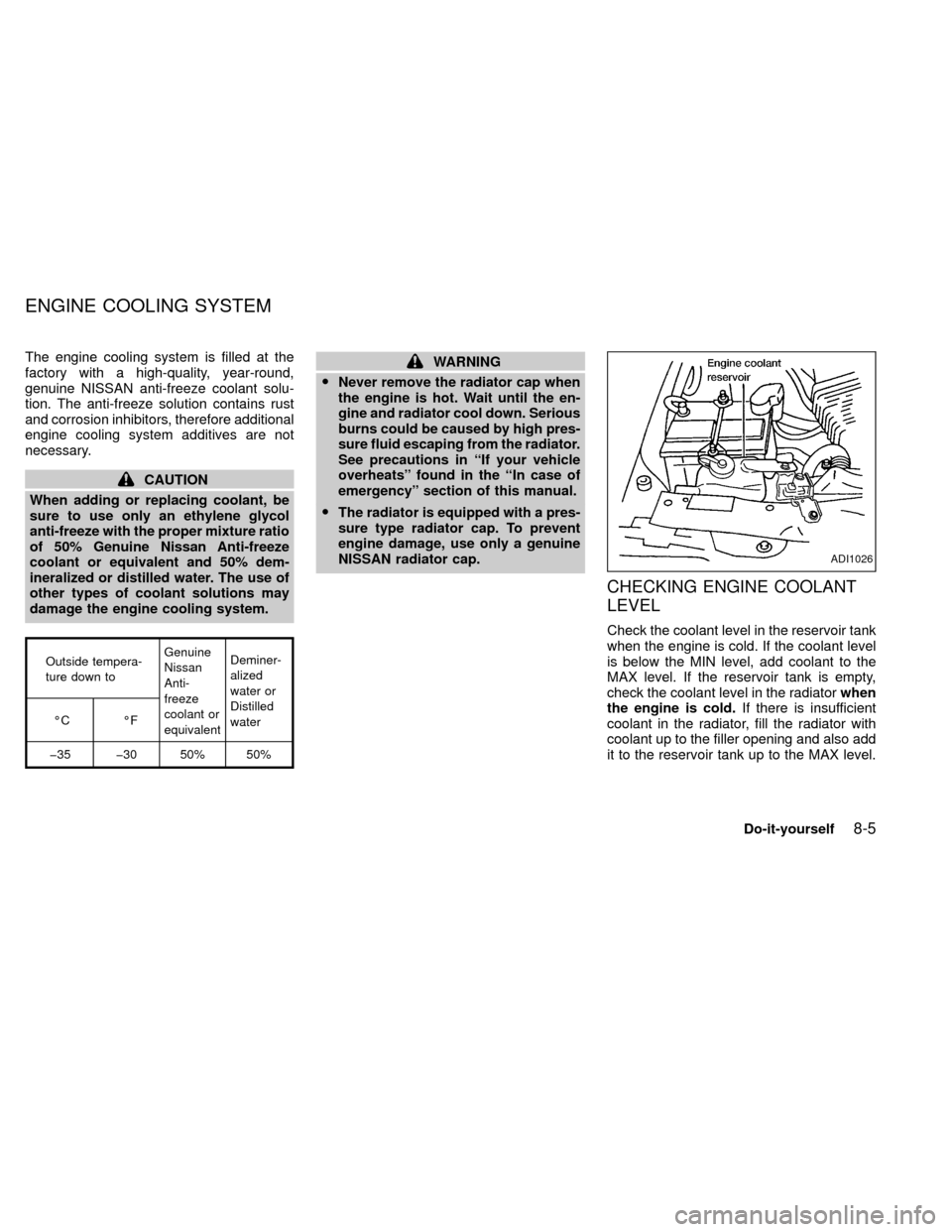
Check the coolant level in the reservoir tank
when the engine is cold. If the coolant level
is below the MIN level, add coolant to the
MAX level. If the reservoir tank is empty,
check the coolant level in the radiatorwhen
the engine is cold.If there is insufficient
coolant in the radiator, fill the radiator with
coolant up to the filler opening and also add
it to the reservoir tank up to the MAX level.
ADI1026
ENGINE COOLING SYSTEM
Do-it-yourself8-5
ZX
Page 181 of 263

8. Start the engine and warm it up until it
reaches normal operating temperature.
Then race the engine two or three times
under no load. Watch the engine coolant
temperature gauge for signs of overheat-
ing.9. Stop the engine. After it completely cools
down, refill the radiator up to the filler
opening. Fill the reservoir tank up the
MAX level.10. Open and close the air release plug to
release air. Then fill the radiator again
and install the radiator cap.
ADI1055ADI1056ADI1057
8-8Do-it-yourself
ZX
Page 230 of 263

ever, you may use unleaded gasoline with
an octane rating as low as 85 AKI in high
altitude areas (over 4,000 ft [1,219 m]) such
as: Colorado, Montana, New Mexico, Utah,
Wyoming, northeastern Nevada, southern
Idaho, western South Dakota, western Ne-
braska, and the part of Texas which is
directly south of New Mexico.
Using unleaded gasoline with an octane
rating lower than stated above can cause
persistent, heavy ``spark knock.'' (``Spark
knock'' is a metallic rapping noise.) If
severe, this can lead to engine damage. If
you detect a persistent heavy spark
knock even when using gasoline of the
stated octane rating, or if you hear steady
spark knock while holding a steady speed
on level roads, have an authorized NIS-
SAN dealer correct the condition. Failure
to correct the condition is misuse of the
vehicle, for which NISSAN is not respon-
sible.
Incorrect ignition timing may result in spark
knock, after-run and/or overheating, which
may cause excessive fuel consumption or
engine damage. If any of the above symp-
toms are encountered, have your vehicle
checked at an authorized NISSAN dealer.However, now and then you may notice
light spark knock for a short time while
accelerating or driving up hills. This is
no cause for concern, because you get
the greatest fuel benefit when there is
light spark knock for a short time under
heavy engine load.
Technical and consumer information
10-5
ZX
Page 249 of 263
Trailer brakes
If your trailer is equipped with a braking
system, make sure it conforms to Federal
and/or local regulations and that it is prop-
erly installed.
WARNING
Never connect a trailer brake system
directly to the vehicle brake system.
Pre-towing tips
OBe certain your vehicle maintains a level
position when a loaded and/or unloaded
trailer is hitched. Do not drive the vehicle
if it has an abnormal nose-up or nose-
down condition; check for improper
tongue load, overload, worn suspension
or other possible causes of either condi-
tion.
OAlways secure items in the trailer to
prevent load shift while driving.
OBe certain your outside mirrors conform
to all federal, state or local regulations. If
not, install any mirrors required for towing
before driving the vehicle.
Trailer towing tips
In order to gain skill and an understanding
of the vehicle's behavior, you should prac-
tice turning, stopping and backing up in an
area which is free from traffic. Steering,
stability and braking performance will be
somewhat different than under normal driv-
ing conditions.
OAlways secure items in the trailer to
prevent load shift while driving.
O
Avoid abrupt starts, acceleration or stops.
OAvoid sharp turns or lane changes.
OAlways drive your vehicle at a moderate
speed.
OAlways block the wheels on both vehicle
and trailer when parking. Parking on a
slope is not recommended; however, if
you must do so, and if your vehicle is
equipped with automatic transmission,
first block the wheels and apply the park-
ing brake, and then move the transmis-
sion shift selector lever into the P (Park)
position. If you move the shift lever to the
P (Park) position before blocking the
wheels and applying the parking brake,
transmission damage could occur.OWhen going down a hill, shift into a lower
gear and use the engine braking effect.
When ascending a long grade, downshift
the transmission to a lower gear and
reduce speed to reduce chances of en-
gine overloading and/or overheating.
However, for long steep grades, do not
stay in 1st or 2nd gear when driving
above 35 MPH (56 km/h).
OIf the engine coolant rises to an ex-
tremely high temperature when the air
conditioning system is on, turn off the air
conditioner. Coolant heat can be addi-
tionally vented by opening the windows,
switching the fan control to high and
setting the temperature control to the
HOT position.
OTrailer towing requires more fuel than
normal circumstances.
OAvoid towing a trailer for your vehicle's
first 500 miles (805 km).
OHave your vehicle serviced more often
than at intervals specified in the recom-
mended Maintenance Schedule.
OWhen making a turn, your trailer wheels
will be closer to the inside of the turn than
your vehicle wheels. To compensate for
10-24Technical and consumer information
ZX
Page 250 of 263
this, make a larger than normal turning
radius during the turn.
OCrosswinds and rough roads adversely
affect vehicle/trailer handling, possibly
causing vehicle sway. When being
passed by larger vehicles, be prepared
for possible changes in crosswinds that
could affect vehicle handling. If swaying
does occur, firmly grip the steering
wheel, steer straight ahead, and immedi-
ately (but gradually) reduce vehicle
speed. This combination helps to stabi-
lize the vehicle. Never increase speed.
OBe careful when passing other vehicles.
Passing while towing a trailer requires
considerably more distance than normal
passing. Remember the length of the
trailer must also pass the other vehicle
before you can safely change lanes.
OTo maintain engine braking efficiency
and electrical charging performance, do
not use fifth gear (manual transmission)
or overdrive (automatic transmission).
OAvoid holding the brake pedal down too
long or too frequently. This could cause
the brakes to overheat, resulting in re-
duced braking efficiency.When towing a trailer, change oil in the
transmission more frequently. For addi-
tional information see the ``Mainte-
nance'' section earlier in this manual.DOT (Department of Transportation) Quality
Grades: All passenger car tires must con-
form to Federal Safety Requirements in
addition to these grades.
Quality grades can be found where appli-
cable on the tire sidewall between tread
shoulder and maximum section width. For
example:
Treadwear 200 Traction AA Temperature A
Treadwear
Treadwear grade is a comparative rating
based on tire wear rate when tested under
controlled conditions on specified govern-
ment test courses. For example, a tire
graded 150 would wear one and a half
(1-1/2) times as well on the government
course as a tire graded 100. However, rela-
tive tire performance depends on actual
driving conditions, and may vary signifi-
cantly due to variations in driving habits,
service practices and differences in road
characteristics and climate.
Traction AA, A, B and C
The traction grades from highest to lowest
are AA, A, B, and C. Those grades repre-
UNIFORM TIRE QUALITY
GRADING
Technical and consumer information10-25
ZX
Page 259 of 263

O
Octane rating (See fuel octane rating) ...... 10-4
Odometer ..................................................... 2-3
Oil
Capacities and recommended fuel/
lubricants .............................................. 10-2
Changing engine oil.............................. 8-10
Changing engine oil filter...................... 8-12
Checking engine oil level ....................... 8-9
Engine oil ................................................ 8-9
Engine oil and oil filter
recommendation ................................... 10-6
Engine oil viscosity ............................... 10-7
Outside mirror control ................................ 3-15
Outside mirrors .......................................... 3-16
Overheat
If your vehicle overheats ...................... 6-10
Owner's manual order form ..................... 10-29
P
Pantograph type jack ................................... 6-6
Parking
Parking brake check ............................. 8-24
Parking brake operation ....................... 5-15
Parking/parking on hills ........................ 5-23
Periodic maintenance schedules ................. 9-5
Power
Power door locks .................................... 3-3
Power steering fluid .............................. 8-14Power steering system ......................... 5-24
Power windows..................................... 2-25
Precautions
Maintenance precautions ....................... 8-2
On-pavement and off-road driving
precautions ............................................. 5-3
Precautions on seat belt usage............ 1-13
Precautions when starting and driving ... 5-2
Push starting .............................................. 6-10
R
Radio
AM-FM radio with cassette player ........ 4-10
AM-FM radio with cassette player and
compact disc player.............................. 4-28
AM-FM radio with compact disc (CD)
player .................................................... 4-22
CB radio or car phone .......................... 4-36
FM-AM radio with compact disc (CD)
player .................................................... 4-15
Readiness for inspection maintenance
(I/M) test................................................... 10-27
Rear anti-lock brake warning light ............. 2-10
Rear door lock ........................................... 3-10
Rear seat ..................................................... 1-4
Rear window defogger switch ................... 2-18
Rear window wiper and washer
switches ..................................................... 2-17
Registering your vehicle in another
country ..................................................... 10-12Remote keyless entry system
(See multi-remote control system) .............. 3-4
Reporting safety defects (USA) ............... 10-27
Roof rack with gear basket ........................ 3-11
S
Safety
Child safety rear door lock ..................... 3-4
Reporting safety defects (USA) .......... 10-27
Seat belt
Precautions on seat belt usage............ 1-13
Seat belt extenders .............................. 1-21
Seat belt maintenance.......................... 1-21
Seat belts.............................................. 1-13
Three-point type with retractor ............. 1-16
Two-point type without retractor
(rear center lap belt) ............................. 1-19
Seat belt warning light ................................. 2-8
Seats
Adjustment .............................................. 1-2
Rear seat ................................................ 1-4
Separate seats ....................................... 1-2
Service manual order form ...................... 10-29
Shifting
Manual transmission............................. 5-13
Skyroof ....................................................... 2-27
Spark plug replacement............................. 8-19
Speedometer ............................................... 2-3
Spotlights (See map light) ......................... 2-24
SRS warning label ..................................... 1-11
11-4
ZX
Page 262 of 263

Recommended fuel:
Unleaded gasoline, at least 87 AKI number
(RON 91)
For further details such as gasohol or diesel
fuel grade, see ``Fuel recommendation'' in
the ``Technical and consumer information''
section.
Recommended engine oil:
OAPI Certification Mark
OAPI grade SG/SH Energy Conserving I &
II or API grade SJ, Energy Conserving
OILSAC grade GF-I & GF-II
See9Engine oil and filter recommendatio-
n9in the ``Technical and consumer informa-
tion'' section.
Tire cold pressure:
See the tire placard affixed to the inside of
the glove box lid.
Recommended new vehicle
break-in procedure:
During the first 1,000 miles (1,600 km) of
vehicle use, follow the recommendations
outlined in the ``BREAK-IN SCHEDULE''found in the ``Starting and Driving'' section of
this Owner's Manual. Follow these recom-
mendations for the future reliability and
economy of your new vehicle. Failure to
follow these recommendations may result in
vehicle damage or shortened engine life.(page)
OIn case of emergency ...................... 6-1
(Flat tire, engine will not start, overheat-
ing, towing)
OHow to start the engine ................... 5-1
OHow to read the meters and
gauges ............................................. 2-1
OMaintenance schedule ..................... 9-1
ODo-it-yourself operations.................. 8-1
OTechnical and consumer
information ..................................... 10-1
GAS STATION INFORMATION QUICK REFERENCE
ZX