2000 NISSAN SENTRA ECU
[x] Cancel search: ECUPage 225 of 240
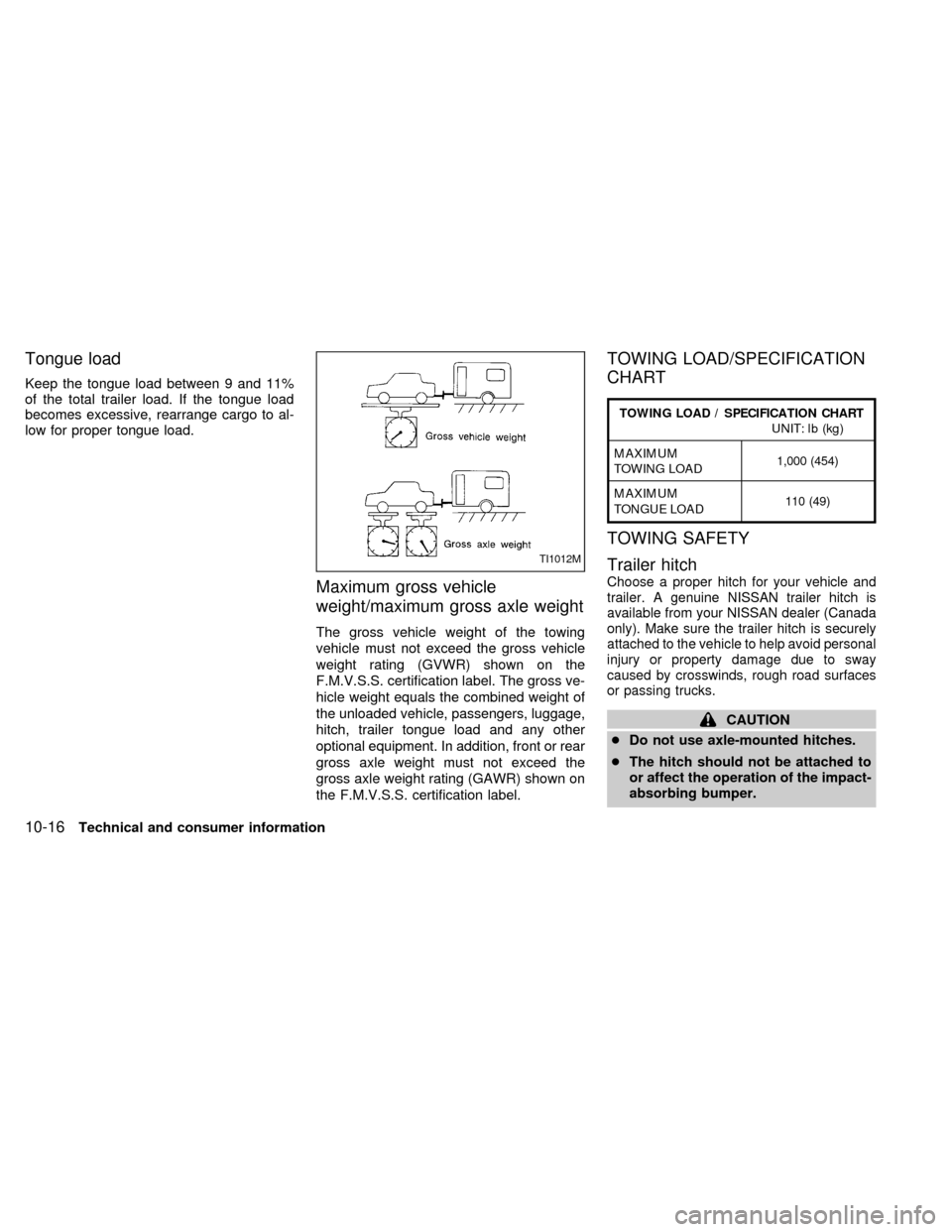
Tongue load
Keep the tongue load between 9 and 11%
of the total trailer load. If the tongue load
becomes excessive, rearrange cargo to al-
low for proper tongue load.
Maximum gross vehicle
weight/maximum gross axle weight
The gross vehicle weight of the towing
vehicle must not exceed the gross vehicle
weight rating (GVWR) shown on the
F.M.V.S.S. certification label. The gross ve-
hicle weight equals the combined weight of
the unloaded vehicle, passengers, luggage,
hitch, trailer tongue load and any other
optional equipment. In addition, front or rear
gross axle weight must not exceed the
gross axle weight rating (GAWR) shown on
the F.M.V.S.S. certification label.
TOWING LOAD/SPECIFICATION
CHART
TOWING LOAD / SPECIFICATION CHART
UNIT: lb (kg)
MAXIMUM
TOWING LOAD1,000 (454)
MAXIMUM
TONGUE LOAD110 (49)
TOWING SAFETY
Trailer hitch
Choose a proper hitch for your vehicle and
trailer. A genuine NISSAN trailer hitch is
available from your NISSAN dealer (Canada
only). Make sure the trailer hitch is securely
attached to the vehicle to help avoid personal
injury or property damage due to sway
caused by crosswinds, rough road surfaces
or passing trucks.
CAUTION
cDo not use axle-mounted hitches.
cThe hitch should not be attached to
or affect the operation of the impact-
absorbing bumper.
TI1012M
10-16Technical and consumer information
ZX
Page 226 of 240
cDo not modify the vehicle exhaust
system, brake system, etc. to install
a trailer hitch.
cTo reduce the possibility of addi-
tional damage if your vehicle is
struck from the rear, where practical,
remove the hitch and/or receiver
when not in use.
cAfter the hitch is removed, seal the
bolt holes to prevent exhaust fumes,
water or dust from entering the pas-
senger compartment.
cRegularly check that all hitch mount-
ing bolts are securely mounted.
Tire pressures
cWhen towing a trailer, inflate the vehicle
tires to the recommended cold tire pres-
sure indicated on the tire placard (lo-
cated on the driver's side rear door
pillar).
cTrailer tire condition, size, load rating
and proper inflation pressure should be
in accordance with the trailer and tire
manufacturers' specifications.
Safety chains
Always use suitable safety chains between
your vehicle and the trailer. Safety chains
should be crossed and should be attached
to the hitch, not to the vehicle bumper or
axle. Be sure to leave enough slack in the
chains to permit turning corners.
Trailer lights
Trailer lights should comply with federal
and/ or local regulations. When wiring the
vehicle for towing, connect the stop and tail
light pickup into the vehicle electrical circuit.
Trailer brakes
If your trailer is equipped with a braking
system, make sure it conforms to federal
and/or local regulations and that it is prop-
erly installed.
WARNING
Never connect a trailer brake system
directly to the vehicle brake system.
Pre-towing tips
cBe certain your vehicle maintains a level
position when a loaded and/or unloadedtrailer is hitched. Do not drive the vehicle if
it has an abnormal nose-up or nose- down
condition; check for improper tongue load,
overload, worn suspension or other pos-
sible causes of either condition.
cAlways secure items in the trailer to
prevent load shift while driving.
cBe certain your rear view mirrors con-
form to all federal, state or local regula-
tions. If not, install any mirrors required
for towing before driving the vehicle.
Trailer towing tips
In order to gain skill and an understanding
of the vehicle's behavior, you should prac-
tice turning, stopping and backing up in an
area which is free from traffic. Steering,
stability, and braking performance are
somewhat different than under normal driv-
ing conditions.
cAlways secure items in the trailer to
prevent load shift while driving.
c
Avoid abrupt starts, acceleration or stops.
cAvoid sharp turns or lane changes.
cAlways drive your vehicle at a moderate
speed.
c
Always block the wheels on both vehicle
and trailer when parking. Parking on a
Technical and consumer information10-17
ZX
Page 230 of 240

2. Accelerate the vehicle to 55 mph (88
km/h), then quickly release the accelera-
tor pedal completely and keep it released
for at least 6 seconds.
3. Quickly depress the accelerator pedal for
a moment, then drive the vehicle at a
speed of 53 to 60 mph (86 to 96 km/h) for
at least 5 minutes.
4. Stop the vehicle.
5. Accelerate the vehicle to 35 mph (55
km/h) and maintain the speed for 20
seconds.
6. Repeat steps four through five at least
three times.
7. Accelerate the vehicle to 55 mph (88
km/h) and maintain the speed for at least
3 minutes.
8. Stop the vehicle [shift selector lever in
the P (Park) or N (Neutral) position].
9. Rev the engine up between 2,500 and
3,500 rpm and hold it for 3 consecutive
minutes, then release the accelerator
pedal completely.
10. Wait 5 seconds at idle.
11. Rev the engine up between 2,000 and3,000 rpm and maintain it for 5 consecu-
tive minutes.
12. Stop the vehicle and turn the engine off.
13. Repeat steps one through twelve at
least one more time.
If step one through seven is interrupted,
repeat the preceding step. Any safe driving
mode is acceptable between steps. Do not
stop the engine until step seven is com-
pleted.
Technical and consumer information
10-21
ZX
Page 237 of 240

N
Nissan vehicle immobilizer system
(NVIS) ......................................... 2-11, 3-2, 5-6
O
Octane rating (See fuel octane rating) ...... 10-3
Odometer ..................................................... 2-3
Oil
Capacities and recommended fuel/
lubricants .............................................. 10-2
Changing engine oil.............................. 8-10
Changing engine oil filter...................... 8-12
Checking engine oil level ....................... 8-9
Engine oil ................................................ 8-9
Engine oil and oil filter
recommendation ................................... 10-5
Engine oil viscosity ............................... 10-5
Opener lever for trunk lid........................... 3-10
Outside mirror control ................................ 3-15
Overdrive switch ........................................ 5-10
Overheat
If your vehicle overheats ...................... 6-10
Owner's manual order form ..................... 10-22
Owner's manual/service manual order
information ............................................... 10-22P
Parking
Parking brake check ............................. 8-23
Parking brake operation ....................... 5-13
Parking/parking on hills ........................ 5-17
Periodic maintenance schedules ................. 9-5
Power
Power door locks .................................... 3-4
Power socket ........................................ 2-19
Power steering fluid .............................. 8-15
Power steering system ......................... 5-18
Power windows..................................... 2-25
Rear power windows ............................ 2-26
Precautions
Maintenance precautions ....................... 8-2
Precautions on seat belt usage............ 1-18
Precautions when starting and driving ... 5-2
Push starting .............................................. 6-10
R
Radio
Car phone or CB radio ......................... 4-23
Compact Disc (CD) changer ................ 4-20
FM-AM radio with cassette player ........ 4-10
FM-AM radio with compact disc (CD)
player .................................................... 4-15
Readiness for inspection maintenance
(I/M) test................................................... 10-20
Rear power windows ................................. 2-26Rear window defogger switch ................... 2-16
Refrigerant recommendation ..................... 10-7
Registering your vehicle in another
country ..................................................... 10-10
Remote keyless entry system
(See multi-remote control system) .............. 3-5
Reporting safety defects (USA) ............... 10-20
S
Safety
Child safety rear door lock ..................... 3-4
Reporting safety defects (USA) .......... 10-20
Seat adjustment
Front manual seat adjustment................ 1-2
Rear seat adjustment ............................. 1-4
Seat belt
Precautions on seat belt usage............ 1-18
Seat belt extenders .............................. 1-24
Seat belt maintenance.......................... 1-24
Seat belts.............................................. 1-18
Shoulder belt height adjustment ........... 1-24
Three-point type with retractor ............. 1-21
Seat belt warning light ................................. 2-8
Seats
Front seats.............................................. 1-2
Security systems (see theft warning) ........ 2-11
Self-adjusting brakes ................................. 8-23
Service manual order form ...................... 10-22
Servicing air conditioner .............................. 4-9
Shift lock release ....................................... 5-10
11-4
ZX