2000 NISSAN SENTRA service
[x] Cancel search: servicePage 204 of 240

To ensure smooth, trouble-free, safe and
economical driving, NISSAN provides two
periodic maintenance schedules that may be
used, depending upon the conditions in
which you usually drive. These schedules
contain both distance and time intervals, up
to 60,000 miles (96,000 km)/48 months. For
most people, the odometer reading indicates
when service is needed. However, if you
drive very little, your vehicle should be ser-
viced at the regular time intervals shown in
the schedules.After 60,000 miles (96,000
km)/48 months, continue periodic mainte-
nance at the same mileage/time intervals.
SCHEDULE ONE
Follow Periodic Maintenance Schedule One
if your driving habits frequently include one
or more of the following driving conditions:
cRepeated short trips of less than 5
miles (8 km).
cRepeated short trips of less than 10
miles (16 km) with outside tempera-
tures below freezing.
cOperating the vehicle in hot weather
during stop-and-go ``rush hour'' traf-
fic.cExtensive idling and/or low speed
driving for long distances, such as
police, taxi or door-to-door delivery
use.
cDriving in dusty conditions.
cDriving on rough, muddy, or salt
spread roads.
cTowing a trailer, using a camper or a
car-top carrier.
SCHEDULE TWO
Follow Periodic Maintenance Schedule Two
if none of the driving conditions shown in
Schedule One apply to your driving habits.
PERIODIC MAINTENANCE
SCHEDULES
Maintenance9-5
ZX
Page 210 of 240

10 Technical and consumer information
Capacities and recommended fuel/lubricants ......10-2
Fuel recommendation...........................................10-3
Engine oil and oil filter recommendation..............10-5
Recommended SAE viscosity number.................10-7
Air conditioner system refrigerant and
lubricant recommendations ..................................10-7
Specifications .......................................................10-8
Engine ..................................................................10-8
Wheels and tires ..................................................10-9
Dimensions and weights ......................................10-9
When traveling or registering your vehicle in
another country ..................................................10-10
Vehicle identification ..........................................10-10
Vehicle identification number (VIN) plate...........10-10
Vehicle identification number
(chassis number) ................................................10-10
Engine serial number .........................................10-11
F.M.V.S.S. certification label ..............................10-11
Emission control information label .....................10-12Tire placard ........................................................10-12
Air conditioner specification label.......................10-12
Installing front license plate................................10-13
Vehicle loading information ................................10-14
Terms .................................................................10-14
Determining vehicle load capacity .....................10-14
Loading tips ........................................................10-14
Trailer towing ......................................................10-15
Maximum load limits...........................................10-15
Towing load/specification chart ..........................10-16
Towing safety .....................................................10-16
Uniform tire quality grading ................................10-19
Emission control system warranty .....................10-20
Reporting safety defects (US only) ....................10-20
Readiness for inspection/maintenance (I/M)
test (US only) .....................................................10-20
Owner's manual/service manual order
information ..........................................................10-22
ZX
Page 212 of 240
FUEL RECOMMENDATION
Your vehicle is designed to operate on
unleaded gasoline with an octane rating
of at least 87 AKI (Anti-Knock Index)
(Research octane number 91).
CAUTION
cUsing a fuel other than that specified
could adversely affect the emission
control system, and may also affect
the warranty coverage.
cUnder no circumstances should a
leaded gasoline be used since this
will damage the three way catalyst.
Reformulated Gasoline
Some fuel suppliers are now producing re-
formulated gasolines. These gasolines are
specially designed to reduce vehicle emis-
sions. NISSAN supports efforts towards
cleaner air and suggests that you use refor-
mulated gasoline when available.
Gasoline containing oxygenates
Some fuel suppliers sell gasoline containing
oxygenates such as ethanol, MTBE and
methanol with or without advertising theirpresence. NISSAN does not recommend
the use of fuels of which the oxygenate
content and the fuel compatibility for your
NISSAN cannot be readily determined. If in
doubt, ask your service station manager.
If you use oxygenate-blend gasoline, please
take the following precautions as the usage
of such fuels may cause vehicle performance
problems and/or fuel system damage.
cThe fuel should be unleaded and
have an octane rating no lower than
that recommended for unleaded
gasoline.
cIf an oxygenate-blend other than a
methanol blend is used, it should
contain no more than 10% oxygenate.
(MTBE may, however, be added up to
15%.)
cIf a methanol blend is used, it should
contain no more than 5% methanol
(methyl alcohol, wood alcohol). It
should also contain a suitable
amount of appropriate cosolvents
and corrosion inhibitors. If not prop-
erly formulated with appropriate co-
solvents and corrosion inhibitors,
such methanol blends may causefuel system damage and/or vehicle
performance problems. At this time,
sufficient data is not available to en-
sure that all methanol blends are suit-
able for use in NISSAN vehicles.
If any driveability problems such as engine
stalling and hard hot-starting are experi-
enced after using oxygenate-blend fuels,
immediately change to a non-oxygenate
fuel or a fuel with a low blend of MTBE.
Take care not to spill gasoline during
refueling. Gasoline containing oxygen-
ates can cause paint damage.
Aftermarket Fuel Additives
NISSAN does not recommend the use of
any fuel additives (i.e., fuel injector cleaners,
octane boosters, intake valve deposit re-
movers, etc.) which are sold commercially.
Many of these additives intended for gum,
varnish or deposit removal may contain ac-
tive solvents or similar ingredients that can
be harmful to the fuel system and engine.
Octane rating tips
In most parts of North America, you should
use unleaded gasoline with an octane rating
Technical and consumer information
10-3
ZX
Page 213 of 240
![NISSAN SENTRA 2000 B15 / 5.G Owners Manual of at least 87 AKI (Anti-Knock Index). How-
ever, you may use unleaded gasoline with
an octane rating as low as 85 AKI (Anti-
Knock Index) in high altitude areas (over
4,000 ft [1,219 m]) such as: Col](/manual-img/5/642/w960_642-212.png "NISSAN SENTRA 2000 B15 / 5.G Owners Manual of at least 87 AKI (Anti-Knock Index). How-
ever, you may use unleaded gasoline with
an octane rating as low as 85 AKI (Anti-
Knock Index) in high altitude areas (over
4,000 ft [1,219 m]) such as: Col")
of at least 87 AKI (Anti-Knock Index). How-
ever, you may use unleaded gasoline with
an octane rating as low as 85 AKI (Anti-
Knock Index) in high altitude areas (over
4,000 ft [1,219 m]) such as: Colorado, Mon-
tana, New Mexico, Utah, Wyoming, north-
eastern Nevada, southern Idaho, western
South Dakota, western Nebraska, and the
part of Texas which is directly south of New
Mexico.
Using unleaded gasoline with an octane
rating lower than stated above can cause
persistent, heavy ``spark knock.'' (``Spark
knock'' is a metallic rapping noise.) If
severe, this can lead to engine damage. If
you detect a persistent heavy spark
knock even when using gasoline of the
stated octane rating, or if you hear steady
spark knock while holding a steady
speed on level roads, have an authorized
NISSAN dealer correct the condition.
Failure to correct the condition is misuse
of the vehicle, for which NISSAN is not
responsible.
Incorrect ignition timing may result in spark
knock, after-run and/or overheating, which
may cause excessive fuel consumption or
engine damage. If any of the above symp-toms are encountered, have your vehicle
checked at an authorized NISSAN dealer or
other competent service facility.
However, now and then you may notice
light spark knock for a short time while
accelerating or driving up hills. This is
not a cause for concern, because you
get the greatest fuel benefit when there
is light spark knock for a short time
under heavy engine load.
10-4Technical and consumer information
ZX
Page 216 of 240
RECOMMENDED SAE
VISCOSITY NUMBER
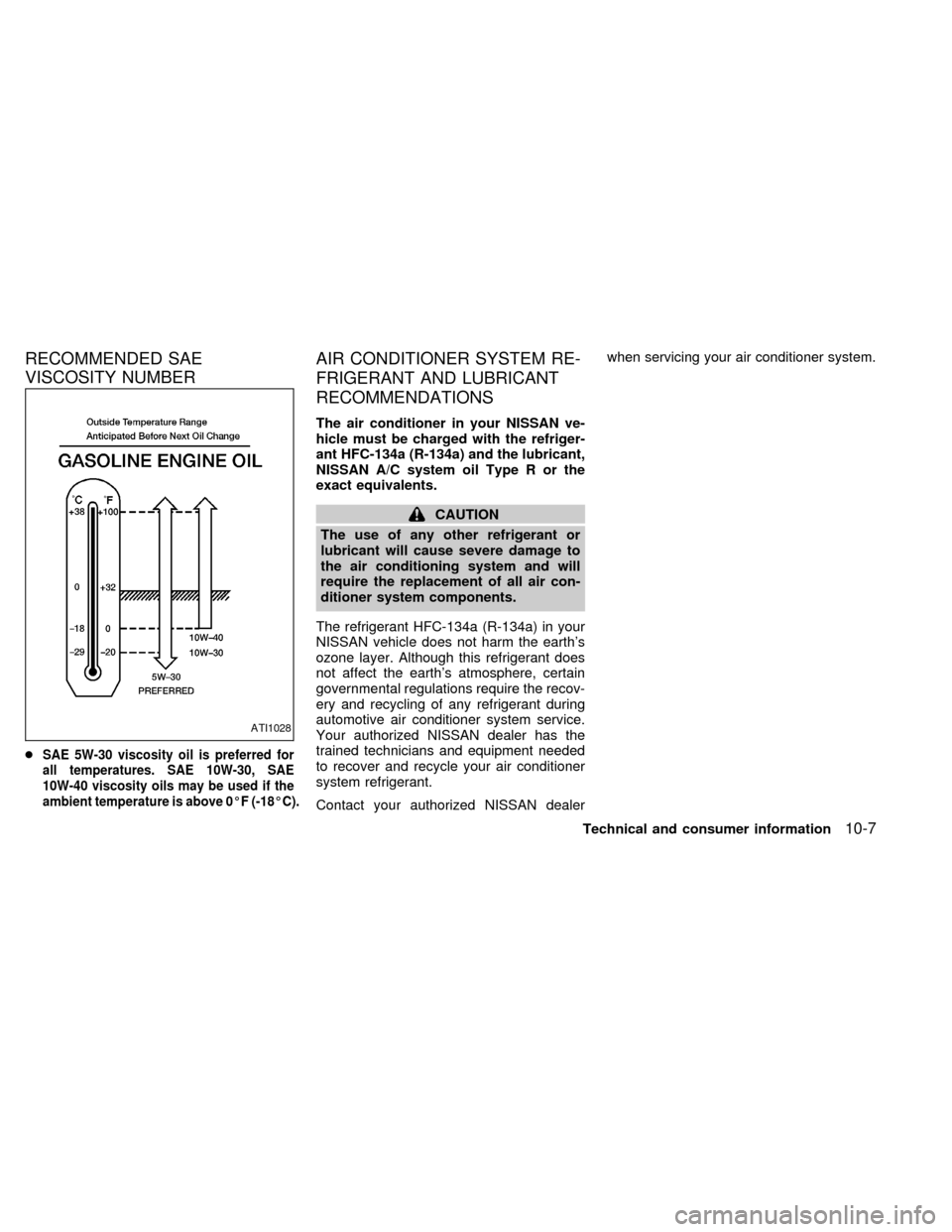
cSAE 5W-30 viscosity oil is preferred for
all temperatures. SAE 10W-30, SAE
10W-40 viscosity oils may be used if the
ambient temperature is above 0ÉF (-18ÉC).
AIR CONDITIONER SYSTEM RE-
FRIGERANT AND LUBRICANT
RECOMMENDATIONS
The air conditioner in your NISSAN ve-
hicle must be charged with the refriger-
ant HFC-134a (R-134a) and the lubricant,
NISSAN A/C system oil Type R or the
exact equivalents.
CAUTION
The use of any other refrigerant or
lubricant will cause severe damage to
the air conditioning system and will
require the replacement of all air con-
ditioner system components.
The refrigerant HFC-134a (R-134a) in your
NISSAN vehicle does not harm the earth's
ozone layer. Although this refrigerant does
not affect the earth's atmosphere, certain
governmental regulations require the recov-
ery and recycling of any refrigerant during
automotive air conditioner system service.
Your authorized NISSAN dealer has the
trained technicians and equipment needed
to recover and recycle your air conditioner
system refrigerant.
Contact your authorized NISSAN dealerwhen servicing your air conditioner system.
ATI1028
Technical and consumer information10-7
ZX
Page 227 of 240

slope is not recommended; however, if
you must do so, and if your vehicle is
equipped with an automatic transmission,
first block the wheels and apply the park-
ing brake, and then move the transmis-
sion shift selector lever into the P (Park)
position. If you move the shift selector
lever to the P (Park) position before block-
ing the wheels and applying the parking
brake, transmission damage could occur.
cWhen going down a hill, shift into a lower
gear and use the engine braking effect.
When ascending a long grade, down-
shift the transmission to a lower gear
and reduce speed to reduce chances of
engine overloading and/or overheating.
cIf the engine temperature coolant rises
to an extremely high temperature when
the air conditioning system is on, turn off
the air conditioner. Coolant heat can be
additionally vented by opening the win-
dows, switching the fan control to high
and setting the temperature control to
the HOT position.
cTrailer towing requires more fuel than
normal circumstances.
cAvoid towing a trailer for your vehicle's
first 500 miles (800 km).cHave your vehicle serviced more often
than at intervals specified in the recom-
mended Maintenance Schedule.
cWhen making a turn, your trailer wheels
will be closer to the inside of the turn
than your vehicle wheels. To compen-
sate for this, make a larger than normal
turning radius during the turn.
cCrosswinds and rough roads adversely
affect vehicle/trailer handling, possibly
causing vehicle sway. When being
passed by larger vehicles, be prepared
for possible changes in crosswinds that
could affect vehicle handling. If swaying
does occur, firmly grip the steering
wheel, steer straight ahead, and imme-
diately (but gradually) reduce vehicle
speed. This combination helps to stabi-
lize the vehicle. Never increase speed.
cBe careful when passing other vehicles.
Passing while towing a trailer requires
considerably more distance than normal
passing. Remember the length of the
trailer must also pass the other vehicle
before you can safely change lanes.
cTo maintain engine braking efficiency
and electrical charging performance, do
not use fifth gear (manual transmission)
or overdrive (automatic transmission).cAvoid holding the brake pedal down too
long or too frequently. This could cause
the brakes to overheat, resulting in re-
duced braking efficiency.
When towing a trailer, change the oil in
the transmission more frequently. For
additional information see the ``Mainte-
nance'' section earlier in this manual.
10-18Technical and consumer information
ZX
Page 228 of 240
DOT Quality Grades: All passenger car tires
must conform to Federal Safety Require-
ments in addition to these grades.
Quality grades can be found where appli-
cable on the tire sidewall between tread
shoulder and maximum section width. For
example:
Treadwear 200 Traction AA Temperature A
Treadwear
Treadwear grade is a comparative rating
based on tire wear rate when tested under
controlled conditions on specified govern-
ment test courses. For example, a tire
graded 150 would wear one and a half
(1-1/2) times as well on the government
course as a tire graded 100. However,
relative tire performance depends on actual
driving conditions, and may vary signifi-
cantly due to variations in driving habits,
service practices and differences in road
characteristics and climate.
Traction AA, A, B and C
The traction grades, from highest to lowest,
are AA, A, B, and C. Those grades repre-
sent a tire's ability to stop on wet pavement
as measured under controlled conditions,
on specified government test surfaces of
asphalt and concrete. A tire marked C mayhave poor traction performance.
WARNING
The traction grade assigned to your
vehicle tires is based on straight-ahead
braking traction tests, and does not
include acceleration, cornering, hydro-
planing, or peak traction characteris-
tics.
Temperature A, B and C
Temperature grades are A (the highest), B,
and C. They represent a tire's resistance to
heat build-up, and its ability to dissipate
heat when tested under controlled condi-
tions on a specified indoor laboratory test
wheel. Sustained high temperature can
cause tire material to degenerate, reducing
tire life. Excessive temperatures can lead to
sudden tire failure. Grade C corresponds to
a performance level which all passenger car
tires must meet under the Federal Motor
Vehicle Safety Standard No. 109. Grades A
and B represent higher levels of perfor-
mance on laboratory test wheels than the
minimum required by law.
WARNING
The temperature grade for this tire is
established for a tire that is properly
inflated and not overloaded. Excessive
speed, under-inflation, or excessive
loading, either separately or in combi-
nation, can cause heat build-up and
possible tire failure.
UNIFORM TIRE QUALITY
GRADING
Technical and consumer information10-19
ZX
Page 231 of 240

OWNER'S MANUAL/SERVICE
MANUAL ORDER INFORMATION
A genuine NISSAN Service Manual is the best
source of service and repair information for
your vehicle. Filled with wiring diagrams, illus-
trations and step-by-step diagnostic and ad-
justment procedures, this manual is the same
one used by the factory trained technicians
working at authorized NISSAN dealerships.
Also available are genuine NISSAN Owner's
Manuals, and genuine NISSAN Service and
Owner's Manuals for older NISSAN models.
In the USA:
For current pricing and availability of genuine
NISSAN Service Manualsfor the 2000 model
year, contact:
Tweddle Litho Company
1-800-639-8841
www.nissan-techinfo.com
For current pricing and availability of genuine
NISSAN Service Manualsfor the 1999 model
year and prior, see an authorized NISSAN
dealer, or contact:
Dyment Distribution Services
20770 Westwood Road
Strongsville, OH 44136
1-800-247-5321
10-22Technical and consumer information
ZX