2000 NISSAN PATHFINDER tow
[x] Cancel search: towPage 177 of 265

tioner temperature control to maximum hot
and fan control to high speed.
3. If engine overheating is caused by climbing
a long hill on a hot day, run the engine at a
fast idle (approximately 1,500 rpm) until the
temperature gauge indication returns to
normal.
4. Get out of the vehicle. Look and listen for
steam or coolant escaping from the radiator
before opening the hood. Wait until no
steam or coolant can be seen before pro-
ceeding.
5. Open the engine hood.
WARNING
If steam or water is coming from the
engine, stand clear to prevent getting
burned.
6. Visually check drive belts for damage or
looseness. Also check if the cooling fan is
running. The radiator hoses and radiator
should not leak water. If coolant is leaking,
the cooling fan belt is missing or loose or
the cooling fan does not run, stop the
engine.
WARNING
IBe careful not to allow your hands,
hair, jewelry or clothing to come into
contact with, or to get caught in, the
cooling fan, or drive belt.
IThe engine cooling fan can start at
any time when the coolant tempera-
ture is high.
7. After the engine cools down, check the
coolant level in the reservoir tank with the
engine running. Add coolant to the reservoir
tank if necessary. Have your vehicle re-
paired at the nearest NISSAN dealer.When towing your vehicle, all State (Provincial
in Canada) and local regulations for towing
must be followed. Incorrect towing equipment
could damage your vehicle. Towing instruc-
tions are available from your NISSAN dealer.
Local service operators will generally be famil-
iar with the applicable laws and procedures for
towing. To assure proper towing and to pre-
vent accidental damage to your vehicle,
NISSAN recommends that you have a service
operator tow your vehicle. It is advisable to
have the service operator carefully read the
following precautions.
WARNING
INever ride in a vehicle that is being
towed.
INever get under your vehicle after it
has been lifted by a tow truck.
CAUTION
IWhen towing, make sure that the
transmission, axles, steering system
and power train are in working condi-TOWING YOUR VEHICLE
6-12
In case of emergency
Z
00.1.17/R50-D/V5
X
Page 178 of 265
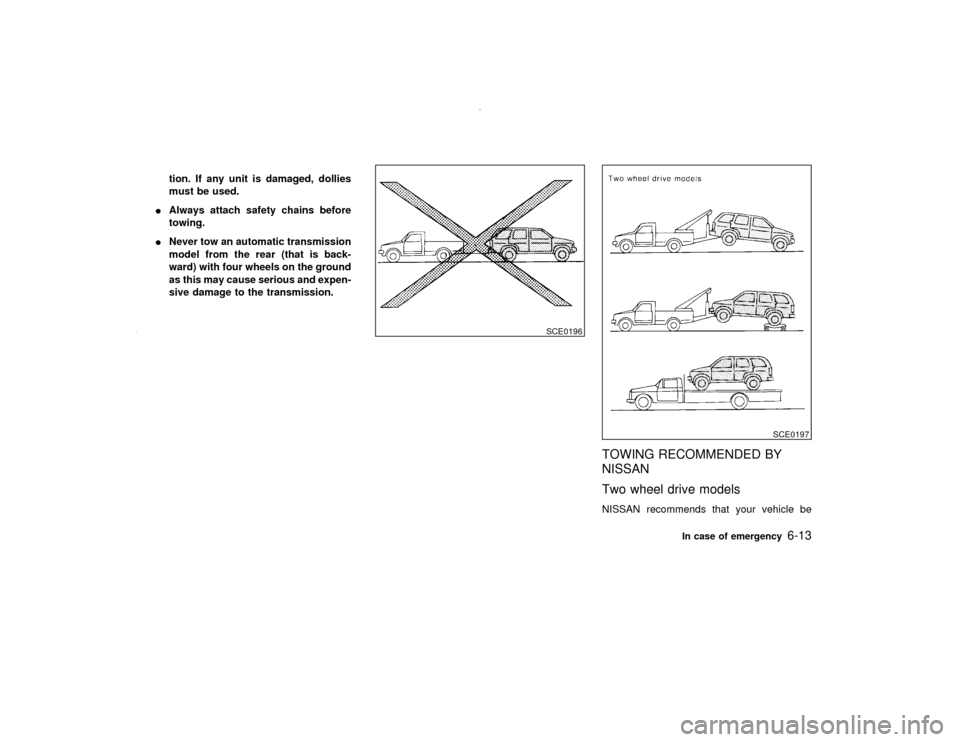
tion. If any unit is damaged, dollies
must be used.
IAlways attach safety chains before
towing.
INever tow an automatic transmission
model from the rear (that is back-
ward) with four wheels on the ground
as this may cause serious and expen-
sive damage to the transmission.
TOWING RECOMMENDED BY
NISSAN
Two wheel drive modelsNISSAN recommends that your vehicle be
SCE0196
SCE0197
In case of emergency
6-13
Z
00.1.17/R50-D/V5
X
Page 179 of 265
towed with the driving (rear) wheels off the
ground as illustrated.
CAUTION
IWhen towing manual or automatic
transmission models with the front
wheels on the ground: Turn the igni-
tion key to the OFF position and se-
cure the steering wheel in a straigh-
tahead position with a rope or similar
device. Never place the ignition key in
the LOCK position. This will result in
damage to the steering lock mecha-
nism.
IWhen towing manual transmission
models with the rear wheels on the
ground or four wheels on the ground
(if you do not use towing dollies):
Always release the parking brake and
move the transmission shift lever to
the N (neutral) position.
Observe the following restricted tow-
ing speeds and distances.
Manual transmission models:ISpeed: Below 60 MPH (95 km/h)
IDistance: Less than 500 miles (800
km)
If the speed or distance must necessarily be
greater, remove the propeller shaft beforehand
to prevent damage to the transmission.
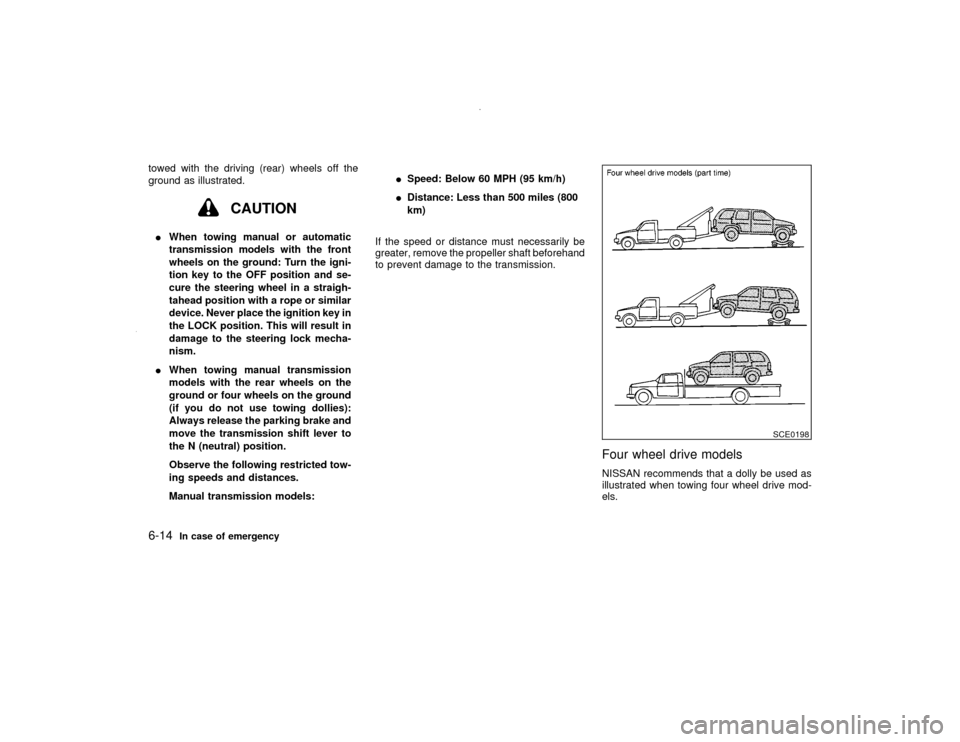
Four wheel drive modelsNISSAN recommends that a dolly be used as
illustrated when towing four wheel drive mod-
els.
SCE0198
6-14
In case of emergency
Z
00.1.17/R50-D/V5
X
Page 180 of 265

CAUTION
If towing with the front wheels on the
ground or with the rear wheels on the
ground (if you cannot use towing dol-
lies) is necessary: Move the transfer
case shift lever into the 2H position.
IWhen towing with the front wheels on
the ground: On manual transmission
models to move the shift lever to the
N (neutral) position, turn the ignition
key to the OFF position and secure
the steering wheel in a straightahead
position with a rope on similar de-
vice.
On automatic transmission models to
move the selector lever to N (neutral)
position, turn the ignition key to the
ACC position. After moving the selec-
tor lever to the N (neutral) position,
turn the ignition key to the OFF posi-
tion and secure the steering wheel in
a straightahead position with a rope
or similar device.
Never place the ignition key in theLOCK position. This will result in
damage to the steering lock mecha-
nism.
IWhen towing manual transmission
models with the rear wheels on the
ground or four wheels on the ground:
Always release the parking brake and
move the transmission shift lever to
the N (neutral) position.
Observe the following restricted tow-
ing speeds and distances.
Manual transmission models:
ISpeed: Below 60 MPH (95 km/h)
IDistance: Less than 500 miles (800
km)
If the speed or distance must necessarily be
greater, remove the front and rear propeller
shafts beforehand to prevent damage to the
transmission.
VEHICLE RECOVERY (Freeing a
stuck vehicle)IUse the towinghookonly, not other parts of
the vehicle. Otherwise, the vehicle body will
be damaged.
IUse the towing hookonlyto free a vehicle
stuck in sand, snow, mud, etc.Nevertow
the vehicle for a long distance using only
the towing hook.
SCE0115A
In case of emergency
6-15
Z
00.1.17/R50-D/V5
X
Page 181 of 265

IThe towing hook is under tremendous force
when used to free a stuck vehicle. Always
pull the cable straight out from the front of
the vehicle.Neverpull on the hook at an
angle.
IStand clear of a stuck vehicle.
WARNING
Do not spin your tires at high speed.
This could cause them to explode and
result in serious injury. Parts of yourvehicle could also overheat and be dam-
aged.
SCE0138
6-16
In case of emergency
Z
00.1.17/R50-D/V5
X
Page 220 of 265

WARNING
IThe small size spare tire (TEMPO-
RARY USE ONLY) should be used
only for emergency. It should be re-
placed by the standard tire at the first
opportunity.
IDrive carefully while the small size
spare tire is installed.
Avoid sharp turns and abrupt braking
while driving.
IPeriodically check the small size
spare tire inflation pressure, and al-
ways keep it at 60 psi (420 kPa, 4.2
bar).
IAlways keep the pressure of the full
size spare tire (if so equipped) at the
recommended pressure for standard
tires, as indicated on the tire placard.
For tire placard location, see ªTire
placardº in the ª10. Technical and
consumer informationº section.
IDo not drive your vehicle at speeds
faster than 50 MPH (80 km/h).IWhen driving on roads covered with
snow or ice, the small size spare tire
should be used on the rear wheel and
the original tire used on the front
wheels (drive wheels). Use tire chains
only on the front two original tires.
ITire tread of the small size spare tire
will wear at a faster rate than the
original tire. Replace the small size
spare tire as soon as the tread wear
indicators appear.
IDo not use the small size spare tire
on other vehicles.
IDo not use more than one small size
spare tire at the same time.
IDo not tow a trailer while the small
size spare tire is installed.
CAUTION
IDo not use tire chains on a small size
spare tire. Tire chains will not fit prop-
erly on the small size spare tire andmay cause damage to the vehicle.
IBecause the small size spare tire is
smaller than the original tire, ground
clearance is reduced. To avoid dam-
age to the vehicle do not drive over
obstacles. Also do not drive the ve-
hicle through an automatic car wash
since it may get caught.
Do-it-yourself
8-33
Z
00.1.17/R50-D/V5
X
Page 226 of 265

roads or to control dust. It is very important to
remove these substances, otherwise rust will
form on the floor pan, frame, fuel lines and
around the exhaust system. At the end of
winter, the underbody should be thoroughly
flushed with plain water, being careful to clean
those areas where mud and dirt may accumu-
late. For additional information, see ªCleaning
exteriorº in the ª7. Appearance and careº sec-
tion.
Fluid leaks:
Check under the vehicle for fuel, oil, water or
other fluid leaks after the vehicle has been
parked for a while. Water dripping from the air
conditioner after use is normal. If you should
notice any leaks or if gasoline fumes are
evident, check for the cause and have it cor-
rected immediately.To ensure smooth, trouble-free, safe and eco-
nomical driving, NISSAN provides two differ-
ent maintenance schedules that may be used,
depending upon the conditions in which you
usually drive. These schedules contain both
distance and time intervals, up to 60,000 miles
(96,000 km)/48 months. For most people, the
odometer reading will indicate when service is
needed. However, if you drive very little, your
vehicle should be serviced at the regular time
intervals shown in the schedule.
After 60,000 miles (96,000 km) or 48
months, continue periodic maintenance at
the same mileage/time intervals.
SCHEDULE 1Follow Periodic Maintenance Schedule 1 if
your driving habits frequently include one or
more of the following driving conditions:
IRepeated short trips of less than 5 miles
(8 km).
IRepeated short trips of less than 10
miles (16 km) with outside temperatures
remaining below freezing.
IOperating in hot weather in stop-and-go
rush hour traffic.
IExtensive idling and/or low speed driv-
ing for long distances, such as police,taxi or door-to-door delivery use.
IDriving in dusty conditions.
IDriving on rough, muddy, or salt spread
roads.
ITowing a trailer, using a camper or a
car-top carrier.
SCHEDULE 2Follow Periodic Maintenance Schedule 2 if
none of the driving conditions shown in Sched-
ule 1 apply to your driving habits.
PERIODIC MAINTENANCE
SCHEDULES
Maintenance
9-5
Z
00.1.17/R50-D/V5
X
Page 228 of 265
![NISSAN PATHFINDER 2000 R50 / 2.G Owners Manual Schedule 1Abbreviations: R = Replace I = Inspect. Correct or replace if necessary. L = Lubricate [ ]: At the mileage intervals onlyMAINTENANCE OPERATIONMAINTENANCE INTERVAL
Perform at number of miles,](/manual-img/5/640/w960_640-227.png "NISSAN PATHFINDER 2000 R50 / 2.G Owners Manual Schedule 1Abbreviations: R = Replace I = Inspect. Correct or replace if necessary. L = Lubricate [ ]: At the mileage intervals onlyMAINTENANCE OPERATIONMAINTENANCE INTERVAL
Perform at number of miles,")
Schedule 1Abbreviations: R = Replace I = Inspect. Correct or replace if necessary. L = Lubricate [ ]: At the mileage intervals onlyMAINTENANCE OPERATIONMAINTENANCE INTERVAL
Perform at number of miles, kilometers
or months, whichever comes first.Miles´1,000 3.75 7.5 11.25 15 18.75 22.5 26.25 30 33.75 37.5 41.25 45 48.75 52.5 56.25 60
(km´1,000) (6) (12) (18) (24) (30) (36) (42) (48) (54) (60) (66) (72) (78) (84) (90) (96)
Months 3 6 9 12 15 18 21 24 27 30 33 36 39 42 45 48
Chassis and body maintenance
Brake lines & cablesIIII
Brake pads, rotors, drums & liningsIIIIIIII
Automatic transmission & transfer fluid,
manual transmission & differential gear oil
(exc. LSD)See NOTE (1)IIII
Limited-slip differential (LSD) gear oil See NOTE (1)IRIR
Steering gear, linkage & transfer gear, axle & suspension partsIIIIIIII
Tire rotation See NOTE (2)
Drive shaft boots (
) IIIIIIII
Propeller shaft See NOTE (3)LLLLLLLL
Front wheel bearing grease (4x2)II
Front wheel bearing grease (
) See NOTE (4)IRIR
Exhaust systemIIIIIIII
Supplemental air bag system and supple-
mental side air bag systems (if so
equipped)See NOTE (5)
Automatic Speed Control Device (ASCD) vacuum hosesIIII
NOTE: (1) If towing a trailer, using a camper or a car-top carrier, or driving on rough or muddy roads, change (not just inspect) oil at every 30,000 miles(48,000 km)
or 24 months except for LSD. Change LSD gear oil every 15,000 miles (24,000 km) or 12 months.
(2) Refer to ªTire rotationº under the ªGeneral maintenanceº heading earlier in this section.
(3) The propeller shaft should be re-greased after being immersed in water.
(4) If operating frequently in water, replace grease every 3,750 miles (6,000 km) or 3 months.
(5) Inspect the supplemental air bag system 10 years after the date of manufacture noted on the F.M.V.S.S. certification label.
Maintenance
9-7
Z
00.1.17/R50-D/V5
X