2000 NISSAN PATHFINDER steering wheel
[x] Cancel search: steering wheelPage 161 of 265

BRAKING PRECAUTIONSThe brake system has two separate hydraulic
circuits. If one circuit develops a problem, you
will still have braking at two wheels.Vacuum assisted brakeThe brake booster aids braking by using en-
gine vacuum. If the engine stops, you can stop
the vehicle by depressing the brake pedal.
However, greater foot pressure on the brake
pedal will be required to stop the vehicle and
the stopping distance will be longer.Using the brakesAvoid resting your foot on the brake pedal
while driving. This will overheat the brakes,
wear out the brake linings and pads faster and
reduce gas mileage.
To help save the brakes and to prevent the
brakes from overheating, before going down a
slope or long grade, reduce speed and down-
shift to a lower gear.Wet brakesWhen the vehicle is washed or driven through
water, the brakes may get wet. As a result,
your braking distance will be longer and the
vehicle may pull to one side during braking.To dry brakes, drive the vehicle at a safe
speed while lightly pressing the brake pedal to
heat-up the brakes. Do this until the brakes
return to normal. Avoid driving the vehicle at
high speeds until the brakes function correctly.
WARNING
IWhile driving on a slippery surface,
be careful when braking, accelerating
or downshifting. Abrupt braking or
accelerating could cause the wheels
to skid and result in an accident.
IIf the engine is not running or is
turned off while driving, the power
assist for the brakes will not work.
Braking will be harder.ANTI-LOCK BRAKE SYSTEM (ABS)The anti-lock brake system controls the brakes
at each wheel so the wheels will not lock when
braking abruptly or when braking on slippery
surfaces. The system detects the rotation
speed at each wheel and varies the brake fluid
pressure to prevent each wheel from locking
and sliding. By preventing wheel lockup, the
system helps the driver maintain steering con-trol and helps to minimize swerving and spin-
ning on slippery surfaces.
Using the systemDepress the brake pedal and hold it down.
WARNING
Do not pump the brake pedal. Doing so
may result in increased stopping dis-
tances.Normal operationThe anti-lock brake system will not operate at
speeds below 3 to 6 MPH (5 to 10 km/h) to
completely stop the vehicle. (The speeds will
vary according to road conditions.) When the
anti-lock system senses that one or more
wheels are close to locking up, the actuator
(under the hood) rapidly applies and releases
hydraulic pressure (like pumping the brakes
very quickly). While the actuator is working,
you may feel a pulsation in the brake pedal
and hear a noise or vibration from the actuator
under the hood. This is normal and indicates
that the anti-lock system is working properly.
However, the pulsation may indicate that road
BRAKE SYSTEM5-26
Starting and driving
Z
00.1.17/R50-D/V5
X
Page 164 of 265

CAUTION
ONLY use spare tires specified for each
four wheel drive model.SPECIAL WINTER EQUIPMENTIt is recommended that the following items be
carried in the vehicle during winter:
IA scraper and stiff-bristled brush to remove
ice and snow from the windows and wiper
blades.
IA sturdy, flat board to be placed under the
jack to give it firm support.
IA shovel to dig the vehicle out of snow-
drifts.
IExtra window washer fluid to refill the res-
ervoir tank.DRIVING ON SNOW OR ICE
WARNING
IWet ice (32ÉF, 0ÉC and freezing rain),
very cold snow or ice can be slick andvery hard to drive on. The vehicle will
have a lot less traction or grip under
these conditions. Try to avoid driving
on wet ice until the road is salted or
sanded.
IWhatever the condition, drive with
caution. Accelerate and slow down
with care. If accelerating or down-
shifting too fast, the drive wheels will
lose even more traction.
IAllow more stopping distance under
these conditions. Braking should be
started sooner than on dry pavement.
IAllow greater following distances on
slippery roads.
IWatch for slippery spots (glare ice).
These may appear on an otherwise
clear road in shaded areas. If a patch
of ice is seen ahead, brake before
reaching it. Try not to brake while
actually on the ice, and avoid any
sudden steering maneuvers.
IDo not use cruise control on slippery
roads.ISnow can trap dangerous exhaust
gases under your vehicle. Keep snow
clear of the exhaust pipe and from
around your vehicle.
ENGINE BLOCK HEATER (if so
equipped)An engine block heater to assist extreme cold
temperature starting is available through your
NISSAN dealer.
WARNING
Do not use your heater with an un-
grounded electrical system or two-
pronged (cheater) adapters. You can be
injured by an electrical shock if you use
an ungrounded connection.
Starting and driving
5-29
Z
00.1.17/R50-D/V5
X
Page 179 of 265
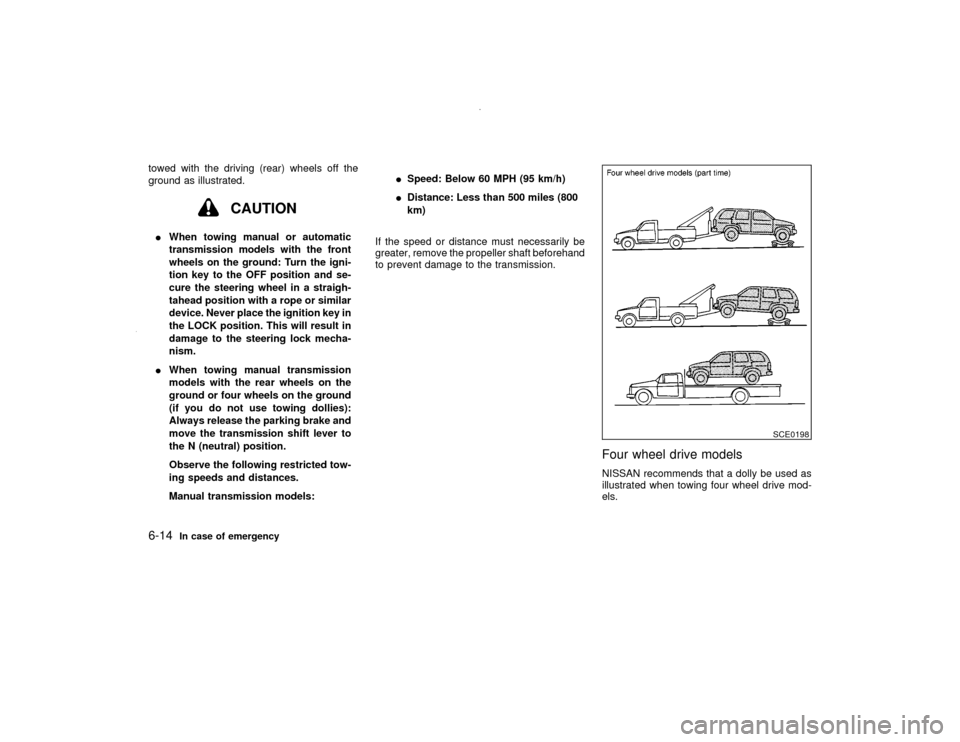
towed with the driving (rear) wheels off the
ground as illustrated.
CAUTION
IWhen towing manual or automatic
transmission models with the front
wheels on the ground: Turn the igni-
tion key to the OFF position and se-
cure the steering wheel in a straigh-
tahead position with a rope or similar
device. Never place the ignition key in
the LOCK position. This will result in
damage to the steering lock mecha-
nism.
IWhen towing manual transmission
models with the rear wheels on the
ground or four wheels on the ground
(if you do not use towing dollies):
Always release the parking brake and
move the transmission shift lever to
the N (neutral) position.
Observe the following restricted tow-
ing speeds and distances.
Manual transmission models:ISpeed: Below 60 MPH (95 km/h)
IDistance: Less than 500 miles (800
km)
If the speed or distance must necessarily be
greater, remove the propeller shaft beforehand
to prevent damage to the transmission.
Four wheel drive modelsNISSAN recommends that a dolly be used as
illustrated when towing four wheel drive mod-
els.
SCE0198
6-14
In case of emergency
Z
00.1.17/R50-D/V5
X
Page 180 of 265

CAUTION
If towing with the front wheels on the
ground or with the rear wheels on the
ground (if you cannot use towing dol-
lies) is necessary: Move the transfer
case shift lever into the 2H position.
IWhen towing with the front wheels on
the ground: On manual transmission
models to move the shift lever to the
N (neutral) position, turn the ignition
key to the OFF position and secure
the steering wheel in a straightahead
position with a rope on similar de-
vice.
On automatic transmission models to
move the selector lever to N (neutral)
position, turn the ignition key to the
ACC position. After moving the selec-
tor lever to the N (neutral) position,
turn the ignition key to the OFF posi-
tion and secure the steering wheel in
a straightahead position with a rope
or similar device.
Never place the ignition key in theLOCK position. This will result in
damage to the steering lock mecha-
nism.
IWhen towing manual transmission
models with the rear wheels on the
ground or four wheels on the ground:
Always release the parking brake and
move the transmission shift lever to
the N (neutral) position.
Observe the following restricted tow-
ing speeds and distances.
Manual transmission models:
ISpeed: Below 60 MPH (95 km/h)
IDistance: Less than 500 miles (800
km)
If the speed or distance must necessarily be
greater, remove the front and rear propeller
shafts beforehand to prevent damage to the
transmission.
VEHICLE RECOVERY (Freeing a
stuck vehicle)IUse the towinghookonly, not other parts of
the vehicle. Otherwise, the vehicle body will
be damaged.
IUse the towing hookonlyto free a vehicle
stuck in sand, snow, mud, etc.Nevertow
the vehicle for a long distance using only
the towing hook.
SCE0115A
In case of emergency
6-15
Z
00.1.17/R50-D/V5
X
Page 188 of 265

8 Do-it-yourselfMaintenance precautions .......................................... 8-2
Engine compartment check locations ....................... 8-4
Engine cooling system .............................................. 8-5
Checking engine coolant level .................................. 8-5
Changing engine coolant .......................................... 8-6
Engine oil .................................................................. 8-7
Checking engine oil level .......................................... 8-7
Changing engine oil .................................................. 8-8
Changing engine oil filter .......................................... 8-9
Automatic transmission fluid ................................... 8-10
Temperature conditions for checking ...................... 8-10
Power steering fluid ................................................ 8-12
Brake and clutch fluid ............................................. 8-12
Brake fluid ............................................................... 8-12
Clutch fluid .............................................................. 8-13
Window washer fluid ............................................... 8-13
Window washer fluid reservoir ................................ 8-13
Battery ..................................................................... 8-14
Jump starting........................................................... 8-15
Drive belts ............................................................... 8-15
Spark plugs ............................................................. 8-16
Replacing spark plugs ............................................. 8-16Air cleaner ............................................................... 8-17
Windshield wiper blades ......................................... 8-18
Cleaning .................................................................. 8-18
Replacement ........................................................... 8-18
Parking brake and brake pedal ............................... 8-19
Checking parking brake .......................................... 8-19
Checking brake pedal ............................................. 8-19
Brake booster .......................................................... 8-20
Clutch pedal ............................................................ 8-21
Checking clutch pedal ............................................. 8-21
Fuses....................................................................... 8-21
Engine compartment ............................................... 8-21
Passenger compartment ......................................... 8-22
Multi-remote controller battery replacement ........... 8-22
Lights ....................................................................... 8-24
Headlights ............................................................... 8-25
Wheels and tires ..................................................... 8-28
Tire pressure ........................................................... 8-28
Types of tires .......................................................... 8-29
Tire chains............................................................... 8-30
Changing wheels and tires...................................... 8-30
Clutch housing drain ................................... 8-34
Z
00.1.17/R50-D/V5
X
Page 224 of 265

Wheel nuts*:
When checking the tires, make sure no nuts
are missing, and check for any loose nuts.
Tighten if necessary.
Tire rotation*:
Tires should be rotated every 7,500 miles
(12,000 km). However, the timing for tire rota-
tion may vary according to your driving habits
and road surface conditions.
Wheel alignment and balance:
If the vehicle should pull to either side while
driving on a straight and level road, or if you
detect uneven or abnormal tire wear, there
may be a need for wheel alignment.
If the steering wheel or seat vibrates at normal
highway speeds, wheel balancing may be
needed.
Windshield wiper blades*:
Check for cracks or wear if they do not wipe
properly.
Doors and engine hood:
Check that all doors and the engine hood,
operate properly. Also ensure that all latches
lock securely. Lubricate hinges, latches, rollers
and links if necessary. Make sure that the
secondary latch keeps the hood from openingwhen the primary latch is released.
When driving in areas using road salt or other
corrosive materials, check lubrication fre-
quently.
Inside the vehicleLights*:
Make sure that the headlights, stop lights, tail
lights, turn signal lights, and other lights are all
operating properly and installed securely. Also
check headlight aim.INTERIOR MAINTENANCEThe maintenance items listed here should be
checked on a regular basis, such as when
performing periodic maintenance, cleaning the
vehicle, etc.
Warning lights and chimes:
Make sure that all warning lights and chimes
are operating properly.
Windshield wiper and washer*:
Check that the wipers and washer operate
properly and that the wipers do not streak.Windshield defroster:
Check that the air comes out of the defroster
outlets properly and in sufficient quantity when
operating the heater or air conditioner.
Steering wheel:
Check for changes in the steering conditions,
such as excessive freeplay, hard steering or
strange noises.
Seats:
Check seat position controls such as seat
adjusters, seatback recliner, etc. to ensure
they operate smoothly and that all latches lock
securely in every position. Check that the head
restraints move up and down smoothly and
that the locks (if so equipped) hold securely in
all latched positions.
Seat belts:
Check that all parts of the seat belt system
(e.g. buckles, anchors, adjusters and retrac-
tors) operate properly and smoothly, and are
installed securely. Check the belt webbing for
cuts, fraying, wear or damage.
Accelerator pedal:
Check the pedal for smooth operation and
make sure the pedal does not catch or require
Maintenance
9-3
Z
00.1.17/R50-D/V5
X
Page 228 of 265
![NISSAN PATHFINDER 2000 R50 / 2.G Owners Manual Schedule 1Abbreviations: R = Replace I = Inspect. Correct or replace if necessary. L = Lubricate [ ]: At the mileage intervals onlyMAINTENANCE OPERATIONMAINTENANCE INTERVAL
Perform at number of miles,](/manual-img/5/640/w960_640-227.png "NISSAN PATHFINDER 2000 R50 / 2.G Owners Manual Schedule 1Abbreviations: R = Replace I = Inspect. Correct or replace if necessary. L = Lubricate [ ]: At the mileage intervals onlyMAINTENANCE OPERATIONMAINTENANCE INTERVAL
Perform at number of miles,")
Schedule 1Abbreviations: R = Replace I = Inspect. Correct or replace if necessary. L = Lubricate [ ]: At the mileage intervals onlyMAINTENANCE OPERATIONMAINTENANCE INTERVAL
Perform at number of miles, kilometers
or months, whichever comes first.Miles´1,000 3.75 7.5 11.25 15 18.75 22.5 26.25 30 33.75 37.5 41.25 45 48.75 52.5 56.25 60
(km´1,000) (6) (12) (18) (24) (30) (36) (42) (48) (54) (60) (66) (72) (78) (84) (90) (96)
Months 3 6 9 12 15 18 21 24 27 30 33 36 39 42 45 48
Chassis and body maintenance
Brake lines & cablesIIII
Brake pads, rotors, drums & liningsIIIIIIII
Automatic transmission & transfer fluid,
manual transmission & differential gear oil
(exc. LSD)See NOTE (1)IIII
Limited-slip differential (LSD) gear oil See NOTE (1)IRIR
Steering gear, linkage & transfer gear, axle & suspension partsIIIIIIII
Tire rotation See NOTE (2)
Drive shaft boots (
) IIIIIIII
Propeller shaft See NOTE (3)LLLLLLLL
Front wheel bearing grease (4x2)II
Front wheel bearing grease (
) See NOTE (4)IRIR
Exhaust systemIIIIIIII
Supplemental air bag system and supple-
mental side air bag systems (if so
equipped)See NOTE (5)
Automatic Speed Control Device (ASCD) vacuum hosesIIII
NOTE: (1) If towing a trailer, using a camper or a car-top carrier, or driving on rough or muddy roads, change (not just inspect) oil at every 30,000 miles(48,000 km)
or 24 months except for LSD. Change LSD gear oil every 15,000 miles (24,000 km) or 12 months.
(2) Refer to ªTire rotationº under the ªGeneral maintenanceº heading earlier in this section.
(3) The propeller shaft should be re-greased after being immersed in water.
(4) If operating frequently in water, replace grease every 3,750 miles (6,000 km) or 3 months.
(5) Inspect the supplemental air bag system 10 years after the date of manufacture noted on the F.M.V.S.S. certification label.
Maintenance
9-7
Z
00.1.17/R50-D/V5
X
Page 230 of 265
![NISSAN PATHFINDER 2000 R50 / 2.G Owners Manual Schedule 2Abbreviations: R = Replace I = Inspect. Correct or replace if necessary. L = Lubricate [ ]: At the mileage intervals onlyMAINTENANCE OPERATIONMAINTENANCE INTERVAL
Perform at number of miles,](/manual-img/5/640/w960_640-229.png "NISSAN PATHFINDER 2000 R50 / 2.G Owners Manual Schedule 2Abbreviations: R = Replace I = Inspect. Correct or replace if necessary. L = Lubricate [ ]: At the mileage intervals onlyMAINTENANCE OPERATIONMAINTENANCE INTERVAL
Perform at number of miles,")
Schedule 2Abbreviations: R = Replace I = Inspect. Correct or replace if necessary. L = Lubricate [ ]: At the mileage intervals onlyMAINTENANCE OPERATIONMAINTENANCE INTERVAL
Perform at number of miles, kilometers or
months, whichever comes first.Miles´1,000 7.5 15 22.5 30 37.5 45 52.5 60
(km´1,000) (12) (24) (36) (48) (60) (72) (84) (96)
Months 6 12 18 24 30 36 42 48
Chassis and body maintenance
Brake lines & cablesIIII
Brake pads, rotors, discs, drums & liningsIIII
Automatic transmission & transfer fluid, manual transmission & dif-
ferential gear oil (exc. LSD)IIII
Limited-slip differential (LSD) gear oilIRIR
Steering gear, linkage & transfer gear, axle & suspension parts I I
Tire rotation See NOTE (1)
Drive shaft boots (
) IIII
Propeller shaft See NOTE (2)LLLL
Front wheel bearing grease (4x2)II
Front wheel bearing grease (
) IRIR
Exhaust systemII
Supplemental air bag system and supplemental
side air bag systems (if so equipped)See NOTE (3)
Automatic Speed Control Device (ASCD) vacuum hosesIIII
NOTE: (1) Refer to ªTire rotationº under the ªGeneral maintenanceº heading earlier in this section.
(2) The propeller shaft should be re-greased after being immersed in water.
(3) Inspect the supplemental air bag system 10 years after the date of manufacture noted on the F.M.V.S.S. certification label.
Maintenance
9-9
Z
00.1.17/R50-D/V5
X