2000 NISSAN PATHFINDER engine oil
[x] Cancel search: engine oilPage 197 of 265
CAUTION
Be careful not to burn yourself, as the
engine oil may be hot.
4. Wipe the engine oil filter mounting surface
with a clean rag.
Be sure to remove any old rubber gasket
remaining on the mounting surface of the
engine.
5. Coat the rubber gasket on the new filter
with engine oil.
6. Screw in the oil filter until a slight resistance
is felt, then tighten an additional 2/3 turn.
7. Start the engine and check for leakage
around the oil filter. Correct as required.
8. Turn the engine off and wait several min-
utes. Check the oil level. Add engine oil if
necessary.
WARNING
IWhen engine is running, keep hands,
jewelry, and clothing away from any
moving parts such as fan and drive
belt.
IAutomatic transmission fluid is poi-
sonous and should be stored care-
fully in marked containers out of the
reach of children.
TEMPERATURE CONDITIONS
FOR CHECKINGThe fluid level should be checked using the
HOT range (L & H marks) on the dipstick at
fluid temperatures between 122 and 176ÉF (50
and 80ÉC) after the vehicle has been driven
approximately 5 minutes in urban areas after
the engine is warmed up. The level can be
checked at fluid temperatures between 86 and
122ÉF (30 and 50ÉC) using the COLD range on
the dipstick for reference, after the engine is
warmed up but before driving. However, the
fluid level must be rechecked using the HOT
range.
1. Park the vehicle on a level surface and set
the parking brake.
2. Start the engine and then move the selector
lever through each gear range, ending in P.
3. Check the fluid level with the engine idling.
If the vehicle has been driven for a long
time at high speeds, or in city traffic in hot
weather, or if it is being used to pull a
trailer, the fluid level cannot be read accu-
rately. You should wait until the fluid has
cooled down (about 30 minutes).
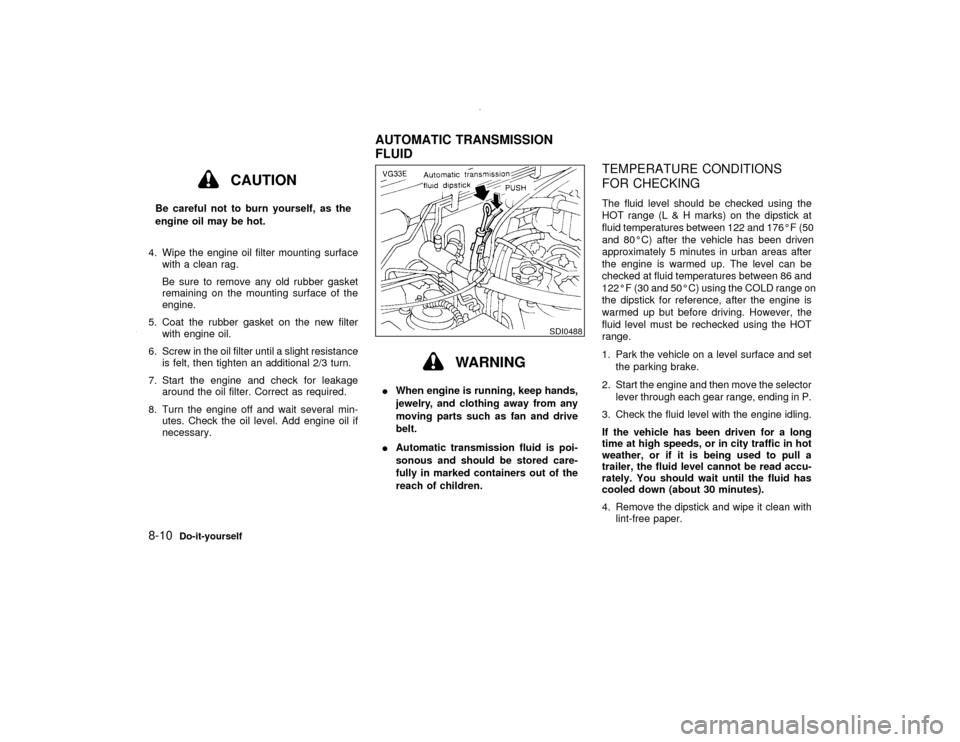
4. Remove the dipstick and wipe it clean with
lint-free paper.
SDI0488
AUTOMATIC TRANSMISSION
FLUID
8-10
Do-it-yourself
Z
00.1.17/R50-D/V5
X
Page 225 of 265

uneven effort. Keep the floor mats away from
the pedal.
Clutch pedal*:
Make sure the pedal operates smoothly and
check that it has the proper free travel.
Brakes:
Check that the brakes do not pull the vehicle to
one side when applied.
Brake pedal and booster*:
Check the pedal for smooth operation and
make sure it has the proper distance under it
when depressed fully. Check the brake
booster function. Be certain to keep floormats
away from the pedal.
Parking brake*:
Check that the lever has the proper travel and
confirm that your vehicle is held securely on a
fairly steep hill with only the parking brake
applied.
Automatic transmission P position
mechanism:
On a fairly steep hill check that your vehicle is
held securely with the selector lever in the P
position without applying any brakes.
Under the hood and vehicleThe maintenance items listed here should be
checked periodically e.g. each time you check
the engine oil or refuel.
Windshield washer fluid*:
Check that there is adequate fluid in the tank.
Engine oil level*:
Check the level after parking the vehicle on a
level spot and turning off the engine. (Be sure
to wait a few minutes to allow the oil to drain
back into the sump.)
Brake and clutch fluid levels*:
Make sure that the brake and clutch fluid level
is between the MAX and MIN lines on the
reservoir.
Power steering fluid level* and lines:
Check the level when the fluid is cold and the
engine is turned off. Check the lines for proper
attachment, leaks, cracks, etc.
Automatic transmission fluid level*:
Check the level after putting the selector lever
in P (Park) with the engine idling.Engine coolant level*:
Check the coolant level when the engine is
cold.
Radiator and hoses:
Check the front of the radiator and clean off
any dirt, insects, leaves, etc., that may have
accumulated. Make sure the hoses have no
cracks, deformation, rot or loose connections.
Engine drive belts*:
Make sure that no belt is frayed, worn, cracked
or oily.
Battery*:
Check the fluid level in each cell. It should be
between the MAX and MIN lines.
Exhaust system:
Make sure there are no loose supports, cracks
or holes. If the sound of the exhaust seems
unusual or there is a smell of exhaust fumes,
immediately locate the trouble and correct it.
See ªPrecautions when starting and drivingº in
the ª5. Starting and drivingº section for exhaust
gas (carbon monoxide).
Underbody:
The underbody is frequently exposed to corro-
sive substances such as those used on icy
9-4
Maintenance
Z
00.1.17/R50-D/V5
X
Page 227 of 265
![NISSAN PATHFINDER 2000 R50 / 2.G Owners Manual Schedule 1Abbreviations: R = Replace I = Inspect. Correct or replace if necessary. [ ]: At the mileage intervals onlyMAINTENANCE OPERATIONMAINTENANCE INTERVAL
Perform at number of miles, kilometers or](/manual-img/5/640/w960_640-226.png "NISSAN PATHFINDER 2000 R50 / 2.G Owners Manual Schedule 1Abbreviations: R = Replace I = Inspect. Correct or replace if necessary. [ ]: At the mileage intervals onlyMAINTENANCE OPERATIONMAINTENANCE INTERVAL
Perform at number of miles, kilometers or")
Schedule 1Abbreviations: R = Replace I = Inspect. Correct or replace if necessary. [ ]: At the mileage intervals onlyMAINTENANCE OPERATIONMAINTENANCE INTERVAL
Perform at number of miles, kilometers or
months, whichever comes first.Miles´1,000 3.75 7.5 11.25 15 18.75 22.5 26.25 30 33.75 37.5 41.25 45 48.75 52.5 56.25 60
(km´1,000) (6) (12) (18) (24) (30) (36) (42) (48) (54) (60) (66) (72) (78) (84) (90) (96)
Months 3 6 9 12 15 18 21 24 27 30 33 36 39 42 45 48
Emission control system maintenance
Drive beltsI* I*
Air cleaner filter See NOTE (1) [R] [R]
EVAP vapor linesI* I*
Fuel linesI* I*
Fuel filter See NOTE (2)*
Engine coolant See NOTE (3)R*
Engine oilRRRRRRRRRRRRRRRR
Engine oil filter
(Use Part No. 15208 31U00 or equivalent.)RRRRRRRRRRRRRRRR
Spark plugs (PLATINUM-TIPPED type)[R]
Timing beltReplace every 105,000 miles (168,000 km)NOTE: (1) If operating mainly in dusty conditions, more frequent maintenance may be required.
(2) When the filter becomes clogged, the vehicle speed cannot be increased as the driver wishes. In such an event, replace the filter.
(3) After 60,000 miles (96,000 km) or 48 months, replace every 30,000 miles (48,000 km) or 24 months.
HMaintenance items and intervals with ª*º are recommended by NISSAN for reliable vehicle operation. The owner need not perform such
maintenance in order to maintain the emission warranty or manufacturer recall liability. Other maintenance items and intervals are required.9-6
Maintenance
Z
00.1.17/R50-D/V5
X
Page 229 of 265
![NISSAN PATHFINDER 2000 R50 / 2.G Owners Manual Schedule 2Abbreviations: R = Replace I = Inspect. Correct or replace if necessary. [ ]: At the mileage intervals onlyMAINTENANCE OPERATIONMAINTENANCE INTERVAL
Perform at number of miles, kilometers or](/manual-img/5/640/w960_640-228.png "NISSAN PATHFINDER 2000 R50 / 2.G Owners Manual Schedule 2Abbreviations: R = Replace I = Inspect. Correct or replace if necessary. [ ]: At the mileage intervals onlyMAINTENANCE OPERATIONMAINTENANCE INTERVAL
Perform at number of miles, kilometers or")
Schedule 2Abbreviations: R = Replace I = Inspect. Correct or replace if necessary. [ ]: At the mileage intervals onlyMAINTENANCE OPERATIONMAINTENANCE INTERVAL
Perform at number of miles, kilometers or
months, whichever comes first.Miles´1,000 7.5 15 22.5 30 37.5 45 52.5 60
(km´1,000) (12) (24) (36) (48) (60) (72) (84) (96)
Months 6 12 18 24 30 36 42 48
Emission control system maintenance
Drive beltsI* I*
Air cleaner filter[R] [R]
EVAP vapor linesI* I*
Fuel linesI* I*
Fuel filter See NOTE (1)*
Engine coolant See NOTE (2)R*
Engine oilRRRRRRRR
Engine oil filter (Use Part No. 15208 31U00 or equivalent.)RRRRRRRR
Spark plugs (PLATINUM-TIPPED type)[R]
Timing beltReplace every 105,000 miles (168,000 km)
NOTE: (1) When the filter becomes clogged, the vehicle speed cannot be increased as the driver wishes. In such an event, replace the filter.
(2) After 60,000 miles (96,000 km) or 48 months, replace every 30,000 miles (48,000 km) or 24 months.
HMaintenance items and intervals with ª*º are recommended by NISSAN for reliable vehicle operation. The owner need not perform such
maintenance in order to maintain the emission warranty or manufacturer recall liability. Other maintenance items and intervals are required.9-8
Maintenance
Z
00.1.17/R50-D/V5
X
Page 231 of 265

Maintenance for offroad driving
(
only)
Whenever you drive offroad through sand,
mud or water as deep as the wheel hub, more
frequent maintenance may be required of the
following items:G
Brake pads and discs
G
Brake lining and drums
G
Brake lines and hoses
G
Wheel bearing grease
G
Differential, transmission and transfer oil
G
Steering linkage
G
Propeller shafts and front drive shafts
G
Air cleaner filter
G
Clutch housing (See ªClutch housing drainº
in the ª8. Do-it-yourselfº section for check-
ing water entry.)
These items should be checked frequently to
assure safe and proper operation of your ve-
hicle.
EXPLANATION OF MAINTENANCE
ITEMS
Emission control system
maintenanceAdditional information on the following
items with * is found in the ª8. Do-it-
yourselfº section.
Drive belts*:
Check drive belts for wear, fraying or cracking
and also for proper tension. Replace the drive
belts if found damaged.
Air filter:
Under normal driving conditions, the air
cleaner filter should be replaced in accordance
with the maintenance schedule. However,
driving the vehicle in dusty areas may cause
more rapid clogging of the element. Conse-
quently, the element may have to be replaced
more frequently.
EVAP vapor lines:
Check vapor lines and connections for failure
or looseness. If leaks are found, replace the
lines.
Fuel lines:
Check the fuel hoses, piping and connectionsfor leaks, looseness or deterioration. Replace
any parts if they are damaged.
Fuel filter:
If the vehicle is operated under extremely
adverse weather conditions or in areas where
ambient temperatures are either extremely low
or extremely high, the filter might become
clogged. In such an event, replace the filter
immediately.
Engine coolant*:
Flush and refill the cooling system.
Engine oil & oil filter*:
Under normal driving conditions, the engine oil
and oil filter should be replaced in accordance
with the maintenance schedule. However, un-
der severe driving conditions, they may have
to be replaced more frequently.
Spark plugs*:
Replace with new plugs having the correct
heat range.
Timing belt:
Replace the timing belt for driving the cam-
shafts.
9-10
Maintenance
Z
00.1.17/R50-D/V5
X
Page 234 of 265

10 Technical and consumer informationCapacities and recommended fuel/lubricants ......... 10-2
Fuel recommendation ............................................. 10-4
Engine oil and oil filter recommendation................. 10-6
Recommended SAE oil viscosity number ............... 10-7
Air conditioning system refrigerant and lubricant
recommendations .................................................... 10-8
Specifications .......................................................... 10-9
Engine ..................................................................... 10-9
Wheels and tires ................................................... 10-10
Dimensions and weights ....................................... 10-10
When traveling or registering your vehicle in another
country................................................................... 10-11
Vehicle identification ............................................. 10-11
Vehicle identification number (VIN) plate.............. 10-11
Vehicle identification number (Chassis
number) ................................................................. 10-11
Engine serial number ............................................ 10-12F.M.V.S.S. certification label ................................. 10-12
Emission control information label ........................ 10-12
Tire placard ........................................................... 10-13
Air conditioner specification label.......................... 10-13
Vehicle loading information ................................... 10-13
Terms .................................................................... 10-13
Determining vehicle load capacity ........................ 10-14
Loading tips ........................................................... 10-14
Towing a trailer ..................................................... 10-15
Maximum load limits.............................................. 10-15
Towing load/specification chart ............................. 10-16
Towing safety ........................................................ 10-17
Emission control system warranty ........................ 10-18
Reporting safety defects (US only) ....................... 10-19
Readiness for inspection/maintenance (I/M) test (US
only)....................................................................... 10-19
Z
00.1.17/R50-D/V5
X
Page 235 of 265

The following values are approximate capacities. The actual refill capacities may be a little different from them. When refilling, follow the
procedure instructed in the ª8. Do-it-yourselfº section to determine the proper refill capacity.
Capacity (Approximate)
Recommended specifications
US
measureImp
measureLiter
Fuel 21-1/8 gal 17-5/8 gal 80Unleaded gasoline with an octane rating
of at least 87 AKI (RON 91)*1
Engine oil*4
Drain and refill
with oil filter
change3-7/8 qt 3-1/4 qt 3.7IAPI Certification Mark*2 *3
IAPI grade SG/SH, Energy Conserving I
& II or API grade SJ, Energy Conserv-
ing*2 *3
IILSAC grade GF-I & GF-II*2 *3 without oil filter
change3-5/8 qt 3 qt 3.4
Cooling system
(with heater and
reservoir tank)10-3/4 qt 9 qt 10.2Genuine Nissan Anti-Freeze Coolant or
equivalent
(Ethylene glycol base 50% demineralized
water or distilled water)
*1: See later in this section for fuel recommendation.
*2: See later in this section for recommended SAE viscosity number.
*3: See later in this section for engine oil and oil filter recommendation.
*4: See ªChanging engine oilº in the ª8. Do-it-yourselfº section for further details.CAPACITIES AND
RECOMMENDED
FUEL/LUBRICANTS10-2
Technical and consumer information
Z
00.1.17/R50-D/V5
X
Page 239 of 265
ENGINE OIL AND OIL FILTER
RECOMMENDATION
Selecting the correct oilIt is essential to choose the correct quality, and
viscosity oil to ensure satisfactory engine life
and performance. Nissan recommends the
use of a low friction oil (energy conserving oil)
in order to improve fuel economy and con-
serve energy. Oils which do not have the
specified quality label should not be used as
they could cause engine damage.
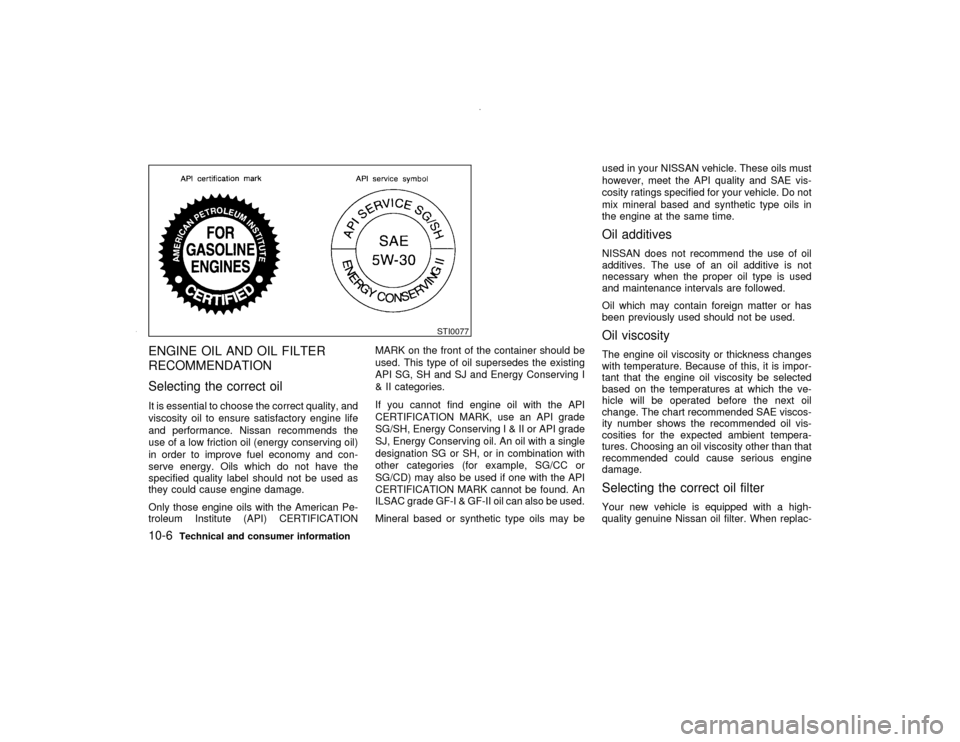
Only those engine oils with the American Pe-
troleum Institute (API) CERTIFICATIONMARK on the front of the container should be
used. This type of oil supersedes the existing
API SG, SH and SJ and Energy Conserving I
& II categories.
If you cannot find engine oil with the API
CERTIFICATION MARK, use an API grade
SG/SH, Energy ConservingI&IIorAPIgrade
SJ, Energy Conserving oil. An oil with a single
designation SG or SH, or in combination with
other categories (for example, SG/CC or
SG/CD) may also be used if one with the API
CERTIFICATION MARK cannot be found. An
ILSAC grade GF-I & GF-II oil can also be used.
Mineral based or synthetic type oils may beused in your NISSAN vehicle. These oils must
however, meet the API quality and SAE vis-
cosity ratings specified for your vehicle. Do not
mix mineral based and synthetic type oils in
the engine at the same time.
Oil additivesNISSAN does not recommend the use of oil
additives. The use of an oil additive is not
necessary when the proper oil type is used
and maintenance intervals are followed.
Oil which may contain foreign matter or has
been previously used should not be used.Oil viscosityThe engine oil viscosity or thickness changes
with temperature. Because of this, it is impor-
tant that the engine oil viscosity be selected
based on the temperatures at which the ve-
hicle will be operated before the next oil
change. The chart recommended SAE viscos-
ity number shows the recommended oil vis-
cosities for the expected ambient tempera-
tures. Choosing an oil viscosity other than that
recommended could cause serious engine
damage.Selecting the correct oil filterYour new vehicle is equipped with a high-
quality genuine Nissan oil filter. When replac-
STI0077
10-6
Technical and consumer information
Z
00.1.17/R50-D/V5
X