2000 NISSAN MAXIMA coolant
[x] Cancel search: coolantPage 168 of 239

The engine cooling system is filled at the
factory with a high-quality, year-round, anti-
freeze coolant solution. The anti-freeze solu-
tion contains rust and corrosion inhibitors,
therefore additional cooling system additives
are not necessary.
CAUTION
When adding or replacing coolant, be
sure to use only a genuine NISSAN anti-
freeze coolant or equivalent with the
proper mixture ratio of 50% anti-freeze
and 50% demineralized water/distilled
water. The use of other types of coolant
solutions may damage your engine
cooling system.Outside temperature
down to
Anti-
freezeDeminer-
alized
water/
distilled
water ÉC ÉF
þ35 þ30 50% 50%
WARNING
INever remove the radiator cap when
the engine is hot. Serious burns
could be caused by high pressure
fluid escaping from the radiator. Wait
until the engine and radiator cool
down.
ISee ªIf your vehicle overheatsº in the
ª6. In case of emergencyº section.
IThe radiator is equipped with a pres-
sure cap. To prevent engine damage,
use only a genuine NISSAN radiator
cap.
CHECKING ENGINE COOLANT
LEVELCheck the coolant level in the reservoir tank
when the engine is cold. If the coolant level is
below MIN, add coolant up to the MAX level. If
the reservoir tank is empty, check the coolant
level in the radiatorwhen the engine is cold.
If there is insufficient coolant in the radiator, fill
the radiator with coolant up to the filler opening
and also add it to the reservoir tank up to the
MAX level.
If the engine cooling system frequently
requires coolant, have it checked by your
NISSAN dealer.
SDI0960
ENGINE COOLING SYSTEM
Do-it-yourself
8-5
Z
00.1.17/A33-D/V5.0
X
Page 169 of 239
CHANGING ENGINE COOLANTIMajor cooling system repairs should be
performed by your NISSAN dealer. The
service procedures can be found in the
appropriate NISSAN Service Manual.IImproper servicing can result in reduced
heater performance and engine overheat-
ing.
WARNING
ITo avoid the danger of being scalded,
never change the coolant when the
engine is hot.
INever remove the radiator cap when
the engine is hot. Serious burns
could be caused by high pressure
fluid escaping from the radiator.
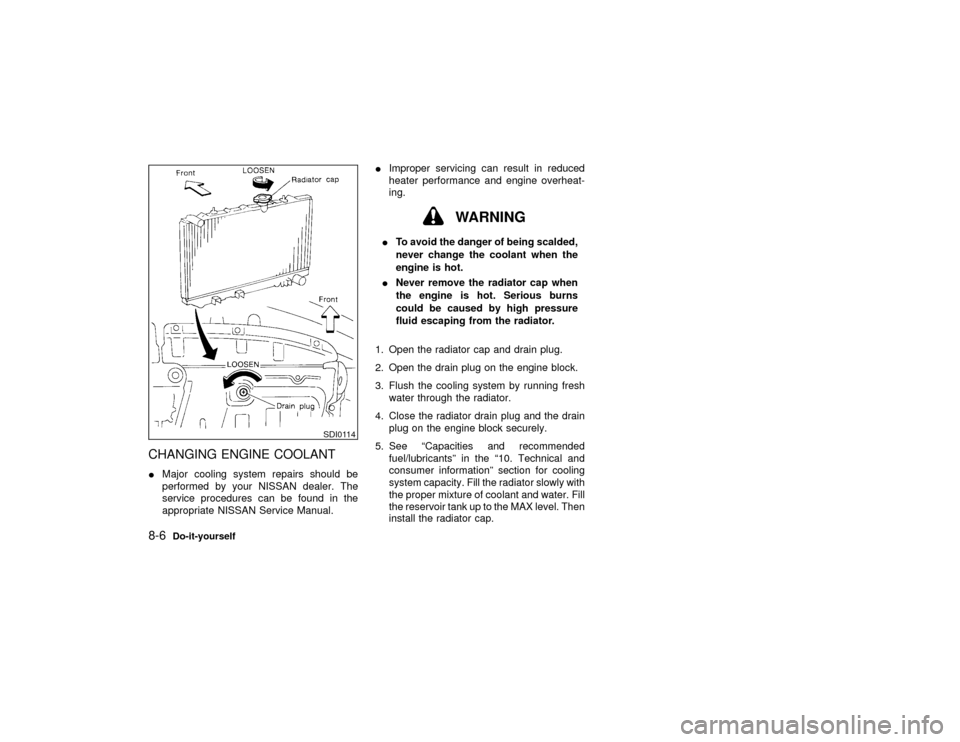
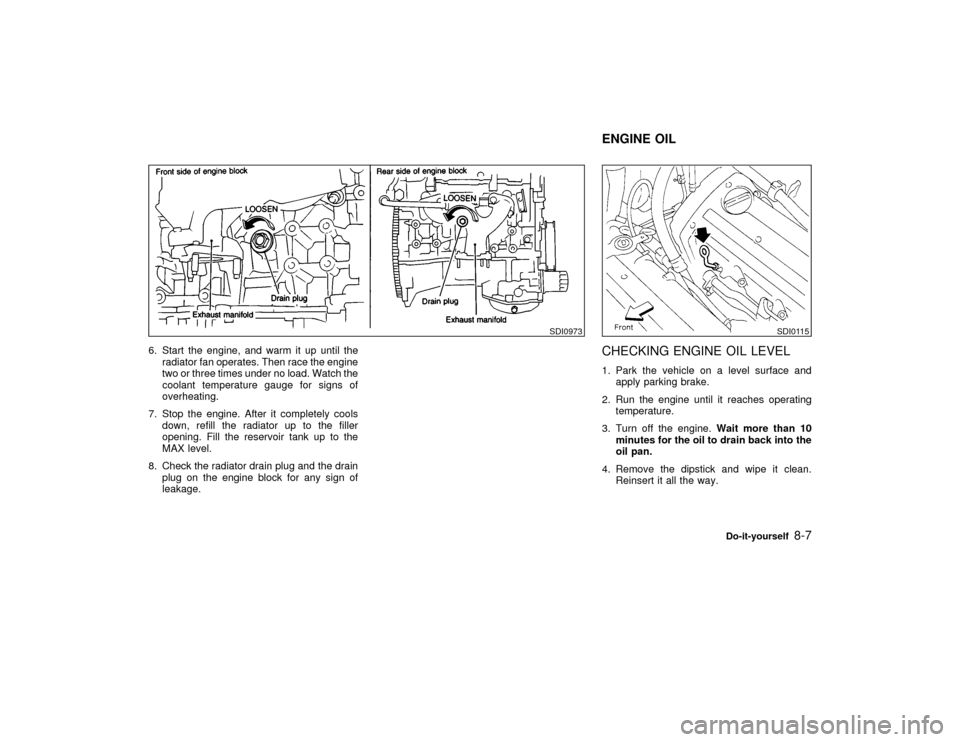
1. Open the radiator cap and drain plug.
2. Open the drain plug on the engine block.
3. Flush the cooling system by running fresh
water through the radiator.
4. Close the radiator drain plug and the drain
plug on the engine block securely.
5. See ªCapacities and recommended
fuel/lubricantsº in the ª10. Technical and
consumer informationº section for cooling
system capacity. Fill the radiator slowly with
the proper mixture of coolant and water. Fill
the reservoir tank up to the MAX level. Then
install the radiator cap.
SDI0114
8-6
Do-it-yourself
Z
00.1.17/A33-D/V5.0
X
Page 170 of 239
6. Start the engine, and warm it up until the
radiator fan operates. Then race the engine
two or three times under no load. Watch the
coolant temperature gauge for signs of
overheating.
7. Stop the engine. After it completely cools
down, refill the radiator up to the filler
opening. Fill the reservoir tank up to the
MAX level.
8. Check the radiator drain plug and the drain
plug on the engine block for any sign of
leakage.
CHECKING ENGINE OIL LEVEL1. Park the vehicle on a level surface and
apply parking brake.
2. Run the engine until it reaches operating
temperature.
3. Turn off the engine.Wait more than 10
minutes for the oil to drain back into the
oil pan.
4. Remove the dipstick and wipe it clean.
Reinsert it all the way.
SDI0973
SDI0115
ENGINE OIL
Do-it-yourself
8-7
Z
00.1.17/A33-D/V5.0
X
Page 176 of 239
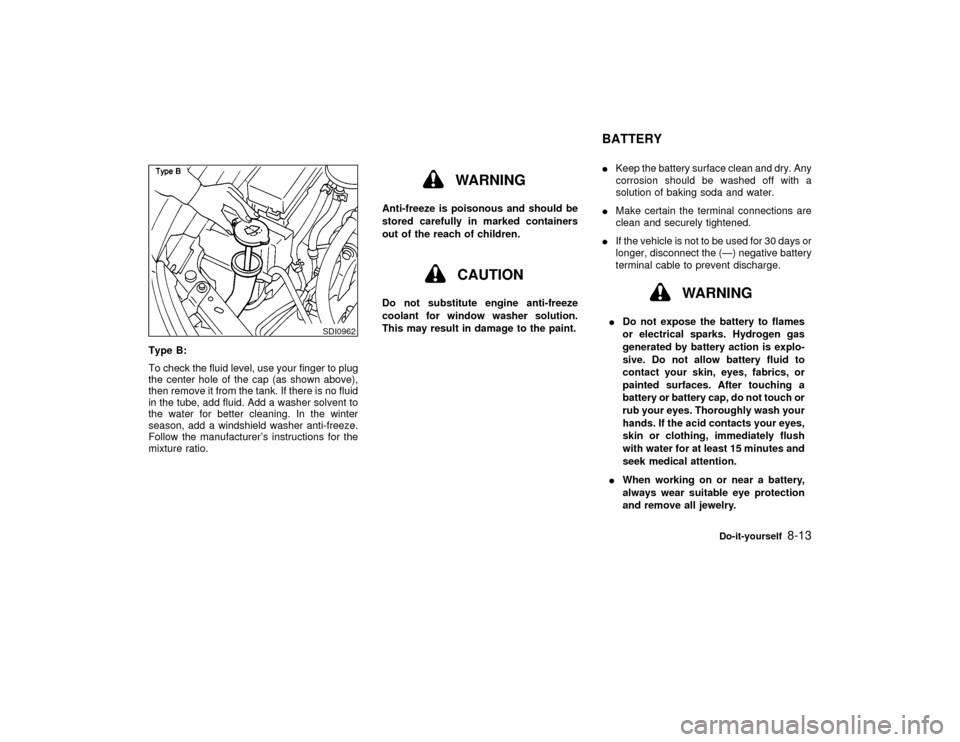
Type B:
To check the fluid level, use your finger to plug
the center hole of the cap (as shown above),
then remove it from the tank. If there is no fluid
in the tube, add fluid. Add a washer solvent to
the water for better cleaning. In the winter
season, add a windshield washer anti-freeze.
Follow the manufacturer's instructions for the
mixture ratio.
WARNING
Anti-freeze is poisonous and should be
stored carefully in marked containers
out of the reach of children.
CAUTION
Do not substitute engine anti-freeze
coolant for window washer solution.
This may result in damage to the paint.IKeep the battery surface clean and dry. Any
corrosion should be washed off with a
solution of baking soda and water.
IMake certain the terminal connections are
clean and securely tightened.
IIf the vehicle is not to be used for 30 days or
longer, disconnect the (Ð) negative battery
terminal cable to prevent discharge.
WARNING
IDo not expose the battery to flames
or electrical sparks. Hydrogen gas
generated by battery action is explo-
sive. Do not allow battery fluid to
contact your skin, eyes, fabrics, or
painted surfaces. After touching a
battery or battery cap, do not touch or
rub your eyes. Thoroughly wash your
hands. If the acid contacts your eyes,
skin or clothing, immediately flush
with water for at least 15 minutes and
seek medical attention.
IWhen working on or near a battery,
always wear suitable eye protection
and remove all jewelry.
SDI0962
BATTERY
Do-it-yourself
8-13
Z
00.1.17/A33-D/V5.0
X
Page 203 of 239

system (for example, buckles, anchors, adjust-
ers and retractors) operate properly and
smoothly, and are installed securely. Check
the belt webbing for cuts, fraying, wear or
damage.
Accelerator pedal:Check the pedal for
smooth operation and make sure the pedal
does not catch or require uneven effort. Keep
the floor mats away from the pedal.
Clutch pedal*:Make sure the pedal operates
smoothly and check that it has the proper free
play.
Brakes:Check that the brakes do not pull the
vehicle to one side when applied.
Brake pedal and booster*:Check the pedal
for smooth operation and make sure it has the
proper distance under it when depressed fully.
Check the brake booster function. Be sure to
keep floor mats away from the pedal.
Parking brake*:Check that the lever has the
proper travel and make sure that the vehicle is
held securely on a fairly steep hill when only
the parking brake is applied.
Automatic transaxle P (Park) position
mechanism:On a fairly steep hill check that
the vehicle is held securely with the selector
lever in the P (Park) position without applying
any brakes.
Under the hood and the vehicleThe maintenance items listed here should be
checked periodically (for example, each time
you check the engine oil or refuel).
Windshield washer fluid*:Check that there
is adequate fluid in the tank.
Engine coolant level*:Check the coolant
level when the engine is cold.
Radiator and hoses:Check the front of the
radiator and clean off any dirt, insects, leaves,
etc., that may have accumulated. Make sure
the hoses have no cracks, deformation, dete-
rioration or loose connections.
Brake and clutch fluid levels*:Make sure
that the brake and clutch fluid levels are be-
tween the MAX and MIN lines on the reservoir.
Battery*:Check the fluid level in each cell. It
should be between the MAX and MIN lines.
Engine drive belts*:Make sure that no belt is
frayed, worn, cracked or oily.
Engine oil level*:Check the level on the
dipstick after parking the vehicle on a level
spot and turning off the engine.
Power steering fluid level* and lines:Check
the level in the reservoir tank with the engineoff. Check the lines for proper attachment,
leaks, cracks, etc.
Automatic transaxle fluid level*:Check the
level on the dipstick after putting the selector
lever in P (Park) position with the engine idling.
Exhaust system:Make sure there are no
loose supports, cracks or holes. If the sound of
the exhaust seems unusual or there is a smell
of exhaust fumes, immediately locate the
trouble and correct it. (See ªPrecautions when
starting and drivingº in the ª5. Starting and
drivingº section for exhaust gas (carbon mon-
oxide).)
Underbody:The underbody is frequently ex-
posed to corrosive substances such as those
used on icy roads or to control dust. It is very
important to remove these substances, other-
wise rust will form on the floor pan, frame, fuel
lines and around the exhaust system. At the
end of winter, the underbody should be thor-
oughly flushed with plain water, being careful
to clean those areas where mud and dirt may
accumulate. For additional information, see
ªCleaning exteriorº in the ª7. Appearance and
careº section.
Fluid leaks:Check under the vehicle for fuel,
oil, water or other fluid leaks after the vehicle
has been parked for a while. Water dripping
from the air conditioner after use is normal. If
9-4
Maintenance
Z
00.1.17/A33-D/V5.0
X
Page 205 of 239
![NISSAN MAXIMA 2000 A33 / 5.G Owners Manual Schedule 1Abbreviations: R = Replace I = Inspect. Correct or replace if necessary. [ ]: At the mileage intervals onlyMAINTENANCE OPERATIONMAINTENANCE INTERVAL
Perform at number of miles,
kilometers or](/manual-img/5/639/w960_639-204.png "NISSAN MAXIMA 2000 A33 / 5.G Owners Manual Schedule 1Abbreviations: R = Replace I = Inspect. Correct or replace if necessary. [ ]: At the mileage intervals onlyMAINTENANCE OPERATIONMAINTENANCE INTERVAL
Perform at number of miles,
kilometers or")
Schedule 1Abbreviations: R = Replace I = Inspect. Correct or replace if necessary. [ ]: At the mileage intervals onlyMAINTENANCE OPERATIONMAINTENANCE INTERVAL
Perform at number of miles,
kilometers or months, which-
ever comes first.Miles x 1,000 3.8 7.5 11.3 15 18.8 22.5 26.3 30 33.8 37.5 41.3 45 48.8 52.5 56.3 60
(km x 1,000) (6) (12) (18) (24) (30) (36) (42) (48) (54) (60) (66) (72) (78) (84) (90) (96)
Months 3 6 9 12 15 18 21 24 27 30 33 36 39 42 45 48Emission control system maintenanceDrive belts See NOTE (1)I*
Air cleaner filter See NOTE (2) [R] [R]
EVAP vapor linesI* I*
Fuel linesI* I*
Fuel filter See NOTE (3)
Engine coolant See NOTE (4)R*
Engine oilRRRRRRRRRRRRRRRR
Engine oil filter (Use part No. 15208-31U01 or equivalent)RRRRRRRRRRRRRRRR
Spark plugs (Use PLATINUM-TIPPED type) Replace every 105,000 miles (169,000 km)
Intake & exhaust valve clear-
ance*See NOTE (5)NOTE: (1) After 60,000 miles (96,000 km) or 48 months, inspect every 15,000 miles (24,000 km) or 12 months.
(2) If operating mainly in dusty conditions, more frequent maintenance may be required.
(3) Maintenance free item
(4) After 60,000 miles (96,000 km) or 48 months, replace every 30,000 miles (48,000 km) or 24 months.
(5) If valve noise increases, inspect valve clearance.
HMaintenance items and intervals with ª*º are recommended by NISSAN for reliable vehicle operation. The owner need not
perform such maintenance in order to maintain the emission warranty or manufacturer recall liability. Other maintenance
items and intervals are required.9-6
Maintenance
Z
00.1.17/A33-D/V5.0
X
Page 207 of 239
![NISSAN MAXIMA 2000 A33 / 5.G Owners Manual Schedule 2Abbreviations: R = Replace I = Inspect. Correct or replace if necessary. [ ]: At the mileage intervals onlyMAINTENANCE OPERATIONMAINTENANCE INTERVAL
Perform at number of miles, kilometers
or](/manual-img/5/639/w960_639-206.png "NISSAN MAXIMA 2000 A33 / 5.G Owners Manual Schedule 2Abbreviations: R = Replace I = Inspect. Correct or replace if necessary. [ ]: At the mileage intervals onlyMAINTENANCE OPERATIONMAINTENANCE INTERVAL
Perform at number of miles, kilometers
or")
Schedule 2Abbreviations: R = Replace I = Inspect. Correct or replace if necessary. [ ]: At the mileage intervals onlyMAINTENANCE OPERATIONMAINTENANCE INTERVAL
Perform at number of miles, kilometers
or months, whichever comes first.Miles x 1,000 7.5 15 22.5 30 37.5 45 52.5 60
(km x 1,000) (12) (24) (36) (48) (60) (72) (84) (96)
Months 6 12 18 24 30 36 42 48Emission control system maintenanceDrive belts See NOTE (1)I*
Air cleaner filter[R] [R]
EVAP vapor linesI* I*
Fuel linesI* I*
Fuel filter See NOTE (2)
Engine coolant See NOTE (3)R*
Engine oilRRRRRRRR
Engine oil filter (Use part No. 15208-31U01 or equivalent)RRRRRRRR
Spark plugs (Use PLATINUM-TIPPED type) Replace every 105,000 miles (169,000 km)
Intake & exhaust valve clearance* See NOTE (4)NOTE: (1) After 60,000 miles (96,000 km) or 48 months, inspect every 15,000 miles (24,000 km) or 12 months.
(2) Maintenance free item
(3) After 60,000 miles (96,000 km) or 48 months, replace every 30,000 miles (48,000 km) or 24 months.
(4) If valve noise increases, inspect valve clearance.
HMaintenance items and intervals with ª*º are recommended by NISSAN for reliable vehicle operation. The owner need not
perform such maintenance in order to maintain the emission warranty or manufacturer recall liability. Other maintenance
items and intervals are required.9-8
Maintenance
Z
00.1.17/A33-D/V5.0
X
Page 209 of 239

EXPLANATION OF MAINTENANCE
ITEMSAdditional information on the following
items with ª*º is found in the ª8. Do-it-
yourselfº section.Emission control system
maintenanceDrive belts*:Check drive belts for wear, fray-
ing or cracking and also for proper tension.
Replace the drive belts if found damaged.
Air cleaner filter:Under normal driving con-
ditions, the air cleaner filter should be replaced
in accordance with the maintenance schedule.
However, driving the vehicle in dusty areas
may cause more rapid clogging of the element.
Consequently, the element may have to be
replaced more frequently.
EVAP vapor lines:Check EVAP vapor lines
and connections for failure or looseness. If
leaks are found, replace them.
Fuel lines:Check the fuel hoses, piping and
connections for leaks, looseness or deteriora-
tion. Replace any parts if they are damaged.
Engine coolant*:Drain and flush the cooling
system.
Engine oil & oil filter*:Under normal drivingconditions, the engine oil and oil filter should
be replaced in accordance with the mainte-
nance schedule. However, under severe driv-
ing conditions, they may have to be replaced
more frequently.
Spark plugs*:Replace with new plugs having
the correct heat range.
Intake & exhaust valve clearance:Check the
valve clearance if valve noise increases.
Chassis and body maintenanceBrake lines & cables:Check the brake lines
and hoses (including brake booster vacuum
hoses, connections & check valve) and park-
ing brake cables for proper attachment, leaks,
cracks, chafing, abrasion, deterioration, etc.
Brake pads & rotors:Check these and the
other neighboring brake components for wear,
deterioration and leaks. Under severe driving
conditions, they may have to be inspected
more frequently.
Manual transaxle oil & automatic transaxle
fluid*:Check the fluid level and visually in-
spect for signs of leakage.
Under severe driving conditions, the oil should
be replaced at the specified interval.
Steering gear & linkage, axle & suspension
parts, and front drive shaft boots:Check fordamage, looseness and leakage of oil or
grease. Under severe driving conditions, they
may have to be inspected more frequently.
Exhaust system:Visually check the exhaust
pipes, muffler, and hangers for proper attach-
ment, leaks, cracks, chafing, abrasion, dete-
rioration, etc. Under severe driving conditions,
inspection should be performed more fre-
quently.
Supplemental air bag, and supplemental
side air bag (if so equipped) systems:Main-
tenance for the supplemental air bags or
supplemental side air bags should be done by
an authorized NISSAN dealer.
Automatic Speed Control Device (ASCD)
vacuum hoses:Check vacuum hose (be-
tween ASCD actuator and ASCD pump) for
breakage, cracks or fracture.
9-10
Maintenance
Z
00.1.17/A33-D/V5.0
X