2000 NISSAN FRONTIER manual transmission
[x] Cancel search: manual transmissionPage 229 of 269
![NISSAN FRONTIER 2000 D22 / 1.G Owners Manual Schedule Two
Abbreviations: R = Replace I = Inspect. Correct or replace if necessary. [ ]: At the mileage intervals only
MAINTENANCE OPERATIONMAINTENANCE INTERVAL
Perform at number of miles, kilometer](/manual-img/5/638/w960_638-228.png "NISSAN FRONTIER 2000 D22 / 1.G Owners Manual Schedule Two
Abbreviations: R = Replace I = Inspect. Correct or replace if necessary. [ ]: At the mileage intervals only
MAINTENANCE OPERATIONMAINTENANCE INTERVAL
Perform at number of miles, kilometer")
Schedule Two
Abbreviations: R = Replace I = Inspect. Correct or replace if necessary. [ ]: At the mileage intervals only
MAINTENANCE OPERATIONMAINTENANCE INTERVAL
Perform at number of miles, kilometers or
months, whichever comes first.Miles ý 1,000 7.5 15 22.5 30 37.5 45 52.5 60
(km ý 1,000) (12) (24) (36) (48) (60) (72) (84) (96)
Months 6 12 18 24 30 36 42 48
Chassis and body maintenance
Brake lines & cablesIIII
Brake pads, rotors, drums & liningsIIII
Automatic transmission, transfer & differential gear oil (exc. LSD)IIII
Manual transmission oil I I I [R]
Limited-slip differential (LSD) gear oil I R I R
Steering gear (box) & linkage, axle & suspension parts I I
Tire rotation See NOTE (2)
Drive shaft boots (
) IIII
Front wheel bearing grease (4x2) I I
Front wheel bearing grease & free-running hub grease (
)I R I R
Exhaust systemII
Supplemental air bag system See NOTE (1)
NOTE: (1) Inspect the supplemental air bag system 10 years after the date of manufacture noted on the FMVSS certification label.
(2) Refer to²Tire rotation²under the²General maintenance²heading earlier in this section.
Maintenance9-9
ZX
Page 230 of 269

EXPLANATION OF
MAINTENANCE ITEMS
Additional information on the following
items with an ``*'' is found in the ``Do-it-
yourself'' section of this manual.
Emission control system
maintenance
Drive belts*Check drive belts for wear,
fraying or cracking and also for proper ten-
sion. Replace any damaged drive belts.
Air cleaner filterUnder normal driving con-
ditions, the air cleaner filter should be re-
placed in accordance with the maintenance
schedule. However, driving the vehicle in
dusty areas may cause rapid clogging of the
element. Consequently, the element may
have to be replaced more frequently.
Positive crankcase ventilation (PCV) fil-
terUnder normal driving conditions, the
filter should be replaced in accordance with
the maintenance schedule. If the vehicle is
operated under extremely adverse weather
conditions or in areas where ambient tem-
peratures are either extremely low or ex-
tremely high, the filter may become cloggedmore rapidly. In such an event, replace the
filter immediately.
EVAP Vapor linesCheck vapor lines and
connections for leaks, looseness, or dete-
rioration. If leaks are found, replace the
lines.
Fuel lines (hoses, piping, connections,
etc.)Check the fuel hoses, piping and con-
nections for leaks, looseness or deteriora-
tion. Replace any damaged parts.
Fuel filterIf the vehicle is operated under
extremely adverse weather conditions or in
areas where ambient temperatures are ei-
ther extremely low or extremely high, the
filter might become clogged. In such an
event, replace the filter immediately.
Engine coolant*Flush and refill the cooling
system.
Engine oil and oil filter*Under normal
driving conditions, the engine oil and oil filter
should be replaced in accordance with the
maintenance schedule. However, under se-
vere driving conditions, they may have to be
replaced more frequently.
Spark plugs*Replace with new plugs hav-
ing the correct heat range.
Chassis and body maintenance
Brake lines and cablesCheck the brake
lines and hoses (including brake booster
vacuum hoses, connections & check valve)
and parking brake cables for proper attach-
ment, leaks, cracks, chafing, abrasion, de-
terioration, etc.
Brake pads, rotors, drums and linings
Check these and the other brake compo-
nents for wear, deterioration and leaks. Un-
der severe driving conditions, they may have
to be inspected more frequently.
Manual and automatic transmission,
transfer and differential gear oilVisually
inspect for signs of leakage and replace oil
for limited-slip differential. Under severe
driving conditions, the oil should be re-
placed at the specified interval.
Steering gear (box) and linkage, axle and
suspension parts and drive shaft boots
Check for damage, looseness and leakage
of oil or grease. Under severe driving con-
ditions, they may have to be inspected more
frequently.
9-10Maintenance
ZX
Page 235 of 269
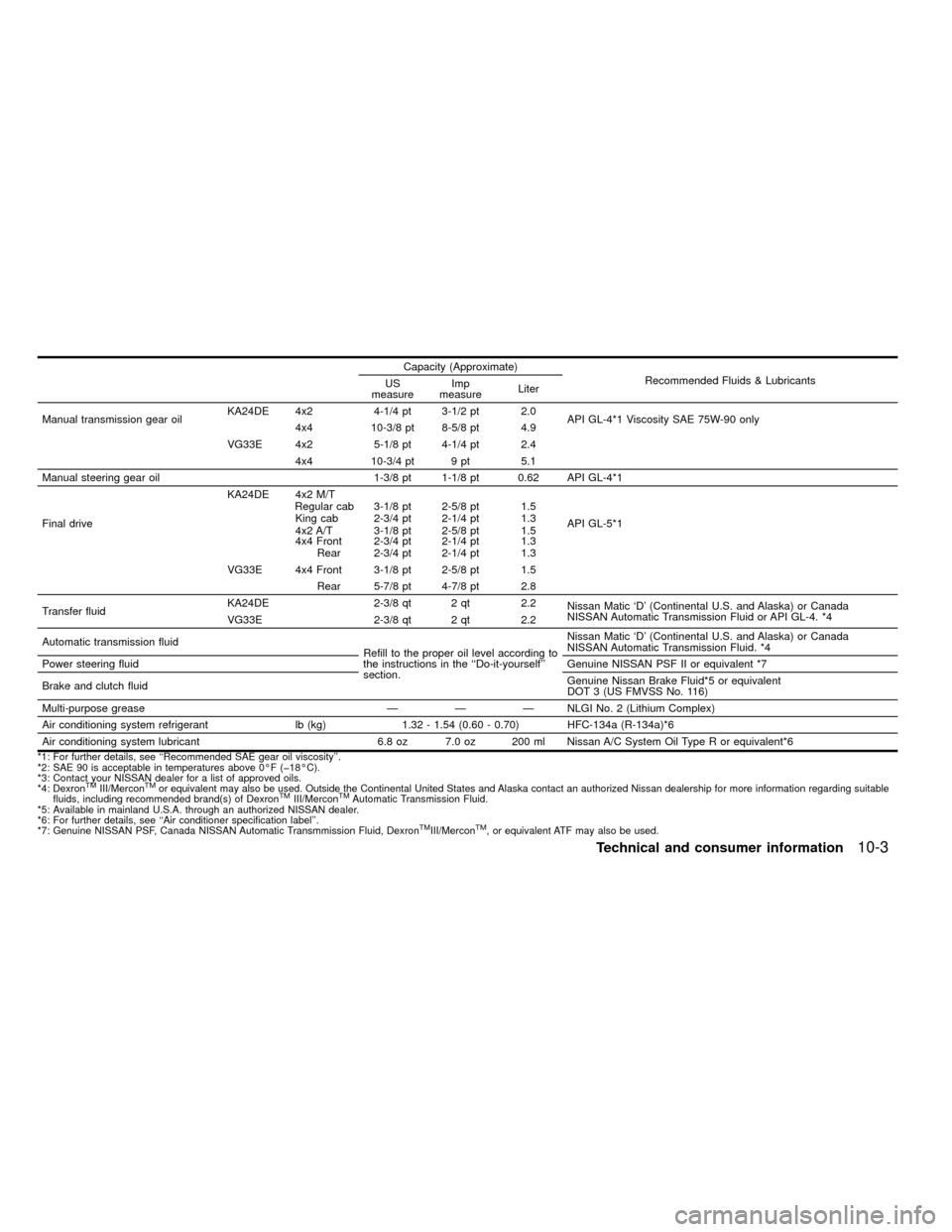
Capacity (Approximate)
Recommended Fluids & Lubricants
US
measureImp
measureLiter
Manual transmission gear oilKA24DE 4x2 4-1/4 pt 3-1/2 pt 2.0
API GL-4*1 Viscosity SAE 75W-90 only
4x4 10-3/8 pt 8-5/8 pt 4.9
VG33E 4x2 5-1/8 pt 4-1/4 pt 2.4
4x4 10-3/4 pt 9 pt 5.1
Manual steering gear oil 1-3/8 pt 1-1/8 pt 0.62 API GL-4*1
Final driveKA24DE 4x2 M/T
API GL-5*1 Regular cab 3-1/8 pt 2-5/8 pt 1.5
King cab 2-3/4 pt 2-1/4 pt 1.3
4x2 A/T 3-1/8 pt 2-5/8 pt 1.5
4x4 Front 2-3/4 pt 2-1/4 pt 1.3
Rear 2-3/4 pt 2-1/4 pt 1.3
VG33E 4x4 Front 3-1/8 pt 2-5/8 pt 1.5
Rear 5-7/8 pt 4-7/8 pt 2.8
Transfer fluidKA24DE 2-3/8 qt 2 qt 2.2
Nissan Matic `D' (Continental U.S. and Alaska) or Canada
NISSAN Automatic Transmission Fluid or API GL-4. *4
VG33E 2-3/8 qt 2 qt 2.2
Automatic transmission fluid
Refill to the proper oil level according to
the instructions in the ``Do-it-yourself''
section.Nissan Matic `D' (Continental U.S. and Alaska) or Canada
NISSAN Automatic Transmission Fluid. *4
Power steering fluidGenuine NISSAN PSF II or equivalent *7
Brake and clutch fluidGenuine Nissan Brake Fluid*5 or equivalent
DOT 3 (US FMVSS No. 116)
Multi-purpose grease Ð Ð Ð NLGI No. 2 (Lithium Complex)
Air conditioning system refrigerant lb (kg) 1.32 - 1.54 (0.60 - 0.70) HFC-134a (R-134a)*6
Air conditioning system lubricant 6.8 oz 7.0 oz 200 ml Nissan A/C System Oil Type R or equivalent*6
*1: For further details, see ``Recommended SAE gear oil viscosity''.
*2: SAE 90 is acceptable in temperatures above 0ÉF (þ18ÉC).
*3: Contact your NISSAN dealer for a list of approved oils.
*4: Dexron
TMIII/MerconTMor equivalent may also be used. Outside the Continental United States and Alaska contact an authorized Nissan dealership for more information regarding suitable
fluids, including recommended brand(s) of DexronTMIII/MerconTMAutomatic Transmission Fluid.
*5: Available in mainland U.S.A. through an authorized NISSAN dealer.
*6: For further details, see ``Air conditioner specification label''.
*7: Genuine NISSAN PSF, Canada NISSAN Automatic Transmmission Fluid, Dexron
TMIII/MerconTM, or equivalent ATF may also be used.
Technical and consumer information10-3
ZX
Page 251 of 269
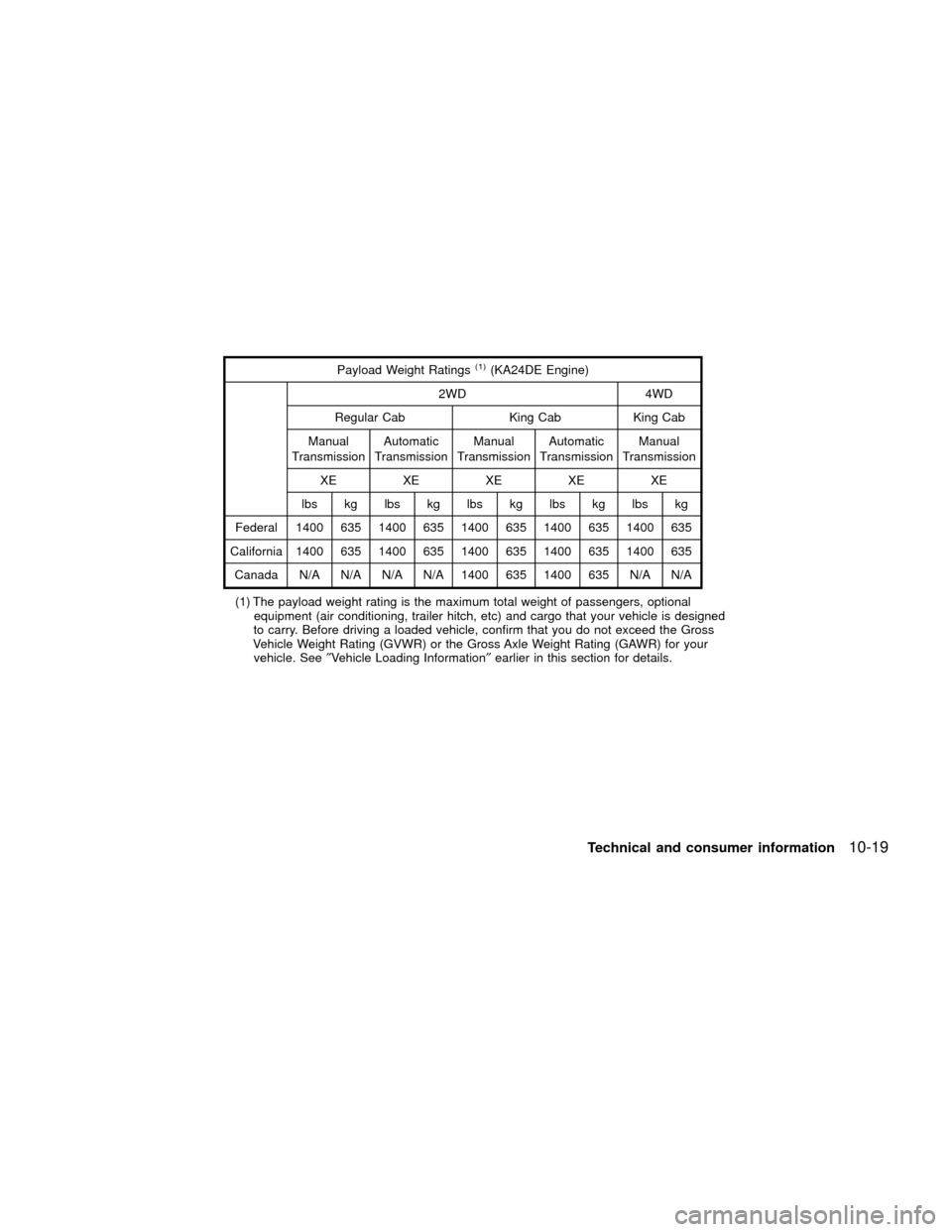
Payload Weight Ratings(1)(KA24DE Engine)
2WD 4WD
Regular Cab King Cab King Cab
Manual
TransmissionAutomatic
TransmissionManual
TransmissionAutomatic
TransmissionManual
Transmission
XE XE XE XE XE
lbs kg lbs kg lbs kg lbs kg lbs kg
Federal 1400 635 1400 635 1400 635 1400 635 1400 635
California 1400 635 1400 635 1400 635 1400 635 1400 635
Canada N/A N/A N/A N/A 1400 635 1400 635 N/A N/A
(1) The payload weight rating is the maximum total weight of passengers, optional
equipment (air conditioning, trailer hitch, etc) and cargo that your vehicle is designed
to carry. Before driving a loaded vehicle, confirm that you do not exceed the Gross
Vehicle Weight Rating (GVWR) or the Gross Axle Weight Rating (GAWR) for your
vehicle. See²Vehicle Loading Information²earlier in this section for details.
Technical and consumer information10-19
ZX
Page 252 of 269
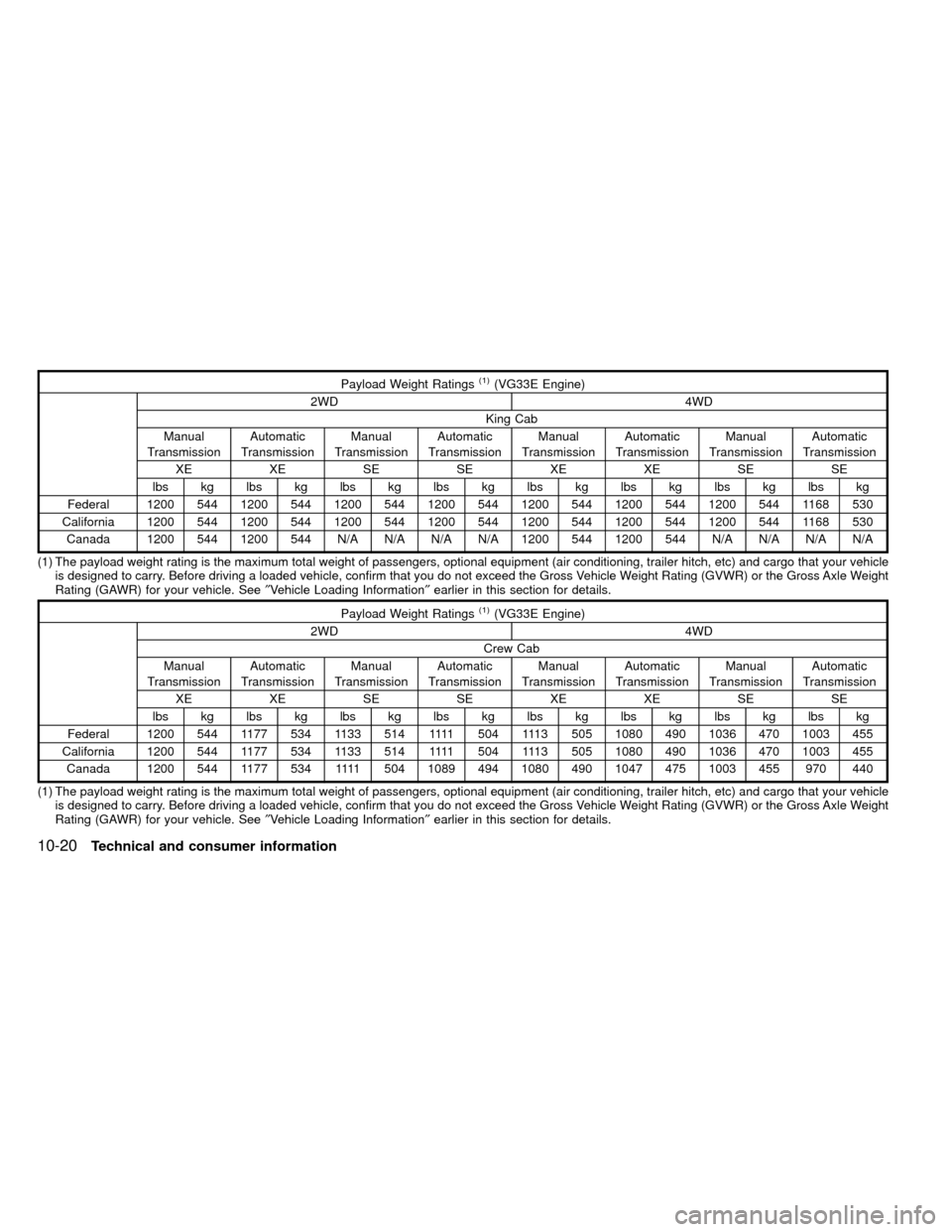
Payload Weight Ratings(1)(VG33E Engine)
2WD 4WD
King Cab
Manual
TransmissionAutomatic
TransmissionManual
TransmissionAutomatic
TransmissionManual
TransmissionAutomatic
TransmissionManual
TransmissionAutomatic
Transmission
XE XE SE SE XE XE SE SE
lbs kg lbs kg lbs kg lbs kg lbs kg lbs kg lbs kg lbs kg
Federal 1200 544 1200 544 1200 544 1200 544 1200 544 1200 544 1200 544 1168 530
California 1200 544 1200 544 1200 544 1200 544 1200 544 1200 544 1200 544 1168 530
Canada 1200 544 1200 544 N/A N/A N/A N/A 1200 544 1200 544 N/A N/A N/A N/A
(1) The payload weight rating is the maximum total weight of passengers, optional equipment (air conditioning, trailer hitch, etc) and cargo that your vehicle
is designed to carry. Before driving a loaded vehicle, confirm that you do not exceed the Gross Vehicle Weight Rating (GVWR) or the Gross Axle Weight
Rating (GAWR) for your vehicle. See²Vehicle Loading Information²earlier in this section for details.
Payload Weight Ratings(1)(VG33E Engine)
2WD 4WD
Crew Cab
Manual
TransmissionAutomatic
TransmissionManual
TransmissionAutomatic
TransmissionManual
TransmissionAutomatic
TransmissionManual
TransmissionAutomatic
Transmission
XE XE SE SE XE XE SE SE
lbs kg lbs kg lbs kg lbs kg lbs kg lbs kg lbs kg lbs kg
Federal 1200 544 1177 534 1133 5141111 5 0 4 111 3 5 0 51080 490 1036 470 1003 455
California 1200 544 1177 534 1133 5141111 5 0 4 111 3 5 0 51080 490 1036 470 1003 455
Canada 1200 544 1177 5341111 5 0 41089 494 1080 490 1047 475 1003 455 970 440
(1) The payload weight rating is the maximum total weight of passengers, optional equipment (air conditioning, trailer hitch, etc) and cargo that your vehicle
is designed to carry. Before driving a loaded vehicle, confirm that you do not exceed the Gross Vehicle Weight Rating (GVWR) or the Gross Axle Weight
Rating (GAWR) for your vehicle. See²Vehicle Loading Information²earlier in this section for details.
10-20Technical and consumer information
ZX
Page 255 of 269
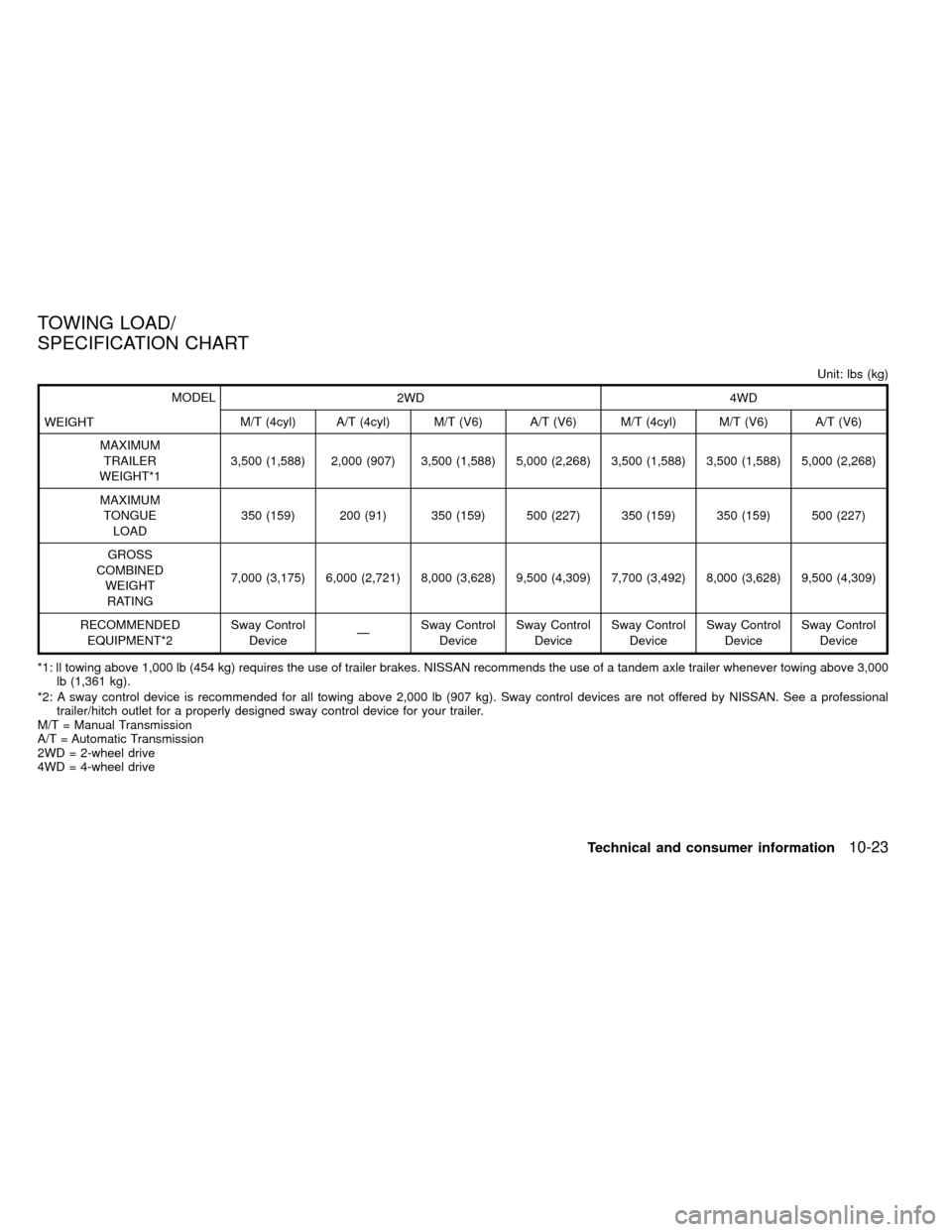
Unit: lbs (kg)
MODEL
WEIGHT2WD 4WD
M/T (4cyl) A/T (4cyl) M/T (V6) A/T (V6) M/T (4cyl) M/T (V6) A/T (V6)
MAXIMUM
TRAILER
WEIGHT*13,500 (1,588) 2,000 (907) 3,500 (1,588) 5,000 (2,268) 3,500 (1,588) 3,500 (1,588) 5,000 (2,268)
MAXIMUM
TONGUE
LOAD350 (159) 200 (91) 350 (159) 500 (227) 350 (159) 350 (159) 500 (227)
GROSS
COMBINED
WEIGHT
RATING7,000 (3,175) 6,000 (2,721) 8,000 (3,628) 9,500 (4,309) 7,700 (3,492) 8,000 (3,628) 9,500 (4,309)
RECOMMENDED
EQUIPMENT*2Sway Control
DeviceÐSway Control
DeviceSway Control
DeviceSway Control
DeviceSway Control
DeviceSway Control
Device
*1: ll towing above 1,000 lb (454 kg) requires the use of trailer brakes. NISSAN recommends the use of a tandem axle trailer whenever towing above 3,000
lb (1,361 kg).
*2: A sway control device is recommended for all towing above 2,000 lb (907 kg). Sway control devices are not offered by NISSAN. See a professional
trailer/hitch outlet for a properly designed sway control device for your trailer.
M/T = Manual Transmission
A/T = Automatic Transmission
2WD = 2-wheel drive
4WD = 4-wheel drive
TOWING LOAD/
SPECIFICATION CHART
Technical and consumer information10-23
ZX
Page 258 of 269
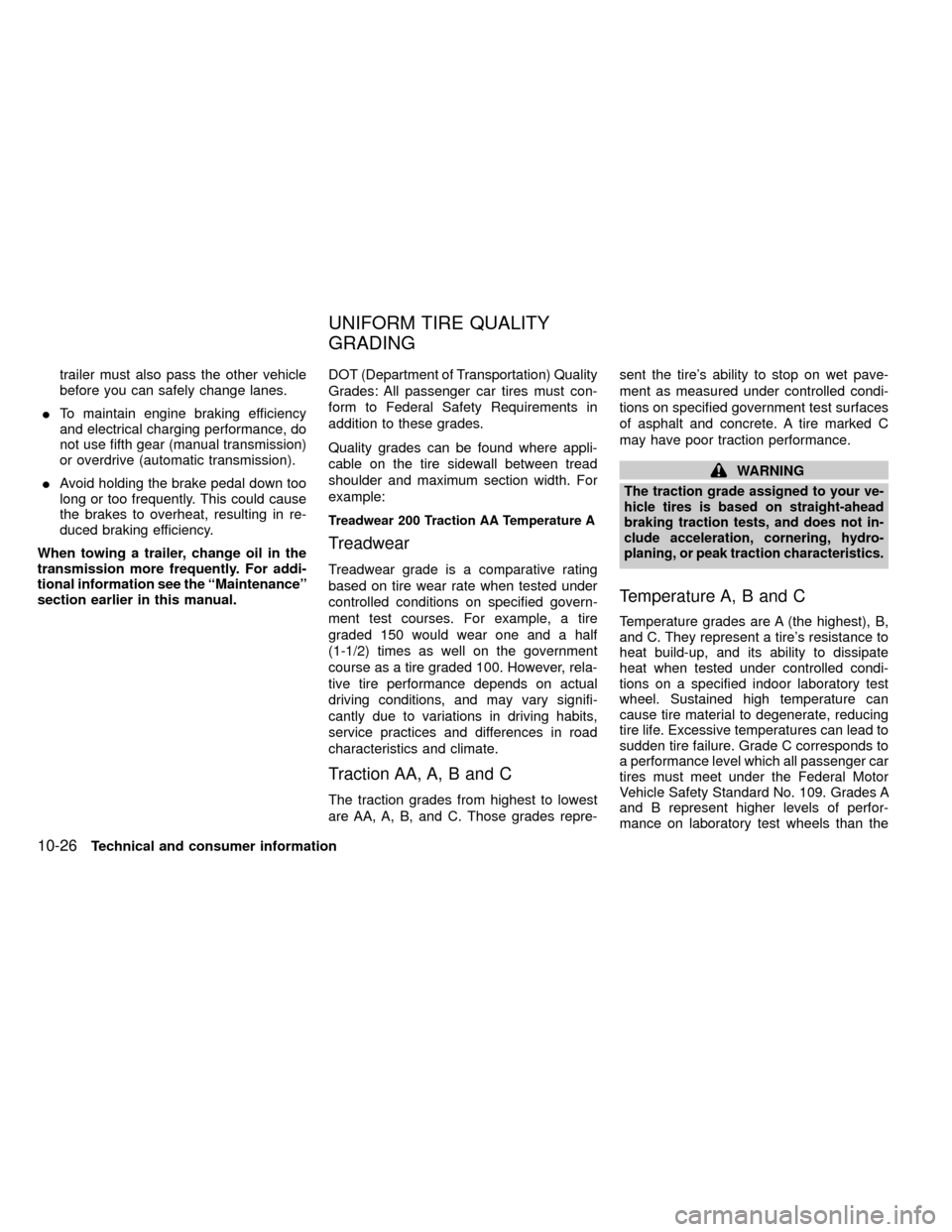
trailer must also pass the other vehicle
before you can safely change lanes.
ITo maintain engine braking efficiency
and electrical charging performance, do
not use fifth gear (manual transmission)
or overdrive (automatic transmission).
IAvoid holding the brake pedal down too
long or too frequently. This could cause
the brakes to overheat, resulting in re-
duced braking efficiency.
When towing a trailer, change oil in the
transmission more frequently. For addi-
tional information see the ``Maintenance''
section earlier in this manual.DOT (Department of Transportation) Quality
Grades: All passenger car tires must con-
form to Federal Safety Requirements in
addition to these grades.
Quality grades can be found where appli-
cable on the tire sidewall between tread
shoulder and maximum section width. For
example:
Treadwear 200 Traction AA Temperature A
Treadwear
Treadwear grade is a comparative rating
based on tire wear rate when tested under
controlled conditions on specified govern-
ment test courses. For example, a tire
graded 150 would wear one and a half
(1-1/2) times as well on the government
course as a tire graded 100. However, rela-
tive tire performance depends on actual
driving conditions, and may vary signifi-
cantly due to variations in driving habits,
service practices and differences in road
characteristics and climate.
Traction AA, A, B and C
The traction grades from highest to lowest
are AA, A, B, and C. Those grades repre-sent the tire's ability to stop on wet pave-
ment as measured under controlled condi-
tions on specified government test surfaces
of asphalt and concrete. A tire marked C
may have poor traction performance.
WARNING
The traction grade assigned to your ve-
hicle tires is based on straight-ahead
braking traction tests, and does not in-
clude acceleration, cornering, hydro-
planing, or peak traction characteristics.
Temperature A, B and C
Temperature grades are A (the highest), B,
and C. They represent a tire's resistance to
heat build-up, and its ability to dissipate
heat when tested under controlled condi-
tions on a specified indoor laboratory test
wheel. Sustained high temperature can
cause tire material to degenerate, reducing
tire life. Excessive temperatures can lead to
sudden tire failure. Grade C corresponds to
a performance level which all passenger car
tires must meet under the Federal Motor
Vehicle Safety Standard No. 109. Grades A
and B represent higher levels of perfor-
mance on laboratory test wheels than the
UNIFORM TIRE QUALITY
GRADING
10-26Technical and consumer information
ZX
Page 264 of 269

Checking engine coolant level ............... 8-5
Engine coolant temperature gauge ........ 2-5
Corrosion protection .................................... 7-4
Cruise control............................................. 5-18
Cup holder ................................................. 2-21
D
Daytime running light system (Canada
only) ........................................................... 2-16
Dimensions and weights .......................... 10-11
Door locks .................................................... 3-2
Drive belts .................................................. 8-18
Driving
Auto-lock free-running hubs ................. 5-22
Cold weather driving............................. 5-30
Driving with automatic transmission ..... 5-14
Driving with manual transmission ......... 5-12
Manual-lock free-running hubs ............. 5-24
Precautions when starting and driving ... 5-2
E
Economy - fuel........................................... 5-20
Emission control information label........... 10-14
Emission control system warranty ........... 10-27
Engine
Before starting the engine ...................... 5-8
Capacities and recommended fuel/
lubricants .............................................. 10-2
Changing engine coolant........................ 8-6Changing engine oil.............................. 8-10
Changing engine oil filter...................... 8-12
Checking engine coolant level ............... 8-5
Checking engine oil level ....................... 8-9
Engine compartment check locations .... 8-3
Engine coolant temperature gauge ........ 2-5
Engine cooling system ........................... 8-5
Engine oil ................................................ 8-9
Engine oil and oil filter
recommendation ................................... 10-6
Engine oil pressure warning light ......... 2-10
Engine oil viscosity ............................... 10-7
Engine serial number ......................... 10-13
Engine specifications ............................ 10-9
Starting the engine ............................... 5-16
Exhaust gas (Carbon monoxide) ................. 5-2
F
Flashers (See hazard warning flasher
switch) ........................................................ 2-19
Flat tire ......................................................... 6-2
Floor mat positioning aid ............................. 7-4
Fluid
Automatic transmission fluid (ATF)....... 8-13
Brake fluid ................................... 10-3, 8-15
Capacities and recommended fuel/
lubricants .............................................. 10-2
Clutch fluid ............................................ 8-15
Engine coolant ........................................ 8-5
Engine oil ................................................ 8-9
Power steering fluid .............................. 8-14Window washer fluid ............................ 8-15
F.M.V.S.S. certification label .................... 10-13
Front seats
Bench...................................................... 1-7
Separate ................................................. 1-2
Fuel
Capacities and recommended fuel/
lubricants .............................................. 10-2
Fuel economy ....................................... 5-20
Fuel filler cap ........................................ 3-11
Fuel gauge.............................................. 2-6
Fuel octane rating................................. 10-5
Fuel recommendation ........................... 10-4
Fuses ......................................................... 8-26
G
Gauge
Engine coolant temperature gauge ........ 2-5
Fuel gauge.............................................. 2-6
Odometer ................................................ 2-3
Speedometer .......................................... 2-3
Tachometer ............................................. 2-5
General maintenance .................................. 9-2
H
Hazard warning flasher switch .................. 2-19
Headlight and turn signal switch ............... 2-16
Headlights .................................................. 8-29
Heater
11-2
ZX