2000 NISSAN ALTIMA tow
[x] Cancel search: towPage 201 of 242
WARNING
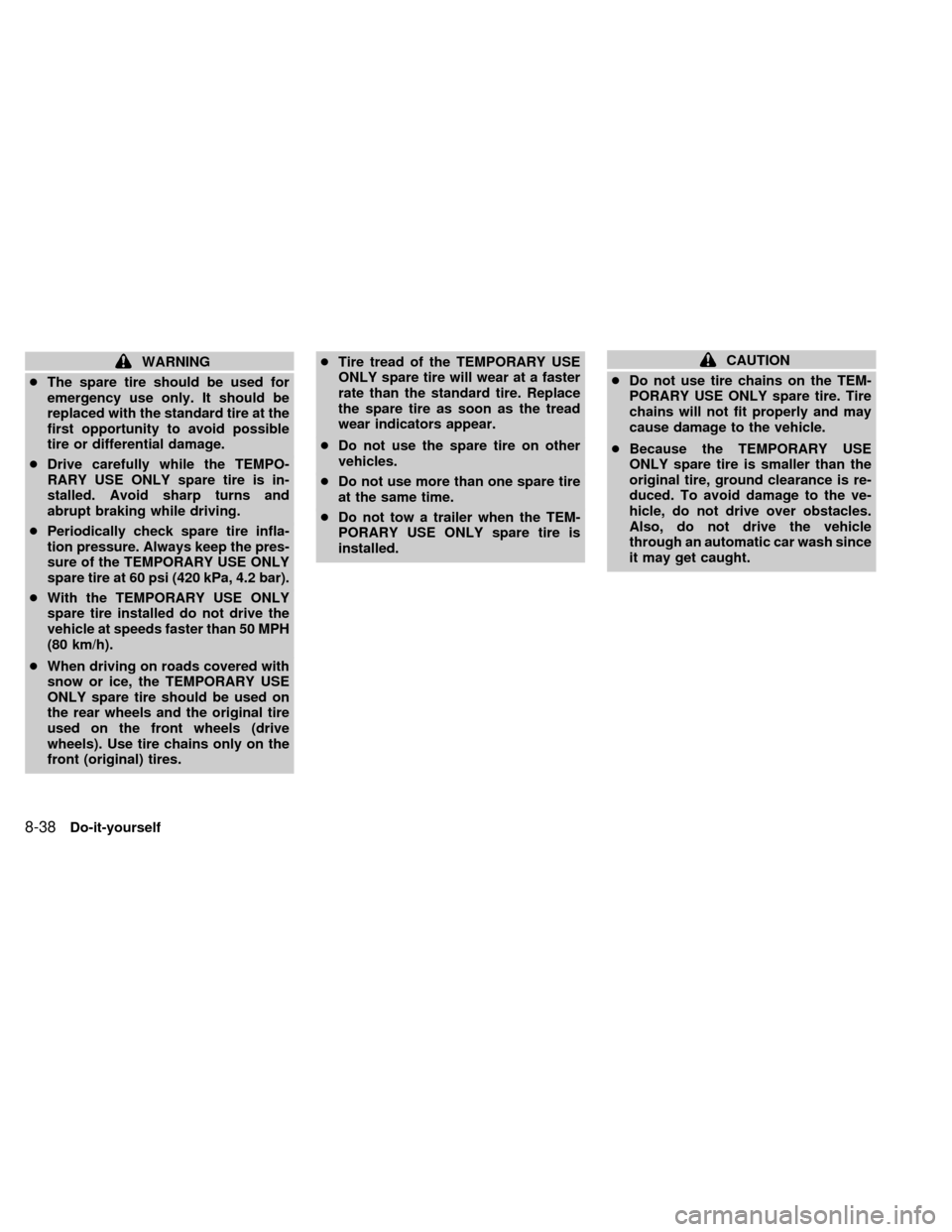
cThe spare tire should be used for
emergency use only. It should be
replaced with the standard tire at the
first opportunity to avoid possible
tire or differential damage.
cDrive carefully while the TEMPO-
RARY USE ONLY spare tire is in-
stalled. Avoid sharp turns and
abrupt braking while driving.
cPeriodically check spare tire infla-
tion pressure. Always keep the pres-
sure of the TEMPORARY USE ONLY
spare tire at 60 psi (420 kPa, 4.2 bar).
cWith the TEMPORARY USE ONLY
spare tire installed do not drive the
vehicle at speeds faster than 50 MPH
(80 km/h).
cWhen driving on roads covered with
snow or ice, the TEMPORARY USE
ONLY spare tire should be used on
the rear wheels and the original tire
used on the front wheels (drive
wheels). Use tire chains only on the
front (original) tires.cTire tread of the TEMPORARY USE
ONLY spare tire will wear at a faster
rate than the standard tire. Replace
the spare tire as soon as the tread
wear indicators appear.
cDo not use the spare tire on other
vehicles.
cDo not use more than one spare tire
at the same time.
cDo not tow a trailer when the TEM-
PORARY USE ONLY spare tire is
installed.CAUTION
cDo not use tire chains on the TEM-
PORARY USE ONLY spare tire. Tire
chains will not fit properly and may
cause damage to the vehicle.
cBecause the TEMPORARY USE
ONLY spare tire is smaller than the
original tire, ground clearance is re-
duced. To avoid damage to the ve-
hicle, do not drive over obstacles.
Also, do not drive the vehicle
through an automatic car wash since
it may get caught.
8-38Do-it-yourself
ZX
Page 206 of 242

and exhaust system. At the end of winter,
the underbody should be thoroughly flushed
with plain water, especially those areas
where mud and dirt may accumulate. See
the ``Appearance and care'' section for ad-
ditional information.
Fluid leaks ÐCheck under the vehicle for
fuel, oil, water or other fluid leaks after the
vehicle has been parked for a while. Water
dripping from the air conditioner after use is
normal. If you should notice any leaks or if
gasoline fumes are evident, check for the
cause and have it corrected immediately by
an authorized NISSAN dealer.To ensure smooth, trouble-free, safe and
economical driving, NISSAN provides two
periodic maintenance schedules that may
be used, depending upon the conditions in
which you usually drive. These schedules
contain both distance and time intervals, up
to 60,000 miles (96,000 km)/48 months. For
most people, the odometer reading indi-
cates when service is needed. However, if
you drive very little, your vehicle should be
serviced at the regular time intervals shown
in the schedules.After 60,000 miles
(96,000 km)/48 months, continue peri-
odic maintenance at the same
mileage/time intervals.
SCHEDULE 1
Follow Periodic Maintenance Schedule 1 if
your driving habits frequently include one or
more of the following driving conditions:
cRepeated short trips of less than 5
miles (8 km).
cRepeated short trips of less than 10
miles (16 km) with outside tempera-
tures below freezing.
cOperating the vehicle in hot weather
during in stop-and-go ``rush hour''
traffic.cExtensive idling and/or low speed
driving for long distances, such as
police, taxi or door-to-door delivery
use.
cDriving in dusty conditions.
cDriving on rough, muddy, or salt
spread roads.
cTowing a trailer, using a camper or a
car-top carrier.
SCHEDULE 2
Follow Periodic Maintenance Schedule 2 if
none of the driving conditions shown in
Schedule 1 apply to your driving habits.
PERIODIC MAINTENANCE
SCHEDULES
Maintenance9-5
ZX
Page 208 of 242
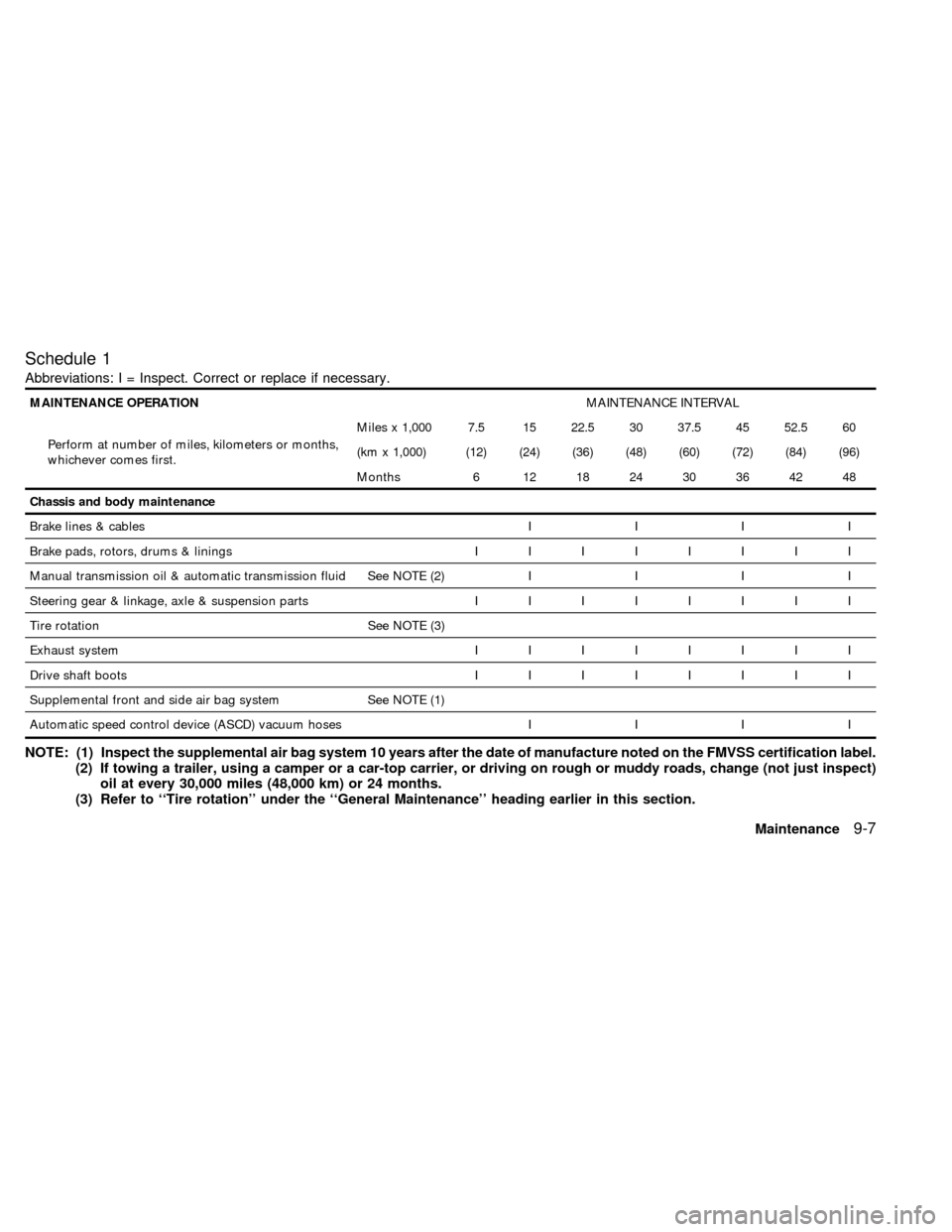
Schedule 1
Abbreviations: I = Inspect. Correct or replace if necessary.
MAINTENANCE OPERATIONMAINTENANCE INTERVAL
Perform at number of miles, kilometers or months,
whichever comes first.Miles x 1,000 7.5 15 22.5 30 37.5 45 52.5 60
(km x 1,000) (12) (24) (36) (48) (60) (72) (84) (96)
Months 6 12 18 24 30 36 42 48
Chassis and body maintenance
Brake lines & cablesIIII
Brake pads, rotors, drums & liningsIIIIIIII
Manual transmission oil & automatic transmission fluid See NOTE (2)IIII
Steering gear & linkage, axle & suspension partsIIIIIIII
Tire rotation See NOTE (3)
Exhaust systemIIIIIIII
Drive shaft bootsIIIIIIII
Supplemental front and side air bag system See NOTE (1)
Automatic speed control device (ASCD) vacuum hosesIIII
NOTE: (1) Inspect the supplemental air bag system 10 years after the date of manufacture noted on the FMVSS certification label.
(2) If towing a trailer, using a camper or a car-top carrier, or driving on rough or muddy roads, change (not just inspect)
oil at every 30,000 miles (48,000 km) or 24 months.
(3) Refer to ``Tire rotation'' under the ``General Maintenance'' heading earlier in this section.
Maintenance
9-7
ZX
Page 214 of 242

10 Technical and consumer information
Capacities and recommended fuel/lubricants ......10-2
Fuel recommendation...........................................10-3
Engine oil and oil filter recommendation..............10-5
Recommended SAE viscosity number.................10-6
Air conditioner system refrigerant and
lubricant recommendations ..................................10-7
Specifications .......................................................10-8
Engine ..................................................................10-8
Wheels and tires ..................................................10-9
Dimensions and weights ......................................10-9
When traveling or registering your vehicle in
another country ..................................................10-10
Vehicle identification ..........................................10-10
Vehicle identification number (VIN) plate...........10-10
Vehicle identification number
(chassis number) ................................................10-10
Engine serial number .........................................10-11
F.M.V.S.S. certification label ..............................10-11
Emission control information label .....................10-12Tire placard ........................................................10-12
Air conditioner specification label.......................10-12
Installing front license plate................................10-13
Vehicle loading information ................................10-13
Terms .................................................................10-13
Determining vehicle load capacity .....................10-14
Loading tips ........................................................10-14
Towing a trailer...................................................10-15
Maximum load limits...........................................10-15
Towing load/specification chart ..........................10-16
Towing safety .....................................................10-16
Uniform tire quality grading ................................10-18
Emission control system warranty .....................10-19
Reporting safety defects (US only) ....................10-19
Readiness for inspection/maintenance (I/M)
test (US only) .....................................................10-20
Owner's manual/service manual order
information ..........................................................10-21
ZX
Page 216 of 242
FUEL RECOMMENDATION
Your vehicle is designed to operate on
unleaded gasoline with an octane rating of
at least 87 AKI (Anti-Knock Index) (Re-
search octane number 91).
CAUTION
cUsing a fuel other than that specified
could adversely affect the emission
control system, and may also affect
warranty coverage.
cUnder no circumstances should a
leaded gasoline be used since this
will damage the three way catalyst.
Reformulated gasoline
Some fuel suppliers are now producing re-
formulated gasolines. These gasolines are
specially designed to reduce vehicle emis-
sions. NISSAN supports efforts towards
cleaner air and suggests that you use refor-
mulated gasoline when available.
Gasoline containing oxygenates
Some fuel suppliers sell gasoline containing
oxygenates such as ethanol, MTBE and
methanol with or without advertising theirpresence. Nissan does not recommend the
use of fuels of which the oxygenate content
and the fuel compatibility for your NISSAN
cannot be readily determined. If in doubt,
ask your service station manager.
If you use oxygenate-blend gasoline, please
take the following precautions as the usage
of such fuels may cause vehicle perfor-
mance problems and/or fuel system dam-
age.
cThe fuel should be unleaded and have
an octane rating no lower than that
recommended for unleaded gasoline.
cIf an oxygenate-blend other than a
methanol blend is used, it should con-
tain no more than 10% oxygenate.
(MTBE may, however, be added up to
15%.)
cIf a methanol blend is used, it should
contain no more than 5% methanol
(methyl alcohol, wood alcohol). It
should also contain a suitable amount
of appropriate cosolvents and corro-
sion inhibitors. If not properly formu-
lated with appropriate cosolvents and
corrosion inhibitors, such methanol
blends may cause fuel system dam-age and/or vehicle performance prob-
lems. At this time, sufficient data is
not available to ensure that all metha-
nol blends are suitable for use in NIS-
SAN vehicles.
If any driveability problems such as engine
stalling and difficult hot-starting are experi-
enced after using oxygenate-blend fuels,
immediately change to a non-oxygenate
fuel or a fuel with a low blend of MTBE.
Take care not to spill gasoline during
refueling. Gasoline containing oxygen-
ates can cause paint damage.
Aftermarket fuel additives
NISSAN does not recommend the use of
any fuel additives (i.e.: fuel injector cleaner,
octane booster, intake valve deposit remov-
ers, etc.) which are sold commercially.
Many of these additives intended for gum,
varnish or deposit removal may contain
active solvents or similar ingredients that
can be harmful to the fuel system and
engine.
Octane rating tips
In most parts of North America, you should
use unleaded gasoline with an octane rating
Technical and consumer information
10-3
ZX
Page 219 of 242

Selecting the correct oil filter
Your new NISSAN vehicle is equipped with
a high- quality genuine NISSAN oil filter.
When replacing, use a genuine NISSAN oil
filter or its equivalent for the reason de-
scribed in ``Change intervals''.
Change intervals
The oil and oil filter change intervals for your
engine are based on the use of the specified
quality oils and filters. Oil and filter other
than the specified quality, or oil and filter
change intervals longer than recommended
could reduce engine life. Damage to the
engine caused by improper maintenance or
use of incorrect oil and filter quality and/or
viscosity is not covered by the new NISSAN
vehicle warranties.
Your engine was filled with a high quality
engine oil when it was built. You do not have
to change the oil before the first recom-
mended change interval. Oil and filter
change intervals depend upon how you use
your vehicle. Operation under the following
conditions may require more frequent oil
and filter changes:
Ð repeated short distance driving at cold
outside temperatures,Ð driving in dusty conditions,
Ð extensive idling,
Ð towing a trailer.
RECOMMENDED SAE
VISCOSITY NUMBER
cSAE 5W-30 viscosity oil is preferred
for all temperatures. SAE 10W-30 or
10W-40 viscosity oil may be used if
TI1028
10-6Technical and consumer information
ZX
Page 228 of 242
Your new vehicle was designed to be used
primarily to carry passengers and cargo. Re-
member that towing a trailer will place addi-
tional loads on your vehicle's engine, drive
train, steering, braking and other systems.
A Nissan Trailer Towing Guide (U.S. only)
containing information on trailer towing ability
and the special equipment required may be
obtained from an authorized NISSAN dealer.
MAXIMUM LOAD LIMITS
Maximum trailer loads:
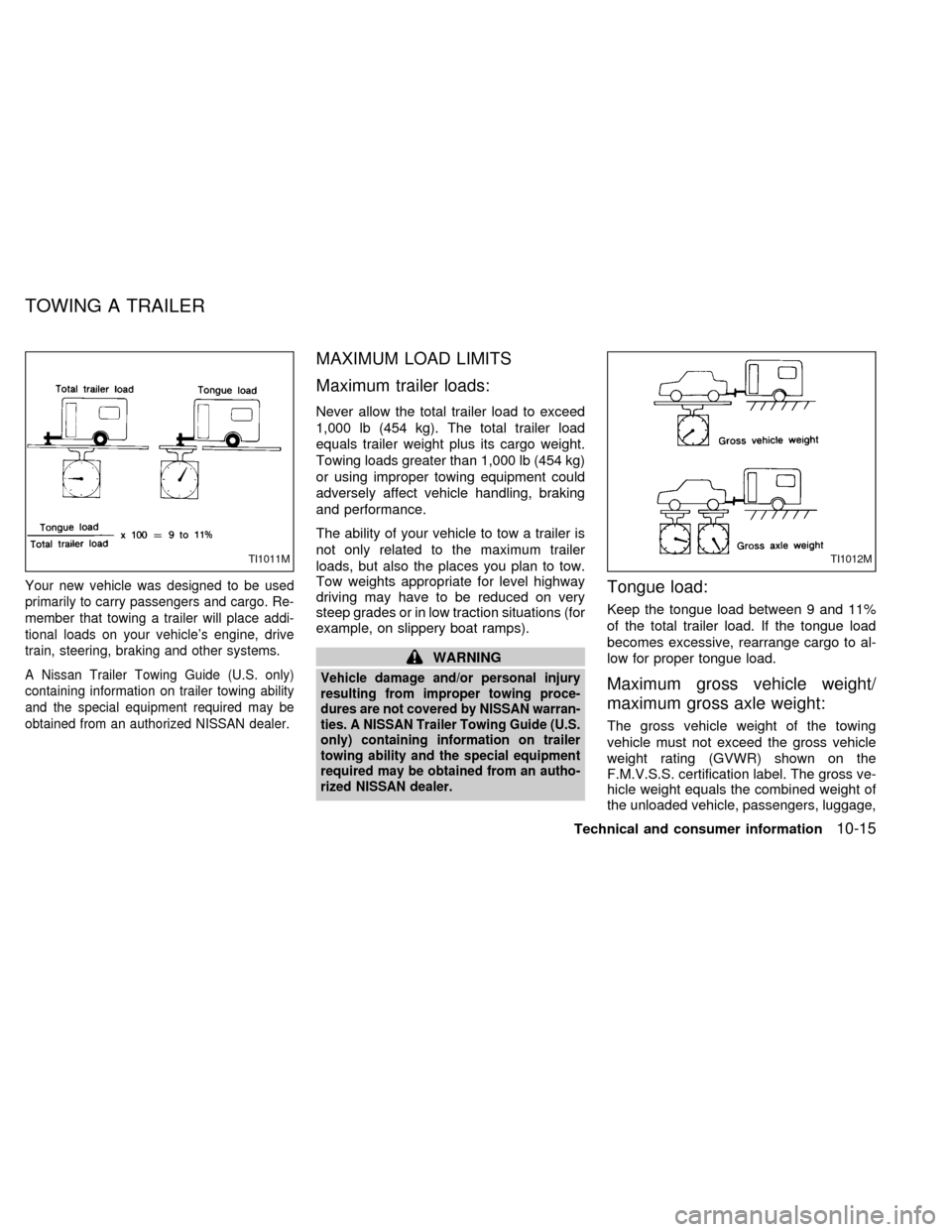
Never allow the total trailer load to exceed
1,000 lb (454 kg). The total trailer load
equals trailer weight plus its cargo weight.
Towing loads greater than 1,000 lb (454 kg)
or using improper towing equipment could
adversely affect vehicle handling, braking
and performance.
The ability of your vehicle to tow a trailer is
not only related to the maximum trailer
loads, but also the places you plan to tow.
Tow weights appropriate for level highway
driving may have to be reduced on very
steep grades or in low traction situations (for
example, on slippery boat ramps).
WARNING
Vehicle damage and/or personal injury
resulting from improper towing proce-
dures are not covered by NISSAN warran-
ties. A NISSAN Trailer Towing Guide (U.S.
only) containing information on trailer
towing ability and the special equipment
required may be obtained from an autho-
rized NISSAN dealer.
Tongue load:
Keep the tongue load between 9 and 11%
of the total trailer load. If the tongue load
becomes excessive, rearrange cargo to al-
low for proper tongue load.
Maximum gross vehicle weight/
maximum gross axle weight:
The gross vehicle weight of the towing
vehicle must not exceed the gross vehicle
weight rating (GVWR) shown on the
F.M.V.S.S. certification label. The gross ve-
hicle weight equals the combined weight of
the unloaded vehicle, passengers, luggage,
TI1011MTI1012M
TOWING A TRAILER
Technical and consumer information10-15
ZX
Page 229 of 242
hitch, trailer tongue load and any other
optional equipment. In addition, front or rear
gross axle weight must not exceed the
gross axle weight rating (GAWR) shown on
the F.M.V.S.S. certification label.
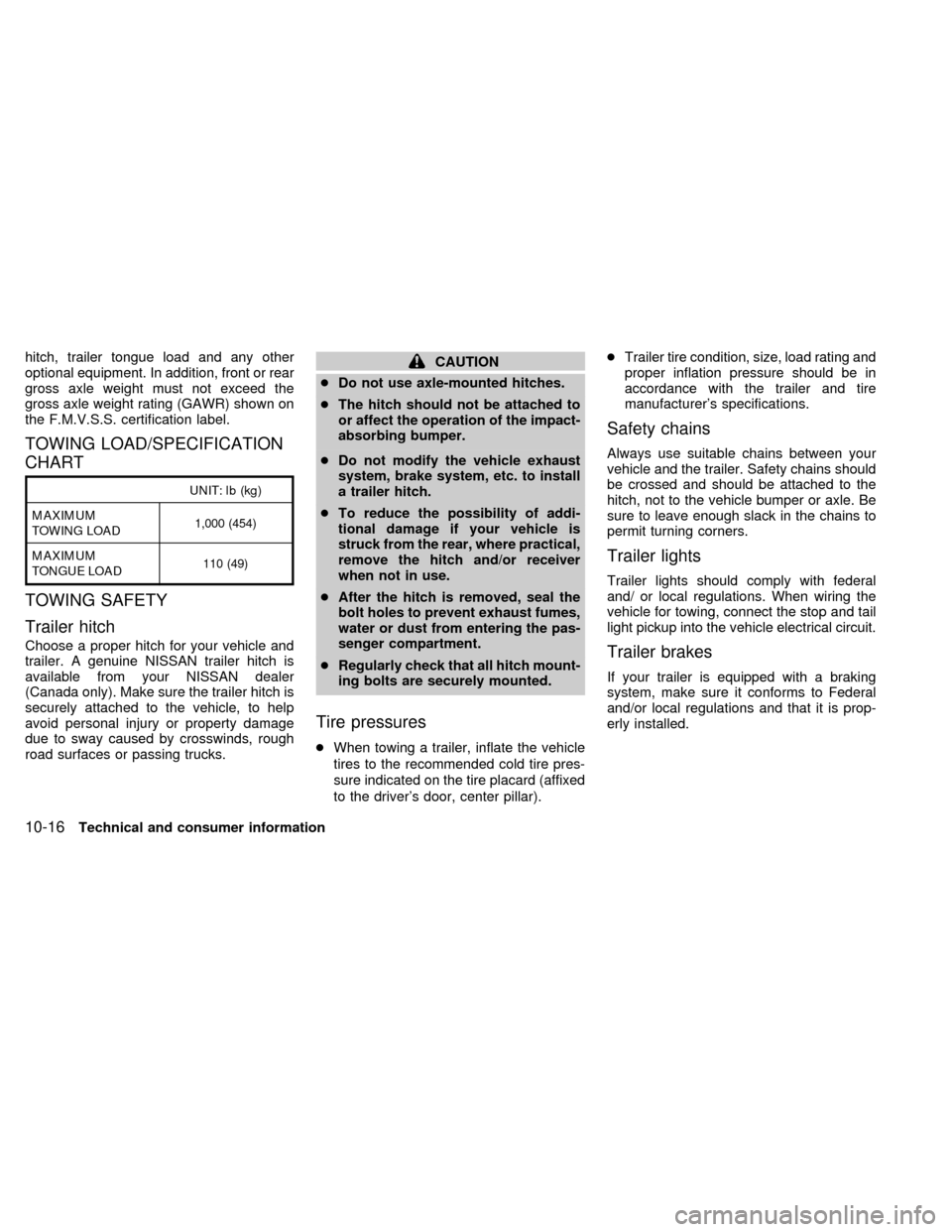
TOWING LOAD/SPECIFICATION
CHART
UNIT: lb (kg)
MAXIMUM
TOWING LOAD1,000 (454)
MAXIMUM
TONGUE LOAD110 (49)
TOWING SAFETY
Trailer hitch
Choose a proper hitch for your vehicle and
trailer. A genuine NISSAN trailer hitch is
available from your NISSAN dealer
(Canada only). Make sure the trailer hitch is
securely attached to the vehicle, to help
avoid personal injury or property damage
due to sway caused by crosswinds, rough
road surfaces or passing trucks.
CAUTION
cDo not use axle-mounted hitches.
cThe hitch should not be attached to
or affect the operation of the impact-
absorbing bumper.
cDo not modify the vehicle exhaust
system, brake system, etc. to install
a trailer hitch.
cTo reduce the possibility of addi-
tional damage if your vehicle is
struck from the rear, where practical,
remove the hitch and/or receiver
when not in use.
cAfter the hitch is removed, seal the
bolt holes to prevent exhaust fumes,
water or dust from entering the pas-
senger compartment.
cRegularly check that all hitch mount-
ing bolts are securely mounted.
Tire pressures
cWhen towing a trailer, inflate the vehicle
tires to the recommended cold tire pres-
sure indicated on the tire placard (affixed
to the driver's door, center pillar).cTrailer tire condition, size, load rating and
proper inflation pressure should be in
accordance with the trailer and tire
manufacturer's specifications.
Safety chains
Always use suitable chains between your
vehicle and the trailer. Safety chains should
be crossed and should be attached to the
hitch, not to the vehicle bumper or axle. Be
sure to leave enough slack in the chains to
permit turning corners.
Trailer lights
Trailer lights should comply with federal
and/ or local regulations. When wiring the
vehicle for towing, connect the stop and tail
light pickup into the vehicle electrical circuit.
Trailer brakes
If your trailer is equipped with a braking
system, make sure it conforms to Federal
and/or local regulations and that it is prop-
erly installed.
10-16Technical and consumer information
ZX