Page 168 of 280
FOR PLEASANT DRIVING
6–28
(4) When storing compact discs, always
store them in their individual cases.
Never place compact discs in direct
sunlight, or in any place where the tem-
perature or humidity is high.
H12F003a
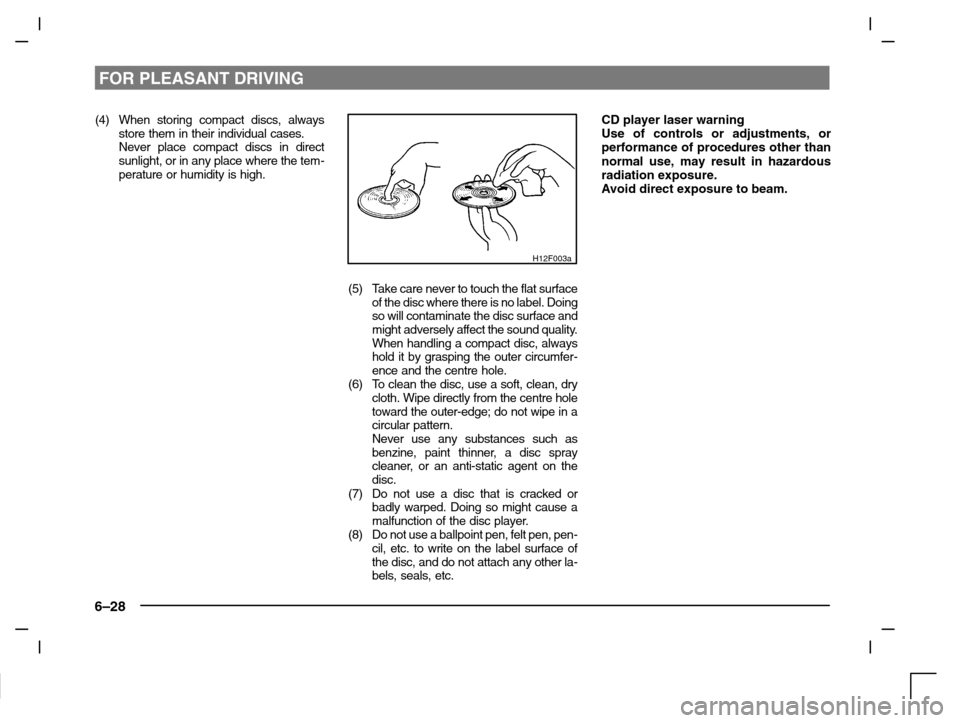
(5) Take care never to touch the flat surface
of the disc where there is no label. Doing
so will contaminate the disc surface and
might adversely affect the sound quality.
When handling a compact disc, always
hold it by grasping the outer circumfer-
ence and the centre hole.
(6) To clean the disc, use a soft, clean, dry
cloth. Wipe directly from the centre hole
toward the outer-edge; do not wipe in a
circular pattern.
Never use any substances such as
benzine, paint thinner, a disc spray
cleaner, or an anti-static agent on the
disc.
(7) Do not use a disc that is cracked or
badly warped. Doing so might cause a
malfunction of the disc player.
(8) Do not use a ballpoint pen, felt pen, pen-
cil, etc. to write on the label surface of
the disc, and do not attach any other la-
bels, seals, etc.
CD player laser warning
Use of controls or adjustments, or
performance of procedures other than
normal use, may result in hazardous
radiation exposure.
Avoid direct exposure to beam.
Page 174 of 280
FOR PLEASANT DRIVING
6–34
RHD
H03H023a
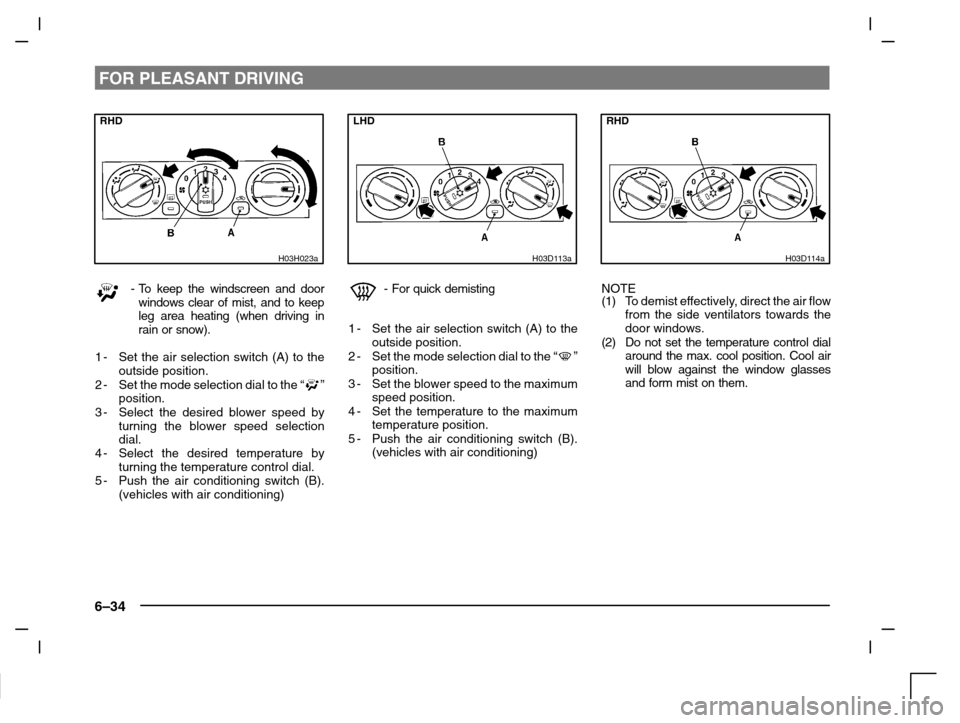
-To keep the windscreen and door
windows clear of mist, and to keep
leg area heating (when driving in
rain or snow).
1-Set the air selection switch (A) to the
outside position.
2-Set the mode selection dial to the “
”
position.
3-Select the desired blower speed by
turning the blower speed selection
dial.
4-Select the desired temperature by
turning the temperature control dial.
5-Push the air conditioning switch (B).
(vehicles with air conditioning)
LHD
H03D113a
-For quick demisting
1-Set the air selection switch (A) to the
outside position.
2-Set the mode selection dial to the “
”
position.
3-Set the blower speed to the maximum
speed position.
4-Set the temperature to the maximum
temperature position.
5-Push the air conditioning switch (B).
(vehicles with air conditioning)
RHD
H03D114a
NOTE
(1)To demist effectively, direct the air flow
from the side ventilators towards the
door windows.
(2) Do not set the temperature control dial
around the max. cool position. Cool air
will blow against the window glasses
and form mist on them.
Page 182 of 280
FOR PLEASANT DRIVING
6–42
H03D172a
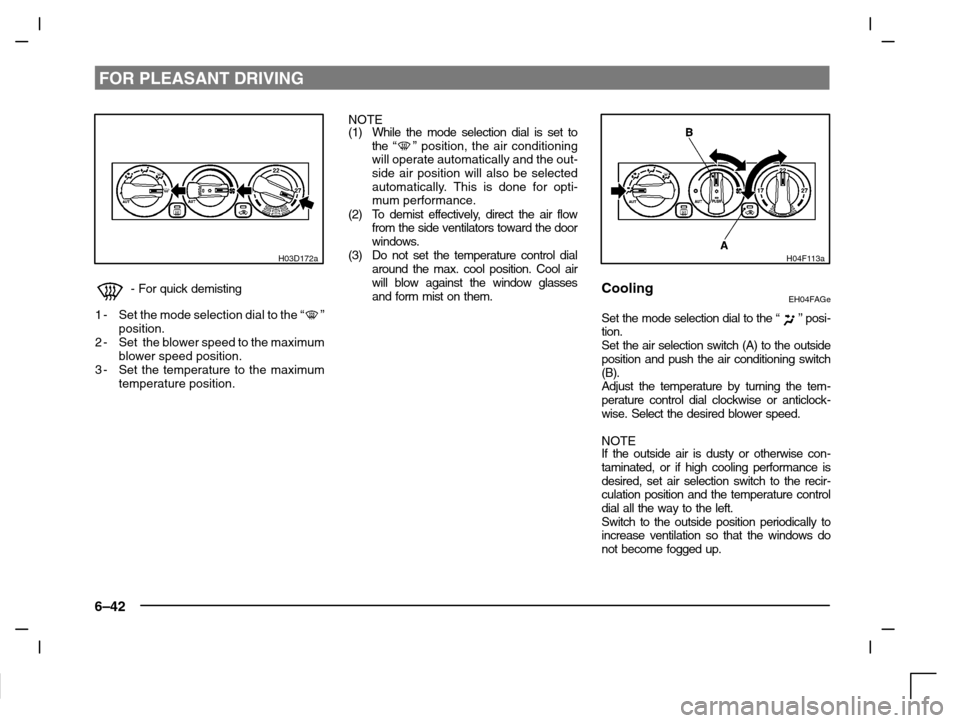
-For quick demisting
1-Set the mode selection dial to the “
”
position.
2-Set the blower speed to the maximum
blower speed position.
3-Set the temperature to the maximum
temperature position.NOTE
(1) While the mode selection dial is set to
the “
” position, the air conditioning
will operate automatically and the out-
side air position will also be selected
automatically. This is done for opti-
mum performance.
(2) To demist effectively, direct the air flow
from the side ventilators toward the door
windows.
(3) Do not set the temperature control dial
around the max. cool position. Cool air
will blow against the window glasses
and form mist on them.
H04F113a
CoolingEH04FAGe
Set the mode selection dial to the “” posi-
tion.
Set the air selection switch (A) to the outside
position and push the air conditioning switch
(B).
Adjust the temperature by turning the tem-
perature control dial clockwise or anticlock-
wise. Select the desired blower speed.
NOTE
If the outside air is dusty or otherwise con-
taminated, or if high cooling performance is
desired, set air selection switch to the recir-
culation position and the temperature control
dial all the way to the left.
Switch to the outside position periodically to
increase ventilation so that the windows do
not become fogged up.
Page 201 of 280

For emergencies
If the vehicle breaks down 8–2. . . . . . . . . . . . . . . . .
Operation under adverse driving conditions 8–2. .
Tools and jack 8–3. . . . . . . . . . . . . . . . . . . . . . . . . . . .
Jacking up the vehicle 8–4. . . . . . . . . . . . . . . . . . . . .
Spare wheel 8–6. . . . . . . . . . . . . . . . . . . . . . . . . . . . . .
Wheel covers* 8–8. . . . . . . . . . . . . . . . . . . . . . . . . . . .
If a tyre is punctured 8–9. . . . . . . . . . . . . . . . . . . . . .
Towing 8–12. . . . . . . . . . . . . . . . . . . . . . . . . . . . . . . . . .
Engine overheating 8–15. . . . . . . . . . . . . . . . . . . . . . .
Emergency starting 8–17. . . . . . . . . . . . . . . . . . . . . .
Bleeding the fuel system
(diesel-powered vehicles only) 8–21. . . . . . . . . . . . .
Removal of water from the fuel filter
(diesel-powered vehicles only) 8–21. . . . . . . . . . . . .
What to do if the engine speed becomes
unstable after the battery is replaced: 8–22. . . . . .
Fuses 8–22. . . . . . . . . . . . . . . . . . . . . . . . . . . . . . . . . . .
Changing a fuse 8–25. . . . . . . . . . . . . . . . . . . . . . . . .
Replacement of lamp bulbs 8–26. . . . . . . . . . . . . . .
Page 207 of 280

FOR EMERGENCIES
8–7
The spare wheel is stored beneath the floor
board of the luggage compartment; to re-
move it, using the wheel nut wrench, remove
the bolt securing the spare wheel, and take
out the spare wheel.Compact spare wheel*
The compact spare tyre is designed to save
space in the luggage compartment and its
lighter weight makes it easier to use if a flat
tyre occurs.
CAUTION
(1) The pressure should be period-
ically checked and maintained at
the specified pressure while the
tyre is stowed.
Driving with an insufficient tyre
pressure can lead to an accident.
If you have no choice but to drive
with an insufficient tyre pressure,
keep your speed down and inflate
the tyre to the correct pressure as
soon as possible. (Refer to “Tyre
inflation pressure” on page
9–12.)
(2) The compact spare wheel is for
temporary use only and should
be removed as soon as the orig-
inal wheel can be repaired or re-
placed.
Flange nuts are used for some
type of aluminium wheel. These
wheel nuts can be used temporar-
ily on the compact spare wheel.
CAUTION
(3) The vehicle must not be driven at
speeds in excess of 80 km/h while
using the compact spare wheel.
(4) The compact spare tyre is not so
good as the standard spare tyre
in controllability and stability.
When the compact spare tyre is
used, avoid quick starts, sudden
braking and sharp steering.
(5) Avoid driving through automatic
vehicle washers and over ob-
stacles that could possibly dam-
age the vehicle’s undercarriage.
Because the compact spare
wheel is smaller than the original
wheel, the ground clearance is
slightly reduced.
(6) The compact spare wheel is spe-
cifically designed for your vehicle
and it should not be used on any
other vehicle.
Page 211 of 280

FOR EMERGENCIES
8–11
N24A206a
7. Place the spare wheel and then install
the wheel nuts with the tapered ends
facing inward, then tighten by hand
until the wheel is no longer loose.
NOTE
(1)Flange nuts (2) can be temporarily
used on the steel wheel, but return to
the original wheel and tyre as soon as
possible.
(2)If all four wheels on vehicles with
flange nuts (2) are changed to steel
wheels, use tapered nuts (1).
CAUTION
Never apply oil to either wheel bolts or
nuts as it will cause them to over-
tighten.
N24A014a
8. Lower the vehicle slowly and then
tighten the nuts diagonally in two or
three steps until each nut has been
tightened to the specified torque.
Tightening torque:
98 to 117 Nm
(Achieved by applying force of
approx. 390 to 450N at end of
wheel nut wrench supplied with
vehicle)
CAUTION
Never use extra force with your foot
on the wheel nut wrench or by using
a pipe extension as you can over-
tighten the nut.
9. Lower and remove the jack and stow
the jack, bar, wheel nut wrench and flat
tyre wheel. Have the flat tyre repaired
as soon as possible.
Page 212 of 280

FOR EMERGENCIES
8–12
N24A071a
10. Check tyre inflation pressure. The
inflation pressure specification is
shown on the label. See illustration.
CAUTION
(1) Compact spare tyre is used tem-
porarily when the standard tyre
flows out. Repair the flown tyre as
soon as possible to replace the
compact spare tyre with the stan-
dard tyre.
(2) After changing the tyre, drive the
vehicle approximately 1000 km
and retighten the wheel nuts to
make sure that they are not loose.
CAUTION
(3) If the steering wheel vibrates
when driving after change of the
tyre, have the tyre checked for
balance at your MITSUBISHI
dealer.
(4) For the safe operation of your ve-
hicle, make sure you avoid mix-
ing one type of with another or
using tyres other than the speci-
fied size.
TowingEN25AIDf
Your vehicle may be towed either by another
vehicle with a rope, or by a tow truck.
The regulations concerning towing may
differ from country to country. It is recom-
mended that you obey the regulations of the
country where you are driving your vehicle.
CAUTION
(1) In the following cases, please
contact the MITSUBISHI dealer.
�The engine runs but the ve-
hicle does not move.
Or abnormal noise is pro-
duced.
�No automatic transmission
fluid is in the transmission.
(2) If the transmission is malfunc-
tioning or damaged, transport the
vehicle using a tow truck. (Refer
to the paragraph “Towing the ve-
hicle by a tow truck”.)
Page 213 of 280

FOR EMERGENCIES
8–13
Front
N25A200a
Towing with a rope
1. For vehicles with automatic transmis-
sion check the automatic transmis-
sion fluid level. (Refer to “Automatic
transmission fluid” on page 9–4.)
If the fluid level is low, transport the ve-
hicle with all wheels off the ground.
CAUTION
If the vehicle is out of automatic trans-
mission fluid, the transmission could
be damaged.
2. The towing hooks (A) are located as
shown in the illustrations. Attach the
tow rope to the towing hooks.
Rear
N25A057a
NOTE
(1) Using any part other than the desig-
nated towing hooks (A) could result in
damage to vehicle body.
(2) Use care that the towing rope is kept as
horizontal as possible.
An angled towing rope can damage the
vehicle body.
(3) Never attempt to tow out a ditched ve-
hicle because the towing rope cannot
be kept horizontal.
3. Turn the ignition switch to the “ACC” or
“ON” position to unlock the steering
wheel.
CAUTION
(1) As the engine is not running, the
brake booster and power steer-
ing pump do not operate. This
means higher brake depression
force and higher steering effort
are required. Therefore vehicle
operation is more difficult than
usual.
(2) Do not leave the key in the
“LOCK” position. If the key is re-
moved while driving, the steering
will be locked causing loss of
control.
4. Turn on the hazard warning lamps.
5. Move the gearshift lever (manual
transmission) or the selector lever (au-
tomatic transmission) to Neutral or the
“N” position.
6. During towing make sure that close
contact is maintained between the
drivers of both vehicles, and that the
vehicles travel at low speed. Avoid
abrupt starting or stopping which
might subject the vehicles to shock.