Page 180 of 273

177 Contents - Instrument cluster display
Te ch n ica l
data Instruments
and controlsOperation DrivingInstrument
cluster displayPractical hints Car care Index
Instrument cluster displayMalfunction and indicator
lamps in the instrument
cluster ......................................... 178
On-board
diagnostic system ....................... 178
Check engine malfunction
indicator lamp ............................. 178
Brake warning lamp .................. 179
Brake pad wear
indicator lamp ............................. 180
Seat belt nonusage
warning lamp .............................. 180Supplemental restraint system
(SRS) indicator lamp ..................180
Fuel reserve and fuel cap
placement warning .................... 181
Electronic stability program
(ESP) — warning lamp ................181
BAS / ESP malfunction
indicator lamp ............................. 181
ABS malfunction
indicator lamp .............................182
Telescoping steering
column warning lamp ................182
Low engine coolant level
warning lamp ..............................183Low windshield and
headlamp washer system
fluid level warning lamp ........... 183
Low engine oil level
warning lamp .............................. 184
Charge indicator lamp ............... 184
Exterior lamp failure
indicator lamp ............................. 185
Additional function
indicator lamps
(in the odometer display) .......... 185
Malfunction and indicator
lamp in the
center console ........................... 185
AIRBAG OFF indicator lamp ..... 185
Page 184 of 273

181 Malfunction and indicator lamps
Te ch n ica l
data Instruments
and controlsOperation DrivingInstrument
cluster displayPractical hints Car care Index Fuel reserve and fuel cap placement warning
With the key in steering lock position 2, the fuel reserve
warning lamp comes on. It should go out immediately
when the engine is running.
If the warning lamp does not go out after starting the
engine, or if it comes on while driving, it indicates that
the fuel level is down to the reserve quantity of
approximately 2.1 gal (8 liters).
The warning lamp blinks when the fuel cap is not
closed, or a fuel system leak has been detected.
Retighten cap and see if warning lamp goes out after
restart and next OBD selfcheck.
If the warning lamp continues to blink after closing the
fuel cap correctly, have the fuel system checked at your
authorized Mercedes-Benz Center as soon as possible.
Leaving the engine running and the fuel cap open can
a lso c ause t he “CH ECK ENG INE” lamp to ill uminate, see
also page 178.Electronic stability program (ESP) — warning lamp
The yellow ESP warning lamp in the
speedometer dial comes on with the key in
steering lock position 2. It should go out
with engine running.
See page 170 if the warning lamp lights up or f lashes
when the vehicle is moving.
BAS / ESP malfunction indicator lamp
The malfunction indicator lamp for the ESP
is combined with that of the BAS.
The yellow BAS / ESP malfunction indicator
lamp in the instrument cluster comes on with the key in
steering lock position 2. It shoul d go out w it h th e engine
running.
If the BAS / ESP malfunction indicator lamp comes on
continuously with the engine running, see page 166
and 170.
Page 185 of 273
182 Malfunction and indicator lamps
Te ch n ica l
data Instruments
and controlsOperation DrivingInstrument
cluster displayPractical hints Car care Index
ABS malfunction indicator lamp
The ABS malfunction indicator lamp in the
instrument cluster comes on with the key in
steering lock position 2 and should go out
with the engine running.
When the ABS malfunction indicator lamp symbol and
warning in the instrument cluster come on while the
engine is running, it indicates that the ABS has detected
a malfunction and has switched off. In this case, the
brake system functions in the usual manner, but
without antilock assistance.
With the ABS malfunctioning, the BAS and ESP are also
switched off. Both malfunction indicator lamps come on
with the engine running.
If the charging voltage falls below 10 volts, the
malfunction indicator lamp comes on and the ABS is
switched off. When the voltage is above this value again,
the malfunction indicator lamp should go out and the
ABS is operational.
Have the system checked at your authorized
Mercedes-Benz Center as soon as possible.
See page 168 for notes on antilock brake system (ABS).Telescoping steering column warning lamp
With the key in steering lock position 2, the
indicator lamp in the instrument cluster
comes on. It should go out when the engine
is running.
If the indicator lamp does not go out after starting the
engine, the adjustable steering column is not locked
properly.
Important!
Do not drive the vehicle until you have properly locked
the steering column.
ABS
Page 200 of 273
197 Vehicle jack
Te ch n ica l
data Instruments
and controlsOperation DrivingInstrument
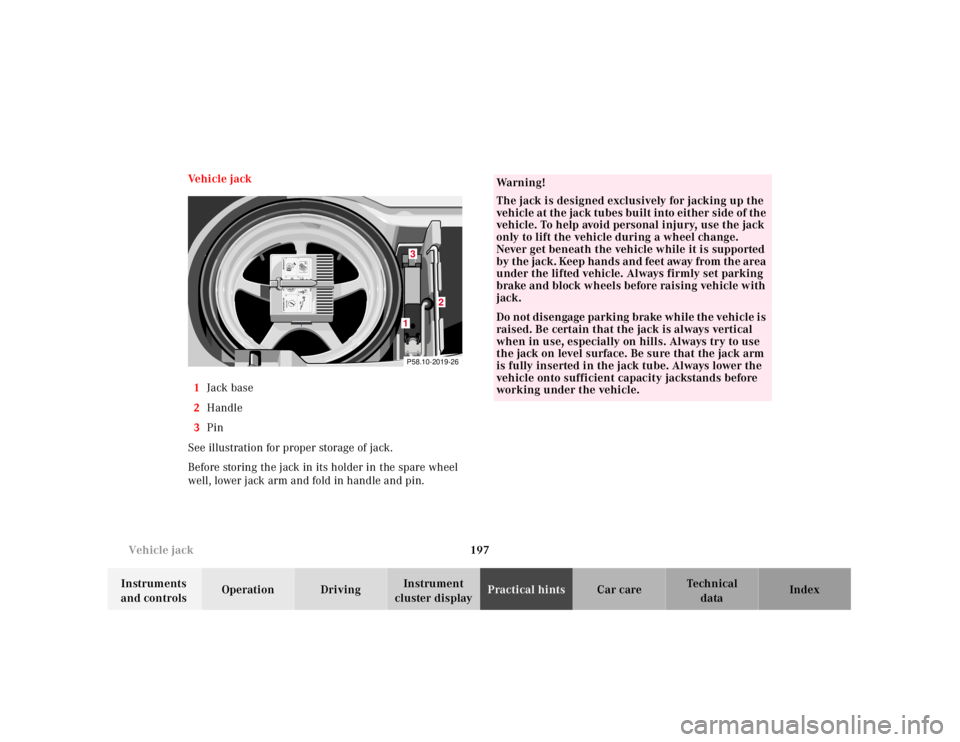
cluster displayPractical hintsCar care Index Ve h i c l e j a c k
1Jack base
2Handle
3Pin
See illustration for proper storage of jack.
Before storing the jack in its holder in the spare wheel
well, lower jack arm and fold in handle and pin.
1
0
456max. 6 min
A 170 584 01 38 AIR COMPRESSOR 23
Mercedes-Benz2
3
2 1
12,5 bar
36 psi1
0 23
4
5
620PSI
BAR40
60
80LUFTPRESSER 1
2
P58.10-2019-261
2
3
Wa r n i n g !
The jack is designed exclusively for jacking up the
veh icle at th e jack tu bes bu ilt into eit her side of th e
vehicle. To help avoid personal injury, use the jack
only to lift the vehicle during a wheel change.
Never get beneath the vehicle while it is supported
by t he jack. Keep hands and feet away from th e area
under the lifted vehicle. Always firmly set parking
brake and block wheels before raising vehicle with
jack.Do not disengage parki ng brake wh ile th e vehi cle i s
raised. Be certain that the jack is always vertical
when in use, especially on hills. Always try to use
the jack on level surface. Be sure that the jack arm
is fully inserted in the jack tube. Always lower the
vehicle onto sufficient capacity jackstands before
working under the vehicle.
Page 262 of 273
259 Consumer information
Te ch n ica l
data Instruments
and controlsOperation DrivingInstrument
cluster displayPractical hints Car care Index Traction
The traction grades, from highest to lowest are “AA”,
“A”, “B”, and “C”. Those grades represent the tire’s
ability to stop on wet pavement as measured under
controlled conditions on specified government test
surfaces of asphalt and concrete. A tire marked “C” may
have poor traction performance.Te mp e r a t u r e
The temperature grades are “A” (the highest), “B”, and
“C”, representing the tire‘s resistance to the generation
of heat and its ability to dissipate heat when tested
under controlled conditions on a specified indoor
laboratory test wheel. Sustained high temperature can
cause the material of the tire to degenerate and reduce
tire life, and excessive temperature can lead to sudden
tire failure. The grade “C” corresponds to a level of
performance which all passenger vehicle tires must
meet under the Federal Motor Vehicle Safety Standard
No. 109. Grades B and A represent higher levels of
performance on the laboratory test wheel than the
minimum required by law.
Wa r n i n g !
The traction grade assigned to this tire is based on
straightahead braking traction tests, and does not
include acceleration, cornering, hydroplaning, or
peak traction characteristics.
Wa r n i n g !
The temperature grade for this tire is established
for a tire that is properly inflated and not
overloaded. Excessive speed, underinflation, or
excessive loading, either separately or in
combination, can cause excessive heat build up
and possible tire failure.