2000 MERCEDES-BENZ E320 Srs
[x] Cancel search: SrsPage 4 of 341

1 Contents
IntroductionProduct information .......................... 7
Operator’s manual ............................. 8
Where to find it ................................ 13
Reporting Safety Defects ................ 15Instruments and controlsInstruments and controls ............... 18
Center console .............................. 20
Overhead control panel ............... 21OperationVehicle keys ...................................... 24
Start lock-out .................................... 27
General notes on the
central locking system ............... 28
Central locking system ................... 29
Radio frequency and
infrared remote control ............... 29
Opening the trunk ....................... 32
Opening and closing
windows and sliding/pop-up
roof from outside .......................... 33Panic button ................................. 34
Mechanical keys .......................... 34
Doors ................................................. 35
Central locking switch .................... 37
Automatic central locking .............. 38
Emergency unlocking
in case of accident ...................... 38
Trunk ................................................. 39
Trunk lid release switch .................41
Trunk lid emergency release ........ 42
Antitheft alarm system ................... 43
Tow-away alarm ............................... 45
Power seats front ............................. 46
Front seat head restraints .............. 52
Rear seat head restraints ............... 53
Multicontour seat ............................ 54
Seat heater ........................................ 55
Seat ventilation ................................ 58
Seat belts and integrated
restraint system .......................... 60
Seat belts .......................................... 60
Seat belt nonusage
warning system ........................... 61BabySmart
TM airbag
deactivation system .................... 67
Self-test BabySmart
TM
without special child
seat installed ................................. 67
Supplemental restraint
system (SRS) ................................ 68
Emergency tensioning
retractor (ETR) ............................. 69
Airbags .............................................. 70
Safety guidelines for the
seat belt, emergency
tensioning retractor
and airbag .................................... 76
Infant and child
restraint systems ......................... 78
Steering wheel adjustment ............ 81
Rear view mirrors ............................ 82
Instrument cluster ........................... 86
Multifunction steering wheel,
multifunction display ................. 92
Trip and main odometer,
FSS and engine oil
level display ................................. 96
Page 6 of 341

3 ContentsShelf below rear window .............. 170
Garage door opener ....................... 171
DrivingControl and operation
of radio transmitters ................ 176
The first 1 000 miles
(1 500 km) ................................. 177
Maintenance ................................... 177
Tele Aid ........................................... 178
Catalytic converter ........................ 188
Emission control ............................ 189
Steering lock ................................... 190
Starting and turning off
the engine .................................. 192
Automatic transmission ............... 193
Parking brake .................................202
Driving instructions ......................203
Drive sensibly - Save Fuel .........203
Drinking and driving .................203
Pedals ...........................................203
Power assistance ........................204
Brakes ..........................................204
Driving off ...................................205Parking ........................................ 205
Tires ............................................. 206
Snow chains ............................... 208
Winter driving
instructions ................................ 209
Block heater .................................210
Deep water ................................... 211
Passenger compartment ............ 211
Traveling abroad ......................... 211
Cruise control .................................212
Brake assist system
(BAS) ...........................................215
Antilock brake system
(ABS) ...........................................217
Four Wheel Electronic Traction
System (4MATIC) .......................219
Electronic stability program
(ESP) ........................................... 220
Parking assist
(Parktronic) .............................. 224
What you should know
at the gas station ...................... 229
Check regularly and
before a long trip ...................... 231
Instrument cluster displayMalfunction and
indicator lamps in the
instrument cluster ....................234
On-board
diagnostic system .......................234
Check engine malfunction
indicator lamp .............................234
Brake warning lamp ..................235
Supplemental restraint
system (SRS)
indicator lamp .............................236
Fuel reserve and fuel cap
placement warning ....................236
Electronic stability program
(ESP) — warning lamp ...............237
BAS / ESP malfunction
indicator lamp .............................237
ABS malfunction
indicator lamp .............................237
Seat belt warning lamp .............238
Malfunction and
indicator lamp in
the center console .....................238
Page 25 of 341

22 Contents - Operation
Te ch n ica l
data Instruments
and controlsOperationDrivingInstrument
cluster displayPractical hints Car care Index
OperationVehicle keys ...................................... 24
Start lock-out .................................... 27
General notes on the
central locking system ............... 28
Central locking system ................... 29
Radio frequency and
infrared remote control ............... 29
Opening the trunk ....................... 32
Opening and closing
windows and sliding/pop-up
roof from outside .......................... 33
Panic button .................................. 34
Mechanical keys ........................... 34
Doors .................................................. 35
Central locking switch .................... 37
Automatic central locking .............. 38
Emergency unlocking
in case of accident ...................... 38
Trunk ................................................. 39
Trunk lid release switch ................. 41
Trunk lid emergency release ......... 42
Antitheft alarm system ................... 43Tow-away alarm ............................... 45
Power seats front ............................. 46
Front seat head restraints .............. 52
Rear seat head restraints ............... 53
Multicontour seat ............................ 54
Seat heater ........................................ 55
Seat ventilation ................................ 58
Seat belts and integrated
restraint system .......................... 60
Seat belts .......................................... 60
Seat belt nonusage
warning system ........................... 61
BabySmart
TM airbag
deactivation system ................... 67
Self-test BabySmart
TM
without special child
seat installed ................................ 67
Supplemental restraint
system (SRS) ............................... 68
Emergency tensioning
retractor (ETR) ............................ 69
Airbags .............................................. 70Safety guidelines for the
seat belt, emergency
tensioning retractor
and airbag .................................... 76
Infant and child
restraint systems ......................... 78
Steering wheel adjustment ............ 81
Rear view mirrors ............................ 82
Instrument cluster ........................... 86
Multifunction steering wheel,
multifunction display ................. 92
Trip and main odometer,
FSS and engine oil
level display ................................. 96
Audio systems .................................. 97
Radio .............................................. 97
CD player ....................................... 98
Cassette player ............................. 99
Telephone ........................................ 100
Telephone book .......................... 100
Redialing ..................................... 102
Incoming call .............................. 104
Navigation system .......................... 105
Trip computer ................................. 106
Page 67 of 341

64 Restraint systems
Te ch n ica l
data Instruments
and controlsOperationDrivingInstrument
cluster displayPractical hints Car care Index
Unfastening of seat belts
Push the release button (3) in the belt buckle (2).
Allow the retractor to completely rewind the seat belt by
guiding the latch plate (1).
Operation
The inertia reel stops the belt from unwinding during
sudden vehicle stops or when quickly pulling on the
belt. The locking function of the reel may be checked by
quickly pulling out the belt.
Wa r n i n g !
USE SEAT BELTS PROPERLY.• Seat belts can only work when used properly.
Never wear seat belts in any other way than as
described in this section, as that could result
in serious injuries in case of an accident.• Each occupant should wear their seat belt at all
times, because seat belts help reduce the
likelihood of and potential severity of injuries
in accidents, including rollovers. The
integrated restraint system includes “SRS”
(driver airbag, front passenger airbag, front
and rear door mounted side impact airbags,
head protection window curtain airbags for
side windows), “ETR” (seat belt emergency
tensioning retractors), and front seat knee
bolsters. The system is designed to enhance the
protection offered to properly belted occupants
in certain frontal (front airbags) and side (side
impact and window curtain airbags) impacts
which exceed preset deployment thresholds.
Page 71 of 341

68 Restraint systems
Te ch n ica l
data Instruments
and controlsOperationDrivingInstrument
cluster displayPractical hints Car care Index
Supplemental restraint system (SRS)
Airbags are intended as a supplement to seat belts.
Airbags alone cannot protect as well as airbags plus
seat belts in impacts for which the airbags were
designed to operate, and do not afford any protection
whatsoever in crashes for which the airbags are not
designed to deploy.
The SRS uses two crash severity levels (thresholds) to
activate either the Emergency Tensioning Retractor
(ETR) or front airbag or both. Activation depends on the
direction and severity of the impact exceeding the
preset thresholds and whether the seat belt is fastened.Seat belt fastened
•first threshold exceeded:
ETR activates
•second threshold exceeded:
airbag also activates
Seat belt not fastened
Front seats:
•first threshold exceeded:
airbag activates, but not ETR
Rear outer seats:
•first threshold exceeded:
ETR activates
Driver, front passenger and rear outer seat systems
operate independently of each other.
Page 72 of 341
69 Restraint systems
Te ch n ica l
data Instruments
and controlsOperationDrivingInstrument
cluster displayPractical hints Car care Index Emergency tensioning retractor (ETR)
The seat belts for the front and outer rear seats are
equipped with emergency tensioning retractors. These
tensioning retractors are located in each belt’s inertia
reel and become operationally ready with the electronic
key in steering lock position 1 or 2.
The emergency tensioning retractors are designed to
activate only when the seat belts are fastened during
frontal impacts exceeding the first threshold of the SRS
and in rear impacts exceeding a preset severity level.
They remove slack from the belts in such a way that the
seat belts fit more snugly against the body restricting its
forward movement as much as possible.In cases of other frontal impacts, angled impacts, roll-
overs, certain side impacts, or other accidents without
sufficient frontal or rear forces, the emergency
tensioning retractors will not be activated. The driver
and passengers will then be protected by the fastened
seat belts and inertia reel in the usual manner.
For seat belt and emergency tensioning retractor safety
guidelines, see page 76.
Page 73 of 341
70 Restraint systems
Te ch n ica l
data Instruments
and controlsOperationDrivingInstrument
cluster displayPractical hints Car care Index
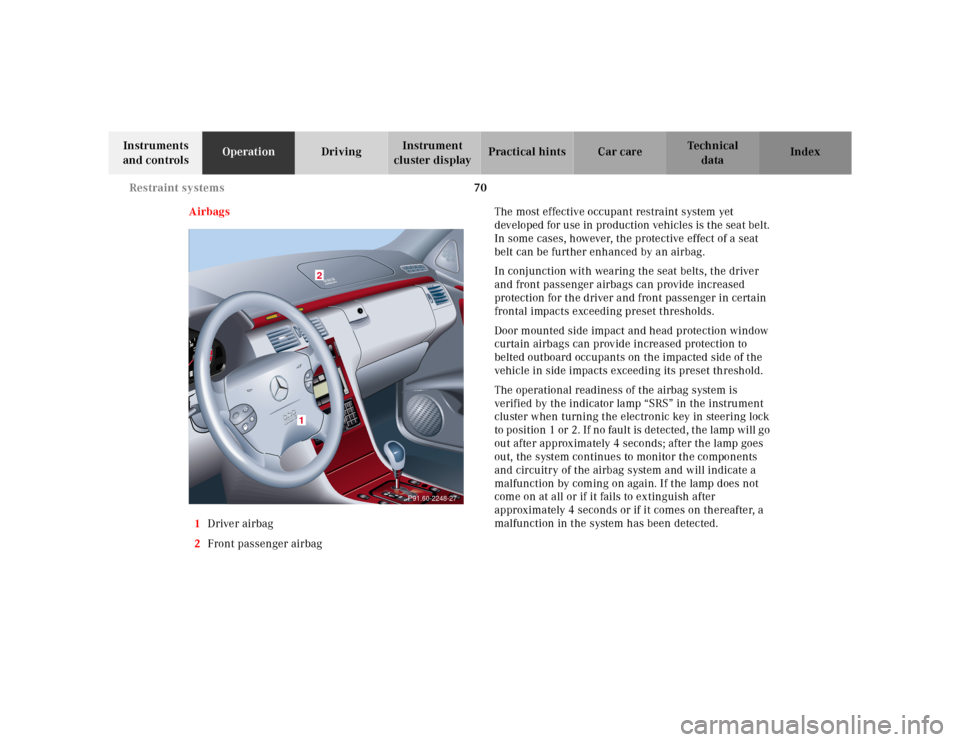
Airbags
1Driver airbag
2Front passenger airbagThe most effective occupant restraint system yet
developed for use in production vehicles is the seat belt.
In some cases, however, the protective effect of a seat
belt can be further enhanced by an airbag.
In conjunction with wearing the seat belts, the driver
and front passenger airbags can provide increased
protection for the driver and front passenger in certain
frontal impacts exceeding preset thresholds.
Door mounted side impact and head protection window
curtain airbags can provide increased protection to
belted outboard occupants on the impacted side of the
vehicle in side impacts exceeding its preset threshold.
The operational readiness of the airbag system is
verified by the indicator lamp “SRS” in the instrument
cluster when turning the electronic key in steering lock
to position 1 or 2. If no fault is detected, the lamp will go
out after approximately 4 seconds; after the lamp goes
out, the system continues to monitor the components
and circuitry of the airbag system and will indicate a
malfunction by coming on again. If the lamp does not
come on at all or if it fails to extinguish after
approximately 4 seconds or if it comes on thereafter, a
malfunction in the system has been detected.
2
1
P91.60-2248-27
Page 74 of 341

71 Restraint systems
Te ch n ica l
data Instruments
and controlsOperationDrivingInstrument
cluster displayPractical hints Car care Index The following system components are monitored or
undergo a selfcheck: crash-sensor(s), airbag ignition
circuits, front seat belt buckles, emergency tensioning
retractors, seat sensor.
Initially, when the electronic key is turned from steering
lock position 0 to position 1 or 2, malfunctions in the
crash-sensors are detected and indicated (the “SRS”
indicator lamp stays on longer than 4 seconds or does
not come on).
Have the system checked at your authorized
Mercedes-Benz Center immediately.
In the operational mode, after the indicator lamp has
gone out following the initial check, interruptions or
short circuits in the airbag ignition circuit and in the
driver and front passenger seat belt buckle harnesses,
and low voltage in the entire system are detected and
indicated.Note:
See page 236 for information on the Supplemental
Restraint System (SRS) indicator lamp.
Wa r n i n g !
In the event a malfunction of the “SRS” is indicated
as outlined above, the “SRS” may not be
operational. For your safety, we strongly
recommend that you visit an authorized
Mercedes-Benz Center immediately to have the
system checked; otherwise the “SRS” may not be
activated when needed in an accident, which could
result in serious or fatal injury, or it might deploy
unexpectedly and unnecessarily which could also
result in injury.