2000 MERCEDES-BENZ C-Class Instrument
[x] Cancel search: InstrumentPage 67 of 130

Drinking and Driving
Warning !
Drinking and driving can be a very dangerous combination. Even a small amount of alcohol or drugs can
affect your reflexes, perceptions and judgement. The possibility of a serious or even fatal accident is
sharply increased when you drink and drive. Please don't drink and drive or allow anyone to drive after
drinking.
Parking Brake
To engage, firmly depress parking brake pedal. When the electronic key is in steering lock position 2, the brake
warning lamp in the instrument cluster should come on brightly. To release the parking brake, pull handle on
instrument panel. The brake warning lamp in the instrument cluster should go out. A warning sounds, if you start
to drive without having released the parking brake. Also see Brake Warning Lamp Test in Index.
Driving Off
Apply the service brakes to test them briefly after driving off. Perform this procedure only when the road is clear
of other traffic. Warm up the engine smoothly. Do not place full load on the engine until the operating temperature has
been reached. When starting off on a slippery surface, do not allow one drive wheel to spin for an extended period
with the ASR or ESP switched off. Doing so may cause serious damage to the drive train which is not covered by
the Mercedes - Benz Limited Warranty.
Warning !
Keep driver's foot area clear at all times. Objects stored in this area may impair pedal movement.
Page 70 of 130

Program Mode Selector Switch
The transmission is provided with a selector switch for Standard "S" and Winter/Wet (snow and ice) "W" program
modes.
Important !
Always be certain of the program mode selected since the vehicle driving characteristics change with the selection of
the program mode.
S - Standard mode Press switch on symbol "S". Use this mode for all regular driving. The vehicle starts out in 1st
gear.
Accelerator Operation:
Fast on = depressing the accelerator pedal quickly (not into kickdown position) while driving continuously, rather
than depressing the accelerator pedal in the usual manner, will cause the automatic transmission to shift down
into a lower gear.
This gear shifting process is dependent on the current vehicle speed.
Fast off = there will be no upshift when releasing the accelerator pedal quickly, e.g. using the engine's braking
power during performance driving
W - Winter/Wet (snow and ice) mode Press switch on symbol "W".
The vehicle starts out in 2nd gear, except with selector lever in 1st gear, or with accelerator pedal in kick-down
position. The "W" mode helps to improve traction and driving stability of the vehicle.
The gear shifting process occurs at lower vehicle and engine speeds than in the "S,' program mode.
Important
Dependent on the program mode selector switch position "S" or "W" and the gear selector lever in position "13", the
ratio of power transmission changes.
Emergency Operation (Limp Home Mode)
If vehicle acceleration worsens, or the transmission no longer shifts, the transmission is most likely operating in Limp
Home Mode which engages when there is a malfunction at the transmission. This condition may be accompanied by
the "CHECK ENGINE" malfunction indicator lamp in the instrument cluster coming on.
In this mode only the 2nd gear or reverse gear can be activated.
To engage 2nd gear or reverse:
1. Stop the vehicle.
2. Move selector lever to position "P".
3. Turn off the engine.
4. Wait 10 seconds.
5. Restart the engine.
6. Move selector lever to position "D" (for 2nd gear), or move selector lever
to position "R" (for reverse gear).
Have the transmission checked at your authorized Mercedes-Benz dealer as soon as possible.
Page 78 of 130

Antilock Brake System (ABS)
Important !
The ABS improves steering control of the vehicle during braking maneuvers. Do not pump the brake pedal, rather use
firm, steady brake pedal pressure. Pu mping the brake pedal defeats the pur pose for ABS and significantly reduces
braking effectiveness.
The ABS prevents the wheels from locking up above a vehicl e speed of approximately 5 mph (8 km/h) independent of
road surface conditions.
At the instant one of the wheels is about to lock up, a slight pulsation can be felt in the brake pedal, indicating that the
ABS is in the regulating mode. Keep firm and steady pressure on the brake pedal while experiencing the pulsation.
On slippery road surfaces, the ABS will re spond even with light brake pedal pressure because of the increased
likelihood of locking wheels. The pulsating brake pedal can be an indication of hazardous road conditions and
functions as a reminder to take extra care while driving.
ABS Control
The ABS malfunction indicator lamp in the instrument cl uster comes on with the electronic key in steering lock
position 2 and should go out when the engine is running.
If the charging voltage falls below 10 volts, the malfunction indicator lamp comes on and the ABS is switched off.
When the voltage is above this value again, the malfunction indicator lamp should go out and the ABS is operational.
With the ABS malfunctioning, the ASR or ESP, if vehicl e so equipped, are also switched off. Both malfunction
indicator lamps come on with the engine running. If the ABS malfunction indicator lamp does not go out or comes on
while driving, it indicates that the ABS has detected a malfunction and has switched off. In this case, the brake
system functions in the usual manner, but without antilock assistance.
Have the system checked at your authorized Mercedes-Benz dealer as soon as possible.
Warning !
ABS cannot prevent the natural laws of physics from acting on the vehicle, nor can it increase the traction
made available by the road conditions. The ABS ca nnot prevent accidents, including those resulting from
excessive speed in turns, following another vehicle too cl osely, or aquaplaning. Only a safe, attentive, and
skillful driver can prevent accidents. The capabilities of an ABS equipped car must never be exploited in a
reckless or dangerous manner which could jeopardize the user's safety or the safety of others.
Note:
To alert following vehicles to slippery road conditions you discover, operate your hazard warning flashers as
appropriate.
Page 79 of 130

Brake Assist System (BAS)
Warning !
BAS cannot prevent the natural laws of physics from acting on the vehicle, nor can it increase braking
efficiency beyond that afforded by the condition of the vehicle brakes and tires or the traction afforded.
The BAS cannot prevent accidents, including those resulting from excessive speed in turns, following
another vehicle too closely, or aquaplaning. Only a safe, attentive, and skillful driver can prevent accidents.
The capabilities of a BAS equipped car must never be exploited in a reckless or dangerous manner which
could jeopardize the user's safety or the safety of others.
The Brake Assist System is designed to maximize the vehicle's braking capability during emergency braking
maneuvers by having maximum power boost applied to the br akes more quickly in emergency braking conditions
than might otherwise be afforded solely by the driver's braking style. This can help reduce braking distances over
what ordinary driving and braking style might do. The BAS complements the Antilock Brake System (ABS).
To receive the benefit of the system you must apply continuous full braking power during the stopping sequence.
Do not reduce brake pedal pressure.
Once the brake pedal is released, the BAS is deactivat ed The malfunction indicator lamps for the ASR and ESP are
combined with the BAS malfunction indicator lamp.
The BAS/ASR or BAS/ESP malfunction indicator lamp in the instrument cluster come on with the electronic key in
steering lock position 2 and should go out with the engine running.
If the BAS/ASR or BAS/ESP malfunction indicator lamp comes on permanently while the engine is running,
a malfunction has been detected in either system. As a resul t, it is possible that now only partial engine output will be
available, and pressing the accelerator pedal will require more effort. If the BAS malfunctions. The brake system
functions in the usual manner, but wi thout BAS. If the charging voltage falls be low 10 volts, the malfunction indicator
lamp comes on and the BAS is switched off. When the volt age is above this value again, the malfunction indicator
lamp should go out and the BAS is operational. With t he ABS malfunctioning, the BAS, ASR or ESP are also
switched off.
Both malfunction indicator lamps come on with the engine running. Have the BAS, ASR or ESP checked at your
authorized Mercedes-Benz dealer as soon as possible .
Page 80 of 130
Acceleration Slip Regulation (ASR)
The acceleration slip regulation will engage at all vehicle speeds, if one or both drive wheels begin to lose traction
and spin in acceleration. While engaged, the yellow warning lamp in the speedometer dial flashes. With the
acceleration slip regulation engaged, the brake is applied to the spinning drive wheel until slip is brought under
control. If both drive wheels spin, the brake is applied to both drive wheels and simultaneously, engine torque is
limited, to improve the vehicle's driving stability. As traction on the road surface increases, thus allowing
acceleration without slip, the allowable engine torque also increases again and the brake is no longer applied to
drive wheels.
Important !
If the ASR warning lamp flashes, adapt your speed and driving to the prevailing road conditions.
Caution!
If the vehicle is towed with the front axle raised (see Towing the vehicle in Index), the engine must be shut off
(electronic key in steering lock position 0 or 1). Otherwise, the ASR regulation will immediately be
engaged and will apply the rear wheel brakes.
Notes:
The indicator lamp for the ASR is combined with that of the BAS The yellow BAS/ASR malfunction indicator
lamp in the instrument cluster and the yellow ASR warning lamp in the speedometer dial come on with the
electronic key in steering lock position 2. They should go out with the engine running. If the BAS/ASR malfunction
indicator lamp comes on with the engine running, a malfunction has been detected in either system. Pressing the
accelerator pedal will require greater effort. Only partial engine output will be available.
If the BAS malfunctions, the brake system functions in the usual manner, but without BAS. Have the BAS or ASR
checked at your authorized Mercedes-Benz dealer as soon as possible. With the ABS malfunctioning, the ASR
is also switched off. Driving the vehicle with varied size tires will cause the wheels to rotate at different speeds,
therefore the ASR may activate (yellow ASR warning lamp in speedometer dial comes on).
For this reason, all wheels, including the spare wheel, must have the same tire size. When testing the parking
brake on a brake test dynamometer, the engine must be shut off. Otherwise, the ASR will immediately be engaged
and will apply the rear wheel brakes. In winter operation, the maximum effectiveness of the ASR is only achieved
with Mercedes-Benz recommended M+S rated radial-ply tires and/or snow chains.
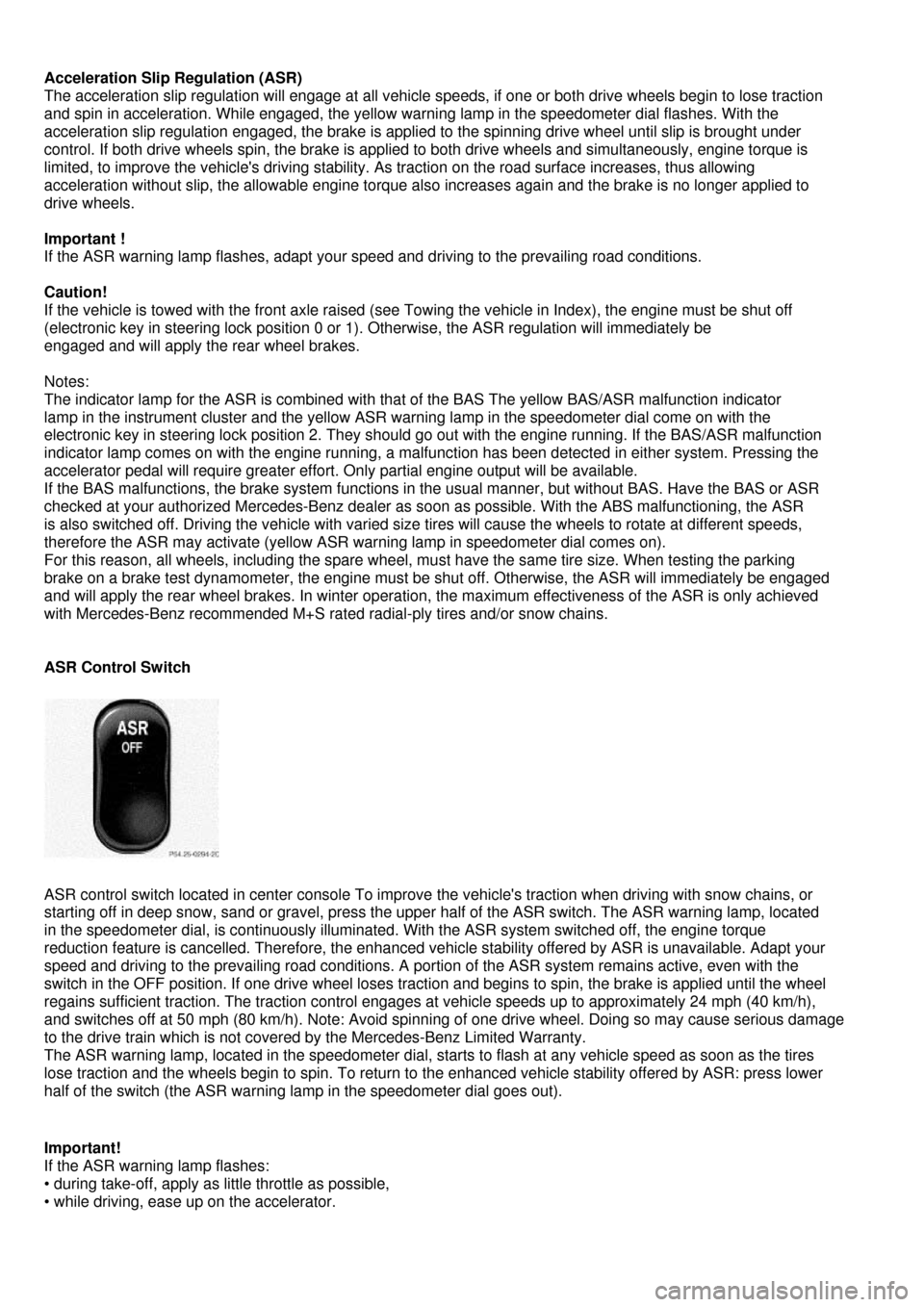
ASR Control Switch
ASR control switch located in center console To improve the vehicle's traction when driving with snow chains, or
starting off in deep snow, sand or gravel, press the upper half of the ASR switch. The ASR warning lamp, located
in the speedometer dial, is continuously illuminated. With the ASR system switched off, the engine torque
reduction feature is cancelled. Therefore, the enhanced vehicle stability offered by ASR is unavailable. Adapt your
speed and driving to the prevailing road conditions. A portion of the ASR system remains active, even with the
switch in the OFF position. If one drive wheel loses traction and begins to spin, the brake is applied until the wheel
regains sufficient traction. The traction control engages at vehicle speeds up to approximately 24 mph (40 km/h),
and switches off at 50 mph (80 km/h). Note: Avoid spinning of one drive wheel. Doing so may cause serious damage
to the drive train which is not covered by the Mercedes-Benz Limited Warranty.
The ASR warning lamp, located in the speedometer dial, starts to flash at any vehicle speed as soon as the tires
lose traction and the wheels begin to spin. To return to the enhanced vehicle stability offered by ASR: press lower
half of the switch (the ASR warning lamp in the speedometer dial goes out).
Important!
If the ASR warning lamp flashes:
• during take-off, apply as little throttle as possible,
• while driving, ease up on the accelerator.
Page 81 of 130

Electronic Stability Program (ESP) (optional)
The ESP enhances directional control and reduces driving wheel spin of the vehicle under any driving condition.
Over/understeering of the vehicle is counteracted by applying brakes to the appropriate wheel to create a
counterpointing vehicle movement. The ESP warning lamp, located in the speedometer dial, starts to flash.
Important !
If the ESP warning lamp flashes, adapt your speed and driving to the prevailing road conditions.
Caution !
If the vehicle is towed with the front axle raised (see Towing the vehicle in Index), the engine must be shut off
(electronic key in steering lock position 0 or 1). Otherwise, the ESP will immediately be engaged and will apply
the rear wheel brakes.
Notes:
The indicator lamp for the ESP is combined with that of the BAS. The yellow BAS/ESP malfunction indicator lamp
in the instrument cluster and the yellow ESP warning lamp in the speedometer dial come on with the electronic key
in steering lock position 2. They should go out with the engine running. If the BAS/ESP multifunction indicator lamp
comes on permanently with the engine running, a malfunction has been detected in either system.
Pressing the accelerator pedal will require greater effort. Only partial engine output will be available. If the BAS
malfunctions, the brake system functions in the usual manner, but without BAS. Have the BAS or ESP checked at
your authorized Mercedes-Benz dealer as soon as possible. With the ABS malfunctioning, the ESP is also switched
off. Driving the vehicle with varied size tires will cause the wheels to rotate at different speeds, therefore the electronic
stability program may activate (yellow ESP warning lamp in speedometer dialcomes on).
For this reason, all wheels, including the spare wheel, must have the same tire size. When testing the parking brake
on a brake test dynamometer, the engine must be shut off. Otherwise, the electronic stability program will
immediately
be engaged and will apply the rear wheel brakes. In winter operation, the maximum effectiveness of the ESP is only
achieved with Mercedes-Benz recommended M+S rated radial-ply tires and/or snow chains.
Synchronizing ESP
If the power supply was interrupted(battery disconnected or empty), the BAS/ESP multifunction indicator lamp
may be illuminated with the engine running. Turn steering wheel completely to the left and then to the right. The
BAS/ESP malfunction indicator lamp should go out.
ESP Control Switch
ESP control switch located on center console To improve the vehicle's traction when driving with snow chains, or
starting off in deep snow, sand or gravel, press the upper half of the ESP switch. The ESP warning lamp, located in
the speedometer dial, is continuously illuminated. With the ESP system switched off, the engine torque reduction
feature is cancelled. Therefore, the enhanced vehicle stability offered by ESP is unavailable. Adapt your speed and
driving to the prevailing road conditions. A portion of the ESP system remains active, even with the switch in the OFF
position.
If one drive wheel loses traction and begins to spin, the brake is applied until the wheel regains sufficient traction.
The traction control engages at vehicle speeds up to approximately 24 mph (40 km/h), and switches off at
50 mph (80 km/h).
Note:
Avoid spinning of one drive wheel. Doing so may cause serious damage to the drive train which is not covered by the
Mercedes-Benz Limited Warranty. The ESP warning lamp, located in the speedometer dial, starts to flash at any
vehicle speed as soon as the tires lose traction and the wheels begin to spin. To return to the enhanced vehicle
stability
offered by ESP: press lower half of the switch (the ESP warning lamp in the speedometer dial goes out).
Page 83 of 130

Emission Control
Certain systems of the engine serve to keep the toxic components of the exhaust gases within permissible limits
required by law. These systems, of course, will function properly only when maintained strictly according to factory
specifications. Any adjustments on the engine should, ther efore, be carried out only by qualified Mercedes-Benz
authorized dealer technicians. Engine adjustments should not be altered in any way. Moreover, the specified service
jobs must be carried out regularly according to Mercedes -Benz servicing requirements. For details refer to the
Service Booklet.
Warning !
Inhalation of exhaust gas is hazardous to your health. All exhaust gas contains carbon monoxide, and
inhaling it can cause unconsciousness and lead to death.
Do not run the engine in confined areas (such as a garage) which are not properly ventilated.
If you think that exhaust gas fumes are entering the vehicle while driving, have the cause determined and
corrected immediately. If you must drive under these conditions, drive only with at least one window fully
open.
On-Board Diagnostic System
The Sequential Multiport Fuel Injection (SFI) control module monitors emission control components that either provide
input signals to or receive output sign als from the control module. Malfunctions resulting from interruptions or failure
of any of these components are indica ted by the "CHECK ENGINE" malfunction indicator lamp in the instrument
cluster and are simultaneously stored in the SFI control module. If the "CHECK ENGINE" malfunction indicator lamp
comes on, have the system checked at your authorized Mercedes-Benz dealer as soon as possible. With some
exceptions the control module switches off the "CHECK ENGINE" indicator lamp if the condition, causing the lamp to
come on, no longer exists during three consecutive cycles. An on-board diagnostic connector is located in the
passenger compartment near to the parking brake pedal, allowi ng the accurate identification of system malfunctions
through the readout of diagnostic trouble codes.
Page 85 of 130

Hood
To open:
To unlock the hood, pull release lever (1) under the driver's side of the instrument panel. At the same time handle
(2) will extend out of the radiator grill (it may be necessary to lift the hood up slightly).
Caution !
To avoid damage to the windshield wiper or hood, open the hood only with wiper in the parked position. Pull handle
(2) completely out of radiator grill and open hood (do not pull up on handle).
To close:
Lower hood and let it drop into lock from a height of approx. 1 ft. (30 cm), assisting with hands placed flat on edges
of hood (3). To avoid hood damage, if hood is not fully closed, repeat closing procedure. Do not push down on hood
to attempt to fully close it.
Warning!
To help prevent personal injury, stay clear of moving parts when the hood is open and the engine is running.
Be sure the hood is properly closed before driving. When closing hood, use extreme caution not to catch
hands or fingers. The engine is equipped with a transistorized ignition system. Because of the high voltage it
is dangerous to touch any components (ignition coils, spark plug sockets, diagnostic socket) of the ignition
system
• with the engine running,
• while starting the engine,
• if ignition is "on" and the engine is turned manually.
If you see flames, steam or smoke coming from the engine compartment, or if the coolant temperature
gauge indicates that the engine is overheated, do not open the hood. Move away from vehicle and do not
open the hood until the engine has cooled. If necessary, call a fire department.