Page 37 of 93
COMFORT ADJUSTMENT
149
SRS AIRBAGS
The SRS (Supplemental Restraint System) airbags
are designed to provide further protection for the
driver and front passenger in addition to the primary
safety protection provided by the seat belts.
16G020b
�Driver and front passenger airbags
In response to a severe frontal impact, the driver and
front passenger airbags work together with the seat
belts to help reduce injury by inflating. The driver
and front passenger airbags help to reduce injuries
mainly to the driver's or front passenger's head or
chest directly hitting the steering wheel or
dashboard.
The front passenger airbag is activated even with no
passenger in the front seat.
Be sure to wear your seat belt.
Page 38 of 93
COMFORT ADJUSTMENT
150
CAUTION
The driver or front passenger too close to the steering
wheel or dashboard during airbag deployment can be
killed or seriously injured. Lexus strongly recommends
that:
�The driver sit as far back as possible from the
steering wheel while still maintaining control of the
vehicle.
�The front passenger sit as far back as possible from
the dashboard.
�All vehicle occupants be properly restrained using
the available seat belts.
16G021a
Page 39 of 93
COMFORT ADJUSTMENT
151 �
Side airbags
In response to a severe side impact, the side airbags
for the driver or front passenger work together with
the seat belts to help reduce injury by inflating. The
side airbags help to reduce injuries mainly to the
driver or front passenger's chest.
The side airbag on the passenger seat is activated even
with no passenger in the front seat.
Be sure to wear your seat belt.
Page 40 of 93
COMFORT ADJUSTMENT
152
CAUTION
The side airbags inflate with considerable force. To
avoid potential death or serious injury when they inflate,
the driver and front passenger must:
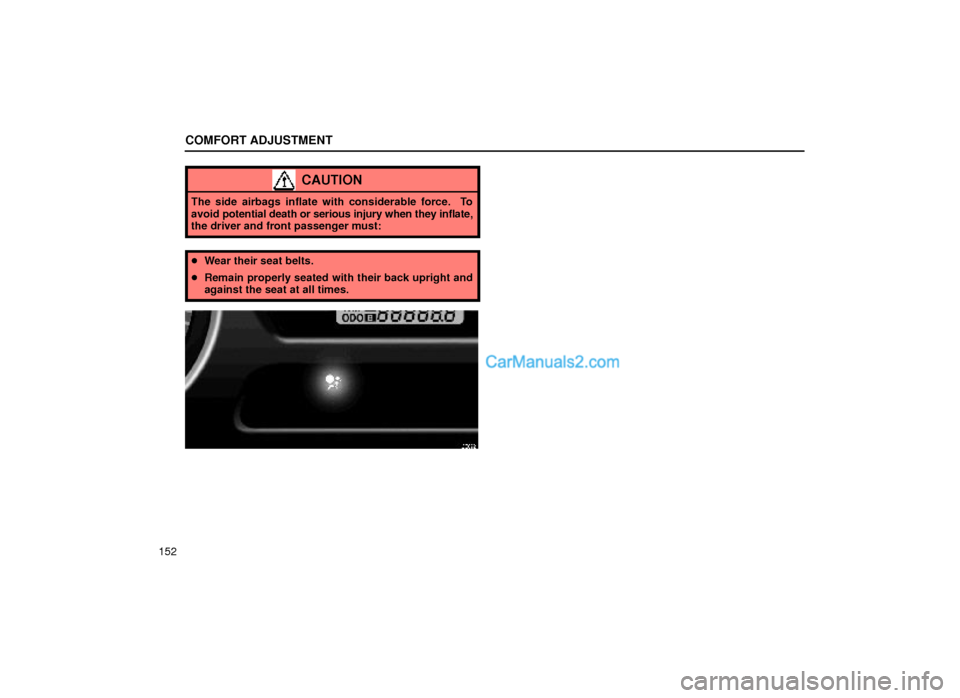
�Wear their seat belts.
�Remain properly seated with their back upright and
against the seat at all times.
16G022
Page 42 of 93
COMFORT ADJUSTMENT
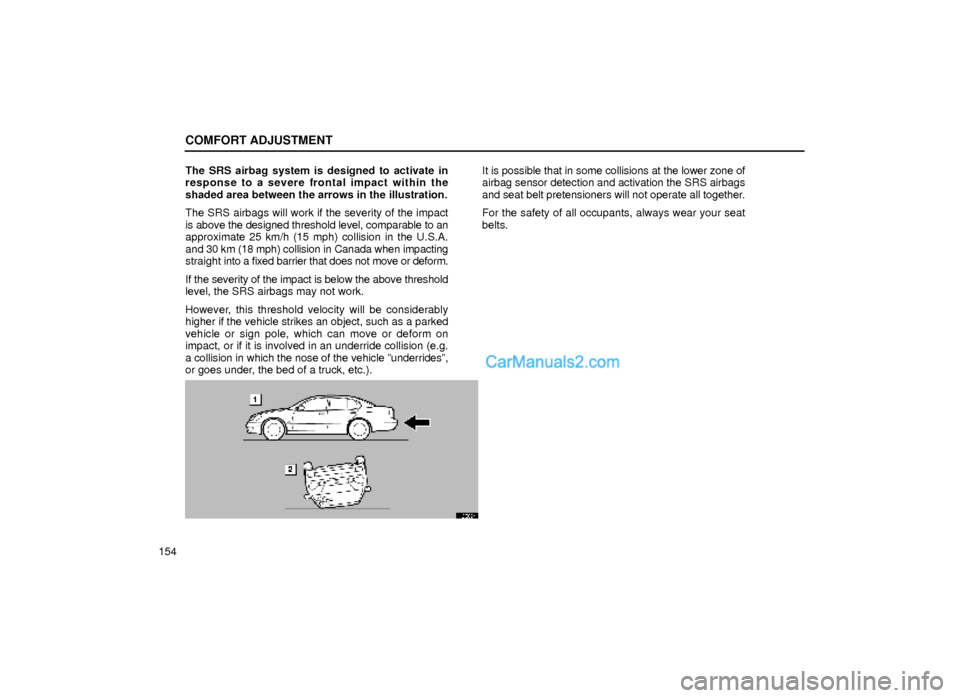
154The SRS airbag system is designed to activate in
response to a severe frontal impact within the
shaded area between the arrows in the illustration.
The SRS airbags will work if the severity of the impact
is above the designed threshold level, comparable to an
approximate 25 km/h (15 mph) collision in the U.S.A.
and 30 km (18 mph) collision in Canada when impacting
straight into a fixed barrier that does not move or deform.
If the severity of the impact is below the above threshold
level, the SRS airbags may not work.
However, this threshold velocity will be considerably
higher if the vehicle strikes an object, such as a parked
vehicle or sign pole, which can move or deform on
impact, or if it is involved in an underride collision (e.g.
a collision in which the nose of the vehicle ºunderridesº,
or goes under, the bed of a truck, etc.).It is possible that in some collisions at the lower zone of
airbag sensor detection and activation the SRS airbags
and seat belt pretensioners will not operate all together.
For the safety of all occupants, always wear your seat
belts.
16G024
Page 48 of 93

COMFORT ADJUSTMENT
160�
1Side airbag module (airbag and inflator)
2Airbag module for front passenger
(airbag and inflator)
3Side airbag sensor assembly
4Airbag module for driver (airbag and inflator)
5SRS warning light
6Airbag sensor assembly
7Front airbag sensors
The SRS airbag system consists mainly of the above
components, and their locations are shown in the
illustration.
The airbag sensor assembly consists of a safing sensor
and airbag sensors.
In a severe frontal impact, the driver and front passenger
airbag sensors detect deceleration and the system
triggers the front airbag inflators. In a severe side
impact, the side airbag sensor triggers the side airbag
inflator. Then a chemical reaction in the inflators quickly
fills the airbags with non±toxic gas to help restrain the
forward or lateral motion of the occupants.When the SRS operates, it produces a fairly loud noise
and release some smoke and residue along with
non±toxic gas. This does not indicate a fire. This gas is
normally harmless; however, for those who have
delicate skin, it may cause a minor skin irritation. Be
sure to wash off any residue as soon as possible to
prevent any potential skin irritation.
Deployment of the airbags happens in a fraction of a
second, so the airbags must inflate with considerable
force. While the system is designed to reduce serious
injuries, it may also cause minor burns or abrasions and
swelling.
Parts of the airbag module (steering wheel hub,
dashboard, front seats) may be hot for several minutes,
but the airbags themselves will not be hot. The airbags
are designed to inflate only once.
A crash severe enough to inflate the driver and front
passenger airbags may break the windshield as the
vehicle buckles. In vehicles with a front passenger
airbag, the windshield may also be damaged by
absorbing some of the force of the inflating airbag.
Page 49 of 93
COMFORT ADJUSTMENT
161
CAUTION
�The SRS airbag system is designed only as a
supplement to the primary protection of the driver
side and front passenger side seat belt systems. The
front seat occupants can be killed or seriously
injured by an inflating airbag if they do not wear the
available seat belts. During sudden braking just
before a collision, an unrestrained driver or front
passenger can move forward into direct contact with
or close proximity to the airbag which may then
deploy during the collision. To ensure maximum
protection in an accident, the driver and all
passengers in the vehicle must wear their seat belts.
Wearing a seat belt during an accident reduces the
chances of death or serious injury or being thrown
out of the vehicle. For instructions and precautions
concerning the seat belt system, see ºSeat beltsº on
page 133.
�Improperly seated and/or restrained infants and
children can be killed or seriously injured by a
deploying airbag. An infant or child who is too small
to use a seat belt should be properly secured using
a child restraint system. Lexus strongly
recommends that all infants and children be placed
in the rear seat of the vehicle and properly restrained.
The rear seat is the safest for infants and children.
For instructions concerning the installation of a child
restraint system, see ºChild restraintº on page 173 .
Page 50 of 93
COMFORT ADJUSTMENT
162
16G057a
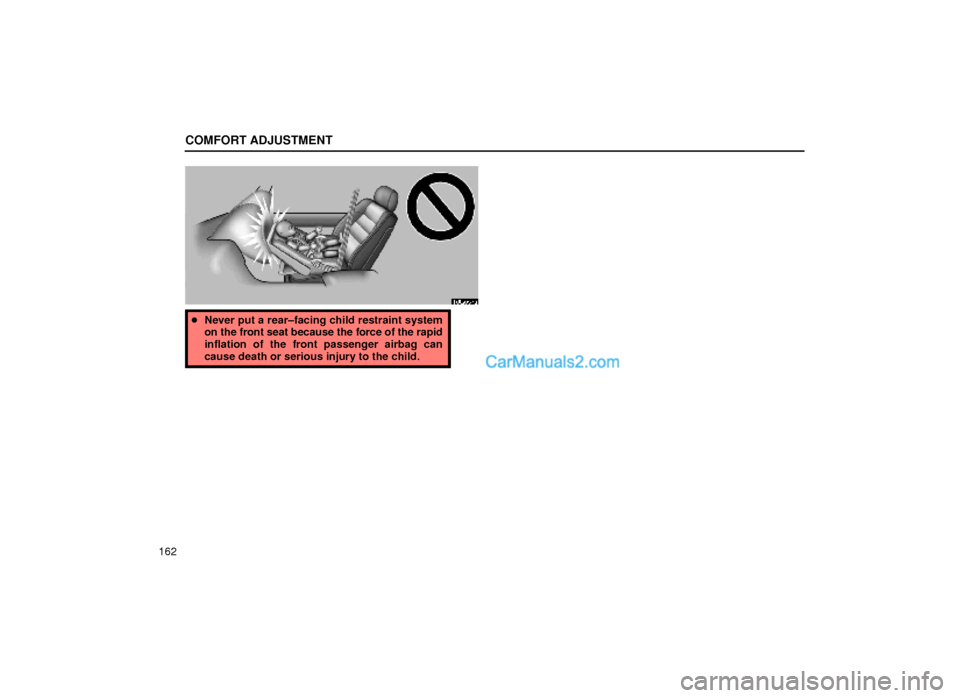
�Never put a rear±facing child restraint system
on the front seat because the force of the rapid
inflation of the front passenger airbag can
cause death or serious injury to the child.