AUDIO
244
21G025
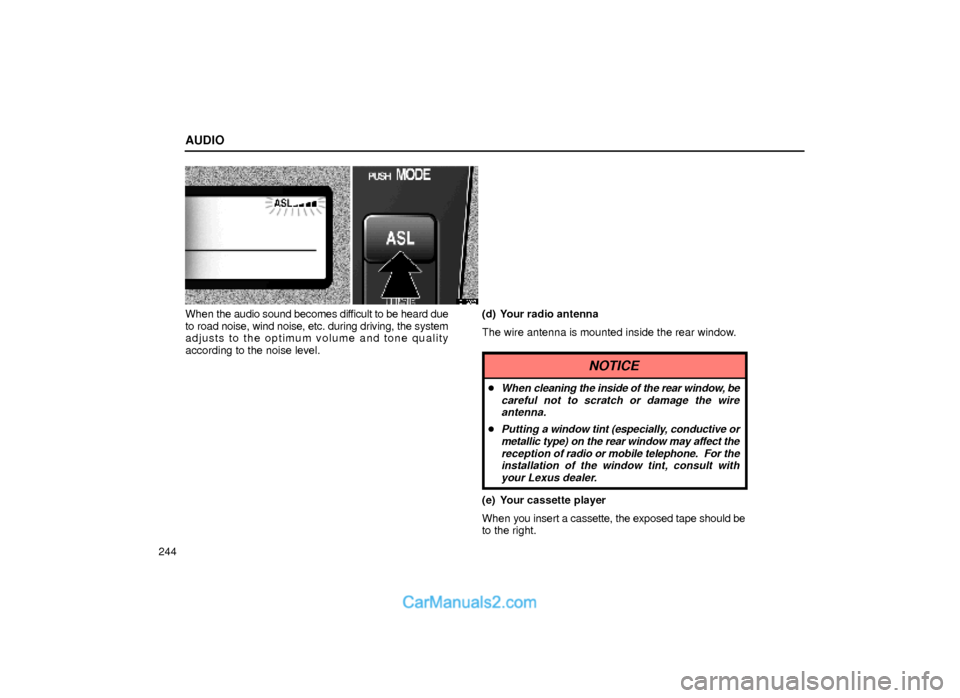
When the audio sound becomes difficult to be heard due
to road noise, wind noise, etc. during driving, the system
adjusts to the optimum volume and tone quality
according to the noise level.(d) Your radio antenna
The wire antenna is mounted inside the rear window.
NOTICE
�When cleaning the inside of the rear window, be
careful not to scratch or damage the wire
antenna.
�Putting a window tint (especially, conductive or
metallic type) on the rear window may affect the
reception of radio or mobile telephone. For the
installation of the window tint, consult with
your Lexus dealer.
(e) Your cassette player
When you insert a cassette, the exposed tape should be
to the right.
AUDIO
269
Car audio system operating hints
NOTICE
To ensure the correct audio system operation:
�Be careful not to spill beverages over the audio
system.
�Do not put anything other than a cassette tape
or CD magazine into the cassette tape slot or
CD changer.
�The use of cellular phone inside or near the
vehicle may cause a noise from the speakers of
the audio system which you are listening to.
However, this does not indicate a malfunction.
Radio reception
Usually, the problem with radio reception does not mean
there is a problem with your radio ± it is just the normal
result of conditions outside the vehicle.
For example, nearby buildings and terrain can interfere
with FM reception. Power lines or telephone wires can
interfere with AM signals. And of course, radio signals
have a limited range. The farther you are from a station,
the weaker its signal will be. In addition, reception
conditions change constantly as your vehicle moves.
Here are some common reception problems that
probably do not indicate a problem with your radio:FM
Fading and drifting stations ± Generally, the effective
range of FM is about 40 km (25 miles). Once outside this
range, you may notice fading and drifting, which
increase with the distance from the radio transmitter.
They are often accompanied by distortion.
Multi±path ± FM signals are reflective, making it
possible for two signals to reach your antenna at the
same time. If this happens, the signals will cancel each
other out, causing a momentary flutter or loss of
reception.
Static and fluttering ± These occur when signals are
blocked by buildings, trees, or other large objects.
Increasing the bass level may reduce static and
fluttering.
Station swapping ± If the FM signal you are listening to
is interrupted or weakened, and there is another strong
station nearby on the FM band, your radio may tune in
the second station until the original signal can be picked
up again.