Page 36 of 273

Seat Belt System Components
Your seat belt system includes lap/
shoulder belts in both seating
positions.
The seat belts are also equipped with
automatic seat belt tensioners.
~ The system also includes a
l±J light on the instrument
panel to remind you and your
passenger to fasten your belts.
If the
driver's seat belt is not fastened
before the ignition is turned
ON (II),
the light will come on and a beeper
will also sound.
The beeper will stop
after a few seconds,
but the light will
stay on until the driver's seat belt is
fastened.
Additional Information About Your Seat Belts
Lap/Shoulder Belt
This seat belt has a single belt that
goes over your shoulder, across your
chest and across your hips.
To fasten the belt, insert the latch
plate into the buckle, then tug on the
belt to make sure the buckle is
latched.
To unlock the belt, push the red
PRESS button on the buckle. Guide
the belt across your body to the door
pillar. After exiting the car, be sure
the belt is out of
the way and will not
get closed in the door.
Both seat belts have an emergency
locking retractor.
In normal driving,
the retractor lets
you move freely
in your seat while it
keeps some tension on the belt.
During a collision or sudden stop,
the retractor automatically locks the
belt to help restrain your body.
The passenger's seat belt has an
additional locking mechanism that
must be activated to secure a child
seat. (See page
27 for instructions on
how to secure a forward-facing child
seat with this type of belt.)
If the shoulder part of the belt is
pulled
all the way out, the locking
mechanism will activate.
The belt
will retract, but it will not allow the
passenger to move freely.
CONTINUED
Driver and Passenger Safety 33
Page 67 of 273
Keys and Locks
Panic Mode
Panic mode allows you to remotely
activate your car's security system to
attract attention. When activated,
the
horn will sound, and the exterior
lights will flash for about
30 seconds.
To activate panic mode, press and
hold
the PANIC button for about one
second.
To cancel Panic mode before 30
seconds, press any button on the
remote transmitter. You can also
turn the ignition switch to
0 N (II).
64 Instruments and Controls
Replacing the Battery
When the remote transmitter's
battery begins to
get weak, it may
take several pushes on the button to
lock or unlock
the doors, and the
LED will
get dim. Replace the
battery as soon as possible.
Battery type: CR2025
To replace the battery, remove the
round cover on the back of the trans
mitter by turning it counterclockwise
with a coin.
Page 84 of 273
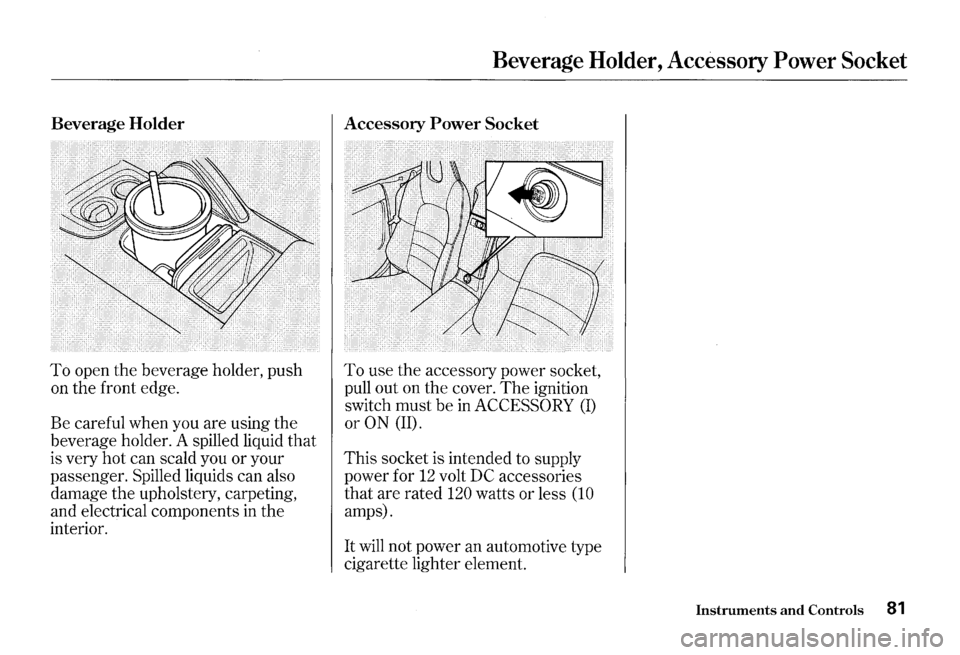
Beverage Holder
To open the beverage holder, push
on the front edge.
Be careful when you are using the
beverage holder. A spilled liquid
that
is very hot can scald you or your
passenger. Spilled liquids can also
damage the upholstery, carpeting,
and electrical components
in the
interior.
Beverage Holder, Accessory Power Socket
Accessory Power Socket
To use the accessory power socket,
pull out on the cover.
The ignition
switch must be
in ACCESSORY (I)
or ON (II).
This socket is intended to supply
power for
12 volt DC accessories
that are rated
120 watts or less (10
amps).
It will not power an automotive type
cigarette lighter element.
Instruments and Controls 81
Page 127 of 273
Carrying Cargo
124 Before Driving
Your car has several convenient
storage areas so you can stow cargo
safely.
The upper and lower console
compartments are designed for small,
lightweight items.
The trunk is
intended for larger, heavier items.
However, carrying too much cargo,
or improperly storing
it, can affect
your car's handling, stability and
operation and make it unsafe. Before
carrying any type of cargo, be sure to
read the following pages.
Page 150 of 273

Your authorized Honda dealer
knows your
car best and can provide
competent, efficient service.
However, service at a dealer is not
mandatory to keep your warranties
in effect. Maintenance may be done
by any qualified service facility or
person who is skilled in this type of
automotive service. Keep all the
receipts as proof of completion, and
have the person who does the work
fill out
the Maintenance Record.
Check your warranty booklet for
more information. We
recommend the use of Genuine
Honda parts and fluids whenever you
have maintenance done.
These are
manufactured to
the same high
quality standards as the original
components, so you can be confident
of their performance and durability.
U.S. Cars:
Maintenance, replacement or
repair of emissions control
devices and systems may be done
by any automotive repair
establishment or individual using
parts that are "certified" to EPA
standards.
Maintenance Schedule
According to state and federal
regulations, failure to perform
maintenance on the items marked
with
# will not void your emissions
warranties. However, Honda
recommends that all maintenance
services be performed
at the
recommended time or mileage
period to ensure long-term reliability.
Maintenance 14 7
Page 162 of 273
Changing the Oil and Filter
Always change the oil and filter
according to the time and distance
(miles/kilometers) recommenda
tions
in the maintenance schedule.
The oil and filter collect contami
nants that can damage your engine
if
they are not removed regularly.
Changing the
oil and filter requires
special tools and access from
underneath
the car. The car should
be raised on a service station-type
hydraulic lift for this service.
Unless
you have the knowledge and proper
equipment, you should have this
maintenance done by a skilled
mechanic.
1. Run the engine until it reaches
normal operating temperature,
then shut it off.
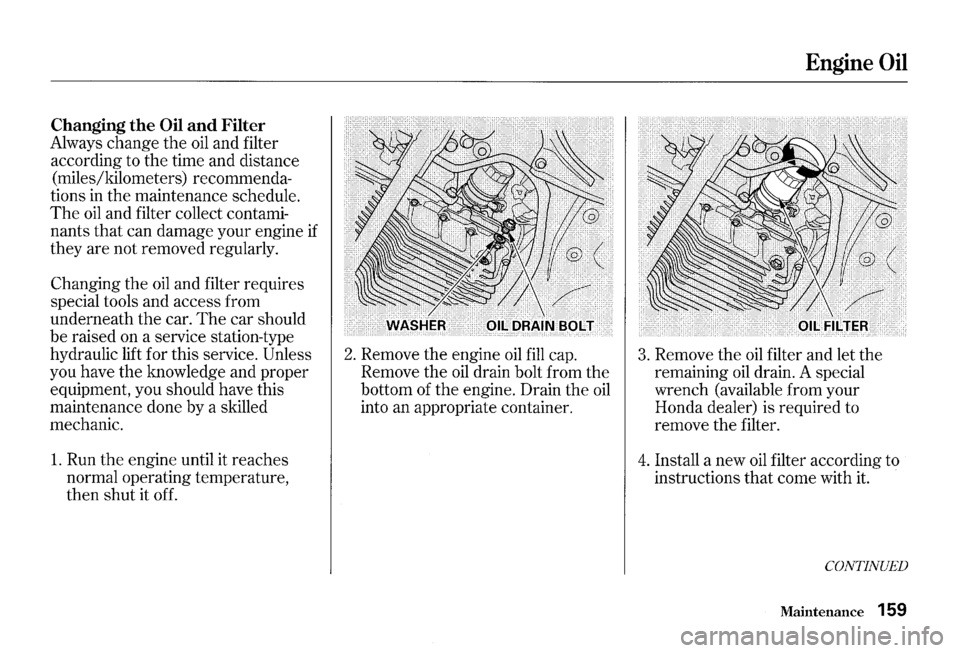
2. Remove the engine oil fill cap.
Remove the
oil drain bolt from the
bottom of
the engine. Drain the oil
into an appropriate container.
Engine Oil
3. Remove the oil filter and let the
remaining
oil drain. A special
wrench (available from your
Honda dealer) is required to
remove the filter.
4. Install a new oil filter according to
instructions that come with it.
CONTINUED
Maintenance 159
Page 188 of 273
To safely operate your car, your tires
must be
the proper type and size, in
good condition with adequate tread,
and correctly inflated.
The following
pages give more detailed information
on how and when to check air
pressure, how to inspect your tires
for damage and wear, and what to
do
when your tires need to be replaced.
Using tires that are excessively
worn or improperly inflated can
cause a crash
in which you can
be
seriously hurt or killed.
Follow all
instructions in this
owner's
manual regarding tire
inflation and maintenance.
Tires
Inflation
Keeping the tires properly inflated
provides the
best combination of
handling, tread life and riding
comfort. Underinflated tires wear
unevenly, adversely affect handling
and fuel economy, and are more
likely to fail from being overheated.
Overinflated tires can make your car
ride more harshly, are more prone to
damage from road hazards, and wear
unevenly.
We recommend that you visually
check your tires every day.
If you
think a tire might be
low, check it
immediately with a tire gauge.
CONTINUED
Maintenance 185
Page 192 of 273
You should carefully inspect your
car's tires for wear, damage, and
proper inflation every
7,500 miles
(12,000 km) (see page 186 ) .
Replacing Tires and Wheels
The tires that came with your car
were selected to match the perform
ance capabilities of the car while
providing the best combination of
handling, ride comfort, and long life.
You should replace them with radial
tires of the same size, load range,
speed rating, and maximum cold tire
pressure rating (as shown on the
tire's sidewall). Mixing radial and
bias-ply tires on your car can reduce
its braking ability, traction, and
steering accuracy.
Tires
Installing improper tires on your
car can affect
handling and
stability. This can cause a crash
in which you can be seriously
hurt or killed.
Always
use the size and type of
tires recommended
in this
owner's
manual.
It is best to replace all four tires at
the same time. If that is not possible
or necessary, then replace the two
front tires or the two
rear tires as a
pair. Replacing just one tire can
seriously affect your car's handling.
CONTINUED
Maintenance 189