2000 HONDA PASSPORT key
[x] Cancel search: keyPage 126 of 267

Adjustin
g th e Soun d
Bass, Treble, Balance, and Fader
are each adjustable. You select
which of these you want to adjust
by pressing the MODE button several times. The selected mode,
BAS, TRE, FAD, or BAL is shown in the display.
Balance/Fade r — These two
modes adjust the strength of the
sound coming from each speaker.
BAL adjusts the side-to-side
strength, while FAD adjusts the
front-to-back strength.
Select BAL or FAD by pressing
the MODE button. Adjust the
Balance or Fader to your liking by pressing the or key by the
MODE button. The number in the
display (from R7 to L7 for BAL, from R7 to F7 for FAD) shows
you the current setting. Treble/Bas
s — Use these modes to
adjust the tone to your liking.
Select TRE or BAS by pressing
the MODE button. Adjust the desired mode by pressing the
or key. The displayed number
(from -5 to 5) shows you the
current setting. The system will automatically
return the display to normal mode about seven seconds after you stop
adjusting a mode with the keys.
Radi o Frequencie s an d
Receptio n
For information, see page 132.
Comfor t an d Convenienc e Feature s
MOD
E ADJUS T BUTTON S
DISPLA
Y
MOD
E
Page 150 of 267
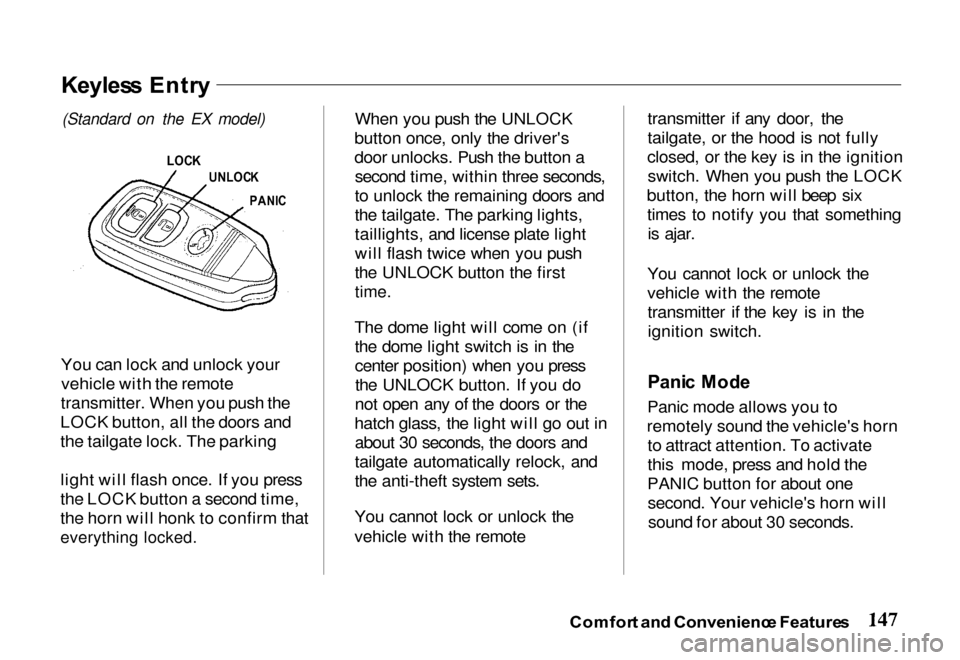
You can lock and unlock your
vehicle with the remote
transmitter. When you push the
LOCK button, all the doors and
the tailgate lock. The parking
light will flash once. If you press
the LOCK button a second time,
the horn will honk to confirm that
everything locked.
When you push the UNLOCK
button once, only the driver's
door unlocks. Push the button a second time, within three seconds,
to unlock the remaining doors and
the tailgate. The parking lights,
taillights, and license plate light
will flash twice when you push
the UNLOCK button the first
time.
The dome light will come on (if the dome light switch is in the
center position) when you pressthe UNLOCK button. If you do
not open any of the doors or the
hatch glass, the light will go out in about 30 seconds, the doors and
tailgate automatically relock, and
the anti-theft system sets.
You cannot lock or unlock the
vehicle with the remote transmitter if any door, the
tailgate, or the hood is not fully
closed, or the key is in the ignition switch. When you push the LOCK
button, the horn will beep six times to notify you that somethingis ajar.
You cannot lock or unlock the
vehicle with the remote transmitter if the key is in the
ignition switch.
Pani c Mod e
Panic mode allows you to
remotely sound the vehicle's horn to attract attention. To activate
this mode, press and hold the
PANIC button for about one second. Your vehicle's horn willsound for about 30 seconds.
Comfor t an d Convenienc e Feature s
Keyles s Entr y
(Standard on
the EX model)
LOC K
UNLOC K
PANI C
Page 151 of 267
To cancel panic mode before 30
seconds, press any button on the
remote transmitter. You can also turn the ignition switch to
ACCESSORY.
Anti-Thef
t Syste m
The anti-theft system is designed
to protect your vehicle and its contents from theft. Any attempt
to forcibly open any door, the
tailgate, or the hood without using
the key or the remote transmitterwill cause the system to alarm.
The horn sounds and the headlights flash for approximately
three minutes. The starter motor
circuit is disabled so the engine
cannot be started. After threeminutes, the system resets. Activatin
g th e Syste m
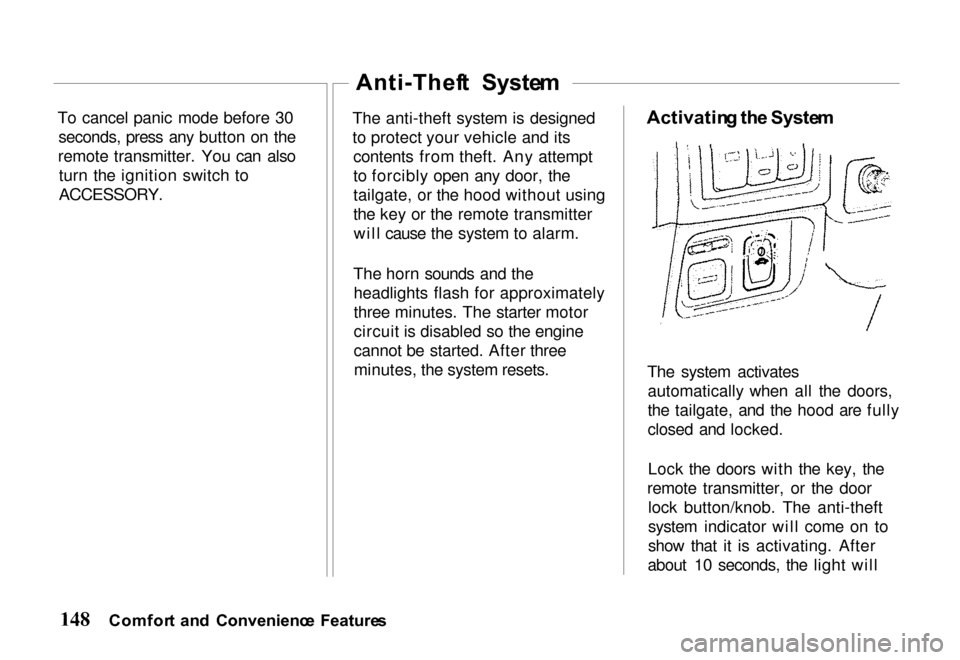
The system activates automatically when all the doors,
the tailgate, and the hood are fully
closed and locked.
Lock the doors with the key, the
remote transmitter, or the door lock button/knob. The anti-theft
system indicator will come on to
show that it is activating. After
about 10 seconds, the light will
Comfor t an d Convenienc e Feature s
Page 152 of 267
begin blinking rapidly to indicate
the system is active.
Deactivatin g th e Syste m
Unlocking the doors or the
tailgate with the key or the remote
transmitter turns off the system.
You can also turn the ignition
switch to the ACCESSORY
position.
Doing any of the above will also
reset an alarming system before
the three minutes have elapsed. The digital clock displays the time
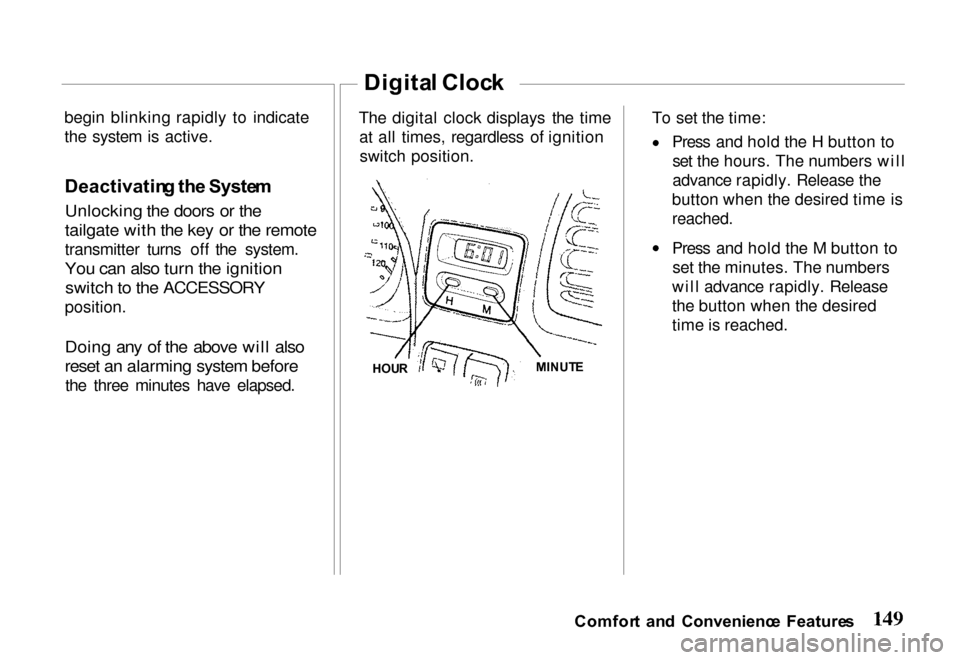
at all times, regardless of ignitionswitch position. To set the time: Press and hold the H button to
set the hours. The numbers will
advance rapidly. Release the
button when the desired time is
reached.
Press and hold the M button to set the minutes. The numbers
will advance rapidly. Release
the button when the desired
time is reached.
Comfor t an d Convenienc e Feature s
Digita l Cloc k
HOU R MINUT
E
Page 155 of 267
Befor
e Drivin g
Drivin g Guideline s
Your Honda has higher ground
clearance than a passenger car
designed for use only on
pavement. Higher ground clearance has many advantages
for off-road driving. It allows you
to travel over bumps, obstacles,
and rough terrain. It also provides
good visibility so you can
anticipate problems earlier.
These advantages come at some
cost. Because your vehicle is
taller and rides higher off the
ground, it has a high center of
gravity. This means that your
vehicle can tip or roll over if you make abrupt turns. Utility
vehicles have a significantly
higher rollover rate than other types of vehicles. To prevent rollover or loss of
control:
Take corners at slower speeds
than you would with a
passenger car. Avoid sharp turns and abrupt
maneuvers whenever possible.
Do not modify your vehicle in
any way that would raise the
center of gravity (see page 170). Do not carry heavy cargo on
the roof (see page 173).
For off-road driving guidelines, see the Off-Road Driving
Information booklet that came with your vehicle.
Befor e Enterin g th e Vehicl e
1. Check that the windows,
mirrors, lights and reflectors
are clean and unobstructed.
2. Check the tires to see if they
are low or flat. You will need
a pressure gauge to tell if tires
are properly inflated.
3. Check that all lights work.
4. Check for fluid leaks.
5. Be sure everything is properly
stowed.
6. Check the area behind the vehicle if you are about to
back up.
Befor e Drivin g th e Vehicl e
1. Lock all doors.
2. Adjust the seat and any movable head restraints.
3. Adjust the inside and outside mirrors.
4. Check that all the indicator lights work when the key
Drivin g Tip s
Page 157 of 267

Ne
w Vehicl e Break-I n
You may drive your new vehicle
from its very first mile/kilometer without following a formal
"break-in" schedule. However,
there are things you can do during
the first few hundred miles/
kilometers of driving that will add
to the future performance and
economy of your vehicle.
It is recommended that your speed
during the first 500 miles (800
kilometers) be limited to a
maximum of 55 mph (90 km/h) and that you do not drive for long
periods at any one constant speed, either fast or slow. During this
period, avoid full-throttle starts and, if possible, avoid hard stops;
especially during the first 200
miles (320 kilometers) of driving.
Always drive at moderate speed
until the engine has completely warmed up.
Parkin
g
When leaving your vehicle
unattended:
Set the parking brake.
Place the shift lever in "P" (Park) position for automatic
transmission.
When parking a vehicle equipped
with a manual transmission on an
upward slope, or on a level surface, place the shift lever in
the "1st" position.
When parking a vehicle
equipped with a manual
transmission on a downward slope, place the shift lever in
the "R" (Reverse) position. Turn the key to the "LOCK"
position.
Remove the key. The beeper
will remind you. Close all windows and lock all
doors.
Check to make certain the
lights are turned off. The
beeper will remind you. If your vehicle is equipped with
a transfer case (4WD), make
sure the shift lever is in 4H or
4L.
Parkin g Tip s
Never drive the vehicle with
the parking brake set. This can
overheat the rear brakes,
reducing their effectiveness and
causing excessive wear or
damage.
Always apply the parking brake
whenever you leave the vehicle,
whether it is equipped with a
manual or automatic transmission.
Drivin g Tip s
Page 169 of 267
Drivin
g fo r Bes t Fue l
Econom y
How, where, and when you drive all affect how many miles/
kilometers you can get from a
gallon/liter of fuel. The careful attention you give your vehicle as
far as maintenance and repairs will also help fuel economy.
Fuel Selection Use only unleaded gasolinemeeting federal government
regulations. The federal
government specifies the
minimum octane rating number of
unleaded gasoline. Unleaded
gasoline must be used for proper
emissions control system
operation. It will also minimize spark plug fouling. The use of
leaded gasoline can damage the
emissions control system and could result in loss of warranty
coverage.
"Jackrabbit" Starts
You can save fuel (and prolong
engine and tire life) by avoiding fast starts away from lights andstop signs.
Stop-and-Go Driving Frequent stop-and-go driving
during a trip will cut down on
your miles per gallon (kilometers
per liter). Plan even your short shopping trips to take advantage
of through streets to avoid traffic
lights. Pace your driving to avoid
unplanned stops.
Excessive Idling
An idling engine uses fuel, too. If
you're faced with more than a few
minutes wait and you're not in traffic, it is better to turn off the
key and start the engine again
later.
Repetitive Harsh Stopping Harsh stops can also waste fuel;instead of moving the vehicle, the
energy is wasted as heat in
braking. Energy in the form of
fuel is also needed to accelerate
back to driving speed.
Lubricants A well-lubricated vehicle meansless friction between moving
parts. This manual lists the proper
lubrication intervals in the "Care
and Maintenance" section.
Air Cleaner Your vehicle gets its power from a
mixture of fuel and air. The air is
taken into the engine through the
Drivin g Tip s
Fue
l Econom y
Page 191 of 267
Use only towing equipment
specifically designed for this
purpose, following the instructions of the equipment
manufacturer. A separate safety
chain system must be used.
For such towing, the parking
brake must be released, thetransmission must be in neutraland the key switch turned to
the "OFF" position (not
"LOCK").
Towing attachments must be made to main structural
members of the vehicle. Do not attach to bumpers or associated
brackets.
Remember that the power brake assist will not beavailable when the engine is
inoperative.
Towin
g Tip s
All Four Wheels on the Ground
1. Transfer case in 2H (4WD model only).
2. Transmission in Neutral
position.
3. Maximum speed 30 mph (50 km/h).
4. Maximum distance 50 miles (80 kilometers).
If you are towing the vehicle at distances and speeds greater thanshown, disconnect the propeller
shaft from the rear axle carrier.
On 4WD models, also disconnect
the front propeller shaft. Safely
secure the propeller shafts so they
will not fall and scrape the
ground.
Front Wheels off the Ground
1. Transfer case in 2H (4WD model only).
2. Transmission in Neutral position.
3. Maximum speed 30 mph (50 km/h).
4. Maximum distance 50 miles (80 kilometers).
If you are towing the vehicle at
distances and speeds greater than shown, disconnect the propeller
shaft from the rear axle carrier.
Safely secure the propeller shaft so it will not fall and scrape the
ground.
I n Cas e o f Emergenc y