Page 74 of 267
Headlights-On Reminder
You will hear a continuous tone
when the key is out of the ignitionswitch and the driver's door is
opened with the headlight switch in the "ON" position. This will
remind you to turn the headlights off. Never leave the headlights onwhen the engine is not running.
They can rapidly discharge the
battery.
Fo
g Light s
EX model only
When fog or heavy mist reducesyour forward vision, push thisswitch to turn the fog lights on.
The indicator light in the switch
turns on. Push the switch again to turn off the fog lights.
The fog lights operate only when the headlight low beams are in
use.
Illuminatio
n Contro l
The instrument panel lights turn on when the light switch is on.
Brightness of the instrument panel
lights is controlled by turning the illumination control knob
clockwise for brighter or counterclockwise for dimmer.
Instrument s an d Control s
DIMMER BRIGHTE
R
Page 76 of 267
Tur
n Signa l Leve r
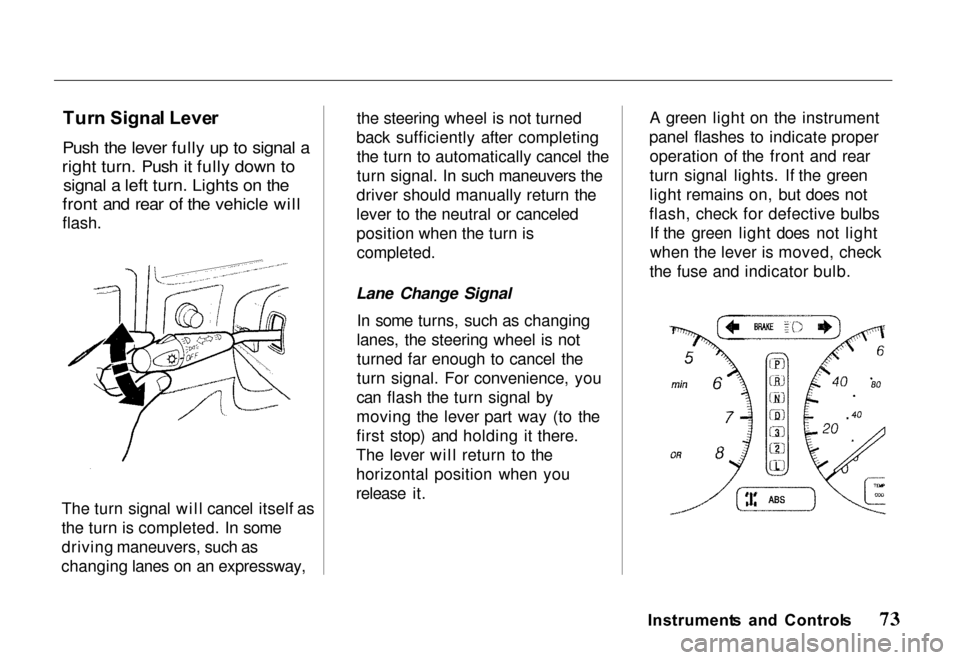
Push the lever fully up to signal a
right turn. Push it fully down to signal a left turn. Lights on the
front and rear of the vehicle will
flash.
The turn signal will cancel itself as
the turn is completed. In some
driving maneuvers, such as
changing lanes on an expressway, the steering wheel is not turned
back sufficiently after completing the turn to automatically cancel the
turn signal. In such maneuvers the
driver should manually return the
lever to the neutral or canceled
position when the turn is
completed.
Lane Change Signal In some turns, such as changing
lanes, the steering wheel is not
turned far enough to cancel the
turn signal. For convenience, you
can flash the turn signal by
moving the lever part way (to the
first stop) and holding it there.
The lever will return to the
horizontal position when you
release it. A green light on the instrument
panel flashes to indicate proper operation of the front and rear
turn signal lights. If the green
light remains on, but does not
flash, check for defective bulbs If the green light does not lightwhen the lever is moved, check
the fuse and indicator bulb.
Instrument s an d Control s
Page 77 of 267
Hazar
d Warnin g Flashe r
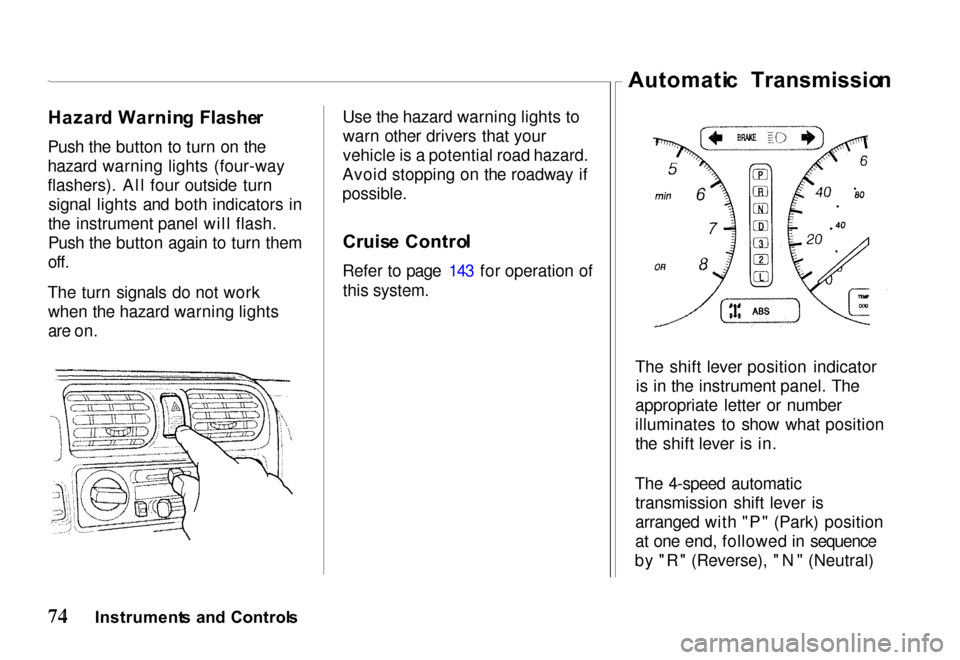
Push the button to turn on the
hazard warning lights (four-way
flashers). All four outside turn signal lights and both indicators in
the instrument panel will flash.
Push the button again to turn them
off.
The turn signals do not work when the hazard warning lights
are on. Use the hazard warning lights to
warn other drivers that your
vehicle is a potential road hazard.
Avoid stopping on the roadway if
possible.
Cruis e Contro l
Refer to page 143 for operation of this system. Automati
c Transmissio n
The shift lever position indicator is in the instrument panel. The
appropriate letter or number
illuminates to show what position
the shift lever is in.
The 4-speed automatic transmission shift lever is
arranged with "P" (Park) position
at one end, followed in sequence
by "R" (Reverse), "N" (Neutral)Instrument s an d Control s
Page 108 of 267
Make sure the rear window wiper
is off and in its parked position.
Turn the key clockwise and push
the outside lock to unlock the
glass. Raise the glass, then pull
the door handle to unlock the door.
Hoo
d Releas e
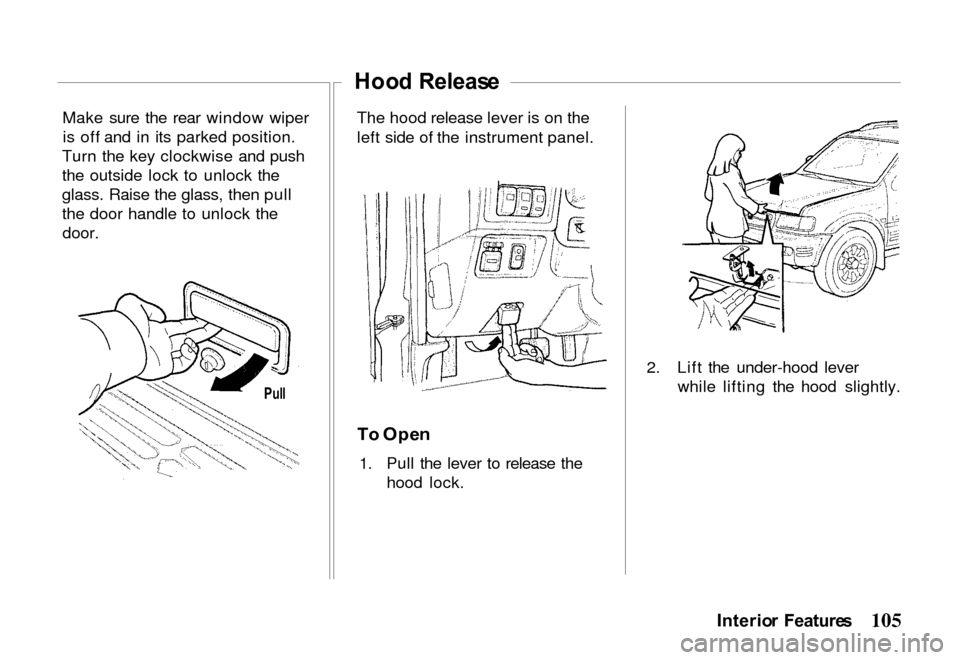
The hood release lever is on the
left side of the instrument panel.
T o Ope n
1. Pull the lever to release the hood lock. 2. Lift the under-hood lever
while lifting the hood slightly.
Interior Feature s
Pul l
Page 115 of 267
positions. Move the steering
wheel to the desired position, then
release the lever. Try to move the steering wheel up and down to
make sure it is locked in position.
Make sure the steering wheel does
not block your view of any of the instrument panel gauges or
indicators.
Cigarett
e Lighte r
The cigarette lighter is on the instrument panel. The ignition
switch must be in ACCESSORY
or ON for the cigarette lighter to
work. To operate, push it in.
When it heats, it automatically
pops out ready for use. Avoid
holding the lighter in by handwhile it is heating, as damage to
the heating element may result.
Ashtray
s
To open either ashtray, pull it out.
To remove the front ashtray for
cleaning, open it, then remove the inner part of the ashtray by lifting
up on both sides near the front.
Interio r Feature s
Adjusting the steering wheel
position while driving may
cause you to lose control of
the vehicle and be seriously injured in a crash.
Adjust the steering wheel only
when the vehicle is stopped.
Page 146 of 267
Cruis
e Contro l
Cruise control allows you to
maintain a set speed above 25
mph (40 km/h) without keeping
your foot on the accelerator pedal.
It should be used for cruising on straight open highways. It is not
recommended for conditions such as city driving, winding roads,slippery roads, heavy rain, or bad
weather. You should have full
control of the vehicle under those
conditions.
Operatio
nSetting a Desired Speed
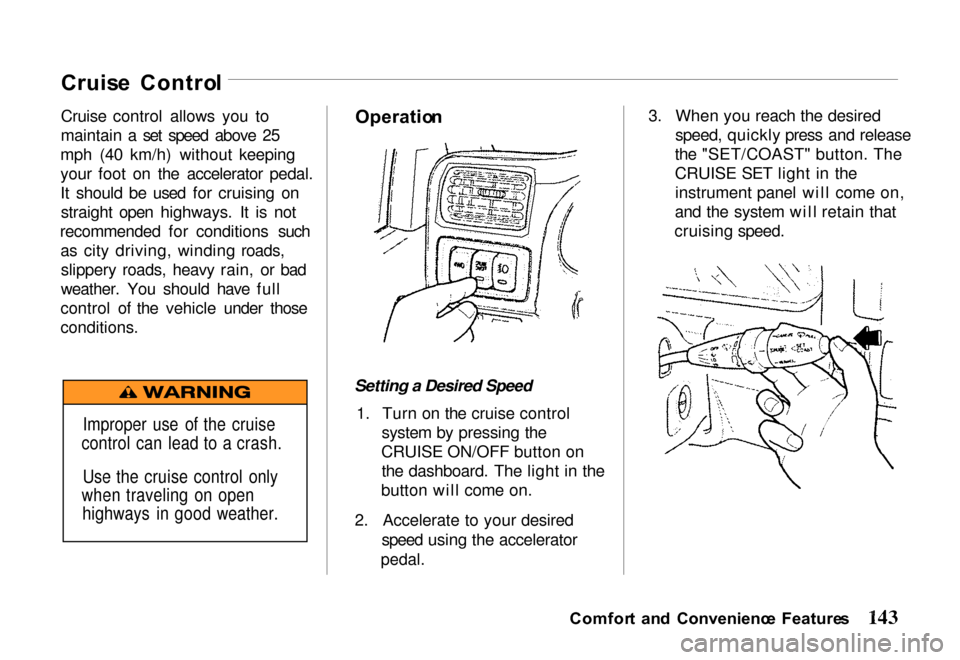
1. Tur
n on the cruise control
system by pressing the
CRUISE ON/OFF button on the dashboard. The light in the
button will come on.
2. Accelerate to your desired speed using the accelerator
pedal.
3. When you reach the desired
speed, quickly press and release
the "SET/COAST" button. The
CRUISE SET light in the instrument panel will come on,
and the system will retain that
cruising speed.
Comfor t an d Convenienc e Feature s
Improper use of the cruise
control can lead to a crash.
Use the cruise control only
when traveling on open highways in good weather.
Page 160 of 267
If anything goes wrong, the ABS
indicator on the instrument panel
comes on (see page 65). This
means th
e anti-lock function of
the braking system has shut down.
The brakes still work like a conventional system without
anti-lock, providing normal stopping ability. You should have
the dealer inspect your vehicle as soon as possible if this light stays
on after you start the engine, or
comes on while driving. Drivin
g Wit h We t Brake s
Driving through deep water may get the brakes wet and reduce
their effectiveness. As a result, the
vehicle may not slow down
normally or may pull in one direction or the other.
If you drive through deep water,apply the brakes lightly to see if
the water has affected them. To
dry the brakes quickly, press
lightly on the brake pedal while
maintaining the same speed with the accelerator pedal. Continue
this until the brakes operate
normally.
Powe
r Brake s
The braking system uses engine vacuum to provide power assist. If
the power assist fails because of astalled engine or other reason, the
reserve vacuum in the system will usually allow you to apply the
brakes at least one time.
The reserve vacuum is partly used up each time the brake pedal isapplied and released. Do not
pump the brakes when the power assist has been lost, except when
needed to maintain steering
control on slippery surfaces.
You can still stop the vehicle
without the power assist by pushing
harder on the brake pedal.
However, the stopping distance
may be longer, even though the
brakes themselves remain fully
operational.
Driving Tip s
Page 192 of 267

Rear Wheels off the Ground
1. Transfer case in 2H (4WD model only).
2. Transmission in Neutral position.
3. Maximum speed 30 mph (50 km/h).
4. Maximum distance 50 miles (80 kilometers).
If you need to tow your vehicle by
this method, secure the steering
wheel to keep the front wheels
pointed straight ahead. Do not
rely on the steering column lock; it is not strong enough to hold the
front wheels straight while
towing. The ignition switch must
be in the OFF position.
Inoperativ
e Electrica l Device s
If you have electrical problems without extreme damage to any
electrical parts, check for burned out fuses, broken wires, poor
connections or poor grounding. Correct as necessary.
The fuse boxes are located under
the left hand side of theinstrument panel and in the right
hand side of the engine compartment. (See "Fuses" on
page 236.)
Replacing a fuse with one that has
a higher rating greatly increases
the chances of damaging the
electrical system. If you do not
have a replacement fuse with the
proper rating for the circuit,
install one with a lower rating.
In Cas e o f Emergenc y
NOTIC
E