Page 201 of 267
This section includes instructions
for simple maintenance tasks,
such as checking and adding oil.
Any service items not detailed in
this section should be performed
by a Honda technician or other qualified mechanic.
Some of the most important safety
precautions are given below. However, we cannot warn you of
every conceivable hazard that can arise in performing maintenance.
Only you can decide whether or
not you should perform a given
task.
Importan
t Safet y Precaution s
Before you begin any
maintenance, make sure your
vehicle is parked on level ground and that the parking brake is on.
Also, be sure the engine is off.
This will help to eliminate several
potential hazards:
Carbo
n monoxid e poisonin g
fro m engin e exhaust . Be sure
there is adequate ventilation
whenever you operate the engine.
Burn
s fro m ho t parts . Let the
engine and exhaust system cool
before touching any parts.
Injur y fro m movin g parts . D o
not run the engine unless instructed to do so.
Read the instructions before you
begin, and make sure you have
the tools and skills required.
To reduce the possibility of fire or
explosion, be careful when
working around gasoline or
batteries. Use a commercially
available degreaser or parts
cleaner, not gasoline, to clean
parts. Keep cigarettes, sparks, and
flames away from the battery and
all fuel-related parts.
You should wear eye protection
and protective clothing when
working near the battery or when
using compressed air.
Car e an d Maintenanc e
Failure t
o properly follow
maintenance instructions and
precautions can cause you to
be seriously hurt or killed.
Always follow the procedures and precautions in this owner's
manual.
Page 203 of 267
Maintenanc
e Schedul e
Check oil and coolant level, at each fuel stop. Under severe driving conditions, service these items more often.
* 1 Using SAE 10W-40 oil, or any viscosity other than those recommended, may reduce engine life and affect the warranty.
* 2 This service is recommended only.
Inspec
t monthly :
— These fluids: brake, clutch, PIS, battery, ATF, windshield washer
— Tire pressure
Car e an d Maintenanc e
R — Replace L — Lube I — Inspect After inspection, clean, adjust, repair or replace if necessary.
Page 204 of 267
R — Replace L — Lube I — Inspect After inspection, clean, adjust, repair or replace if necessary.
Check oi
l and coolant level at each fuel stop.
Under severe driving conditions, service these items more often. These conditions are: Service for severe driving conditions
Repeated short trips in cold weather Frequent idling and/or frequent low-speed operation Change engine oil and filter - Every 3,750 miles (6,000 km) Driving in dusty areas Towing a trailer or 3 months
Change rear axle oil - Every 15,000 miles (24,000 km)
Care an d Maintenanc e
Page 210 of 267
Underbod
y — Corrosive
materials used for road-ice, snow
removal and dust control can collect on the underbody. If these
materials are not removed,
accelerated corrosion (rust) can
occur on underbody parts such as
the fuel line, frame, floor pan and
exhaust system. At least once a
year, in the spring, flush these
materials from the underbodywith plain water.
Take care to thoroughly clean any areas where mud and other debris
can collect. Sediment trapped in
closed areas of the frame should
be loosened before being flushed. Prope
r Qualit y Oi l
Engine oils are labeled on the
containers with various API (American Petroleum Institute)
designations of quality.
Use Only SJ Quality Oil
Additional designations of quality may also be present, but SJ must
be included.
The "SJ" designation may be shown alone, or in combination
with other designations, such as
"SJ/CC," "SJ/CD," or "SJ, CC"
etc.
As long as the letters "SJ" appearsomewhere in the designation of
oil quality indicated on the
container, the oil is of suitable
quality. Chang
e Interva l
The oil and filter change intervals for your engine are based on the
use of the recommended oil
quality and viscosity, as well as
high-quality filters. Using oils other than recommended, or
extending oil change intervals longer than those recommended,
could reduce engine life.
Your engine was filled with a
high-quality engine oil when it left the factory. You do not have
to change this oil before the
suggested change period.
If your normal driving does not include one or more of the "severe
driving" conditions listed below,
change the oil every 7,500 miles(12,000 kilometers) or 6 months,
whichever comes first.
Car e an d Maintenanc e
Engin
e Oi l an d Filte r
Page 211 of 267
Change the oil and oil filter every
3,750 miles (6,000 kilometers) or
every three months if you drive under one or more of these
"severe driving" conditions: Driving in dusty areas
Towing a trailer
Frequent idling or idling for
long periods Frequent short trips (4 miles [6
kilometers] or less) in cold or
freezing weather, where the
engine does not thoroughly
warm up. Change the oil and oil filter as
soon as possible after driving in
a dust storm.
Oi
l Chang e
Changing the oil and filter requires
special tools and access from underneath the vehicle. The vehicle
should be raised on a service station-type hydraulic lift for this
service. Unless you have the
knowledge and proper equipment,
you should have this maintenance
done by a skilled mechanic.
1. Warm up the engine. This makes the oil drain faster and
more thoroughly.
2. Remove the oil filler cap.
3. Remove the drain plug and drain oil fully.
4. Install the drain plug, with a new gasket, and tighten it.
5. Fill the engine with the proper amount of new oil (see
"Specifications"). Oil Filter Installation
1. Remove the old oil filter with the filter wrench.
2. Apply a light coat of engine oil to the oil filter gasket.
3. Hand-tighten the filter until the gasket contacts the sealing
face.
4. Using the filter wrench, tighten the filter one full turn.
5. Run the engine and inspect for
leaks.
6. Shut off the engine. After a couple of minutes, check the
oil level. If necessary, add oilto bring it to the FULL mark.
An improperly installed oil filter can result in severe engine
damage.
Car e an d Maintenanc e
NOTIC
E
Page 212 of 267
Oi
l Viscosit y
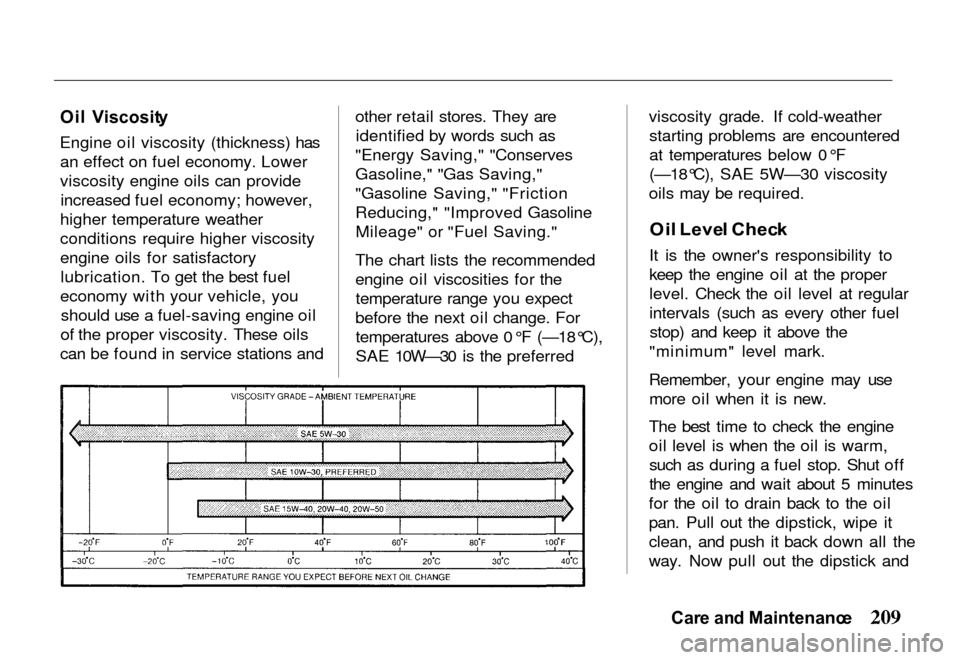
Engine oil viscosity (thickness) has an effect on fuel economy. Lower
viscosity engine oils can provideincreased fuel economy; however,
higher temperature weather
conditions require higher viscosity
engine oils for satisfactory lubrication. To get the best fuel
economy with your vehicle, you should use a fuel-saving engine oil
of the proper viscosity. These oils
can be found in service stations and other retail stores. They are
identified by words such as
"Energy Saving," "Conserves
Gasoline," "Gas Saving,"
"Gasoline Saving," "Friction
Reducing," "Improved Gasoline Mileage" or "Fuel Saving."
The chart lists the recommended
engine oil viscosities for the temperature range you expect
before the next oil change. For temperatures above 0°F (—18°C),
SAE 10W—30 is the preferred viscosity grade. If cold-weather
starting problems are encountered
at temperatures below 0°F
(—18°C), SAE 5W—30 viscosity
oils may be required.
Oi l Leve l Chec k
It is the owner's responsibility to
keep the engine oil at the proper
level. Check the oil level at regular
intervals (such as every other fuel stop) and keep it above the
"minimum" level mark.
Remember, your engine may use more oil when it is new.
The best time to check the engine
oil level is when the oil is warm, such as during a fuel stop. Shut off
the engine and wait about 5 minutes
for the oil to drain back to the oil
pan. Pull out the dipstick, wipe it
clean, and push it back down all the
way. Now pull out the dipstick and
Car e an d Maintenanc e
Page 213 of 267
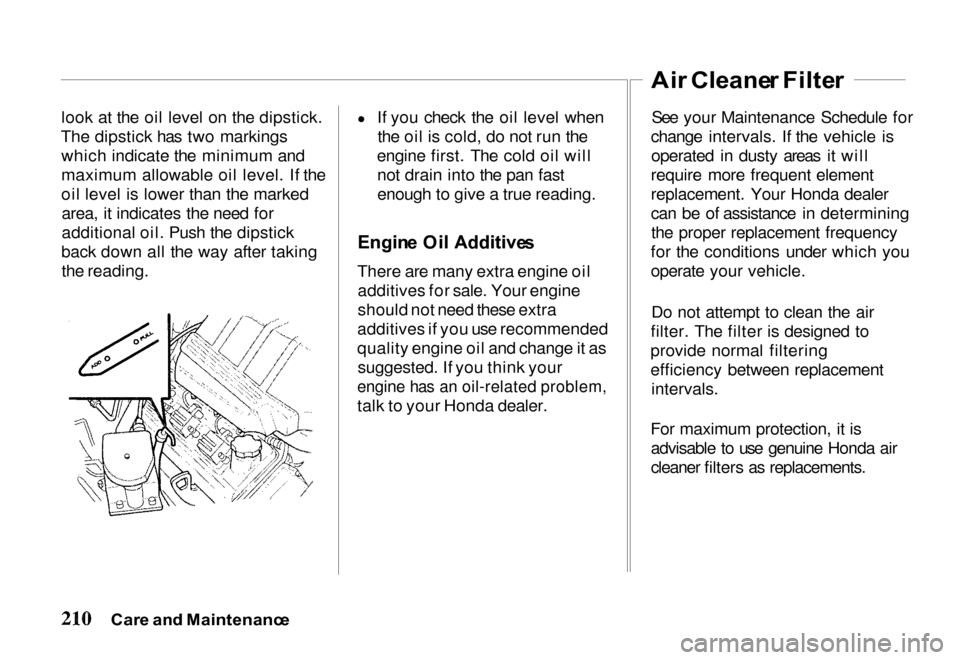
look at the oil level on the dipstick.
The dipstick has two markings which indicate the minimum and
maximum allowable oil level. If the
oil level is lower than the markedarea, it indicates the need for
additional oil. Push the dipstick
back down all the way after taking the reading. If you check the oil level when
the oil is cold, do not run the
engine first. The cold oil will not drain into the pan fast
enough to give a true reading.
Engin e Oi l Additive s
There are many extra engine oil additives for sale. Your engine
should not need these extra
additives if you use recommended
quality engine oil and change it as suggested. If you think your
engine has an oil-related problem,
talk to your Honda dealer. Ai
r Cleane r Filte r
See your Maintenance Schedule for
change intervals. If the vehicle is operated in dusty areas it will
require more frequent element
replacement. Your Honda dealer
can be of assistance in determining the proper replacement frequency
for the conditions under which you
operate your vehicle.
Do not attempt to clean the air
filter. The filter is designed to
provide normal filtering
efficiency between replacement intervals.
For maximum protection, it is advisable to use genuine Honda air
cleaner filters as replacements.
Car e an d Maintenanc e
Page 214 of 267
Never run the engine with the air
cleaner filter removed. If the
engine should backfire, it could
possibly cause an engine
compartment fire.
Be sure to reinstall the air cleaner
filter and assembly correctly. If it is installed incorrectly, engine
damage could result. Manua
l Transmissio n Flui d
See the Maintenance Schedule to
find out how often the lubricant
level should be checked.
Check that the fluid level reaches
the plug hole by removing the
filler plug on the transmission and transfer case. If the fluid level is
low, refill the case up to the filler
plug hole.
Use a high-quality engine oil
labeled SG or SF that is of the
correct viscosity for existing ambient temperatures as follows.
(2WD)
OIL FIL L PLU G
DRAI N PLU G
DRAI N PLU G
Car e an d Maintenanc e
(4WD)
RIGH
T SID E
LEF T SID E
OIL FIL L PLU G