2000 HONDA PASSPORT air condition
[x] Cancel search: air conditionPage 135 of 267
Radi
o Frequencie s
Your Honda's radio can receive
the complete AM and FM bands.
Those bands cover these
frequencies:
AM band: 530 to 1,710 kilohertz
FM band: 87.7 to 107.9 megahertz
Radio stations on the AM band are assigned frequencies at least 10
kilohertz apart (530, 540, 550).
Stations on the FM band are
assigned frequencies at least 0.2
megahertz apart (87.9, 88.1, 88.3).
Stations must use these exact
frequencies. It is fairly common
for stations to round-off the
frequency in their advertising, so
your radio could show a
frequency of 100.9 even though
the announcer may call the station
"FM 101." Radi
o Receptio n
How well your Honda's radio
receives stations is dependent on many factors, such as the distance
from the station's transmitter,
nearby large objects, and
atmospheric conditions.
A radio station's signal gets weaker as you get farther away
from its transmitter. If you are
listening to an AM station, you
will notice the sound volume
becoming weaker, and the station
drifting in and out. If you are
listening to an FM station, you
will see the stereo indicator
flickering off and on as the signal
weakens. Eventually, the stereo indicator will go off and the sound
will fade completely as you get
out of range of the station's
signal.
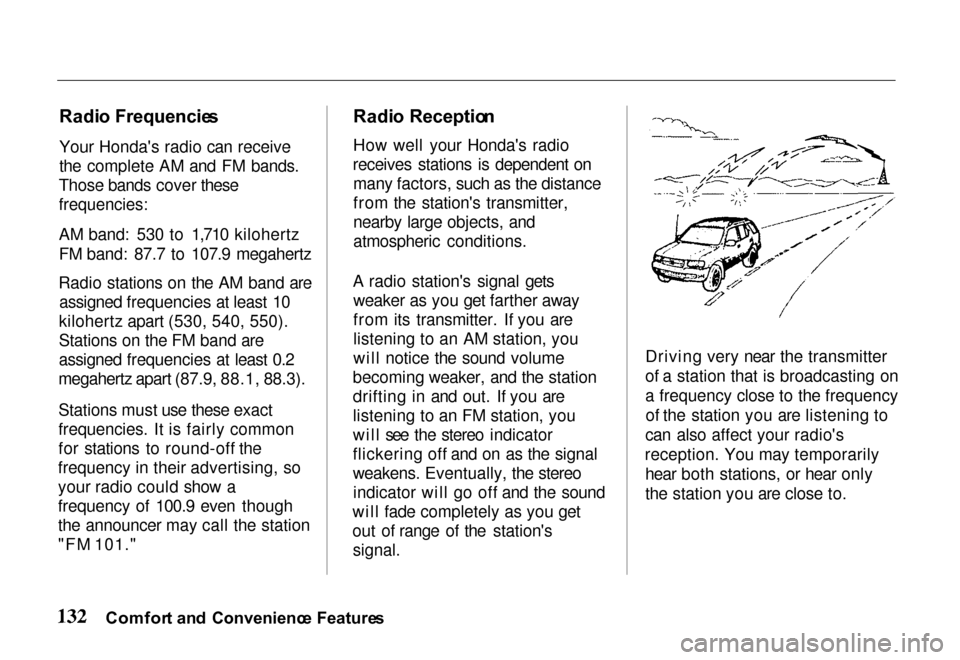
Driving very near the transmitter
of a station that is broadcasting on
a frequency close to the frequency
of the station you are listening to
can also affect your radio's
reception. You may temporarily hear both stations, or hear only
the station you are close to.
Comfor t an d Convenienc e Feature s
Page 162 of 267
distances will be longer and
vehicle control more limited.
While driving on a surface with
reduced traction, avoid maneuvers involving sudden steering,
acceleration, or braking (including
engine braking due to shifting to
lower gear), that could cause the
tires to skid.
Drivers may not realize the surface is slippery until the
vehicle is skidding.
Learn to recognize warning
clues — such as enough water or ice on the road to make a
"mirrored surface"— and slow
down when there is any doubt.
Also see "Traction" under "Tires" in this section. To safely operate your vehicle,
your tires must be the proper type
and size, in good condition with
adequate tread, and correctly
inflated. The following pages give
more detailed information on how
and when to check air pressure,
how to inspect your tires for damage and wear, and what to do
when your tires need to be
replaced.
Driving Tip s
Rapid slowing down or
speeding-up can cause loss
of control on slippery
surfaces. If you crash, you
can be injured.
Use extra care when driving
on slippery surfaces.
Using tires that are excessivelyworn or improperly inflated can
cause a crash in which you
can be seriously hurt or killed.
Follow all instructions in this
owner's manual regarding tire inflation and maintenance.
Tire
s
Page 163 of 267
Inflatio
n
Keeping the tires properly inflated
provides the best combination of
handling, tread life, and riding
comfort. Underinflated tires wear
unevenly, adversely affect handling and fuel economy, and are more
likely to fail from being overheated. Overinflated tires can make your
vehicle ride more harshly, are
more prone to damage from road
hazards, and wear unevenly.
We recommend that you visually check your tires every day. If you
think a tire might be low, check it
immediately with a tire gauge.
Use a gauge to measure the air
pressure at least once a month. Even tires that are in good
condition may lose one to two psi
per month. Remember to checkthe spare tire at the same time you
check all the other tires. Check the pressure in the tires
when they are cold. This means
the vehicle has been parked for at
least three hours. If you have to
drive the vehicle before checking
the tire pressure, the tires can still be considered "cold" if you drive
less than 1 mile (1.6 km).
If you check the pressure when the tires are hot (the vehicle has
been driven several miles), you will see readings 4 to 6 psi (28 to
41 kPa, 0.3 to 0.4 kg/cm2) higher
than the cold reading. This is
normal. Do not let air out to
match the specified cold pressure.
The tire will be underinflated.
You should get your own tire
pressure gauge and use it at all times. That makes it easier for
you to tell if a pressure loss is
caused by a tire problem and not a
variation between gauges.
Recommended Tire Pressures for
Normal Driving
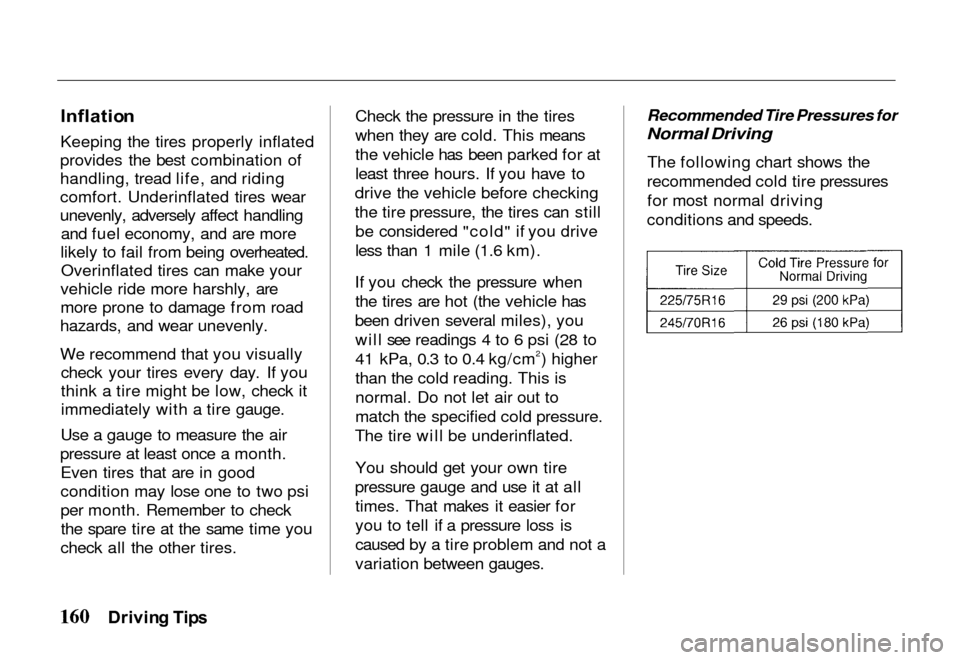
The
following chart shows the
recommended cold tire pressures for most normal driving
conditions and speeds.
Drivin g Tip s
Page 170 of 267
air cleaner, so it's important to
replace the air cleaner filter at
required intervals. See "Care and Maintenance." A dirty air cleaner
filter reduces engine performance
and can waste fuel.
Air Conditioning
Turn off the air conditioning whenit is not needed. The air
conditioning compressor is not on
in this position and the reduced
engine load can improve fuel
economy.
Tuned Engine
An engine that is properly
maintained will provide better
fuel economy than one that is not.
One misfiring spark plug will cut
fuel economy significantly, and
will make a difference in the
amount of pollution emitted from
your vehicle.
Excessive Weight
Fuel economy is related to thework the engine must do. The
heavier the load, the more fuel it takes to run your vehicle. Keep
weight to a minimum by removing
unnecessary luggage or cargo.
Tire Inflation
Underinflation not only causes
needless tire wear but can also
waste fuel. It's a good idea to
check tire pressure often and keep your tires inflated to the pressures
shown on the tire placard located
on the driver's doorjamb.
Wheel Alignment
Improper alignment will cause the
front tires to roll at an angle that
will result in faster tire wear. It takes power to overcome this
improper alignment, which, inturn, wastes fuel.
Use of 4-Wheel Drive
In normal driving, put the 4WD-2WD switch in the 2WD
position.
Driving Tip s
Page 184 of 267

If a battery sits in extreme cold,
the electrolyte inside can freeze.
Attempting to jump start a frozen battery can cause it to rupture.
4. Jumper Cable Connection Instructions:and Connect the first
jumper cable from the
positive "+" (red) terminal
on one battery to the
positive "+" (red) terminal
on the other battery. Never
connect"+" (red) to "— "
(black) or "— " to "+." Next, connect one end
of the second cable to the
grounded negative "— "
(black) terminal of the good
(charged) battery. Lastly, connect the other
end of the second, grounded
jumper cable to a solid,
stationary, metallic point on
the engine of the vehicle
with the discharged battery but at a point at least 18
inches (45 cm) away from
the battery. Do not connect it to pulleys, fans, or other
parts that move. Beware of touching hot manifolds that
can cause burns. (Themounting brackets for the
alternator or air
conditioning compressor generally make a good
point for this final ground attachment point. Take care
that the jumper cable does
not contact moving parts on
or near the alternator or
compressor.)
5. Start the engine on the vehicle with the good (charged) battery
and run the engine at moderate
speed.
I n Cas e o f Emergenc y
NOTIC
E
Do no t allo w th e
vehicle s to touch .
Mak
e las t connectio n
o n engin e awa y fro m
th e battery . Mak
e connection s
i n numerica l order .
DISCHARGE D
VEHICL E
CHARGED
VEHICL E
1st CABL E
2n d
CABL E
Page 190 of 267

find a leak, it must be repaired
before you can continue
driving. (See
Towing on page
187.)
If you don't find an obvious leak, check the coolant level inthe radiator reserve tank. If the
level is below the MIN mark, add
coolant to halfway between the
MIN and MAX marks.
If there was no coolant in the
reserve tank, you may also
have to add coolant to the
radiator.
Let the engine cool down until
the pointer reaches the middle
of the temperature gauge, orlower, before checking the
radiator. If needed, add coolant to the
radiator to bring the level up to the filler neck, and to the
reservoir up to the level indicated on the reservoir tank. Proper equipment must be used to
prevent damage to vehicles during
any towing. State and local laws
that apply to vehicles in tow must
be followed. Get detailed towing
instructions from your Honda
dealer.
Should it become necessary to
tow your vehicle, follow these
directions.
Precaution s
Before towing, make sure that
the power train, axle,
transmission, wheels and steering system are in good
condition.
If any of these items are
damaged, a flatbed trailer must
be used.
In Cas e o f Emergenc y
Towin
g
Removing the radiator cap
while the engine is hot can
cause the coolant to spray out, seriously scalding you.
Always let the engine andradiator cool down before
removing the radiator cap.
Page 194 of 267

Car
e an d Maintenanc e
This section explains why it is important to keep your vehicle
well maintained and to follow
basic maintenance safety
precautions.
This section also includes Maintenance Schedules for
normal driving and severe driving
conditions, a Maintenance
Record, and instructions for simple maintenance tasks you
may want to take care of yourself.
If you have the skills and tools
required to perform more complex
maintenance tasks on your Honda,
you may want to purchase the Service Manual. See page 249 for
information on how to obtain a
copy, or see your Honda dealer. Service Station Information . 193
Fuel Fill Cap .......... 193Fuel Recommendation ... 194
Fuel Tank Capacity ..... 194
Engine Oil Recommendation ...... 194
Windshield Washer ..... 194
Tire Inflation Pressures .. 194 Battery ............... 194
Hood Release .......... 195
Engine Oil Dipstick ..... 196
Fuel Requirements ........ 196 Oxygenated Fuels ...... 196
Maintenance Safety ....... 197 Important Safety
Precautions .......... 198
Maintenance Schedule ..... 199
Required Maintenance Record 202
Owner Safety Checks ...... 204
Engine Oil and Filter ...... 207 Proper Quality Oil ...... 207 Change Interval ........ 207
Oil
Change ........... 208
Oil Filter Installation . 208
Oil Viscosity .......... 209
Oil Level Check ....... 209
Engine Oil Additives ... 210
Air Cleaner Filter ........ 210
Manual Transmission Fluid 211
Automatic Transmission Fluid .................. 212
Front (4WD) and Rear Axles ............. 212
Engine Cooling System ... 213
Other Required Maintenance 215 Brake Master Cylinder . . 215
Shift-on-the-Fly System
. 216
Front Whee
l Bearings ... 216
Hood Latch and Hinges . 217
Air Conditioning ....... 217 Body Lubrication ...... 217
Car e an d Maintenanc e
Page 203 of 267

Maintenanc
e Schedul e
Check oil and coolant level, at each fuel stop. Under severe driving conditions, service these items more often.
* 1 Using SAE 10W-40 oil, or any viscosity other than those recommended, may reduce engine life and affect the warranty.
* 2 This service is recommended only.
Inspec
t monthly :
— These fluids: brake, clutch, PIS, battery, ATF, windshield washer
— Tire pressure
Car e an d Maintenanc e
R — Replace L — Lube I — Inspect After inspection, clean, adjust, repair or replace if necessary.