2000 HONDA ODYSSEY Fuel
[x] Cancel search: FuelPage 306 of 352
If You r Engin e Won' t Start , Jum p Startin g
The Starte r Operate s Normall y
In this case, the starter motor's speed sounds normal, or even faster
than normal, when you turn the ignition switch to START (III), but
the engine does not run. Are you using the proper startingprocedure? Refer to Startin g th e
Engin e on page 203 .
Do you have fuel? Turn the
ignition switch to ON (II) for a
minute and watch the fuel gauge.
The low fuel level warning light may not be working, so you were
not reminded to fill the tank.
There may be an electrical problem, such as no power to the
fuel pump. Check all the fuses (see page 311).
If you find nothing wrong, you will
need a qualified technician to find
the problem. See Emergenc y
Towin g on page 317. Jum
p Startin g
If your vehicle's battery has run
down, you may be able to start the
engine by using a booster battery.
Although this seems like a simple
procedure, you should take several
precautions.
You cannot start a Honda by pushing
or pulling it. To jump start your vehicle, follow
these directions closely:
1. Open the hood and check the physical condition of the battery(see page 257). In very cold
weather, check the condition of the electrolyte. If it seems slushyor like ice, do not try jump starting
until it thaws.
If a battery sits in extreme cold, the
electrolyte inside can freeze.
Attempting to jump start with a frozen
battery can cause it to rupture.
2. Turn off all the electrical acces- sories: heater, A/C, climate
control, stereo system, lights, etc. Put the transmission in Neutral or
Park and set the parking brake.
CONTINUED
Takin g Car e o f th e Unexpecte d
A battery can explode if you do
not follow the correct procedure,
seriously injuring anyone nearby.
Keep all sparks, open flames,
and smoking materials away
from the battery.
NOTIC E
Page 312 of 352
Malfunction Indicato r Lam p
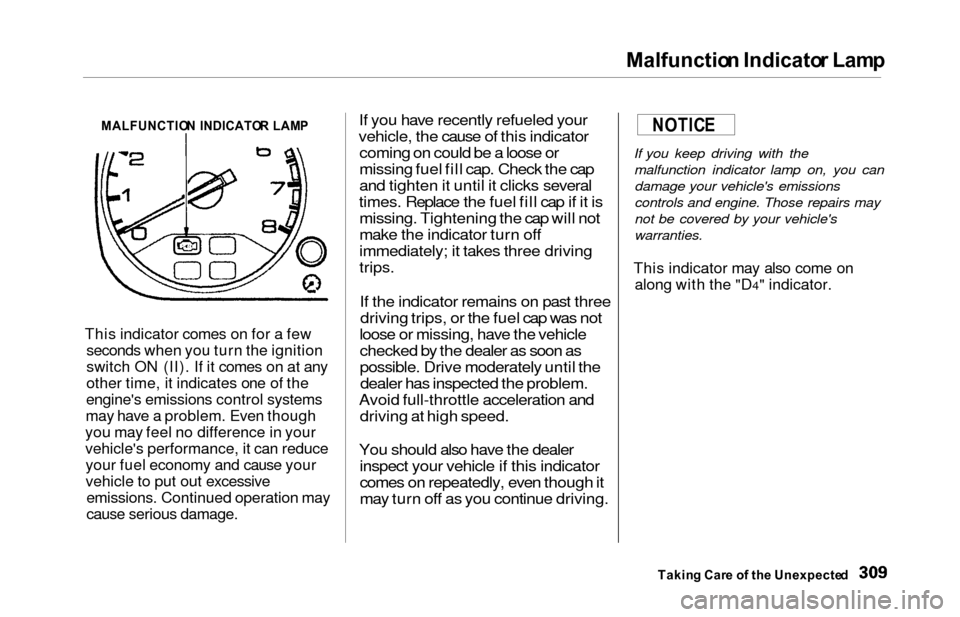
MALFUNCTIO N INDICATO R LAM P
This indicator comes on for a few
seconds when you turn the ignition
switch ON (II). If it comes on at any
other time, it indicates one of the
engine's emissions control systems
may have a problem. Even though
you may feel no difference in your
vehicle's performance, it can reduce your fuel economy and cause your
vehicle to put out excessive emissions. Continued operation may
cause serious damage.
If you have recently refueled your
vehicle, the cause of this indicator coming on could be a loose or
missing fuel fill cap. Check the cap
and tighten it until it clicks several
times. Replace the fuel fill cap if it is missing. Tightening the cap will not
make the indicator turn off
immediately; it takes three driving
trips.
If the indicator remains on past threedriving trips, or the fuel cap was not
loose or missing, have the vehicle checked by the dealer as soon as
possible. Drive moderately until thedealer has inspected the problem.
Avoid full-throttle acceleration and driving at high speed.
You should also have the dealer inspect your vehicle if this indicator
comes on repeatedly, even though it
may turn off as you continue driving.
If you keep driving with the
malfunction indicator lamp on, you candamage your vehicle's emissions
controls and engine. Those repairs may
not be covered by your vehicle's
warranties.
This indicator may also come on along with the "D
4" indicator.
Takin g Car e o f th e Unexpecte d
NOTICE
Page 322 of 352

Technical Informatio n
The diagrams in this section give
you the dimensions and capacities of
your Honda, and the locations of theidentification numbers. The expla-
nations of several electronic and mechanical systems on your Honda
are for the more technically-oriented
owner. Identification Numbers................. 320
Specifications................................. 322
DOT Tire Quality Grading........... 324
Treadwear.................................. 324
Traction....................................... 324
Temperature............................. . 325Oxygenated Fuels.......................... 326
Driving in Foreign Countries....... 327
Emissions Controls........................ 328 The Clean Air Act...................... 328Crankcase Emissions Control System.................................... . 328
Evaporative Emissions Control System.................................... . 328
Exhaust Emissions Controls.... 329
PGM-FI System..................... 329
Ignition Timing Control System................................. 329
Exhaust Gas Recirculation (EGR) System.................... 329
Three Way Catalytic Converter............................ 329
Replacement Parts..................... 329
Three Way Catalytic Converter... 330
Technica l Informatio n
Page 329 of 352
Oxygenated Fuel s
Some conventional gasolines are
being blended with alcohol or an
ether compound. These gasolines
are collectively referred to as
oxygenated fuels. To meet clean air
standards, some areas of the United
States and Canada use oxygenated
fuels to help reduce emissions.
If you use an oxygenated fuel, be
sure it is unleaded and meets the
minimum octane rating requirement.
Before using an oxygenated fuel, try
to confirm the fuel's contents. Some
states/provinces require this
information to be posted on the
pump.
The following are the U.S. EPA and
Canadian CGSB approved
percentages of oxygenates:
ETHANO L (ethyl or grain alcohol)
You may use gasoline containing up to 10 percent ethanol by volume. Gasoline containing ethanol may be
marketed under the name "Gasohol."
MTB E (Methyl Tertiary Butyl
Ether)
You may use gasoline containing up to 15 percent MTBE by volume.
METHANO L (methyl or wood
alcohol)
You vehicle was not designed to use
fuel that contains methanol. Methanol can corrode metal parts in
the fuel system, and also damage
plastic and rubber components. This damage would not be covered by
your warranties. If you notice any undesirable
operating symptoms, try another
service station or switch to another
brand of gasoline.
Fuel system damage or performance
problems resulting from the use of
an oxygenated fuel containing more
than the percentages of oxygenates
given above are not covered under
warranty.
Technica
l Informatio n
Page 330 of 352

Driving in Foreig n Countrie s
Technica l Informatio n
If you are planning to take your
Honda outside the U.S. or Canada,
contact the tourist bureaus in the
areas you will be traveling in to find
out about the availability of unleaded
gasoline with the proper octane
rating.
If unleaded gasoline is not available,
be aware that using leaded gasoline in your Honda will affect perfor-
mance and fuel mileage, and damage
its emissions controls. It will no
longer comply with U.S. andCanadian emissions regulations, and
will be illegal to operate in North
America. To bring your vehicle back into compliance will require the re-
placement of several components,such as the oxygen sensors and the
three way catalytic converter. These
replacements are not covered under
warranty.
Page 331 of 352
Emissions Control s
The burning of gasoline in your
vehicle's engine produces several by-products. Some of these are carbon
monoxide (CO), oxides of nitrogen (NO
x) and hydrocarbons (HC).
Gasoline evaporating from the tank
also produces hydrocarbons. Con-
trolling the production of NOx, CO, and HC is important to the environ-
ment. Under certain conditions ofsunlight and climate, NOx and HC
react to form photochemical "smog." Carbon monoxide does not contri-
bute to smog creation, but it is a
poisonous gas.
Th e Clea n Ai r Ac t
The United States Clean Air Act*
sets standards for automobile
emissions. It also requires that
automobile manufacturers explain to
owners how their emissions controls
work and what to do to maintain
them. This section summarizes how
the emissions controls work.
Scheduled maintenance is on page
230.
* In Canada, Honda vehicles comply
with the Canadian Motor Vehicle
Safety Standards (CMVSS) for
Emissions valid at the time they are
manufactured.
Crankcas e Emission s Contro l
System
Your vehicle has a Positive
Crankcase Ventilation System. This
keeps gasses that build up in the engine's crankcase from going into
the atmosphere. The Positive Crank- case Ventilation valve routes them
from the crankcase back to the
intake manifold. They are then drawn into the engine and burned.
Evaporativ e Emission s Contro l
Syste m
As gasoline evaporates in the fuel tank, an evaporative emissions
control canister filled with charcoaladsorbs the vapor. It is stored in this
canister while the engine is off. After
the engine is started and warmed up,
the vapor is drawn into the engine and burned during driving.
Technica l Informatio n
Page 332 of 352
Emissions Control s
Exhaus t Emission s Control s
The exhaust emissions controls include four systems: PGM-FI,
Ignition Timing Control, ExhaustGas Recirculation and Three Way
Catalytic Converter. These four
systems work together to control the
engine's combustion and minimize
the amount of HC, CO, and NOx that
comes out the tailpipe. The exhaust emissions control systems are
separate from the crankcase and
evaporative emissions control
systems.
PGM-FI System
The PGM-FI System uses sequential multiport fuel injection.
It has three subsystems: Air Intake,
Engine Control, and Fuel Control.
The Powertrain Control Module (PCM) uses various sensors to
determine how much air is going
into the engine. It then controls how
much fuel to inject under all operat-
ing conditions.
Ignition Timing Control System
This system constantly adjusts the ignition timing, reducing the amountof HC, CO and NOx produced.
Exhaust Gas Recirculation (EGR)
System
The Exhaust Gas Recirculation (EGR) system takes some of the
exhaust gas and routes it back into
the intake manifold. Adding exhaust
gas to the air/fuel mixture reduces
the amount of NOx produced when
the fuel is burned.
Three Way Catalytic Converter
The three way catalytic converter is in the exhaust system. Through
chemical reactions, it converts HC,CO, and NOx in the engine's exhaust
to carbon dioxide (CO
2), dinitrogen
(N
2), and water vapor. Replacemen
t Part s
The emissions control systems are designed and certified to work to-
gether in reducing emissions to
levels that comply with the Clean Air
Act. To make sure the emissions remain low, you should use only newGenuine Honda replacement parts or
their equivalent for repairs. Using
lower quality parts may increase the emissions from your vehicle.
The emissions control systems are covered by warranties separate from
the rest of your vehicle. Read your
warranty manual for more informa- tion.
Technica l Informatio n
Page 344 of 352

Index
Checklist, Before Driving............. 202
Childproof Door Locks.................. . 85
Child Safety..................................... . 22
Cleaner Element, Air..................... 252
Cleaning
Aluminum Wheels.................... 285
Carpeting................................... . 286
Exterior....................................... 284
Fabric.......................................... 286
Interior........................................ 286
Seat Belts.................................... 286
Vinyl........................................... . 286
Windows.................................... . 287
Climate Control System................ 138
Clock, Setting the.......................... 117 Coat Hook....................................... 123
Code, Audio System ..................... 186
CO in the Exhaust ........................ 328
Coin Holder................................... . 122
Cold Weather, Starting in............. 203
Compact Spare............................... 292
Consumer Information*................ 332
Controls, Instruments and.............. 55
Coolant
Adding ........................................ 243
Checking ....................................
193
Proper Solution.......................... 243
Replacing.................................... 245
Temperature Gauge.................... 63
Corrosion Protection..................... 288
Crankcase Emissions Control
System......................................... 328
Cruise Control Operation .............. 73
Customer Relations Office........... 332
DANGER, Explanation of................. ii
Dashboard.................................... 2, 56
Daytime Running Lights................. 67
Dead Battery, What to Do............ 303
Defects, Reporting Safety............. 336
Defogger, Rear Window................. 71 Defrosting the Windows...... 135, 145
DEXRON
® III Automatic
Transmission Fluid.................... 249
Dimensions..................................... 322
Dimming the Headlights................ 66
Dipstick Automatic Transmission........... 249
Engine Oil................................... 192
Directional Signals........................... 68
Disabled, Towing Your
Vehicle If..................................... 317
Disc Brake Wear Indicators ........ 210
Disposal of Used Oil ................... 242
Doors
Locking and Unlocking ............. 79
Lockout Prevention ................... 80
Manual Sliding Doors.................. 88
Monitor Light .............................. 60
Power Door Locks....................... 79
Power Sliding Doors .................. 90
DOT Tire Quality Grading........... 324
Drive Belts..................................... 262
Driver and Passenger Safety .......... 5
Driving............................................ 201
Economy.................................... 194
In Bad Weather ....................... 216
In Foreign Countries ............... 327
Economy, Fuel............................... 194
Emergencies on the Road............. 291
Battery, Jump Starting.............. 303
CONTINUED