Page 684 of 2189
Description
Power Flow
O: Operates, x: Doesn't operate.*1: Although the 1st clutch engages, driving power is not transmitted as the one-way clutch slips.*2: The one-way clutch engages when accelerating, and slips when decelerating.
\ARTPOSMON\
TOROUE1ST GEAR
CLUTCH
2ND GEAR
2ND
CLUTCH
3RD GEAR
3RD
CLUTCH
4THREVERSE
GEAR
PARK
GEARCONVERTERCLUTCH
Eoo
Eooo
Eo
D]
1SToo*,
2NDoo*,o
3RDoo*1o
4THoo*1oo
tr
oO*r
2NDoo+ro
3RDoo*1o
Eoo*1o
14-6
Page 686 of 2189
Description
Power Flow (cont'dl
lst Gesr (E or @ position)
In lE or E position, the optimum gear is automatically selected from 1st,2nd,3rd and 4th gears, according to conditionssuch as the balance between throttle opening (engine load) and vehicle speed.
1. Hydraulic pressure is applied to the 1st clutch, which rotates together with the mainshaft, causing the mainshaft 1stgear to rotate.
Power is transmitted to the countershaft 1st gear, which drives the countershaft via the one-way clutch.
Power is transmitted to the final drive gear, which drives the final driven gear.
TOROUE CONVERTER
MAINSHAFT 1ST GEAR
lST CLUTCH
MAINSHAFT
AY CLUTCH
FINAL DRIVE GEAR
PARK GEAR
L
COUNTERSHAFT1ST GEAR
14-8
Page 692 of 2189
Description
Electronic Control System (cont'd)
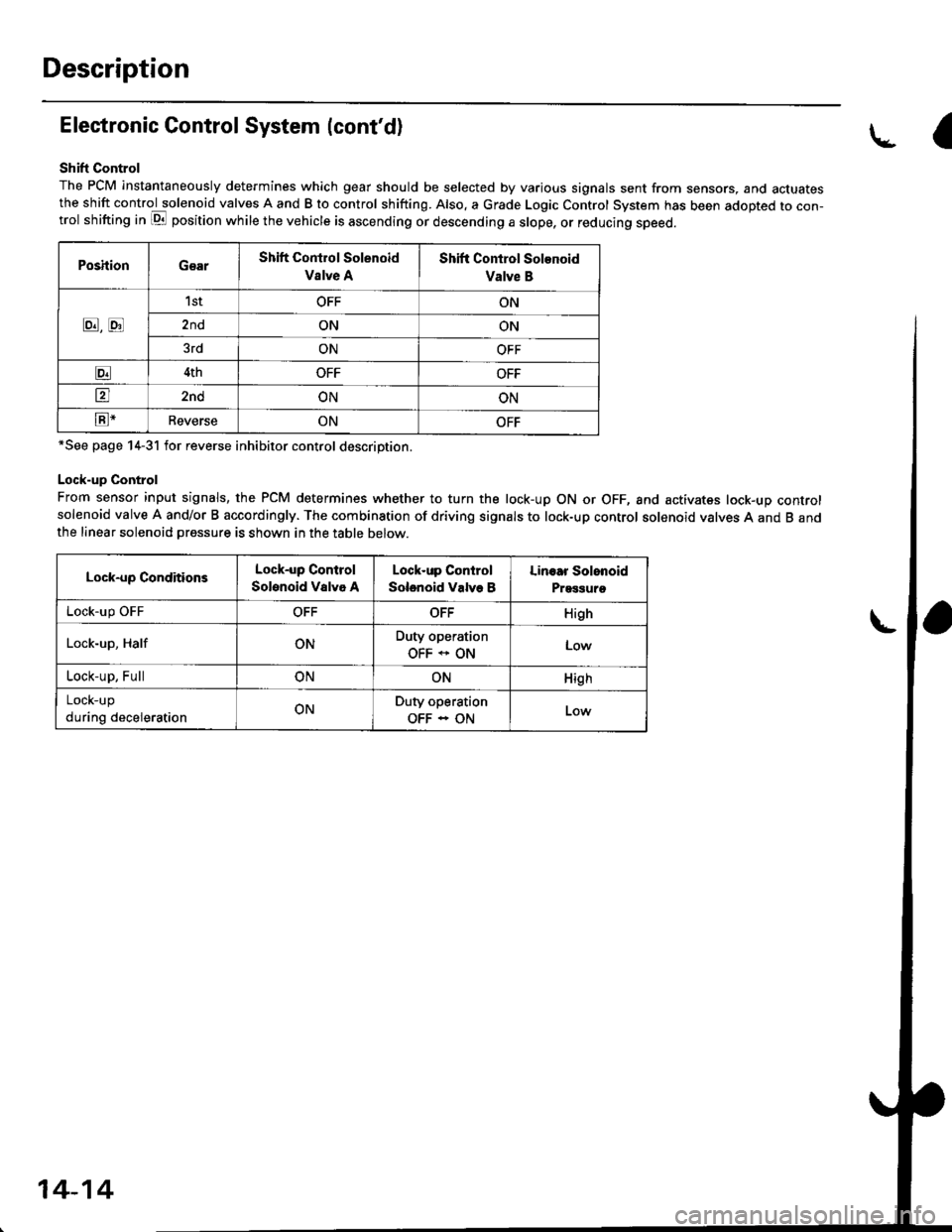
Shift Control
The PCM instantaneously determines which gear should be selected by various signals sent from sensors, and actuatesthe shift control solenoid valves A and B to control shifting. Also. a Grade Logic Control System has been adopted to con-trol shifting in E position while the vehicle is ascending or descending a slope, or reducing speed.
PoshionGearShift Control Solenoid
Vslve A
Shift Control Solenoid
Valve B
8,tr
1stOFFON
2ndONON
3rdONOFF
E4thOFFOFF
tr2ndONON
E-ReverseONOFF
*See page 14-31 for reverse inhibitor control description.
Lock-up Control
From sensor input signals, the PCM determines whether to turn the lock-up ON or OFF, and activates lock-up controlsolenoid valve A and/or B accordingly. The combination of driving signals to lock-up control solenoid valves A and B andthe linear solenoid pressure is shown in the table below.
Lock-up ConditionsLock-up Control
Solenoid Valvo A
Lock-up Control
Solenoid Valve B
Linoar Solonoid
Prggguro
Lock-up OFFOFFOFFHigh
Lock-up, HalfONDuty operation
OFF * ONLow
Lock-up, FullONONHigh
LOCK-Up
during decelerationONDuty operation
OFF - ON
a
14-14
Page 694 of 2189

Description
Electronic Control System {cont'dl
Ascending Control
When the PCM determines that the vehicle is climbing a hill in E position, the system oxtends the sngagement area of2nd gear and 3rd gear to prevent ths transmission from fr€quently shifting between 2nd and 3rd gears, and between 3rdand 4th gears, so the vehicle can run smooth and have more power when needed. There are two ascending modes withdifferent 3rd gear driving areas according to the magnitude of a gradient stored in the pCM.
NOTE:
. The PCM memory contains shift schedules between 2nd and 3rd gears, and between 3rd and 4th gears that enable thePCM's fuzzy logic to automatically select the most suitable gear according to the magnitude of a gradient. Fuzzy logic is a form of artificial intelligence that lets computers respond to changing conditions much like a humanmind would,
Dssconding Control
When the PCM determines that the vehicle is going down a hilt in E position, the shift-up speed from 3rd to 4th gearwhen th€ throftle is closed becomes faster than the set speed for flat road driving to widen the 3rd gear driving area.This, in combination with engine braking from the deceleration lock-up, achieves smooth driving when the vehicle isdescending. There are two descending modes with different downshift (4 - 3) schedules according to the magnitude of agradient stored in the PCM. When the vehicle is in 4th gear, and you are decelerating on a gradual hill, or when you areapplying the brakes on a steep hill, the transmission will downshift to 3rd gear. When you accel6rate, the transmission willthen return to 4th gear.
ASCENDING MODEDESCENDING MODE
4TH SHIFTING
L.
F
CHARACTERISIICSCONTROL AREA
ff.1"11", vehicr. 3pe€dff;Tlr., vohicre speed
GRADUAL ASCENOINGCONTROL AREA
Docel6ration Control
When the vehicle goes around a corner. and needs to first decelerate and then accelerate. the rcM sets the data for decelerationcontrol to reduce the number of times the transmission shifts. When the vehicle is decelerating from speeds above 26 mph(41 km/h), the rcM shifts the transmission from 4th to 2nd earlier than normal to cope with upcoming acceleration.
14-16
Page 697 of 2189
Hydraulic Control
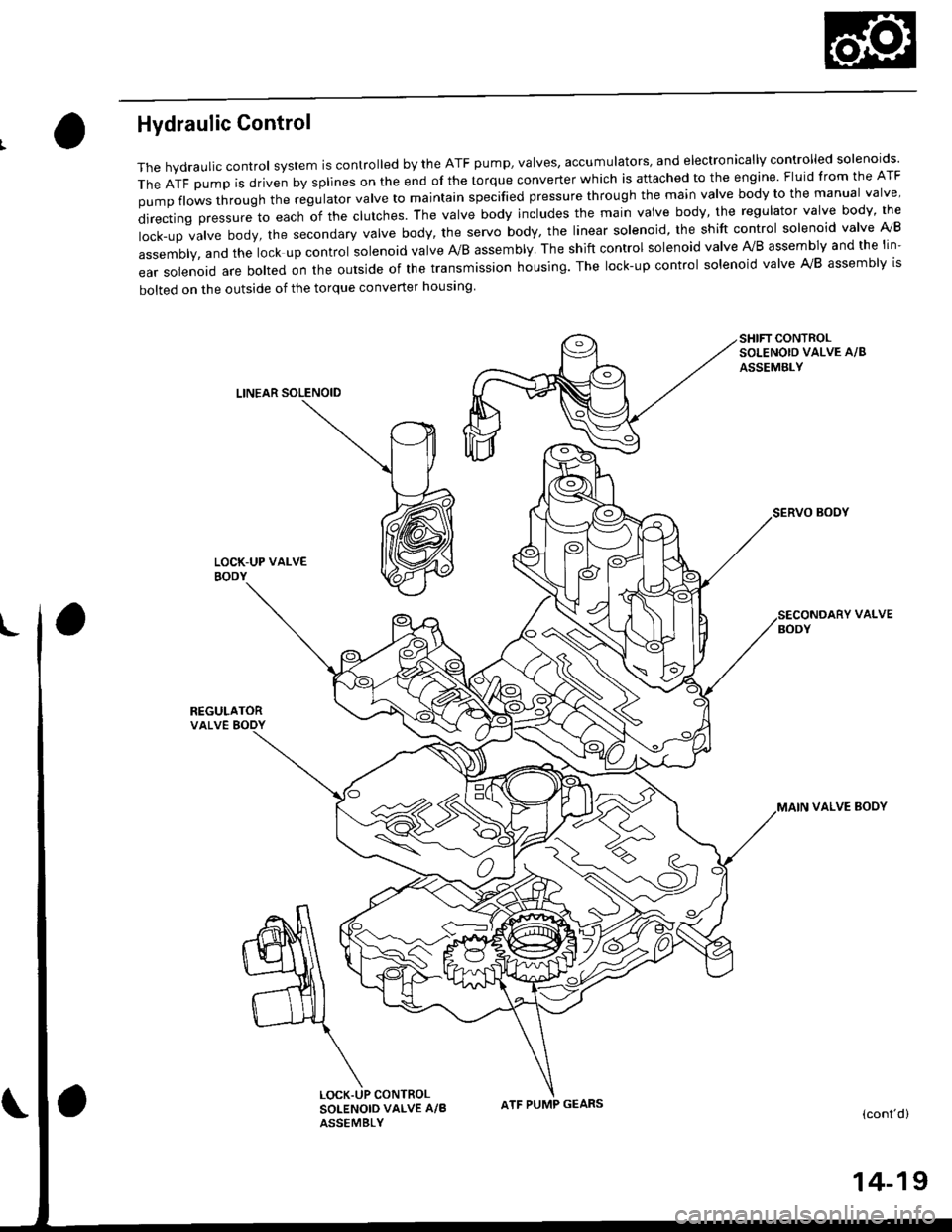
The hydraulic control system is controlled by the ATF pump, valves, accumulators, and electronically controlled solenoids'
TheATFpUmpisdrivenbysp||nesontheendofthetorqueconverterWhichisattachedtotheengine.F|uidfromtheATF
pumpf|owsthroughtheregu|atorva|vetomajntainspecifiedpressurethroughthemainva|vebodytothemanuaIva|ve'
directingpressuretoeachofthec|utches.Theva|vebodyinc|udesthemainvaivebody,theregu|atorvalvebody,the
|ock-upva|vebody,thesecondaryVa|vebody,theservobody,theIinearso|enoid,theshiftcontro|so|enoidva|velVB
assembly, and the lock up control solenoid valve A/B assembly. The shift control solenoid valve Ay'B assembly and the lin-
ear solenoid are bolted on the outside of the transmission housing. The lock-up control solenoid valve A,/B assembly is
bolted on the outside of the torque converter housing
SHIFT CONTROLSOLENOIO VALVE A/8
ASSEMBLY
LINEAR SOLENOID
SERVO BOOY
REGULATORVALVE BODY
VALVE
VALVE BOOY
(cont'd)
CONTROLSOLENOID VALVE A/BASSEMBLY
ATF PUMP GEARS
14-19
Page 700 of 2189

Description
Hydraulic Control (cont'dl
Regulator Valve
The regulator valve maintains a constant hydraulic pressure from the ATF pump to the hydraulic control system, whitealso furnishing fluid to the lubricating system and torque converter. The fluid from the ATF pump flows through B and 8,.The regulator valve has a valve orifice. The fluid entering from B flows through the orifice to the A cavity. This pressure ofthe A cavity pushes the regulator valve to the right side, and this movement of the regulator valve uncovers the fluid portto the torque converter and the relief valve. The fluid flows out to the torque converter, and the relief valve and regulatorvalve moves to the left side. According to the level of the hydraulic pressure through B, the position of the regutator vatvechanges and the amount of the fluid from B' through D and c also changes. This operation is continued. maantaining theline pressure,
NOTE: When used. "|eft" or "right" indicates direction on the illustration betow.
ENGINE NOT RUNNING
TOROUE CONVERTER
ENGINE RUNNING
To TOROUE CONVERTER Lubrication
Stator Roaction Hydraulic Prossur6 Control
Hydraulic pressure increases according to torque, are performed by the regulator valve using the stator torque reaction.The stator shaft is splined with the stator in the torque converter, and its arm end contacts the regulator sprang cap. whenthe vehicle is accelerating or climbing (Torque Convert€r Range), the stator torque reaction acts on the stator shaft, andthe stator arm pushes the regulator spring cap in the direction of the arrow in proponion to the reaction. Jne stator reac-tion spring compresses, and th€ reoulator valve moves to increase the line pressure which is regulated by the regulatorvalve. The line pressure reaches its maximum when the stator torque reaction reaches its maximum.
STATOR SHAFT ARM
REGULATOR VALVE
14-22
STATORATOR SHAFT ARM
SPRING CAP
Page 701 of 2189
\
Servo Body
The servo body is located on the secondary valve body. The servo body contains the servo valve which is integrated with
the reverse shift fork, and the accumulators
2NO ACCUMULA
SERVO BODY
1ST ACCUMULATOR
3RD ACCUMULATOR
SERVO VALVE/SHIFTFORK SHAFT
NoTE: The illustration shows the'96 - '98 models; the '99 - 00 models are similar'
14-23
Page 702 of 2189

Description
Hydraulic Flow
General Chart ol Hydraulic PressureATF Pump- pegurator varve -_l- Line pressure -f- Modurator pressure - Linear sorenoid
| -Clutch pressure
-Torque Converter pressure
t-Lubrication Pressure
Distribution of Hydraulic Pressur€. Regulator Valve -]- Torque Converter pressure
F_ Lubrication pressure
i- To regulate Line pressure
. Manual valve _ To select Line pressure _ clutch pressure
' Modulator Valve i/odulator pressure _ ___f_ Shift Control Solenoid Valves
F_ Lock_up Control Solenoid ValvesL_ Linear Solenoid
. 1-2 Shift Valve - l. 2-3 Shift Valve - 1- Ctutch pressure. 3-4 Shift Valve
lra
PORT NO.DESCRIPTION OF PRESSUREPORT NO.DESCRIPTION OF PRESSUREPORT NO.DESCRIPTION OF PRESSURE
1LINE6B
MODULATE(SHIFT CONTROL
SOLENOID VALVE B)
414TH CLUTCH
LINEMODULATE(LOCK-UP CONTROL
SOLENOID VALVE A)
56LINEAR SOLENOID
LINE6D
MODULATE(LOCK-UP CONTROL
SOLENOID VALVE B)
90TOROUE CONVEBTER
2LINE6D'
MODULATE
(LOCK-UP CONTROL
SOLENOID VALVE B)
91TOROUE CONVERTER
LINE7LINE92TOROUE CONVERTERLINE8LINE/CPC93ATF COOLER3"LINE9LINE94TOROUE CONVERTER4LIN E'101ST CLUTCH95LUBRICATION
LINE202ND CLUTCHYOTOROUE CONVERTERLINE20A2ND ACCUMULATOR97TOROUE CONVERTER5LINE99SUCTION
MODULATE303RD CLUTCHXDRAIN
6A
MODULATE(SHIFT CONTROL
SOLENOID VALVE A)
404TH CLUTCH
14-24


