2000 HONDA CIVIC Acc
[x] Cancel search: AccPage 1919 of 2189
![HONDA CIVIC 2000 6.G Workshop Manual i
;iil;------lonl|,ATO9ITl5a
----li----J8
WHT/GFN
c352PHOTO 8
UNDER-HOODFUSE/RELAYBOX506 Po
€rDislrhulbn,page lot3.
* = 96-97 models* = GX models
CABLEREEL
,r:ill
ilifl?H]"*,--*
,rllI
g**. ---](/manual-img/13/6068/w960_6068-1918.png "HONDA CIVIC 2000 6.G Workshop Manual i
;iil;------lonl|,ATO9ITl5a
----li----J8
WHT/GFN
c352PHOTO 8
UNDER-HOODFUSE/RELAYBOX506 Po
€rDislrhulbn,page lot3.
* = 96-97 models* = GX models
CABLEREEL
,r:ill
ilifl?H]\"*,--*
,rllI
g**. ---")
i
;iil;------'lonl|,ATO9ITl5a
----li----J8
WHT/GFN
c352PHOTO 8
UNDER-HOODFUSE/RELAYBOX506 Po
€rDislrhulbn,page lot3.
* = '96-'97 models*' = GX models
CABLEREEL
,r:ill
ilifl'?H]"*,--*'
,rllI
g**. ---!
",
f,*,,-":l
2gu{3ItK
?
I
I
lr
I
S€sllorns
I
I
I
I
Closed withbrak€ pedal
. deprcssed,
BRAKEswtTcHPHOTO 68
r-r------
I3ll' | \o"n.t""t I L-
A ..^at ,,^"1,
nfig*,',,"1o,, ","*"
"+f--a=={
*-'*:'! |s.triL!fl8;lp,*,;,, LT.FN,FEDI
--.'*""*-[
(s6 -'s7 moders i)J[ - - (sl g -o9"95]I-( e6-e7 moders lll
c430
---:--l cRUlsEf Br?kp Sevdecel Resuma/ t Ctitrf-nlOr_r^ swilch signal input acc€lsignal i uNif intut inp,n - | p#ib *
I lvtEw 13
-----J
CNU|sECONTNOLSETngSUt EswlTcH
1 CABLE
IREEL
IJ
STEERINGWHEEL
(cont'd)
Rlroma/AccelSultch
34-1
Page 1922 of 2189
Gruise Control (cont'd)
- How the Circuit Works
The cruise control system uses mechanical and
electrical devices to maintain the car's sDeed at a
setting selected by the driver.
System Description
The cruise control unit receives command signals
from the crurse control main switch and the cruise
control SeVResume switch. With the ignition switch
in ON (ll) or START (lll), voltage is provided to the
cruise control main switch through fuse 14. When
you push the switch to ON, power is provided to the
cruise control unit and the brake switch.
The cruise control unit receives information about
operating conditions from the brake switch, the
vehicle speed sensor (VSS), and the clutch switch
(manual transmission) or the A,/T gear position
switch (automatic transmission). The cruise control
unit then sends signals to the cruise control actuator
which regulates the throttle position to maintain the
selected speed. The conlrol unit compares the
actual speed of the car to the selected speed. The
control unit then uses the result of that comoarison
to open or close the throttle.
The brake switch releases the system's control of
the throttle at the instant you press on the brake
pedal. The switch sends a signal to the control unit
by removing power from the normally closed brake
input (GRY wire), and providing power at the
normally open brake input (GRN/vVHT wire). The
control unit responds by allowing the throttle to
close. The clutch switch or the A,/T gear position
switch sends a "disengage" signal to the control unit
that also allows the throttle to close.
The cruise control system will set and automatically
maintain any speed above 25 mph (40 km/h). To set
it, make sure the main switch is on and the switch
indicator is on. Then, after reaching the desired
speed, press the SET switch. This sends a "set"
signal to the cruise control unit which, in turn,
controls the cruise control actuator to maintain the
set speed.
When you push the SET switch and the cruise
control system is on, the "cruise control" ON
indicator lights up.
34-4
(
You can cancel the cruise control system by
turning the main switch off . This removes power to
the control unit and erases the set speed from
memory. lf the system is disengaged temporarily
by the brake switch, or clutch switch, and the car's
speed is still above 25 mph, press the resume
switch: the car will automatically return to the
previously set speed.
For gradual acceleration without pressing the
accelerator pedal, push the RESUME switch and
hold it there. This will send an "acceleration" signal
to the control unit. When you release the switch, the
system will be reprogrammed for the new speed. To
slow the car down. oush the SET switch in and hold
it there. This sends a "deceleration" signal to the
control unit, causing the car to coast. When the
desired speed is reached, release the SET switch.
This reprograms the system tor the new speed.
Refer to the Service Manual (Section 23, Electrical)
tor specific tests or troubleshooting procedures.
(
a
Page 1939 of 2189
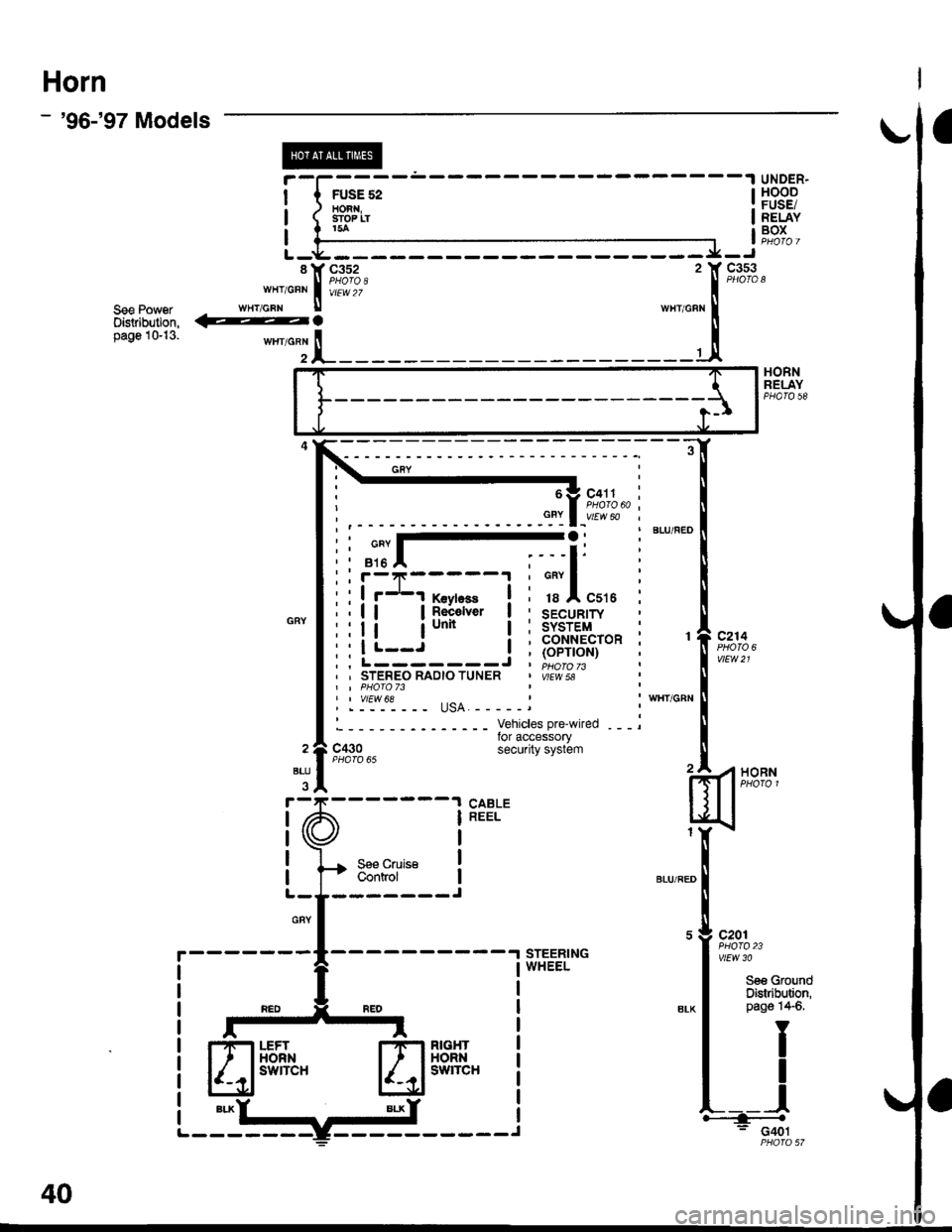
Horn
- '96-'97 Models
UNDER.HOODFUSE/RELAYBOX
c353PHOTOs
See PowerOistribution,pag610-13.""^T.!,-
HORNRELAYPHA|O 58
c214
vtEw21
BLU/FEO
1
VHT/qRN
I1
WHT/qRN
: :i-I:::--li i ! !'-'! fevtess
! a;fi."*
,,lr--J I::.-------J. , STEREO RAOIO TUNER
| | vtEw 68
HORN
l
h: c4o1PHQ|A 57
c430
Sse CruiseControl
Vehicles pre-wired ---lor accessorysecurity system
BLU
GBY
------- J
- -.! STEERINGWHEEL
6 g c411
| _vtEw 60
a,---li
cnv I
18 A C516
sEcuRtwSYSTEMCONNECTOR(oPTroN)PHO|O 73VEW 5A
40
Page 1941 of 2189
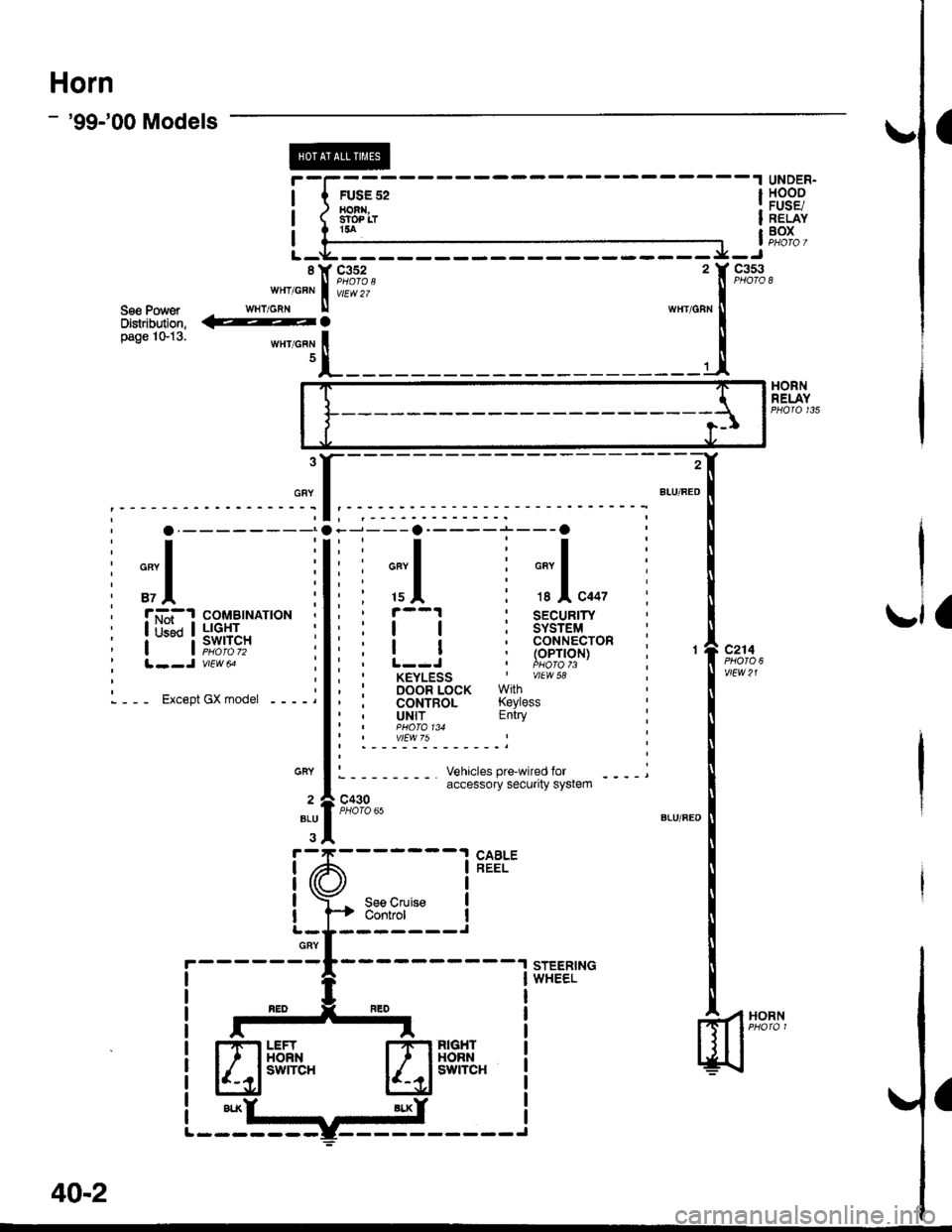
Horn
- '99-'00 Models
FUSE 52HORI,SfOP LTt5a
UNDER.HOODFUSE/RELAYBOX
HORNRELAY
2
BIU/FED
Ior
GRY
.,1 ,
J---a-----r---O
i ;l i ;,1...,' r--1 : SECUR|TY:ll:sYsrEM,ia,coNNEcroR' ! ! (oPrloN), L--J , i!,o!o 73, KEYLESS I vlEw 58
: DooR LocK withi coNTRoL Kevless, UNIT EntryI PHOIO 134I vtEw 75
i o.--------;
:T:' cnvl :
i"l ii ri-'--.| coMBtNATtoN
: lrft ! !',f,11" I' | | puotozz :', l--J vttw u ;
i--- Er""pt ex.ooer ----j
c214
v|EW21
c430PHOTO 65
Vehicles pre-wired foraccessory security system
STEERINGWHEEL
CABLEREEL
.l
I
I
I
ISee CruiseControl
GRY
ELU
I
a\
I
GRY
HORN
---------^1
niffil"a!m"
40-2
Page 1946 of 2189
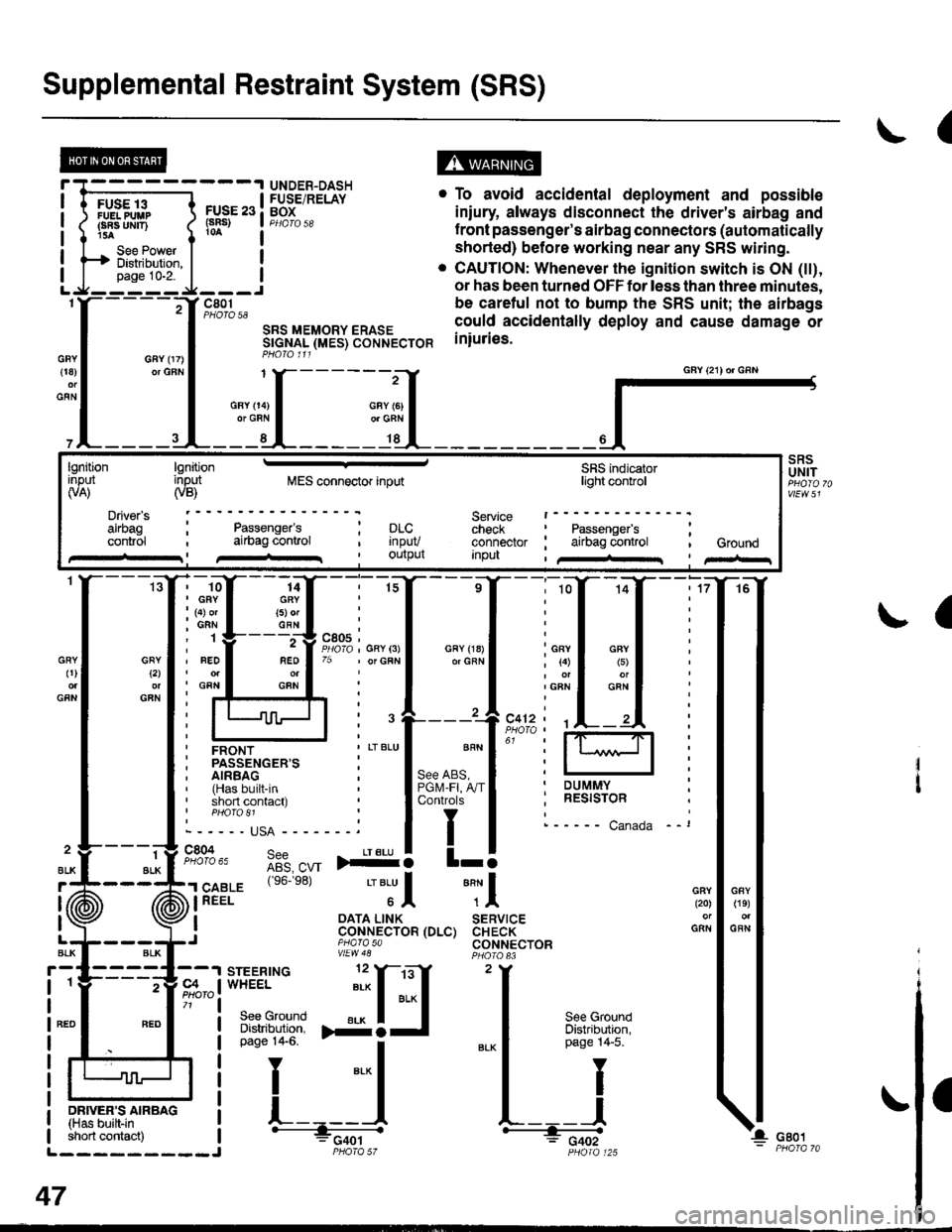
Supplemental Restraint System (SRS)
(
FUSE 13FUELPUUPFBA UMT)15A
See PowerDistibution,page 10-2.
FUSE 23(sRs)
c801PHOTO 58
SRS MEMORY ERASESTGNAL (MES) CONNECTORPHO|O 111
. To avoid accidental deployment and possible
iniury always disconnect the driver's airbag and
f ront passenger's airbag connectors (automatically
shorted) before working near any SRS wiring.
. CAUTION: Whenever the ignition switch is ON (tt),
or has been turned OFF for less than three minutes,
be caretul not to bump the SRS unit; the airbags
could accidentally deploy and cause damage or
iniuries.
UNDER-DASHFUSE/RELAYBOX
GFY 07)or GFN{18)
GFN
GFYt2l
GFN
GRY0)
GFN
2
ALK
J (ii
t\
GFY O4)or GRN
SRSUNIT
a
-ffiffi,*l-{
H!=";=_J
iffii'r:fi:*" i tH-
PHOIO 125short contact) | - FCqOtL_________J PHO|A 57
47
GAY (21) or GRN
lgnitionInput(VA)
Driver's
cont.ol
lgnitioninput(VB)MES connector inputSRS indicatorlighl control
Service t------check : Passengefs ;connector ; airbag control , GroundInpu , /+rr I pir-r
Passenger'sai|bag conlrol; prc..t rnpuv, Ourpul
14GRY(5) orGFN
rffi{{_ilil
i ffi i""'"1*"o,"'.1'' i lffil
ffirtu!-T:l
ir:r*::"."
ilstEl'{s6.e8'
'"'Jl "Tl
, I oATA L|NK SERVTCE: CoNNECTOR (DLC) CHECK,J piarasa CONNECTORvtEw48
Page 1954 of 2189
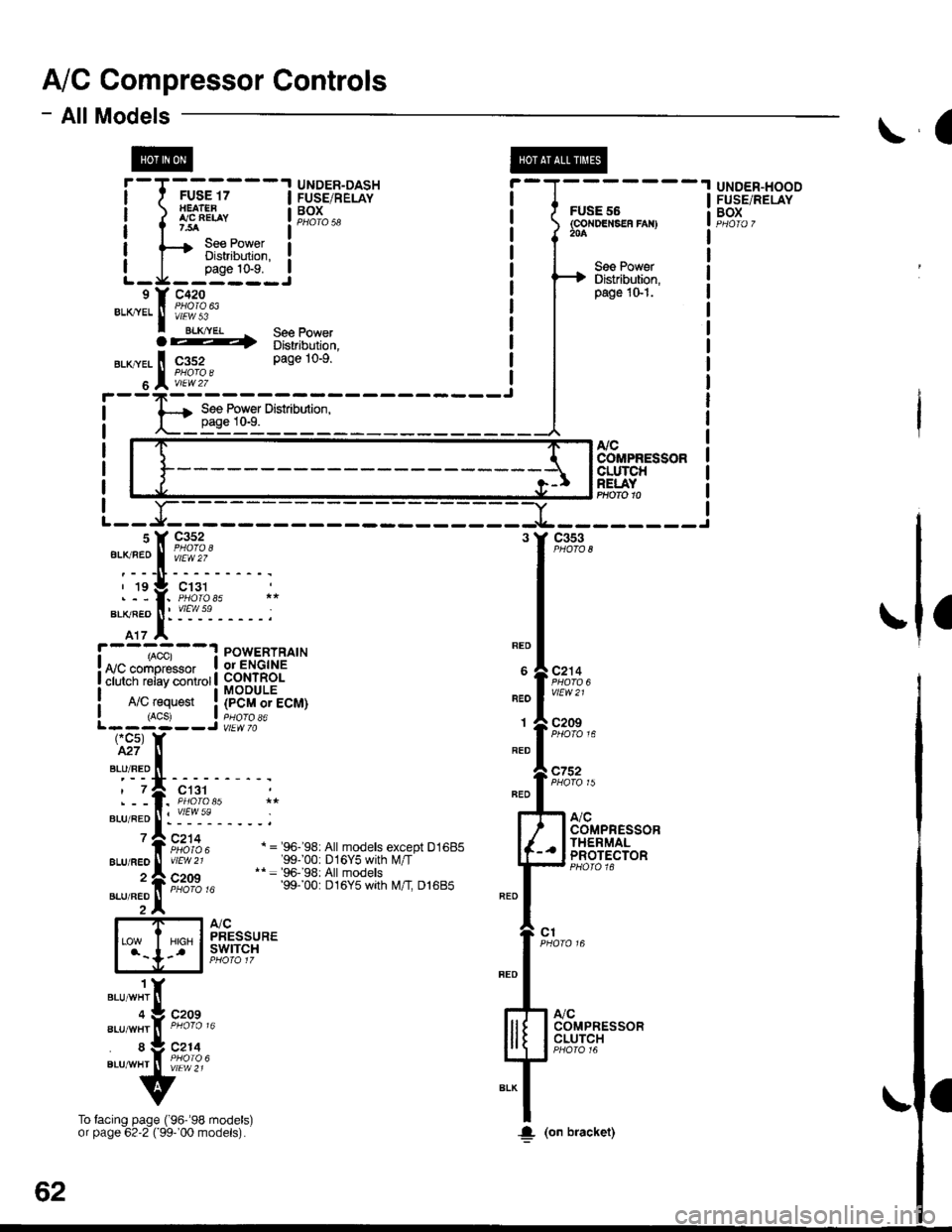
A/C Compressor Controls
- AllModels
cc5)M7
BLU/RED
?
\a
@
&cCOMPRESSORCLUTCHRELAYPHOfO 10
a
! ,acc, : POWERTRATN! arn.^-^,o..^, I or ENGINE
! ii i"i-iiii"v i.,ii.r | fi 3$18.
I A/C request ! (pCM or ECM)I (ACSJ a pHOrO a6L------J vtEw 70
REO
BEO
1
RED
BLU/FEO
2
BLU/FEO
ct31
:"1'!i'------;
Fi:rz, a ='e6-'s8: A|| moders except D1685vtEw 21 '99100: D16Y5 with l\illT'* = 96-'98: All models
ir'iio ," 99. 00: Dt6y5 wth t\4/t Dl6Bb
atcPRESSUREswtTcH
c752
c1
".,n""t 1(
".r-".rf, "tA% "
"."-:,fi tfr,]4.
v
To facing page ('96''98 models)or page 62'2 ( 99-'00 models).
-Yl
-t---------Jc353
c2'14
vtEW21
c209
A,/CCOMPRESSORCLUTCH
COMPRESSORTHERMALPROTECTOR
UNDER-HOODFUSE/RELAYBOXf-T-*-'.T'---l H53.',EPA?' i-l-------
i iflH* !F,?r",, i f6F"'.i:.",",
| tsBi":J;"#il ! a T| | oaoe 1o-9. ! I I See PowerL_J1_j:_-_j ! H Distriburion.e Y c42o i I
pase 1o-1.
***
f ifi"l'
^ see power ! |
62
!(on bracket)
Page 1976 of 2189
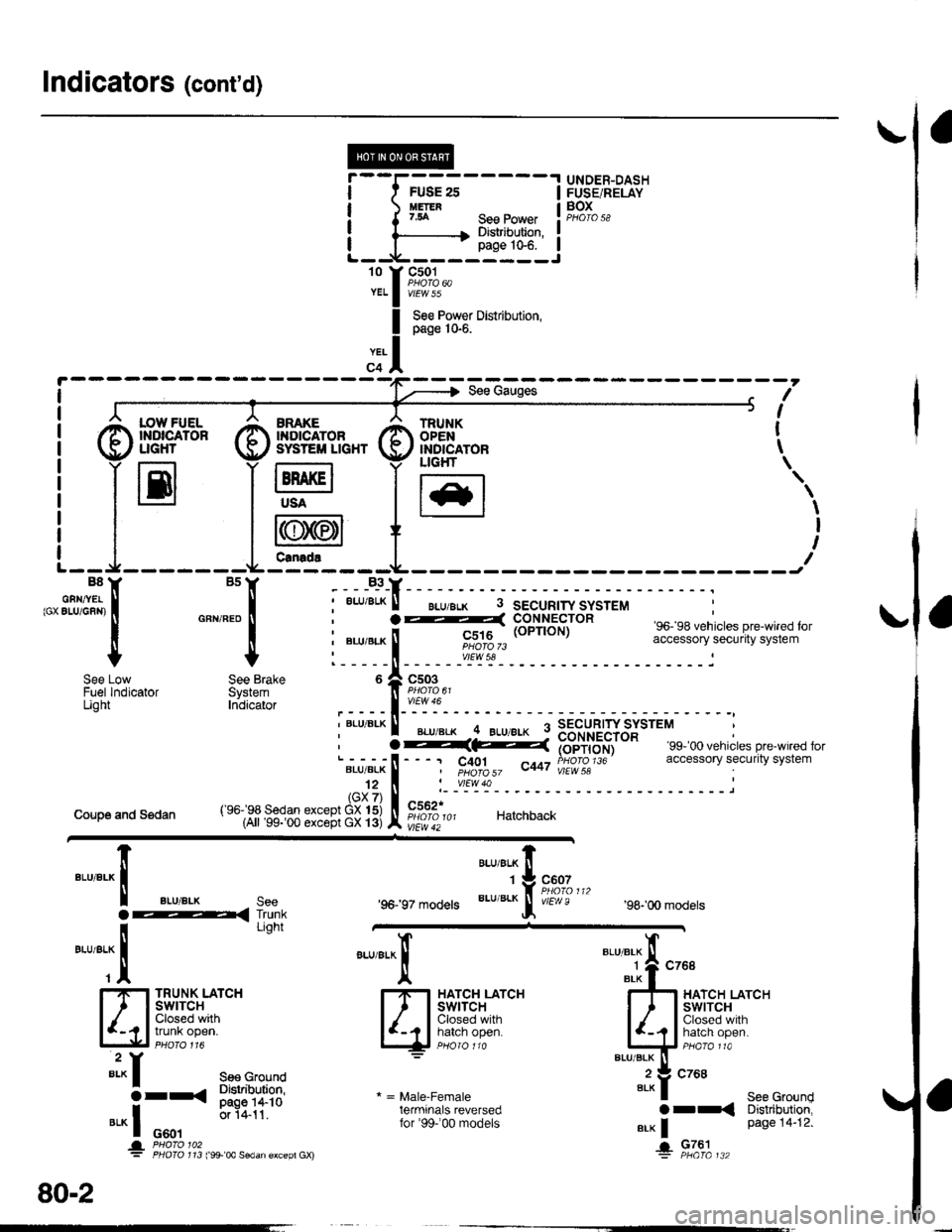
Indicators (cont'd)
I
I
I
I
't0 t
YEL
YEL
FUSE 2sUETER7.54
.I UNDER-DASH
IFUSE/RELAY
! F,gI".,I
IJ
See PowerDistribution,page 10€.
@f,*+* @sv#ftn* G)ffig^,", t
I
S€e Pow€r Distribution,page 10-6.
?-(: i#i',du), c401 ^t,a PHOfO 1J6I pHOfO 57 v"r vlEW 58
'99- 00 vehicles pre-wired foraccessory security system
I :7 r----r -7 ucHr \
i llEl lH lt*l
'.,
| | i r{rN/,6n1I I I l\y
//l I t
t--J-------Lfe---t---- ---JB8Y BsY B3YB8Y BsY -___B_3_Y_
,"' sfilJi:, i "*,*" i ;
""'"'*
! - "*-i
F"EIi,6HiJttr" so. sa venricres pre_w reo ror
I | : ".u,"r" ! ii|ot$,, accessory securrtv svstem
+ + l-----il------"rl';r'- ------------i
i "Lu,"r" ! rc;1rg (oPrroN) """"";:"J; !H;fi;"";Jt"'
l_____ll_ ____-v'_E\s!- __________-_i
o A csoeI PsOrO 6t
,----l-'':y:-
i """'^ I ".u"." -4 ELueLx 9 3B"rU"?'JYSJtttt :
See Low See Brake 6 Zl C503Fuel lndicator System ]l Paoro o'Light Inbicator ,____l_'':Y":-, BLU BLK ll _... _.._ q SECURTW SYSTEM, I BLU'BLK .. BLU/8!K : nourpcrrip
Coupe and Sedan
'96197 models
"ar,"a^ fi
'tg::1",,,
BLU/BLK
Jf v/Er,! e'98-'00 models
TRUNK LATCHSWITCHClosed withtrunk open.
"arr"a*l
qF*til'-""
* = Male-Femaleterminals reversedfor'99-'00 models
"'"'"i{ "^'
4r*liT;--'""""'-it:':
Bi?fi,,ri"li
".* | Page 14"12'
+ Fla'|",.
""'"'-lt
aLU/aLK see
i-< I'dli
-*TT
"'*f see cround
3rr< Sl"JliT:?s
".* I o*.,
0.1411'
* '&3i311'" ,:*'* ""dan €xcep, Gx)
80-2
Page 1980 of 2189
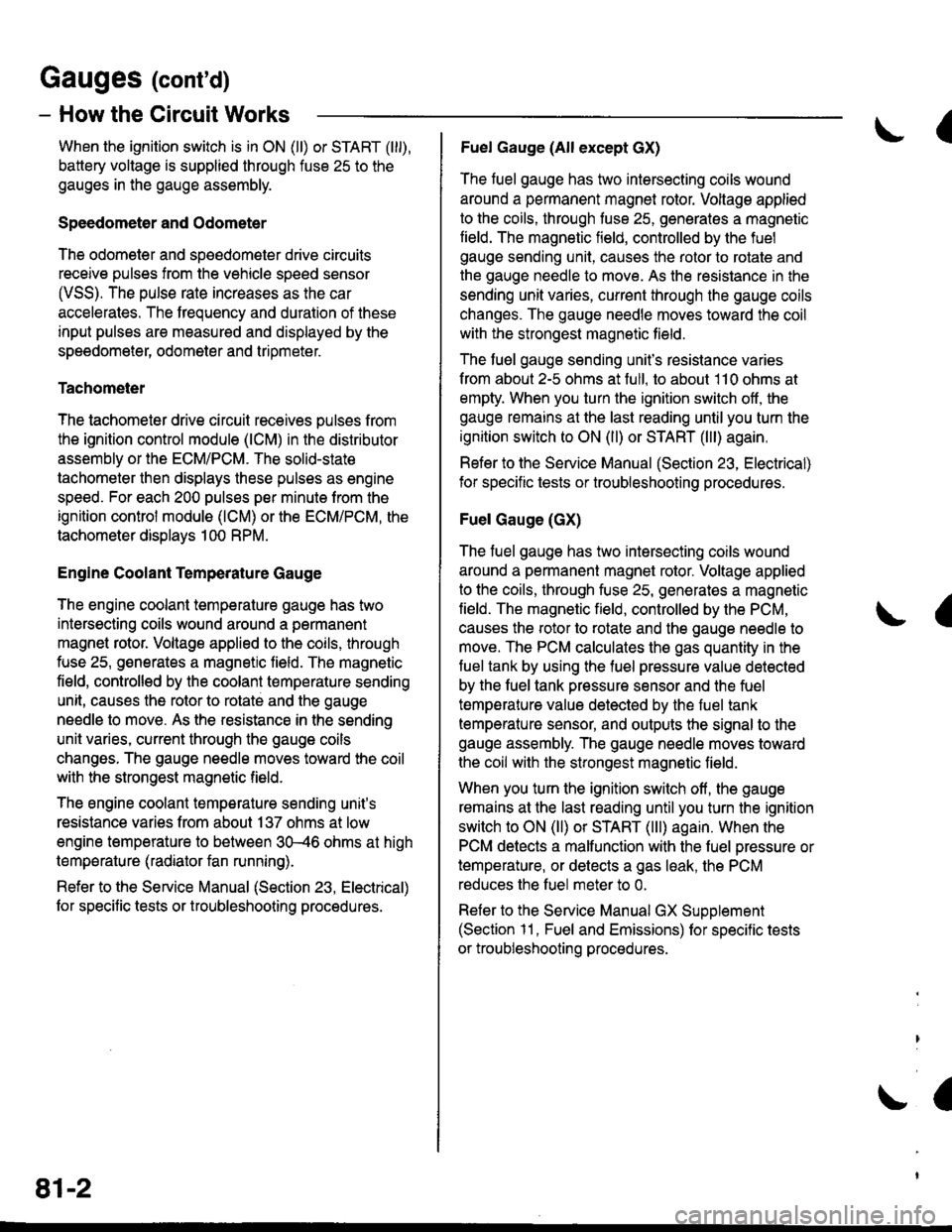
Gauges (cont'd)
- How the Gircuit Works
When the ignition switch is in ON (ll) or START (lll),
battery voltage is supplied through fuse 25 to the
gauges in the gauge assembly.
Speedometer and Odometer
The odometer and soeedometer drive circuits
receive pulses from the vehicle speed sensor
(VSS). The pulse rate increases as the car
accelerates. The frequency and duration of these
input pulses are measured and displayed by the
speedometer, odometer and tripmeter.
Tachometer
The tachometer drive circuit receives pulses from
the ignition control module (lCM) in the distributor
assembly or the ECM/PCM. The solid-state
lachometer then displays these pulses as engine
speed. For each 200 pulses per minute from the
ignition control modul€ (lCM) or the ECM/PCM, the
tachometer displays 100 RPM.
Engine Coolant Temperature Gauge
The engine coolant temperature gauge has two
intersecting coils wound around a permanent
magnet rotor. Voltage applied to the coils, through
fuse 25, generates a magnetic lield. The magnetic
field, controlled by the coolant temperature sending
unit, causes the rotor to rotate and the gauge
needle to move. As the resistance in the sending
unit varies, current through the gauge coils
changes. The gauge needle moves toward the coil
with the strongest magnetic field.
The 6ngine coolant temperature sending unit's
resistance varies from about 137 ohms at low
engine temperature to between 3H6 ohms at high
temperature (radiator fan running).
Refer to the Service Manual (Section 23, Electrical)
for specific tests or troubleshooting procedures.
81-2
(
Fuel Gauge (All except cX)
The fuel gauge has two intersecting coils wound
around a permanent magnet rotor. Voltage applied
to the coils, through tuse 25, generates a magnetic
field. The magnetic field, controlled by the fuel
gauge sending unit, causes the rotor to rotate and
the gauge needle to move. As the resislance in the
sending unit varies, current through the gauge coils
changes. The gauge needle moves toward the coil
with the strongest magnetic field.
The fuel gauge sending unit's resistance varies
from about 2-5 ohms at full, to about 110 ohms at
empty. When you turn the ignition switch off, the
gauge remains at the last reading until you turn the
ignition switch to ON (ll) or START (lll) again,
Refer to the Service Manual (Section 23, Electrical)
for specific tests or troubleshooting procedures.
Fuel Gauge (GX)
The fuel gauge has two intersecting coils wound
around a permanent magnet rotor. Voltage applied
to the coils, through fuse 25, generates a magnetic
field. The magnetic field, controlled by the PCM,
causes the rotor to rotate and the gauge needle to
move. The PCM calculates the gas quantity in the
fuel tank by using the fuel pressure value detected
by the tuel tank pressure sensor and the fuel
temperature value detected by the fuel tank
temperalure sensor, and outputs the signal to the
gauge assembly. The gauge needle moves toward
the coil with the strongest magnetic field.
When you turn the ignition switch off , the gauge
remains at the last reading until you turn the ignition
switch to ON (ll) or START (lll) again. When the
PCM detects a malfunction with the fuel pressure or
temperature, or detects a gas leak, the PCM
reduces the fuel meter to 0.
Refer to the Service Manual GX Supplement
(Section 11 , Fuel and Emissions) for specific tests
or troubleshooting procedures.
a
a