Page 162 of 413
2-85
The following situations can cause the transmission to
operate at higher temperatures:
�Towing a trailer
�Hot outside air temperatures
�Hauling a heavy load
�Low transmission fluid level
�High transmission fluid level
�Restricted air flow to the radiator and the auxiliary
transmission oil cooler (if equipped).
A temporary solution to hotter transmission operating
temperatures may be to let the transmission cool down.
If the transmission is operated at higher temperatures on
a frequent basis, see ªScheduled Maintenanceº in the
Index for the proper transmission maintenance intervals.LOW COOLANT
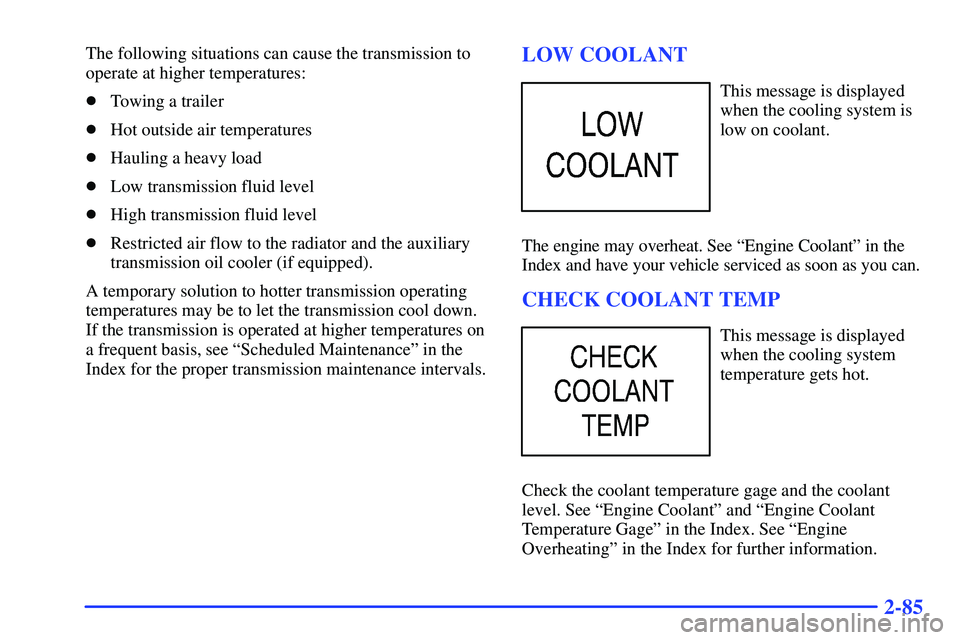
This message is displayed
when the cooling system is
low on coolant.
The engine may overheat. See ªEngine Coolantº in the
Index and have your vehicle serviced as soon as you can.
CHECK COOLANT TEMP
This message is displayed
when the cooling system
temperature gets hot.
Check the coolant temperature gage and the coolant
level. See ªEngine Coolantº and ªEngine Coolant
Temperature Gageº in the Index. See ªEngine
Overheatingº in the Index for further information.
Page 222 of 413

4-19 Before You Go Off-Roading
There are some things to do before you go out. For
example, be sure to have all necessary maintenance and
service work done. Check to make sure all underbody
shields (if so equipped) are properly attached. Be sure
you read all the information about your four
-wheel-drive
vehicle in this manual. Is there enough fuel? Is the spare
tire fully inflated? Are the fluid levels up where they
should be? What are the local laws that apply to
off
-roading where you'll be driving? If you don't know,
you should check with law enforcement people in the
area. Will you be on someone's private land? If so,
be sure to get the necessary permission.
Loading Your Vehicle for Off-Road Driving
There are some important things to remember about
how to load your vehicle.
�The heaviest things should be on the load floor and
forward of your rear axle. Put heavier items as far
forward as you can.
�Be sure the load is secured properly, so driving on
the off
-road terrain doesn't toss things around.
CAUTION:
�Cargo on the load floor piled higher than the
seatbacks can be thrown forward during a
sudden stop. You or your passengers could
be injured. Keep cargo below the top of
the seatbacks.
�Unsecured cargo on the load floor can be
tossed about when driving over rough terrain.
You or your passengers can be struck by flying
objects. Secure the cargo properly.
�Heavy loads on the roof raise the vehicle's
center of gravity, making it more likely to
roll over. You can be seriously or fatally
injured if the vehicle rolls over. Put heavy
loads inside the cargo area, not on the roof.
Keep cargo in the cargo area as far forward
and low as possible.
You'll find other important information in this manual.
See ªVehicle Loading,º ªLuggage Carrierº and ªTiresº
in the Index.
Page 233 of 413

4-30
If the water isn't too deep, then drive through it slowly.
At fast speeds, water splashes on your ignition system
and your vehicle can stall. Stalling can also occur if you
get your tailpipe under water. And, as long as your
tailpipe is under water, you'll never be able to start your
engine. When you go through water, remember that
when your brakes get wet, it may take you longer to stop.
CAUTION:
Driving through rushing water can be dangerous.
Deep water can sweep your vehicle downstream
and you and your passengers could drown. If it's
only shallow water, it can still wash away the
ground from under your tires, and you could lose
traction and roll the vehicle over. Don't drive
through rushing water.
See ªDriving Through Waterº in the Index for more
information on driving through water.
After Off-Road Driving
Remove any brush or debris that has collected on
the underbody, chassis or under the hood. These
accumulations can be a fire hazard.
After operation in mud or sand, have the brake linings
cleaned and checked. These substances can cause
glazing and uneven braking. Check the body structure,
steering, suspension, wheels, tires and exhaust system
for damage. Also, check the fuel lines and cooling
system for any leakage.
Your vehicle will require more frequent service due to
off
-road use. Refer to the Maintenance Schedule for
additional information.
Page 265 of 413

4-62 When You Are Ready to Leave After
Parking on a Hill
1. Apply your regular brakes and hold the pedal down
while you:
�Start your engine;
�Shift into a gear; and
�Release the parking brake.
2. Let up on the brake pedal.
3. Drive slowly until the trailer is clear of the chocks.
4. Stop and have someone pick up and store the chocks.
Maintenance When Trailer Towing
Your vehicle will need service more often when you're
pulling a trailer. See the Maintenance Schedule for more
on this. Things that are especially important in trailer
operation are automatic transmission fluid (don't
overfill), engine oil, axle lubricant, belt, cooling system
and brake system. Each of these is covered in this
manual, and the Index will help you find them quickly.
If you're trailering, it's a good idea to review these
sections before you start your trip.
Check periodically to see that all hitch nuts and
bolts are tight.
Trailer Wiring Harness
Your vehicle is equipped with the following wiring
harnesses for towing a trailer.
Basic Trailer Wiring Package
The trailer wiring harness with a seven-pin connector
located at the rear of the vehicle and are tied to the
vehicle's frame. The harness connector can be plugged
into a seven
-pin universal heavy-duty trailer connector
available through your dealer.
Page 304 of 413

6-
6-1
Section 6 Service and Appearance Care
Here you will find information about the care of your vehicle. This section begins with service and fuel information,
and then it shows how to check important fluid and lubricant levels. There is also technical information about your
vehicle, and a part devoted to its appearance care.
6
-2 Service
6
-3 Fuel
6
-5 Fuels in Foreign Countries
6
-5 Filling Your Tank
6
-7 Filling a Portable Fuel Container
6
-8 Checking Things Under the Hood
6
-10 Engine Oil
6
-14 Engine Air Cleaner/Filter
6
-16 Passenger Compartment Air Filter
(If Equipped)
6
-17 Automatic Transmission Fluid
6
-20 Rear Axle
6
-21 Four-Wheel Drive
6
-22 Engine Coolant
6
-25 Coolant Surge Tank Pressure Cap
6
-26 Power Steering Fluid6
-27 Windshield Washer Fluid
6
-28 Brakes
6
-32 Battery
6
-32 Bulb Replacement
6
-36 Windshield Wiper Blade Replacement
6
-36 Tires
6
-45 Appearance Care
6
-46 Cleaning the Inside of Your Vehicle
6
-49 Cleaning the Outside of Your Vehicle
6
-53 GM Vehicle Care/Appearance Materials
6
-54 Vehicle Identification Number (VIN)
6
-55 Electrical System
6
-63 Replacement Bulbs
6
-64 Capacities and Specifications
6
-67 Normal Maintenance Replacement Parts
Page 305 of 413
6-2
Service
Your dealer knows your vehicle best and wants you to
be happy with it. We hope you'll go to your dealer for
all your service needs. You'll get genuine GM parts and
GM
-trained and supported service people.
We hope you'll want to keep your GM vehicle all GM.
Genuine GM parts have one of these marks:
Doing Your Own Service Work
If you want to do some of your own service work, you'll
want to use the proper service manual. It tells you much
more about how to service your vehicle than this manual
can. To order the proper service manual, see ªService
and Owner Publicationsº in the Index.
Your vehicle may have an air bag system. If it does, see
ªServicing Your Air Bag
-Equipped Vehicleº in the
Index before attempting to do your own service work.
You should keep a record with all parts receipts and list
the mileage and the date of any service work you
perform. See ªMaintenance Recordº in the Index.
Page 306 of 413

6-3
CAUTION:
You can be injured and your vehicle could be
damaged if you try to do service work on a
vehicle without knowing enough about it.
�Be sure you have sufficient knowledge,
experience, the proper replacement parts
and tools before you attempt any vehicle
maintenance task.
�Be sure to use the proper nuts, bolts and
other fasteners. ªEnglishº and ªmetricº
fasteners can be easily confused. If you use
the wrong fasteners, parts can later break
or fall off. You could be hurt.
Adding Equipment to the Outside of
Your Vehicle
Things you might add to the outside of your vehicle can
affect the airflow around it. This may cause wind noise
and affect windshield washer performance. Check with
your dealer before adding equipment to the outside of
your vehicle.
Fuel
Use regular unleaded gasoline rated at 87 octane or
higher. It is recommended that the gasoline meet
specifications which have been developed by the
American Automobile Manufacturers Association
(AAMA) and endorsed by the Canadian Motor
Vehicle Manufacturers Association for better vehicle
performance and engine protection. Gasolines meeting
the AAMA specification could provide improved
driveability and emission control system performance
compared to other gasolines.
Be sure the posted octane is at least 87. If the octane is
less than 87, you may get a heavy knocking noise when
you drive. If it's bad enough, it can damage your engine.
If you're using fuel rated at 87 octane or higher and
you hear heavy knocking, your engine needs service.
But don't worry if you hear a little pinging noise when
you're accelerating or driving up a hill. That's normal,
and you don't have to buy a higher octane fuel to get
rid of pinging. It's the heavy, constant knock that means
you have a problem.
Page 318 of 413
6-15
Your air cleaner is located in the passenger's side front
corner of the engine compartment.1. To remove the air filter, loosen the screws on the
cover. Then lift the cover upward and remove the
filter out of the air cleaner housing. Care should be
taken to dislodge as little dirt as possible.
2. Clean the filter sealing surface and the filter housing.
3. Install the new filter.
4. Install the cover and tighten the screws on the air
cleaner cover.
Refer to the Maintenance Schedule to determine when to
replace the air filter. See ªOwner Checks and Servicesº
in the Index.