Page 112 of 381

2-49
NOTICE:
Don't hold a cigarette lighter in with your hand
while it is heating. If you do, it won't be able to
back away from the heating element when it's
ready. That can make it overload, damaging the
lighter and the heating element.
Sun Visors
To block out glare, you can swing down the sun visor.
You can also swing the visor from side to side.
Visor Vanity Mirror
Pull the sun visor down and lift the cover to expose the
vanity mirror.
Illuminated Visor Vanity Mirror
(If Equipped)
Pull the sun visor down and lift the mirror cover to turn
on the lamps.
Accessory Power Outlets
(If Equipped)
If you have accessory power outlets, you can plug in
auxiliary electrical equipment. The accessory power
outlets are located near the center of the vehicle on the
lower part of the instrument panel. Just remove the
plug from the outlet and follow the proper installation
instructions that are included with any electrical
equipment you install.
These circuits are protected by a fuse and have
maximum current levels.
NOTICE:
When using the accessory power outlets,
maximum electrical load must not exceed
20 amps. Always turn off any electrical
equipment when not in use. Leaving electrical
equipment on for extended periods will drain
your battery.
Page 113 of 381
2-50
Instrument Panel - Your Information System
A. Air Vents
B. Instrument Cluster
C. Transfer Case (If Equipped)
D. Glove Box
E. Audio SystemF. Heated Outside Rearview
Mirror Switch (If Equipped)
G. Auxiliary Power Outlets
(If Equipped)
H. Comfort ControlsI. Ashtray
J. Passenger Air Bag Off Switch
K. Brake Release
L. Fog Lamps (If Equipped)
M. Lamp Controls
Page 114 of 381
2-51
Instrument Panel Cluster
Your instrument cluster is designed to let you know at a glance how your vehicle is running. You'll know how fast you're
going, about how much fuel you've used, and many other things you'll need to know to drive safely and economically.
Standard Cluster, Canada Similar
Page 118 of 381

2-55 Air Bag Readiness Light
There is an air bag readiness light on the instrument
panel, which shows the air bag symbol. The system
checks the air bag's electrical system for malfunctions.
The light tells you if there is an electrical problem. The
system check includes the air bag sensors, the air bag
modules, the wiring, the passenger air bag suppression
circuit and the crash sensing and diagnostic module. For
more information on the air bag system, see ªAir Bagº
in the Index.
This light will come on
when you start your vehicle,
and it will flash for a few
seconds. Then the light
should go out. This means
the system is ready.
If the air bag readiness light stays on after you start the
vehicle or comes on when you are driving, your air bag
system may not work properly. Have your vehicle
serviced right away.
CAUTION:
If the air bag readiness light stays on after you
start your vehicle, it means the air bag system
may not be working properly. The air bags in
your vehicle may not inflate in a crash, or they
could even inflate without a crash. To help avoid
injury to yourself or others, have your vehicle
serviced right away if the air bag readiness light
stays on after you start your vehicle.
The air bag readiness light should flash for a few
seconds when you turn the ignition key to RUN. If the
light doesn't come on then, have it fixed so it will be
ready to warn you if there is a problem.
Page 131 of 381

3-2
Comfort Controls
With these systems, you can control the heating, cooling
and ventilation in your vehicle.
Standard Climate Control System
Fan Control
The knob on the left side of the heating system control panel
controls the fan speed. To increase airflow, turn the knob
clockwise. To decrease airflow, turn it counterclockwise.
Temperature Knob
The middle knob on the control panel lets you select
the relative temperature of the air flowing into the
passenger area of your vehicle. Turn the knob clockwise
toward the red area for warmer air. Turn the knob
counterclockwise toward the blue area for cooler air.Mode Knob
The right knob on the control panel allows you to
choose the direction of air delivery.
OFF: This setting turns the system off. Some outside
air will still enter the vehicle whenever the vehicle is
moving forward.
VENT: This setting directs most of the air through
the instrument panel outlets and a small amount through
the floor outlets.
BI-LEVEL: Air is delivered through the heater
floor outlets as well as the instrument panel outlets.
HEATER: This setting directs most of the
warmed air through the heater floor outlets and some
air through the windshield defroster outlets.
BLEND: Airflow is divided equally between the
heater floor outlet and the windshield defroster outlets.
DEFROST: This setting directs most air through
the windshield defroster outlets and some through the
heater outlets.
Page 132 of 381
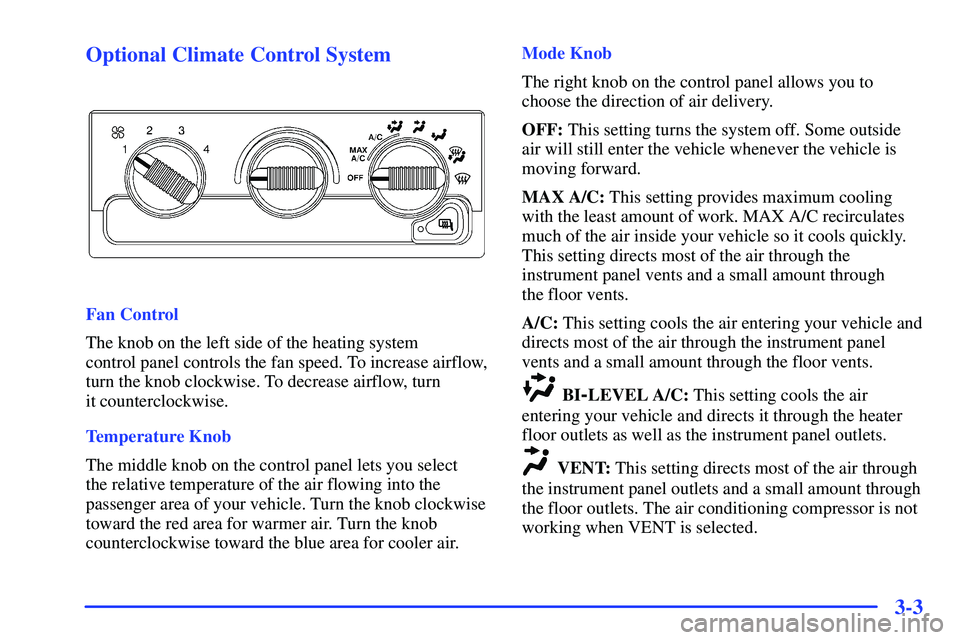
3-3 Optional Climate Control System
Fan Control
The knob on the left side of the heating system
control panel controls the fan speed. To increase airflow,
turn the knob clockwise. To decrease airflow, turn
it counterclockwise.
Temperature Knob
The middle knob on the control panel lets you select
the relative temperature of the air flowing into the
passenger area of your vehicle. Turn the knob clockwise
toward the red area for warmer air. Turn the knob
counterclockwise toward the blue area for cooler air.Mode Knob
The right knob on the control panel allows you to
choose the direction of air delivery.
OFF: This setting turns the system off. Some outside
air will still enter the vehicle whenever the vehicle is
moving forward.
MAX A/C: This setting provides maximum cooling
with the least amount of work. MAX A/C recirculates
much of the air inside your vehicle so it cools quickly.
This setting directs most of the air through the
instrument panel vents and a small amount through
the floor vents.
A/C: This setting cools the air entering your vehicle and
directs most of the air through the instrument panel
vents and a small amount through the floor vents.
BI-LEVEL A/C: This setting cools the air
entering your vehicle and directs it through the heater
floor outlets as well as the instrument panel outlets.
VENT: This setting directs most of the air through
the instrument panel outlets and a small amount through
the floor outlets. The air conditioning compressor is not
working when VENT is selected.
Page 133 of 381

3-4
HEATER: This setting directs most of the
warmed air through the heater floor outlets and some air
through the windshield defroster outlets.
BLEND: Airflow is divided equally between the
heater floor outlet and the windshield defroster outlets.
DEFROST: This setting directs most air through
the windshield defroster outlets and some through the
heater outlets.
Air Conditioning (If Equipped)
On hot days, open the windows long enough to let hot
inside air escape. This reduces the time it takes for your
vehicle to cool down. Then keep your windows closed
for the air conditioner to work its best.
For quick cool
-down on very hot days, use MAX A/C
with the temperature knob turned counterclockwise.
This setting should be used to keep odors and/or dust
from entering the vehicle. For normal cooling on
hot days, use A/C with the temperature knob
turned counterclockwise.On cool but sunny days, use BI
-LEVEL A/C to deliver
warm air to the floor and cooler air to the instrument
panel outlets.
If you have the VORTEC 4300 V6 engine, when the
air conditioner is on, you may sometimes notice slight
changes in your vehicle's engine speed and power. This
is normal because the system is designed to cycle the
compressor on and off to keep the desired temperature.
Heating
The heater works best if you keep your windows closed
while using it. On cold days, use HEATER with the
temperature knob turned clockwise. BLEND is useful in
cool weather when you have fog or ice on the
windshield or side windows.
If you use the optional engine coolant heater before
starting your engine, your heating system will produce
warmer air faster to heat the passenger compartment in
cold weather. See ªEngine Coolant Heaterº in the Index.
Page 134 of 381

3-5 Defogging and Defrosting
On cool, humid days, use BLEND to keep the
windshield and side windows clear.
Use DEFROST to remove fog or ice from the
windshield quickly in extreme humid or cold conditions.
Turn the temperature knob clockwise and turn the fan
control toward high.
If you have the heated outside mirror feature, you can
use it to defog or defrost your outside mirrors. For more
information, see ªHeated Outside Mirrorsº in the Index.
Ventilation System
For mild outside temperatures when little heating or
cooling is needed, use VENT to direct outside air
through your vehicle. Airflow is through the instrument
panel outlets.
Your vehicle's ventilation system supplies outside air to
the inside of your vehicle when it is moving. When the
vehicle is not moving, you can get outside air to flow
through by selecting any mode and any fan speed.
You will find air outlets in the center and on the sides of
your instrument panel.
You can direct the airflow side
-to-side by moving the
thumbwheel located in the center of the vent. The vent
can be tilted up and down also. To control the amount
of airflow through the outlets, move the thumbwheel
below the vent.

