Page 239 of 398
yellowblue
5-23
For vans with the 15-passenger seating arrangement,
the jack is secured on the rear passenger side floor of
the vehicle.
Remove the retaining wing bolt and lift it out of the
mounting bracket. Set the jack and jacking equipment
near the flat tire.
The ratchet has a DOWN side and an UP side.
Attach the ratchet, with the DOWN side facing you, to
the extension. The extension has a socket end and a flat
chisel end.
Put the flat end of the extension on an angle through the
hole in the rear door frame, above the bumper. Be sure
the flat end connects into the hoist shaft.
Page 251 of 398
yellowblue
5-35
4. Attach the ratchet, with the UP side facing you, to
the extension.5. Put the flat end of the extension on an angle through
the hole in the rear door frame, above the bumper.
6. Raise the tire fully against the underside of the
vehicle. Continue turning the ratchet/wheel wrench
until the tire is secure and the cable is tight. The
spare tire hoist cannot be overtightened.
Page 260 of 398
yellowblue
6-6
The fuel cap is behind a
hinged door on the driver's
side of your vehicle.
While refueling your
vehicle, hang the cap by the
tether from the hook on the
filler door.To remove the cap, turn it slowly to the left
(counterclockwise). The cap has a spring in it; if you let
go of the cap too soon, it will spring back to the right.
CAUTION:
If you get gasoline on yourself and then
something ignites it, you could be badly burned.
Gasoline can spray out on you if you open the
fuel filler cap too quickly. This spray can happen
if your tank is nearly full, and is more likely in
hot weather. Open the fuel filler cap slowly and
wait for any ªhissº noise to stop. Then unscrew
the cap all the way.
Be careful not to spill gasoline. Clean gasoline from
painted surfaces as soon as possible. See ªCleaning the
Outside of Your Vehicleº in the Index.
Page 262 of 398
yellowblue
6-8
Checking Things Under the Hood
CAUTION:
If your vehicle has air conditioning, the auxiliary
engine fan under the hood can start up and
injure you even when the engine is not running.
Keep hands, clothing and tools away from any
underhood electric fan.
CAUTION:
Things that burn can get on hot engine parts and
start a fire. These include liquids like gasoline or
diesel fuel, oil, coolant, brake fluid, windshield
washer and other fluids, and plastic or rubber. You
or others could be burned. Be careful not to drop
or spill things that will burn onto a hot engine.
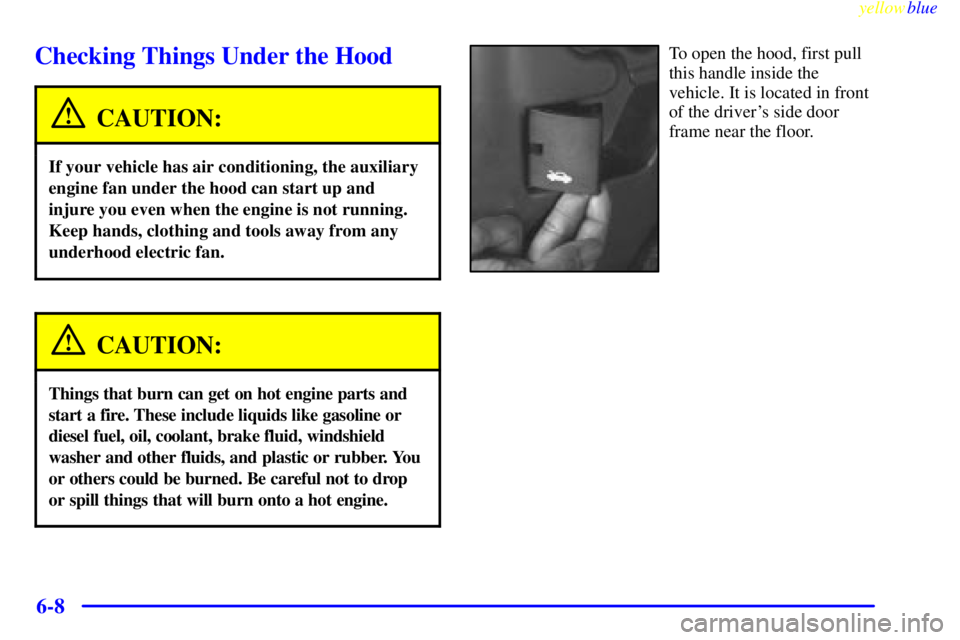
To open the hood, first pull
this handle inside the
vehicle. It is located in front
of the driver's side door
frame near the floor.
Page 290 of 398
yellowblue
6-36
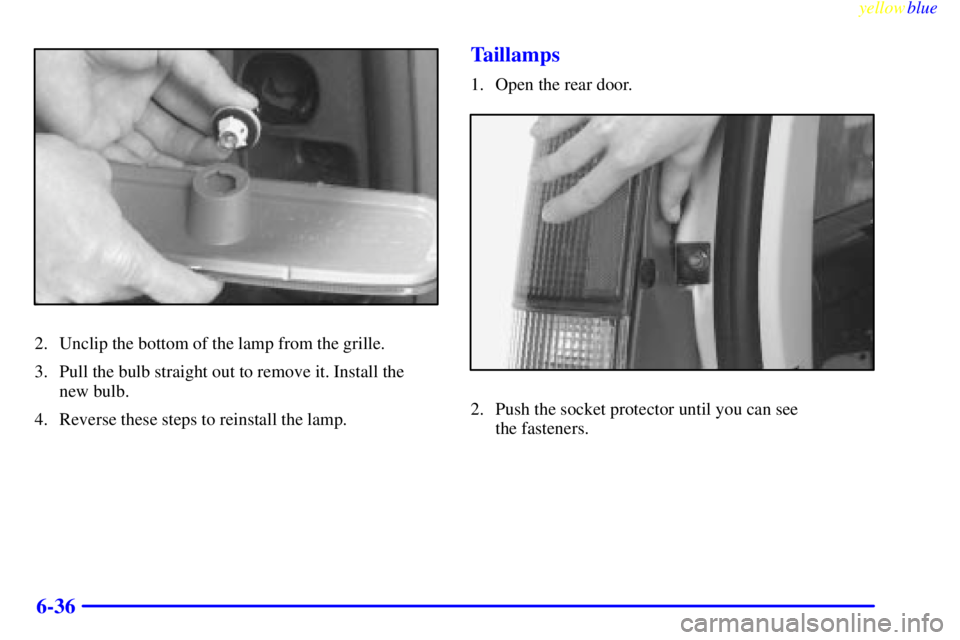
2. Unclip the bottom of the lamp from the grille.
3. Pull the bulb straight out to remove it. Install the
new bulb.
4. Reverse these steps to reinstall the lamp.
Taillamps
1. Open the rear door.
2. Push the socket protector until you can see
the fasteners.
Page 295 of 398
yellowblue
6-41
CAUTION:
Poorly maintained and improperly used tires
are dangerous.
�Overloading your tires can cause
overheating as a result of too much friction.
You could have an air
-out and a serious
accident. See ªLoading Your Vehicleº in
the Index.
�Underinflated tires pose the same danger as
overloaded tires. The resulting accident
could cause serious injury. Check all tires
frequently to maintain the recommended
pressure. Tire pressure should be checked
when your tires are cold.
�Overinflated tires are more likely to be
cut, punctured or broken by a sudden
impact
-- such as when you hit a pothole.
Keep tires at the recommended pressure.
�Worn, old tires can cause accidents. If your
tread is badly worn, or if your tires have
been damaged, replace them.
Inflation -- Tire Pressure
The Certification/Tire label, which is on the rear edge of
the driver's door, shows the correct inflation pressures
for your tires when they're cold. ªColdº means your
vehicle has been sitting for at least three hours or driven
no more than 1 mile (1.6 km).
NOTICE:
Don't let anyone tell you that underinflation or
overinflation is all right. It's not. If your tires
don't have enough air (underinflation), you can
get the following:
�Too much flexing
�Too much heat
�Tire overloading
�Bad wear
�Bad handling
�Bad fuel economy.
NOTICE: (Continued)
Page 301 of 398

yellowblue
6-47
Treadwear
The treadwear grade is a comparative rating based on
the wear rate of the tire when tested under controlled
conditions on a specified government test course. For
example, a tire graded 150 would wear one and a half
(1 1/2) times as well on the government course as a tire
graded 100. The relative performance of tires depends
upon the actual conditions of their use, however, and
may depart significantly from the norm due to variations
in driving habits, service practices and differences in
road characteristics and climate.
Traction
-- AA, A, B, C
The traction grades, from highest to lowest, are AA, A,
B, and C. Those grades represent the tire's ability to stop
on wet pavement as measured under controlled
conditions on specified government test surfaces of
asphalt and concrete. A tire marked C may have poor
traction performance. Warning: The traction grade
assigned to this tire is based on straight
-ahead braking
traction tests, and does not include acceleration,
cornering, hydroplaning, or peak traction characteristics.Temperature
-- A, B, C
The temperature grades are A (the highest), B, and C,
representing the tire's resistance to the generation of
heat and its ability to dissipate heat when tested under
controlled conditions on a specified indoor laboratory
test wheel. Sustained high temperature can cause the
material of the tire to degenerate and reduce tire life, and
excessive temperature can lead to sudden tire failure.
The grade C corresponds to a level of performance
which all passenger car tires must meet under the
Federal Motor Vehicle Safety Standard No. 109. Grades
B and A represent higher levels of performance on the
laboratory test wheel than the minimum required by law.
Warning: The temperature grade for this tire is
established for a tire that is properly inflated and not
overloaded. Excessive speed, underinflation, or
excessive loading, either separately or in combination,
can cause heat buildup and possible tire failure.
Page 304 of 398

yellowblue
6-50 Tire Chains
NOTICE:
Use tire chains only where legal and only when
you must. Use chains that are the proper size for
your tires. Install them on the tires of the
rear axle.
Tighten them as tightly as possible with the ends
securely fastened. Drive slowly and follow the
chain manufacturer's instructions. If you can
hear the chains contacting your vehicle, stop and
retighten them. If the contact continues, slow
down until it stops. Driving too fast or spinning
the wheels with chains on will damage
your vehicle.
Appearance Care
Remember, cleaning products can be hazardous. Some
are toxic. Others can burst into flame if you strike a
match or get them on a hot part of the vehicle. Some are
dangerous if you breathe their fumes in a closed space.
When you use anything from a container to clean your
vehicle, be sure to follow the manufacturer's warnings
and instructions. And always open your doors or
windows when you're cleaning the inside.
Never use these to clean your vehicle:
�Gasoline
�Benzene
�Naphtha
�Carbon Tetrachloride
�Acetone
�Paint Thinner
�Turpentine
�Lacquer Thinner
�Nail Polish Remover
They can all be hazardous
-- some more than
others
-- and they can all damage your vehicle, too.