Page 2 of 378
Free lockout assistance
Free dead-battery assistance
Free out-of-fuel assistance
Free flat-tire change
Emergency towing
1-800-GMC-8782
(For vehicles purchased in Canada,
call
1-800-268-6800)
that provides in an emergency:
Bumper-to-Bumper
3-years/36,000 miles (60 000 km)
Limited Warranty
Courtesy
Transportation
Deluxe Trip
Routing
Every
2000 Envoy
under warranty is
backed with the
following
services:
1-800-GMC-8782
(For vehicles purchased in Canada,
call
1-800-268-6800)
ProCarManuals.com
Page 5 of 378
Table of Contents (cont'd)
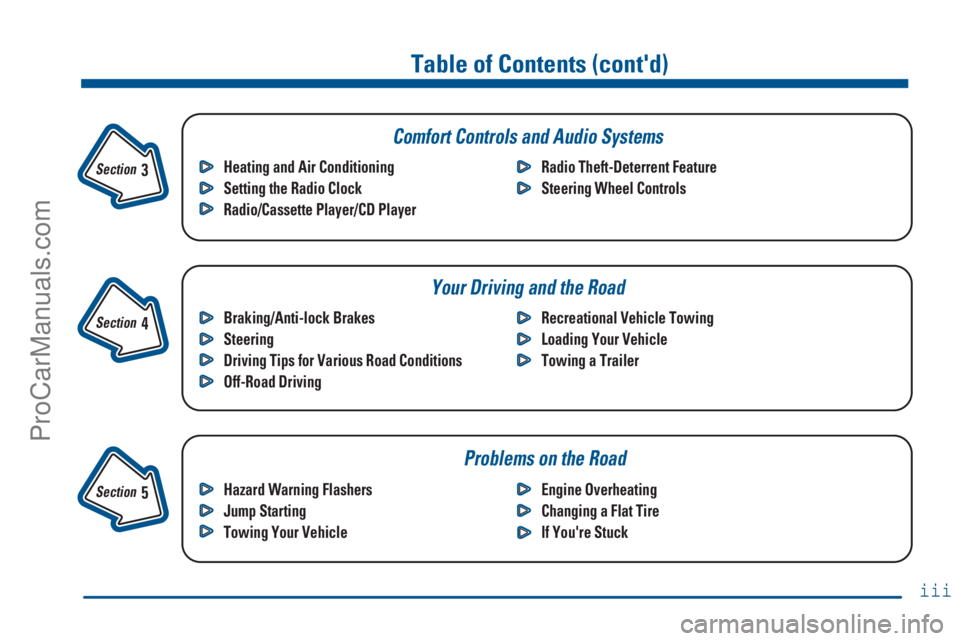
Braking/Anti-lock Brakes
Steering
Driving Tips for Various Road Conditions
Off-Road DrivingRecreational Vehicle Towing
Loading Your Vehicle
Towing a Trailer Heating and Air Conditioning
Setting the Radio Clock
Radio/Cassette Player/CD PlayerRadio Theft-Deterrent Feature
Steering Wheel Controls
Hazard Warning Flashers
Jump Starting
Towing Your VehicleEngine Overheating
Changing a Flat Tire
If You're Stuck
Problems on the Road
Section
3
Section
4
Section
5
Your Driving and the Road Comfort Controls and Audio Systems
iii
ProCarManuals.com
Page 14 of 378
1-2
Seats and Seat Controls
This section tells you about the seats -- how to adjust
them, and fold them up and down.
Power Seats
Horizontal Control: Raise the front of the seat by
raising the forward edge of the button. Lower the front
of the seat by lowering the forward edge of the button.
Move the seat forward by moving the whole button
toward the front of the vehicle.
Raise the rear of the seat by raising the rear edge of the
button. Lower the rear of the seat by lowering the rear
edge of the button. Move the seat rearward by moving
the whole button toward the rear of the vehicle.
Moving the whole button up or down raises or lowers
the whole seat.
Vertical Control: Move the reclining front seatback
rearward by moving the button toward the rear of the
vehicle. Move the seatback forward by moving the
button toward the front of the vehicle.
ProCarManuals.com
Page 36 of 378

1-24
How does an air bag restrain?
In moderate to severe frontal or near
-frontal collisions,
even belted occupants can contact the steering wheel or
the instrument panel. Air bags supplement the protection
provided by safety belts. Air bags distribute the force of
the impact more evenly over the occupant's upper body,
stopping the occupant more gradually. But air bags
would not help you in many types of collisions, including
rollovers, rear impacts and side impacts, primarily because
an occupant's motion is not toward those air bags.
Air bags should never be regarded as anything more than
a supplement to safety belts, and then only in moderate
to severe frontal or near
-frontal collisions.
What will you see after an air bag inflates?
After an air bag inflates, it quickly deflates, so quickly
that some people may not even realize the air bag
inflated. Some components of the air bag module
-- the
steering wheel hub for the driver's air bag, or the
instrument panel for the right front passenger's
bag
-- will be hot for a short time. The parts of the bag
that come into contact with you may be warm, but not
too hot to touch. There will be some smoke and dust
coming from vents in the deflated air bags. Air bag
inflation doesn't prevent the driver from seeing or from
being able to steer the vehicle, nor does it stop people
from leaving the vehicle.
CAUTION:
When an air bag inflates, there is dust in the air.
This dust could cause breathing problems for
people with a history of asthma or other
breathing trouble. To avoid this, everyone in the
vehicle should get out as soon as it is safe to do so.
If you have breathing problems but can't get out
of the vehicle after an air bag inflates, then get
fresh air by opening a window or door.
ProCarManuals.com
Page 49 of 378
1-37
Child Restraints
Every time infants and young children ride in
vehicles, they should have protection provided by
appropriate restraints.
Q:What are the different types of add-on
child restraints?
A:Add-on child restraints are available in four basic
types. When selecting a child restraint, take into
consideration not only the child's weight and
size, but also whether or not the restraint will be
compatible with the motor vehicle in which it will
be used.
An infant car bed (A) is a special bed made for use
in a motor vehicle. It's an infant restraint system
designed to restrain or position a child on a
continuous flat surface. With an infant car bed,
make sure that the infant's head rests toward the
center of the vehicle.
ProCarManuals.com
Page 60 of 378
1-48
Accident statistics show that children are safer if they
are restrained in the rear seat. But they need to use the
safety belts properly.
�Children who aren't buckled up can be thrown out
in a crash.
�Children who aren't buckled up can strike other
people who are.
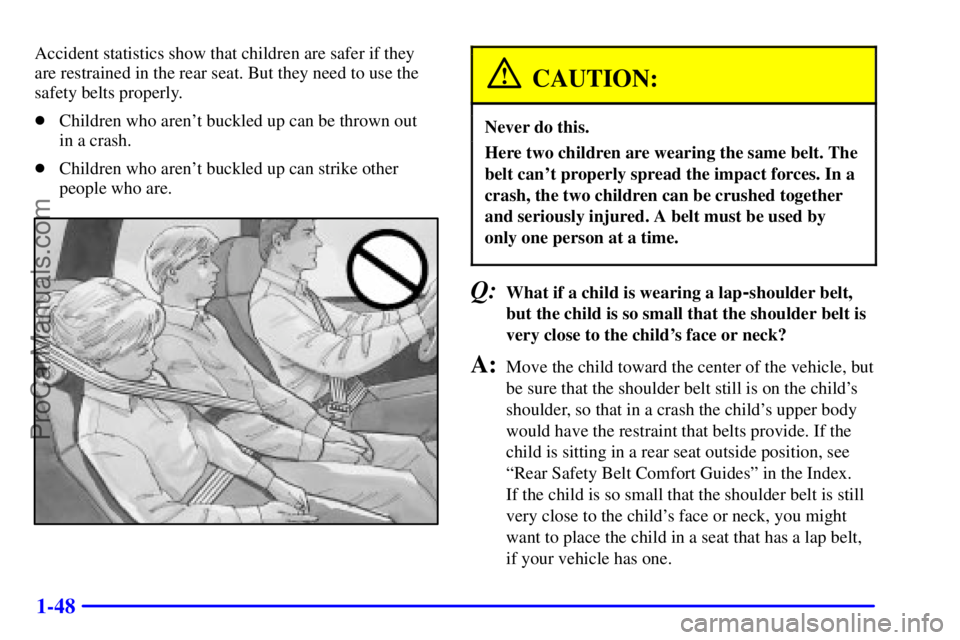
CAUTION:
Never do this.
Here two children are wearing the same belt. The
belt can't properly spread the impact forces. In a
crash, the two children can be crushed together
and seriously injured. A belt must be used by
only one person at a time.
Q:What if a child is wearing a lap-shoulder belt,
but the child is so small that the shoulder belt is
very close to the child's face or neck?
A:Move the child toward the center of the vehicle, but
be sure that the shoulder belt still is on the child's
shoulder, so that in a crash the child's upper body
would have the restraint that belts provide. If the
child is sitting in a rear seat outside position, see
ªRear Safety Belt Comfort Guidesº in the Index.
If the child is so small that the shoulder belt is still
very close to the child's face or neck, you might
want to place the child in a seat that has a lap belt,
if your vehicle has one.
ProCarManuals.com
Page 63 of 378

2-
2-1
Section 2 Features and Controls
Here you can learn about the many standard and optional features on your vehicle, and information on starting,
shifting and braking. Also explained are the instrument panel and the warning systems that tell you if everything is
working properly
-- and what to do if you have a problem.
2
-2 Keys
2
-4 Door Locks
2
-6 Keyless Entry System
2
-9 Liftgate/Liftglass
2
-10 Theft
2
-11 Content Theft-Deterrent
2
-13 Passlock�
2-13 New Vehicle ªBreak-Inº
2
-14 Ignition Positions
2
-15 Starting Your Engine
2
-17 Engine Coolant Heater (If Equipped)
2
-18 Automatic Transmission Operation
2
-20 Tow/Haul Selector Switch
2
-21 Four-Wheel Drive
2
-25 Parking Brake
2
-26 Shifting Into PARK (P)
2
-28 Shifting Out of PARK (P)
2
-28 Parking Over Things That Burn2
-29 Engine Exhaust
2
-29 Running Your Engine While You're Parked
2
-30 Locking Rear Axle
2
-30 Windows
2
-32 Tilt Wheel
2
-32 Turn Signal/Multifunction Lever
2
-39 Exterior Lamps
2
-41 Interior Lamps
2
-43 Mirrors
2
-45 Storage Compartments
2
-53 Ashtrays and Cigarette Lighter
2
-55 Accessory Power Outlets
2
-56 OnStar� System (If Equipped)
2
-56 Sunroof (If Equipped)
2
-57 HomeLink� Transmitter
2
-61 Instrument Panel
2
-62 Instrument Panel Cluster
2
-64 Warning Lights, Gages and Indicators
ProCarManuals.com
Page 72 of 378
2-10 Emergency Release for Opening Liftgate
1. Peel back or slit the carpet locally to expose the
access hole in the trim panel.
2. Use a thin screwdriver
to reach through the
access holes in both
the trim panel and the
hardware cover.
3. Pry the release lever toward the passenger's side
until the glass latch pops open.
4. Reattach the carpet securely.
Remote Liftglass Release
This button to the right of
the steering wheel on the
instrument panel allows
you to release the liftglass
from inside the vehicle.
Your shift lever must be in PARK (P) or NEUTRAL (N)
for the release to work.
Theft
Vehicle theft is big business, especially in some cities.
Although your vehicle has a number of theft
-deterrent
features, we know that nothing we put on it can make
it impossible to steal. However, there are ways you
can help.
ProCarManuals.com