Page 2 of 378
Free lockout assistance
Free dead-battery assistance
Free out-of-fuel assistance
Free flat-tire change
Emergency towing
1-800-GMC-8782
(For vehicles purchased in Canada,
call
1-800-268-6800)
that provides in an emergency:
Bumper-to-Bumper
3-years/36,000 miles (60 000 km)
Limited Warranty
Courtesy
Transportation
Deluxe Trip
Routing
Every
2000 Envoy
under warranty is
backed with the
following
services:
1-800-GMC-8782
(For vehicles purchased in Canada,
call
1-800-268-6800)
ProCarManuals.com
Page 4 of 378
Table of Contents
Keys and Door Locks
Remote Keyless Entry (RKE) System
Liftgate
Automatic Transmission
Four-Wheel Drive Operation
Parking Brake
Windows
Tilt Wheel
Turn Signal/Multifunction Lever
Windshield WipersCruise Control
Interior and Exterior Lamps
Mirrors
Storage Compartments
Luggage Carrier
Accessory Power Outlets
OnStar® System (If Equipped)
Sunroof (If Equipped)
Homelink® Transmitter
Instrument Panel, Warning Lights and Gages Seats and Seat Controls
Safety BeltsAir Bag Systems
Child Restraints
Section
1
Section
2
Seats and Restraint Systems
Features and Controls
ii
ProCarManuals.com
Page 5 of 378
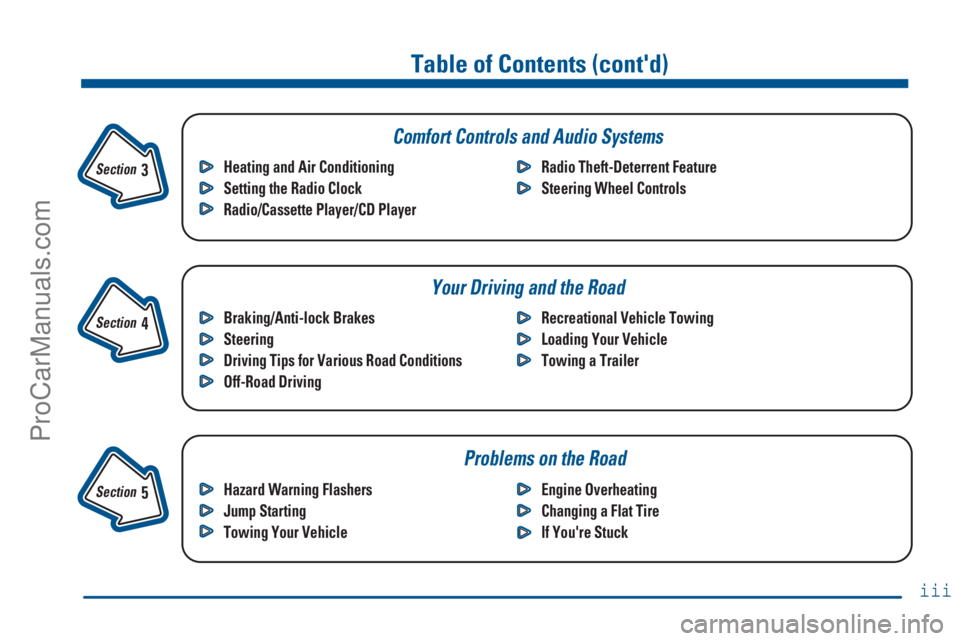
Table of Contents (cont'd)
Braking/Anti-lock Brakes
Steering
Driving Tips for Various Road Conditions
Off-Road DrivingRecreational Vehicle Towing
Loading Your Vehicle
Towing a Trailer Heating and Air Conditioning
Setting the Radio Clock
Radio/Cassette Player/CD PlayerRadio Theft-Deterrent Feature
Steering Wheel Controls
Hazard Warning Flashers
Jump Starting
Towing Your VehicleEngine Overheating
Changing a Flat Tire
If You're Stuck
Problems on the Road
Section
3
Section
4
Section
5
Your Driving and the Road Comfort Controls and Audio Systems
iii
ProCarManuals.com
Page 11 of 378
ix
For example,
these symbols
are used on an
original battery:
CAUTION
POSSIBLE
INJURY
PROTECT
EYES BY
SHIELDING
CAUSTIC
BATTERY
ACID COULD
CAUSE
BURNS
AVOID
SPARKS OR
FLAMES
SPARK OR
FLAME
COULD
EXPLODE
BATTERY
These symbols
are important
for you and
your passengers
whenever your
vehicle is
driven:
DOOR LOCK
UNLOCK
FASTEN
SEAT
BELTS
POWER
WINDOW
AIR BAG
These symbols
have to do with
your lamps:
MASTER
LIGHTING
SWITCH
TURN
SIGNALS
PARKING
LAMPS
HAZARD
WARNING
FLASHER
DAYTIME
RUNNING
LAMPS
FOG LAMPS
These symbols
are on some of
your controls:
WINDSHIELD
WIPER
WINDSHIELD
WASHER
WINDSHIELD
DEFROSTER
REAR
WINDOW
DEFOGGER
VENTILATING
FAN
These symbols
are used on
warning and
indicator lights:
ENGINE
COOLANT
TEMP
BATTERY
CHARGING
SYSTEM
BRAKE
COOLANT
ENGINE OIL
PRESSURE
ANTI-LOCK
BRAKES
Here are some
other symbols
you may see:
FUSE
LIGHTER
HORN
SPEAKER
FUEL
Vehicle Symbols
These are some of the symbols you may find on your vehicle.
ProCarManuals.com
Page 16 of 378

1-4
3. To program your keyless entry transmitter,
press the UNLOCK button within five seconds of
programming the memory button. You will hear a
chime to confirm programming of the transmitter.
When your vehicle is in PARK (P), push and release the
numbered memory button you just stored. The seat will
move to the set position. You will hear one chime.
Repeat Steps 1 and 2 to readjust the seat. The transmitter
need not be reprogrammed unless it needs to correspond
to the other numbered memory button.
If there is a third driver, use the seat adjuster switch to
adjust the seat.
Pressing any of the seat adjuster switches, the SET
button or pressing the desired memory button twice will
cause the seat to stop moving. If you push the numbered
button to adjust the seat and start the vehicle while the
seat is still adjusting, adjustment will pause while the
ignition is in START. Adjustment will resume after the
ignition is in RUN.Heated Front Seats
This control is located on
the side of the seat. This
feature will quickly heat the
lower cushion and lower
back of the driver and front
passenger seats for
added comfort.
Press the lower part of the switch to turn the heater on
low. Press the upper part of the switch to turn the heater
on high. Put the switch in the center position to turn the
heater off.
The passenger's safety belt must be engaged for the
heated seat feature to work on the passenger's seat.
ProCarManuals.com
Page 18 of 378

1-6 Head Restraints
Slide the head restraint up or down so that the top of the
restraint is closest to the top of your ears. This position
reduces the chance of a neck injury in a crash.
The rear seat head restraints in your vehicle are
adjustable. Slide an adjustable head restraint up or down
so that the top of the restraint is closest to the top of
your ears. This position reduces the chance of a neck
injury in a crash.
Push the button located under the rear head restraint to
raise or lower it. After releasing the button, push and
pull on the head restraint to make sure it's locked
in place.
Rear Seats
Your vehicle has a folding rear seat which lets you fold
the seatbacks down for more cargo space.
The rear seat release handles are on the rear of the
seatbacks. Push back on the seatbacks as you pull up
on the handles. The head restraint will automatically
fold out of the way when the seatback is folded down.
To raise the seatbacks, just lift up the seatbacks and
push until they lock in the upright position. Push and
pull on the seatbacks to check that the latches have
locked in the upright position. If they haven't, have
them fixed immediately.
ProCarManuals.com
Page 19 of 378

1-7
To return the head restraints to the upright position,
reach behind the seats and pull the head restraint up
until it locks into position.
Push and pull on the head restraints to check that they
have locked in the upright position. If they haven't, have
them fixed immediately.
The rear seat head restraints are adjustable. For
information on adjusting the rear seat head restraints
see ªHead Restraintsº in the Index.
Safety Belts: They're for Everyone
This part of the manual tells you how to use safety belts
properly. It also tells you some things you should not do
with safety belts.
And it explains the air bag system.
CAUTION:
Don't let anyone ride where he or she can't wear
a safety belt properly. If you are in a crash and
you're not wearing a safety belt, your injuries
can be much worse. You can hit things inside the
vehicle or be ejected from it. You can be seriously
injured or killed. In the same crash, you might
not be if you are buckled up. Always fasten your
safety belt, and check that your passengers' belts
are fastened properly too.
ProCarManuals.com
Page 25 of 378

1-13
How to Wear Safety Belts Properly
Adults
This part is only for people of adult size.
Be aware that there are special things to know about
safety belts and children. And there are different rules
for smaller children and babies. If a child will be
riding in your vehicle, see the part of this manual
called ªChildren.º Follow those rules for
everyone's protection.
First, you'll want to know which restraint systems your
vehicle has.
We'll start with the driver position.
Driver Position
This part describes the driver's restraint system.
Lap-Shoulder Belt
The driver has a lap-shoulder belt. Here's how to wear
it properly.
1. Close and lock the door.
2. Adjust the seat (to see how, see ªSeatsº in the Index)
so you can sit up straight.
3. Pick up the latch plate and pull the belt across you.
Don't let it get twisted.
The shoulder belt may lock if you pull the belt across
you very quickly. If this happens, let the belt go back
slightly to unlock it. Then pull the belt across you
more slowly.
ProCarManuals.com