2000 FORD WINDSTAR warning
[x] Cancel search: warningPage 166 of 280
ABS warning lampABS
TheABSwarning lamp in the instrument cluster momentarily illuminates
when the ignition is turned to the ON position. If the light does not
illuminate momentarily at start up or remains on the ABS needs to be
serviced.
With the ABS light on, the anti-lock
brake system is disabled and normal
braking is still effective unless the
brake warning light also remains
illuminated with parking brake released. (If your brake warning lamp
illuminates, have your vehicle serviced immediately.)
Using ABS
²In an emergency or when maximum efficiency from the ABS is
required, apply continuous force on the brake. The ABS will be
activated immediately, thus allowing you to retain full steering control
of your vehicle and, providing there is sufficient space, will enable you
to avoid obstacles and bring the vehicle to a controlled stop.
²The Anti-Lock system does not decrease the time necessary to apply
the brakes or always reduce stopping distance. Always leave enough
room between your vehicle and the vehicle in front of you to stop.
²We recommend that you familiarize yourself with this braking
technique. However, avoid taking any unnecessary risks.
Parking brake
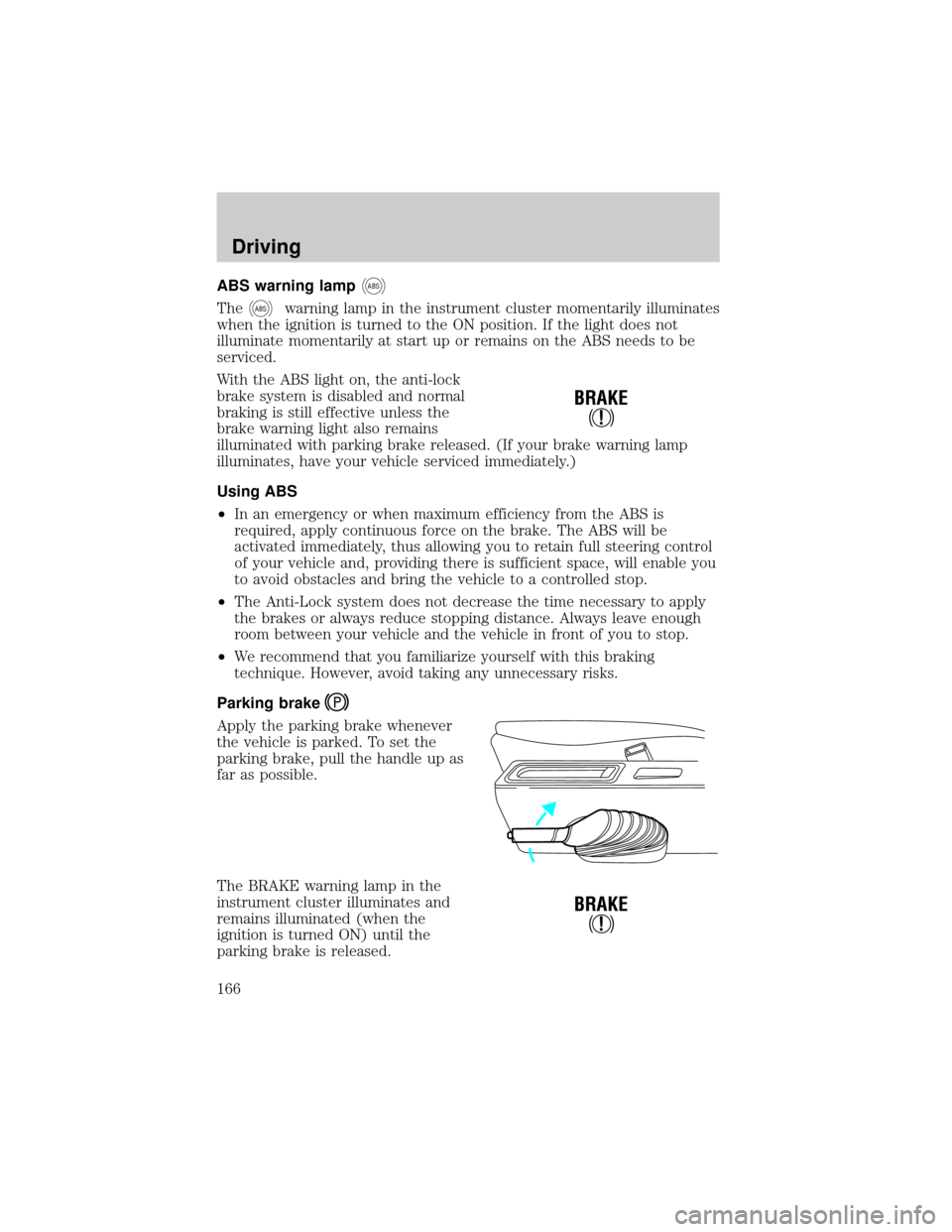
Apply the parking brake whenever
the vehicle is parked. To set the
parking brake, pull the handle up as
far as possible.
The BRAKE warning lamp in the
instrument cluster illuminates and
remains illuminated (when the
ignition is turned ON) until the
parking brake is released.
!
BRAKE
!
BRAKE
Driving
166
Page 168 of 280

motor type of sound coming from the engine compartment and the
engine will not ªrev-upº when you push further on the accelerator. This
is normal system behavior.
If you should become stuck in snow or on a very slippery road surface,
try switching the Traction Controlysystem off with the traction control
switch located on the left hand side of the radio. This may allow excess
wheel spin to ªdigº the vehicle out or enable a successful ªrockingº
maneuver.
If the Traction Controlysystem is cycled excessively, the brake portion
of the system will shut down to prevent the front brakes from
overheating. A limited Traction Controlyfunction using only engine
torque reduction will still control wheels from over-spinning. When the
front brakes have cooled down, the system will again function normally.
Anti-lock braking is not affected by this condition and will function
normally during the cool down period.
If a system fault is detected, CHECK TRACTION CONTROL is displayed
on the message center, the ªTC OFFº warning indicator lamp is on and
your vehicle should be serviced.
STEERING
Your vehicle is equipped with power steering. Power steering uses energy
from the engine to help steer the vehicle.
To prevent damage to the power steering pump:
²Never hold the steering wheel to the extreme right or the extreme left
for more than a few seconds when the engine is running.
²Do not operate the vehicle with a low power steering pump fluid level.
If the power steering system breaks down (or if the engine is turned
off), you can steer the vehicle manually, but it takes more effort.
If the steering wanders or pulls, the condition could be caused by any of
the following:
²underinflated tire(s) on any wheel(s)
²high crown in center of road
²high crosswinds
²wheels out of alignment
²loose or worn components in steering linkage
Driving
168
Page 169 of 280
AUTOMATIC TRANSAXLE OPERATION
Brake-shift interlock
This vehicle is equipped with a brake-shift interlock feature that prevents
the gearshift lever from being moved from P (Park) unless the brake
pedal is depressed.
If the gearshift lever cannot be moved from P (Park) with the brake
pedal depressed, it is possible that a fuse has blown or the vehicle's
brakelamps are not operating properly. Refer toFuses and relaysin the
Roadside emergencieschapter.
Do not drive your vehicle until you verify that the brakelamps
are working.
If your vehicle gets stuck in mud or snow it may be rocked out by
shifting from forward and reverse gears, stopping between shifts, in a
steady pattern. Press lightly on the accelerator in each gear.
Do not rock the vehicle if the engine is not at normal operating
temperature or damage to the transaxle may occur.
Do not rock the vehicle for more than a few minutes or damage
to the transaxle and tires may occur or the engine may overheat.
Always set the parking brake fully and make sure the gearshift is
latched in P (Park). Turn off the ignition whenever you leave
your vehicle.
If the parking brake is fully released, but the brake warning lamp
remains illuminated, the brakes may not be working properly.
See your dealer or a qualified service technician.
Driving with an automatic overdrive transaxle with column
gearshift and O/D off switch
Your automatic transaxle electronically controls the shift feel by using an
adaptive learning strategy. This feature is designed to optimize shift
smoothness. It is normal for your transaxle to shift firmly during the first
few hundred kilometers (miles) of operation until the adaptive strategy
has been learned. The adaptive learning strategy is maintained by power
from the battery. When the battery is disconnected or a new battery is
Driving
169
Page 214 of 280
When the engine is cool, add a50/50 mixtureof engine coolant and
distilled water to the engine coolant reservoir, until the coolant is at the
ªcold fill levelº or within the ª cold fill rangeº as listed in the engine
coolant reservoir (depending upon application).
²NEVER increase the coolant concentration above 60%.
²NEVER decrease the coolant concentration below 40%.
²Engine coolant concentrations above 60% or below 40% will
decrease the freeze protection characteristics of the engine
coolant and may cause engine damage.
Plain water may be added in an emergency, but youmustreplace it with
a 50/50 mixture of engine coolant and distilled water as soon as possible.
Check the coolant level in the reservoir before you drive your vehicle the
next few times (with the engine cool). If necessary, add a50/50
mixtureof engine coolant and distilled water to the engine coolant
reservoir until the coolant level is at the ªcold fill levelº or within the
ªcold fill rangeº as listed on the reservoir (depending upon application).
Have your dealer check the engine cooling system for leaks if you have
to add more than 1.0 liter (1.0 quart) of engine coolant per month.
To avoid scalding hot steam or coolant from being released from
the engine cooling system, never remove the radiator cap while
the engine is running or hot. Failure to follow this warning may result
in damage to the engine's cooling system and possible severe personal
injury.
If you must remove the radiator cap, follow these steps to avoid personal
injury:
1. Before you remove the cap, turn the engine off and let it cool.
2. When the engine is cool, wrap a thick cloth around the cap. Slowly
turn cap counterclockwise until pressure begins to release.
3. Step back while the pressure releases.
4. When you are sure that all the pressure has been released, use the
cloth to turn it counterclockwise and remove the cap.
Recycled engine coolant
Ford Motor Company recommends the use of a recycled engine coolant
produced by Ford-approved processes.
Maintenance and care
214
Page 239 of 280
EMISSION CONTROL SYSTEM
Your vehicle is equipped with various emission control components and a
catalytic converter which will enable your vehicle to comply with
applicable exhaust emission standards. To make sure that the catalytic
converter and other emission control components continue to work
properly:
²Use only the specified fuel listed.
²Avoid running out of fuel.
²Do not turn off the ignition while your vehicle is moving, especially at
high speeds.
²Have the items listed in your Scheduled Maintenance Guide performed
according to the specified schedule.
The scheduled maintenance items listed in the Scheduled Maintenance
Guide are essential to the life and performance of your vehicle and to its
emissions system.
If other than Ford, Motorcraft or Ford-authorized parts are used for
maintenance replacements or for service of components affecting
emission control, such non-Ford parts should be equivalent to genuine
Ford Motor Company parts in performance and durability.
Do not park, idle, or drive your vehicle in dry grass or other dry
ground cover. The emission system heats up the engine
compartment and exhaust system, which can start a fire.
Illumination of the ªCheck Engineº light, charging system warning light
or the temperature warning light, fluid leaks, strange odors, smoke or
loss of engine power, could indicate that the emission control system is
not working properly.
Exhaust leaks may result in entry of harmful and potentially
lethal fumes into the passenger compartment.
Do not make any unauthorized changes to your vehicle or engine. By
law, vehicle owners and anyone who manufactures, repairs, services,
sells, leases, trades vehicles, or supervises a fleet of vehicles are not
permitted to intentionally remove an emission control device or prevent
it from working. Information about your vehicle's emission system is on
the Vehicle Emission Control Information Decal located on or near the
Maintenance and care
239
Page 240 of 280

engine. This decal identifies engine displacement and gives some tune up
specifications.
Please consult your ªWarranty Guideº for complete emission warranty
information.
Readiness for Inspection/Maintenance (I/M) testing
In some localities, it may be a legal requirement to pass an I/M test of
the on-board diagnostics system. If your ªCheck Engine/Service Engine
Soonº light is on, refer to the description in theWarning Lights and
Chimessection of theInstrumentationchapter. Your vehicle may not
pass the I/M test with the ªCheck Engine/Service Engine Soonº light on.
If the vehicle's powertrain system or its battery has just been serviced,
the on-board diagnostics system is reset to a ªnot ready for I/M testº
condition. To ready the on-board diagnostics system for I/M testing, a
minimum of 30 minutes of city and highway driving is necessary as
described below:
²First, at least 10 minutes of driving on an expressway or highway.
²Next, at least 20 minutes driving in stop-and-go, city-type traffic with
at least four idle periods.
Allow the vehicle to sit for at least eight hours without starting the
engine. Then, start the engine and complete the above driving cycle. The
engine must warm up to its normal operating temperature. Once started,
do not turn off the engine until the above driving cycle is complete.
BULBS
Replacing exterior bulbs
It is a good idea to check the operation of the following lights frequently:
²Headlamps
²Turn signals
²Cornering lamps
²High-mount brakelamp
²Tail lamps
²Brakelamps
²Backup lamps
²License plate lamps
Maintenance and care
240
Page 273 of 280

Accessory delay ..........................90
Air bag supplemental
restraint system ..........140,141,145
and child safety seats ............142
description .......................141,145
disposal ....................................148
driver air bag ...................143,146
indicator light .............10,144,147
operation ..........................143,146
passenger air bag ............143,146
side air bag ..............................145
Air cleaner filter .......................254
Air conditioning ..........................28
Air filter, cabin ..........................220
Antifreeze
(see Engine coolant) ................211
Anti-lock brake system
(see Brakes) .......................165,166
Anti-theft system ......................113
arming the system ..................113
disarming a
triggered system .....................114
warning light ...............................9
Audio system (see Radio) .........38
Automatic transaxle .................169
driving with .............................170
fluid, adding ............................218
fluid, checking ........................218
fluid, refill capacities ..............255
fluid, specification ..................257
Auxiliary power point ...............116
Axle
lubricant specifications ..........256
Battery .......................................223
acid, treating emergencies .....223
charging system warning light ..8
jumping a disabled battery ....197
maintenance-free ....................223
replacement, specifications ...254
servicing ..................................223
Belt minder ...............................136
Brakes ........................................165anti-lock ............................165,166
anti-lock brake system
(ABS) warning light ..........10,166
brake warning light ..................10
fluid, checking and adding ....210
fluid, refill capacities ..............255
fluid, specifications ..........256,257
lubricant specifications ...256,257
parking ....................................166
pedals (see Power
adjustable foot pedals) ............81
shift interlock ..........................169
Break-in period .............................3
Capacities for refilling fluids ....255
Cargo net ...................................118
Cassette tape player ...................63
CD changer .................................74
Certification Label ....................259
Child safety restraints ..............148
child safety belts ....................148
Child safety seats ......................149
in front seat ............................150
in rear seat .......................150,153
tether anchorage hardware ...154
Cleaning your vehicle ...............248
engine compartment ..............250
exterior ....................................249
exterior lamps .........................250
instrument panel ....................251
instrument panel lens ............251
interior .......................251,252,253
mirrors .....................................249
plastic parts ............................249
safety belts ..............................252
washing ....................................248
waxing .....................................248
wheels ......................................249
windows ..................................252
wiper blades ............................250
woodtone trim ........................252
Climate control (see Air
conditioning or Heating) ............28
Index
273
Page 274 of 280

Clock ..................................41,49,60
Compass, electronic
set zone adjustment .................23
Console ......................................104
overhead ....................................99
Controls
power seat ...............................121
Coolant
checking and adding ..............211
refill capacities .................215,255
specifications ...................256,257
Cruise control
(see Speed control) ....................82
Cupholder(s) .............................122
Customer Assistance ................180
Ford accessories
for your vehicle ......................267
Ford Extended
Service Plan ............................260
Getting assistance outside
the U.S. and Canada ..............266
Getting roadside assistance ...180
Getting the
service you need ....................260
Ordering additional
owner's literature ...................271
The Dispute
Settlement Board ...................263
Utilizing the Mediation/
Arbitration Program ...............266
Daytime running lamps
(see Lamps) ................................26
Defrost
rear window ..............................37
Dipstick
automatic
transmission fluid ...................218
engine oil .................................206
Doors
door ajar warning .....................12
lubricant specifications ..........256
power sliding ..........................101Driving under special
conditions
through water .........................173
Emergencies, roadside
jump-starting ..........................197
Emission control system ..........239
Engine ........................................257
check engine/
service engine soon light .........11
cleaning ...................................250
coolant .....................................211
idle speed control ...................223
lubrication
specifications ...................256,257
refill capacities ........................255
service points ...................205,206
starting after a collision .........181
Engine block heater .................163
Engine oil ..................................206
change oil soon warning,
message center .......................206
checking and adding ..............206
dipstick ....................................206
filter, specifications .........209,254
recommendations ...................209
refill capacities ........................255
specifications ...................256,257
Exhaust fumes ..........................164
Floor mats .................................104
Fluid capacities .........................255
Fuel ............................................230
calculating fuel economy ..24,235
cap ...........................................233
capacity ...................................255
choosing the right fuel ...........233
comparisons with EPA fuel
economy estimates .................238
detergent in fuel .....................235
filling your vehicle
with fuel ....................230,233,235
filter, specifications .........235,254
fuel pump shut-off switch .....181
Index
274