2000 FORD TAURUS brakes
[x] Cancel search: brakesPage 125 of 232

If driving through deep or standing water is unavoidable, proceed very
slowly. Never drive through water that is higher than the bottom of the
hubs (for trucks) or the bottom of the wheel rims (for cars).
Once through the water, always try the brakes. Wet brakes do not stop the
vehicle as effectively as dry brakes. Drying can be improved by moving
your vehicle slowly while applying light pressure on the brake pedal.
Driving through deep water where the transmission vent tube is
submerged may allow water into the transmission and cause
internal transmission damage.
TRAILER TOWING
Your vehicle is classified as a light duty towing vehicle. The amount of
weight you can safely tow depends on the type of engine you have in your
vehicle. Your vehicle does not come from the factory fully equipped to tow.
No towing packages are available through Ford or Mercury/Lincoln dealers.
Do not tow a trailer until your vehicle has been driven at least 800 km (500
miles). If towing with a station wagon, inflate the rear tires to 35 psi.
Towing a trailer places an additional load on your vehicle's engine,
transaxle, brakes, tires and suspension. Inspect these components
carefully after towing.
In order to identify your vehicle's engine, refer toIdentifying components
in the engine compartmentin the Maintenance and Care chapter.
The amount of weight that you can tow depends on the type of engine in
your vehicle. See the following charts:
3.0L 2-Valve Vulcan Engine
Model Passenger Load -
#/kg (lbs.)Luggage Load -
kg (lbs.)Max Trailer
Wt.- kg (lbs.)
Sedan 5/340 (750) 0 365 (800)
4/270 (600) 70 (150) 365 (800)
2/135 (300) 70 (150) 500 (1 100)
2/135 (300) 0 565 (1 250)
Wagon 4/270 (600) 0 365 (800)
2/135 (300) 70 (150) 430 (950)
2/135 (300) 0 500 (1 100)
The above chart is based on the specified vehicle at a maximum GCW
(Vehicle weight + Trailer weight) equal to 2 245 kg (4 950 lbs.).
Driving
125
Page 127 of 232
Trailer brakes
Electric brakes and manual, automatic or surge-type trailer brakes are
safe if installed properly and adjusted to the manufacturer's
specifications. The trailer brakes must meet local and Federal
regulations.
Do not connect a trailer's hydraulic brake system directly to your
vehicle's brake system. Your vehicle may not have enough
braking power and your chances of having a collision greatly increase.
The braking system of the tow vehicle is rated for operation at the
GVWR not GCWR.
Trailer lamps
Trailer lamps are required on most towed vehicles. Make sure your
trailer lamps conform to local and Federal regulations. See your dealer or
trailer rental agency for proper instructions and equipment for hooking
up trailer lamps.
Driving while you tow
When towing a trailer:
²Ensure that you turn off your speed control. The speed control may
shut off automatically when you are towing on long, steep grades.
²Consult your local motor vehicle speed regulations for towing a trailer.
²Use D (Drive) or a lower gear when towing up or down steep hills.
This will eliminate excessive downshifting and upshifting for optimum
fuel economy and transaxle cooling.
²Anticipate stops and brake gradually.
Servicing after towing
If you tow a trailer for long distances, your vehicle will require more
frequent service intervals. Refer to your scheduled maintenance guide for
more information.
Trailer towing tips
²Practice turning, stopping and backing up in an area before starting on
a trip to get the feel of the vehicle trailer combination. When turning,
make wider turns so the trailer wheels will clear curbs and other
obstacles.
Driving
127
Page 155 of 232
BRAKE FLUID
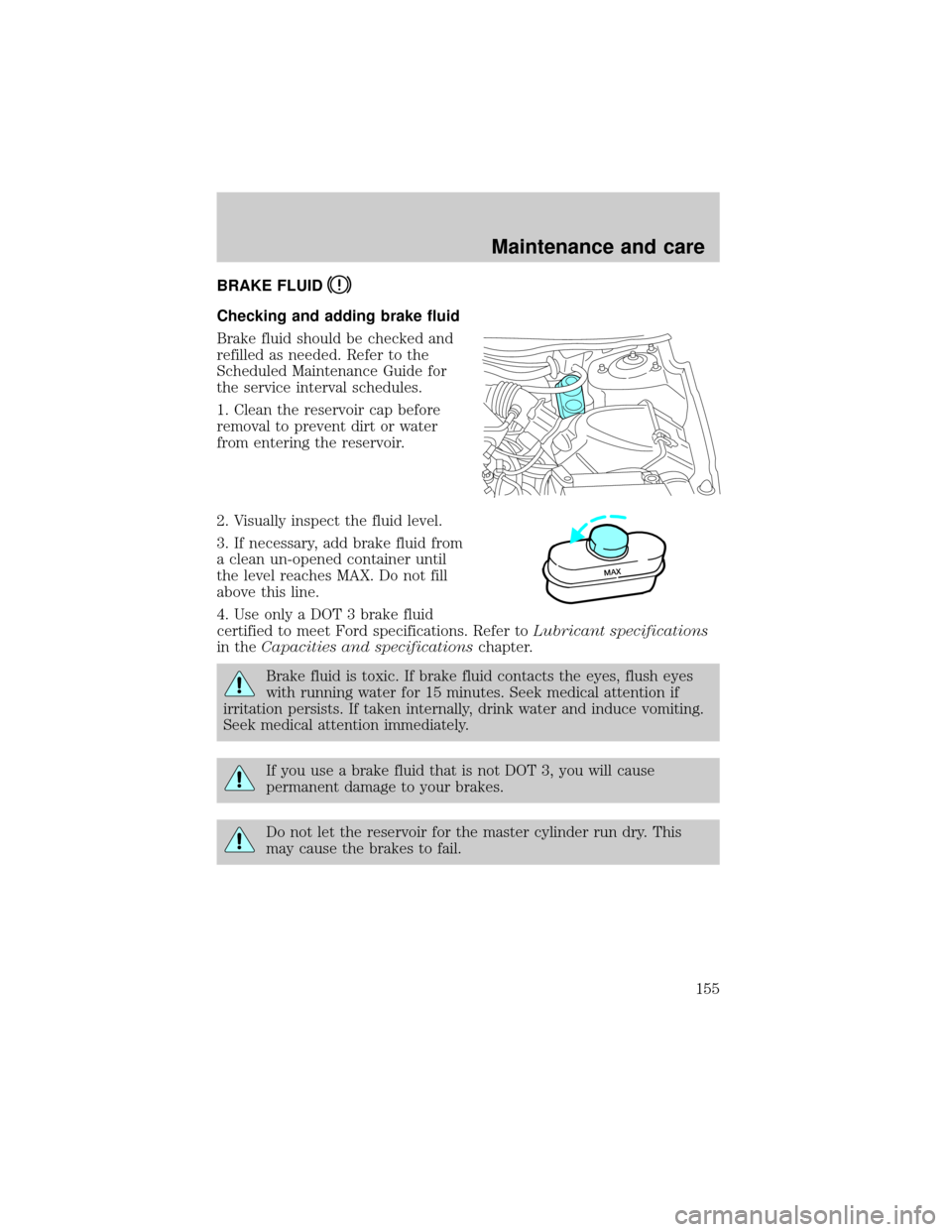
Checking and adding brake fluid
Brake fluid should be checked and
refilled as needed. Refer to the
Scheduled Maintenance Guide for
the service interval schedules.
1. Clean the reservoir cap before
removal to prevent dirt or water
from entering the reservoir.
2. Visually inspect the fluid level.
3. If necessary, add brake fluid from
a clean un-opened container until
the level reaches MAX. Do not fill
above this line.
4. Use only a DOT 3 brake fluid
certified to meet Ford specifications. Refer toLubricant specifications
in theCapacities and specificationschapter.
Brake fluid is toxic. If brake fluid contacts the eyes, flush eyes
with running water for 15 minutes. Seek medical attention if
irritation persists. If taken internally, drink water and induce vomiting.
Seek medical attention immediately.
If you use a brake fluid that is not DOT 3, you will cause
permanent damage to your brakes.
Do not let the reservoir for the master cylinder run dry. This
may cause the brakes to fail.
MAX
Maintenance and care
155
Page 199 of 232
Washing your vehicle
Wash your vehicle regularly with
cold or lukewarm water. Never use
strong detergents or soap. If your
vehicle is particularly dirty, use a
quality car wash detergent. Always
use a clean sponge, washing glove
or similar device and plenty of water
for best results. To avoid spots,
avoid washing when the hood is still
warm, immediately after or during
exposure to strong sunlight.
During winter months, it is especially important to wash the vehicle on a
regular basis. Large quantities of dirt and road salt are difficult to
remove and also cause damage to the vehicle.
Any gasoline spilled on the vehicle or deposits such as bird droppings
should be washed and sponged off as soon as possible. Deposits not
removed promptly can cause damage to the vehicle's paintwork.
Remove any exterior accessories, such as antennas, before entering a car
wash. If you have wax applied to the vehicle at a commercial car wash, it
is recommended that you clean the wiper blades and windshield as
described inCleaning the wiper blades and windshield.
After washing, apply the brakes several times to dry them.
Waxing your vehicle
Waxing your vehicle on a regular basis will reduce minor scratches and
paint damage.
Wax when water stops beading on the surface. This could be every three
or four months, depending on operating conditions.
Use only carnauba or synthetic-based waxes. Use a cleaning fluid with a
clean cloth to remove any bugs before waxing your vehicle. Use tar
remover to remove any tar spots.
Avoid getting wax on the windshield, or on any surfaces which appear
coarse or bumpy. If you have wax applied at a commercial car wash, it is
recommended that you clean the wiper blades and windshield as
described inCleaning the wiper blades and windshield.
Maintenance and care
199
Page 225 of 232

Accessory delay ..........................54
Air bag supplemental
restraint system ................94,95,98
and child safety seats ..............96
description ...........................95,98
disposal ....................................100
driver air bag ..................94,97,99
indicator light ......................12,97
operation .........................94,97,99
passenger air bag ...........94,97,99
side air bag ................................98
Air cleaner filter .......................205
Air conditioning ..........................18
automatic temperature
control system ..........................21
Air filter, cabin ..........................166
Antifreeze
(see Engine coolant) ................157
Anti-lock brake system
(see Brakes) .......................113,114
Anti-theft system ........................64
arming the system ....................64
disarming a triggered system ..66
warning light .............................11
Audio system (see Radio) .........28
Automatic transaxle .................118
driving with .............................120
fluid, adding ............................163
fluid, checking ........................163
fluid, refill capacities ..............206
fluid, specification ..................208
Auxiliary power point .................27
Axle
lubricant specifications ..........207
Battery .......................................171
acid, treating emergencies .....171
charging system
warning light .............................12
jumping a disabled battery ....142
maintenance-free ....................171
replacement, specifications ...205
servicing ..................................171Belt minder .................................90
Brakes ........................................113
anti-lock ............................113,114
anti-lock brake system
(ABS) warning light ..........11,114
brake warning light ..................12
fluid, checking and adding ....155
fluid, refill capacities ..............206
fluid, specifications ..........207,208
lubricant specifications ...207,208
parking ....................................115
pedals (see Power
adjustable foot pedals) ............43
shift interlock ..........................118
Break-in period .............................3
Capacities for refilling fluids ....206
Cargo area shade ........................59
Cargo cover .................................58
Cargo net .....................................58
CD changer .................................38
Cellular telephone
Wireless Interface Module .......51
Certification Label ....................210
Child safety restraints ..............101
child safety belts ....................101
Child safety seats ......................102
attaching with tether straps ..106
in front seat ............................103
in rear seat .......................103,106
Cleaning your vehicle ...............198
engine compartment ..............201
exterior ....................................200
exterior lamps .........................200
instrument panel ....................203
instrument panel lens ............203
interior ..............................203,204
mirrors .....................................200
plastic parts ............................200
safety belts ..............................203
washing ....................................199
waxing .....................................199
wheels ......................................200
Index
225
Page 227 of 232

low fuel warning light ..............10
octane rating ....................182,208
quality ......................................183
running out of fuel .................184
safety information relating to
automotive fuels .....................178
Fuses ...................................133,134
Gas cap (see Fuel cap) ............181
Gas mileage
(see Fuel economy) .................184
Gauges .........................................13
engine coolant
temperature gauge ...................14
fuel gauge ..................................15
odometer ...................................15
speedometer .............................13
tachometer ................................14
trip odometer ............................15
GAWR
(Gross Axle Weight Rating) .....123
definition .................................123
driving with a heavy load ......123
location ....................................123
GVWR (Gross
Vehicle Weight Rating) .............123
calculating ...............................123
definition .................................123
driving with a heavy load ......123
location ....................................123
Hazard flashers .........................131
Head restraints ...........................74
Headlamps ...................................16
aiming ......................................197
autolamp system .......................17
bulb specifications ..................196
daytime running lights .............16
flash to pass ..............................16
high beam ..............................8,16
replacing bulbs .......................190
turning on and off ....................16
warning chime ..........................13
Heating ........................................18heating and
air conditioning system ............18
Hood ..........................................149
Ignition ..................................43,208
Infant seats
(see Safety seats) .....................102
Inspection/
maintenance (I/M) testing .......189
Instrument panel
cleaning ...................................203
cluster ...................................8,203
lighting up
panel and interior .....................17
location of components ..............8
Jump-starting your vehicle ......142
Keyless entry system .................67
autolock .....................................69
keypad .......................................67
locking and unlocking doors ....68
programming entry code .........67
Keys
key in ignition chime ...............13
positions of the ignition ...........43
Lamps
autolamp system .......................17
bulb replacement
specifications chart ................196
cargo lamps ...............................17
daytime running light ...............16
headlamps .................................16
headlamps, flash to pass ..........16
instrument panel, dimming .....17
interior lamps ......................49,50
replacing
bulbs ............189,190,192,193,194
Lane change indicator
(see Turn signal) ........................47
Liftgate ...................................57,61
Lights, warning and indicator ......8
air bag ........................................12
anti-lock brakes (ABS) .....11,114
anti-theft ...................................11
Index
227