2000 FORD F150 change wheel
[x] Cancel search: change wheelPage 72 of 280
Never adjust the steering wheel when the vehicle is moving.
HAZARD FLASHER
For information on the hazard flasher control, refer toHazard flasherin
theRoadside emergencieschapter.
WINDSHIELD WIPER/WASHER CONTROLS
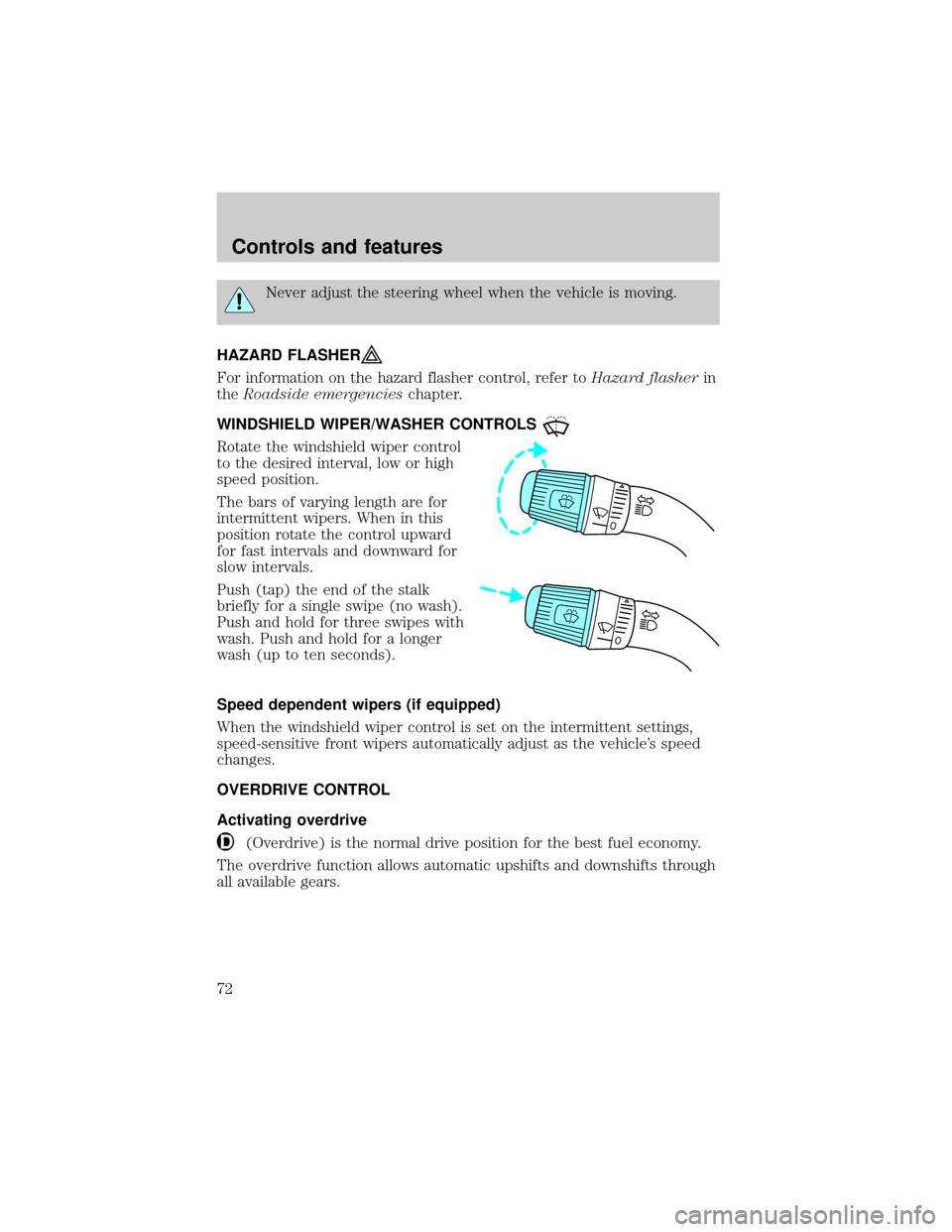
Rotate the windshield wiper control
to the desired interval, low or high
speed position.
The bars of varying length are for
intermittent wipers. When in this
position rotate the control upward
for fast intervals and downward for
slow intervals.
Push (tap) the end of the stalk
briefly for a single swipe (no wash).
Push and hold for three swipes with
wash. Push and hold for a longer
wash (up to ten seconds).
Speed dependent wipers (if equipped)
When the windshield wiper control is set on the intermittent settings,
speed-sensitive front wipers automatically adjust as the vehicle's speed
changes.
OVERDRIVE CONTROL
Activating overdrive
(Overdrive) is the normal drive position for the best fuel economy.
The overdrive function allows automatic upshifts and downshifts through
all available gears.
Controls and features
72
Page 157 of 280
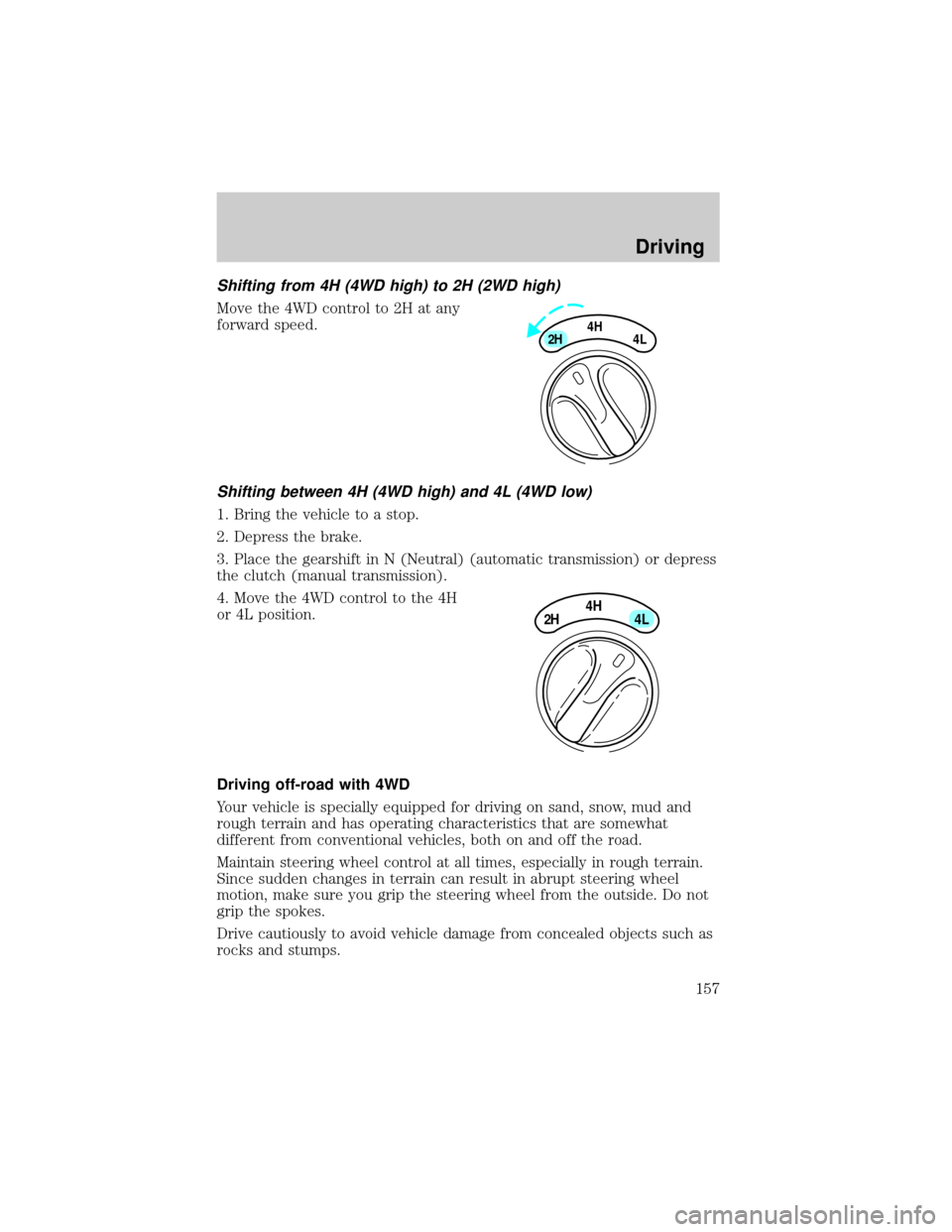
Shifting from 4H (4WD high) to 2H (2WD high)
Move the 4WD control to 2H at any
forward speed.
Shifting between 4H (4WD high) and 4L (4WD low)
1. Bring the vehicle to a stop.
2. Depress the brake.
3. Place the gearshift in N (Neutral) (automatic transmission) or depress
the clutch (manual transmission).
4. Move the 4WD control to the 4H
or 4L position.
Driving off-road with 4WD
Your vehicle is specially equipped for driving on sand, snow, mud and
rough terrain and has operating characteristics that are somewhat
different from conventional vehicles, both on and off the road.
Maintain steering wheel control at all times, especially in rough terrain.
Since sudden changes in terrain can result in abrupt steering wheel
motion, make sure you grip the steering wheel from the outside. Do not
grip the spokes.
Drive cautiously to avoid vehicle damage from concealed objects such as
rocks and stumps.
4H
2H
4L
4H
2H
4L
Driving
157
Page 158 of 280
You should either know the terrain or examine maps of the area before
driving. Map out your route before driving in the area. For more
information on driving off-road, read the ªFour Wheelingº supplement in
your owner's portfolio.
If your vehicle gets stuck
If the vehicle is stuck it may be rocked out by shifting from forward and
reverse gears, stopping between shifts, in a steady pattern. Press lightly
on the accelerator in each gear.
Do not rock the vehicle if the engine is not at normal operating
temperature or damage to the transmission may occur.
Do not rock the vehicle for more than a few minutes or damage
to the transmission and tires may occur or the engine may
overheat.
Do not spin the wheels at over 56 km/h (35 mph). The tires may
fail and injure a passenger or bystander.
Sand
When driving over sand, try to keep all four wheels on the most solid
area of the trail. Do not reduce the tire pressures but shift to a lower
gear and drive steadily through the terrain. Apply the accelerator slowly
and avoid spinning the wheels.
Mud and water
If you must drive through high water, drive slowly. Traction or brake
capability may be limited.
When driving through water, determine the depth; avoid water higher
than the bottom of the hubs (if possible) and proceed slowly. If the
ignition system gets wet, the vehicle may stall.
Once through water, always try the brakes. Wet brakes do not stop the
vehicle as effectively as dry brakes. Drying can be improved by moving
your vehicle slowly while applying light pressure on the brake pedal.
After driving through mud, clean off residue stuck to the driveshafts and
tires. Excess mud stuck on tires and rotating driveshafts causes an
imbalance that could damage drive components.
If the transmission, transfer case or front axle are submerged in water,
their fluids should be checked and changed, if necessary.
Driving
158
Page 170 of 280

Trailer towing tips
²Practice turning, stopping and backing up before starting on a trip to
get the feel of the vehicle trailer combination. When turning, make
wider turns so the trailer wheels will clear curbs and other obstacles.
²Allow more distance for stopping with a trailer attached.
²The trailer tongue weight should be no more than 10±15% of the
loaded trailer weight.
²After you have traveled 80 km (50 miles), thoroughly check your
hitch, electrical connections and trailer wheel lug nuts.
²When stopped in traffic for long periods of time in hot weather, place
the gearshift in P (Park) (automatic transmissions) or N (Neutral)
(manual transmissions). This aids engine cooling and air conditioner
efficiency.
²Vehicles with trailers should not be parked on a grade. If you must
park on a grade, place wheel chocks under the trailer's wheels.
Launching or retrieving a boat
When backing down a ramp during boat launching or retrieval,
²Do not allow the static water level to rise above the bottom edge of
the rear bumper and
²Do not allow waves to break higher than 15 cm (6 inches) above the
bottom edge of the rear bumper.
Exceeding these limits may allow water to enter critical vehicle
components, adversely affecting driveability, emissions, reliability and
causing internal transmission damage.
Replace the rear axle lubricant anytime the axle has been submerged in
water. Rear axle lubricant quantities are not to be checked or changed
unless a leak is suspected or repair required.
Disconnect the wiring to the trailer before backing the trailer into the
water. Reconnect the wiring to the trailer after the trailer is removed
from the water.
Recreational towing (all wheels on the ground)
An example of recreational towing would be towing your vehicle behind
a Motorhome. Follow these guidelines if you have the need for
recreational towing your vehicle with all four wheels on the ground.
Driving
170
Page 187 of 280
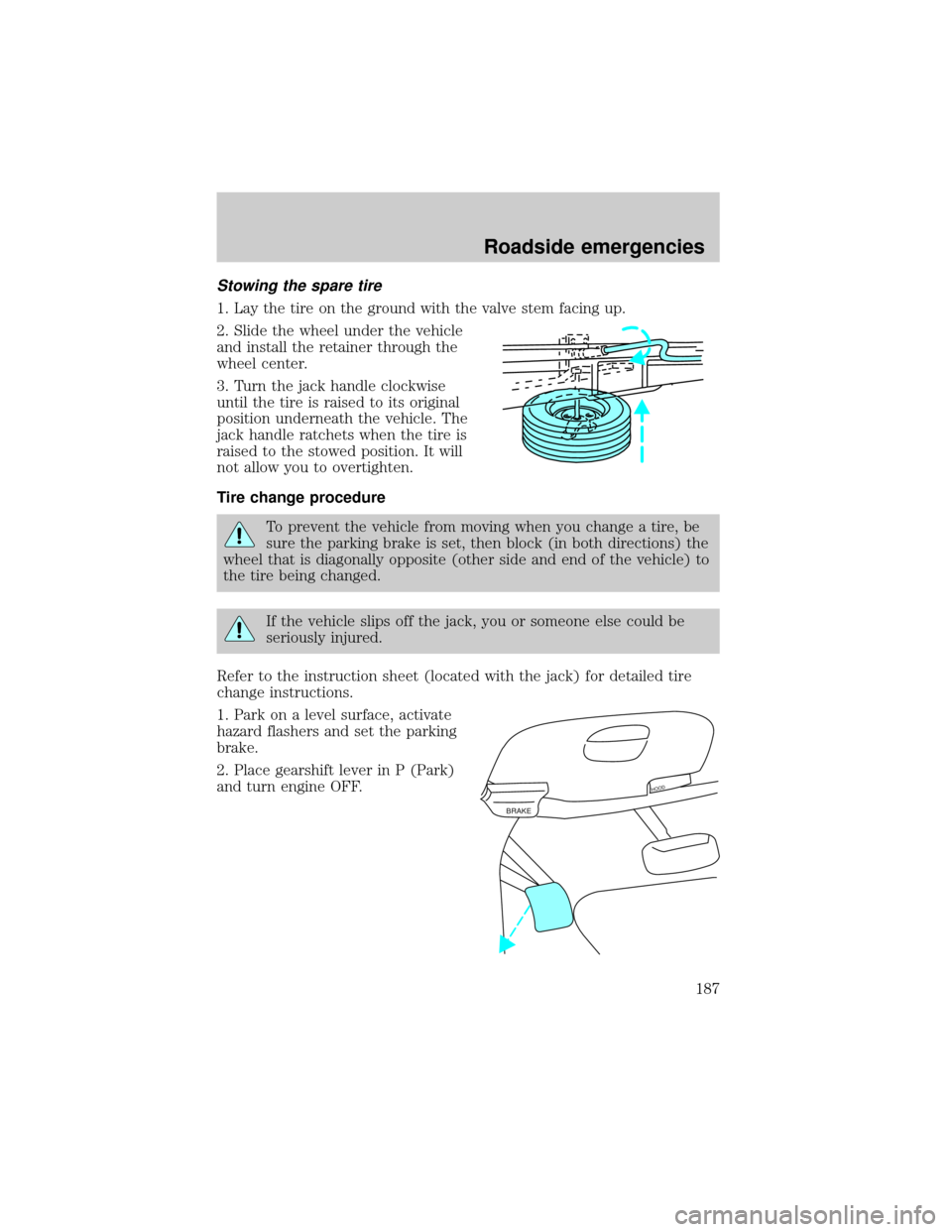
Stowing the spare tire
1. Lay the tire on the ground with the valve stem facing up.
2. Slide the wheel under the vehicle
and install the retainer through the
wheel center.
3. Turn the jack handle clockwise
until the tire is raised to its original
position underneath the vehicle. The
jack handle ratchets when the tire is
raised to the stowed position. It will
not allow you to overtighten.
Tire change procedure
To prevent the vehicle from moving when you change a tire, be
sure the parking brake is set, then block (in both directions) the
wheel that is diagonally opposite (other side and end of the vehicle) to
the tire being changed.
If the vehicle slips off the jack, you or someone else could be
seriously injured.
Refer to the instruction sheet (located with the jack) for detailed tire
change instructions.
1. Park on a level surface, activate
hazard flashers and set the parking
brake.
2. Place gearshift lever in P (Park)
and turn engine OFF.
BRAKE
HOOD
Roadside emergencies
187
Page 188 of 280
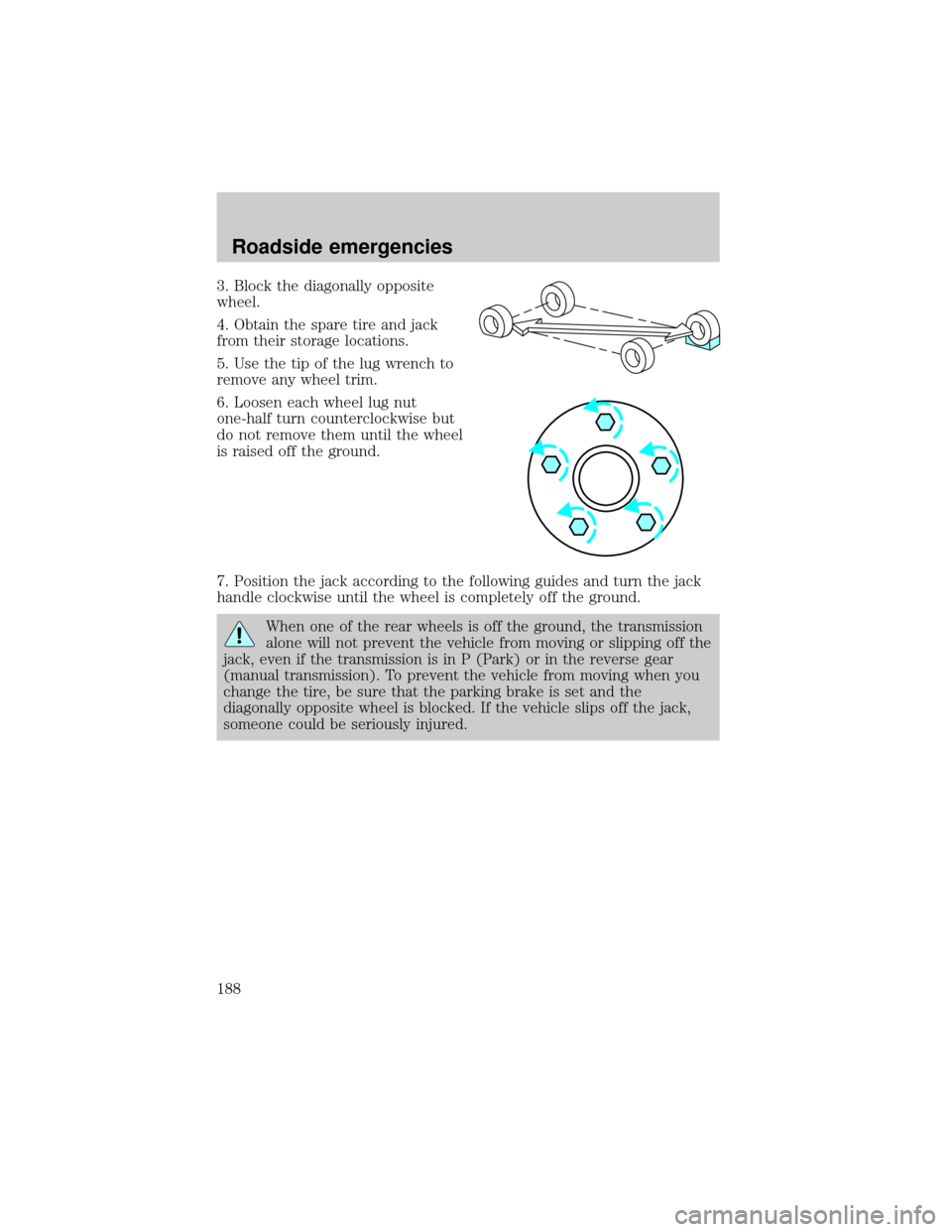
3. Block the diagonally opposite
wheel.
4. Obtain the spare tire and jack
from their storage locations.
5. Use the tip of the lug wrench to
remove any wheel trim.
6. Loosen each wheel lug nut
one-half turn counterclockwise but
do not remove them until the wheel
is raised off the ground.
7. Position the jack according to the following guides and turn the jack
handle clockwise until the wheel is completely off the ground.
When one of the rear wheels is off the ground, the transmission
alone will not prevent the vehicle from moving or slipping off the
jack, even if the transmission is in P (Park) or in the reverse gear
(manual transmission). To prevent the vehicle from moving when you
change the tire, be sure that the parking brake is set and the
diagonally opposite wheel is blocked. If the vehicle slips off the jack,
someone could be seriously injured.
Roadside emergencies
188
Page 248 of 280
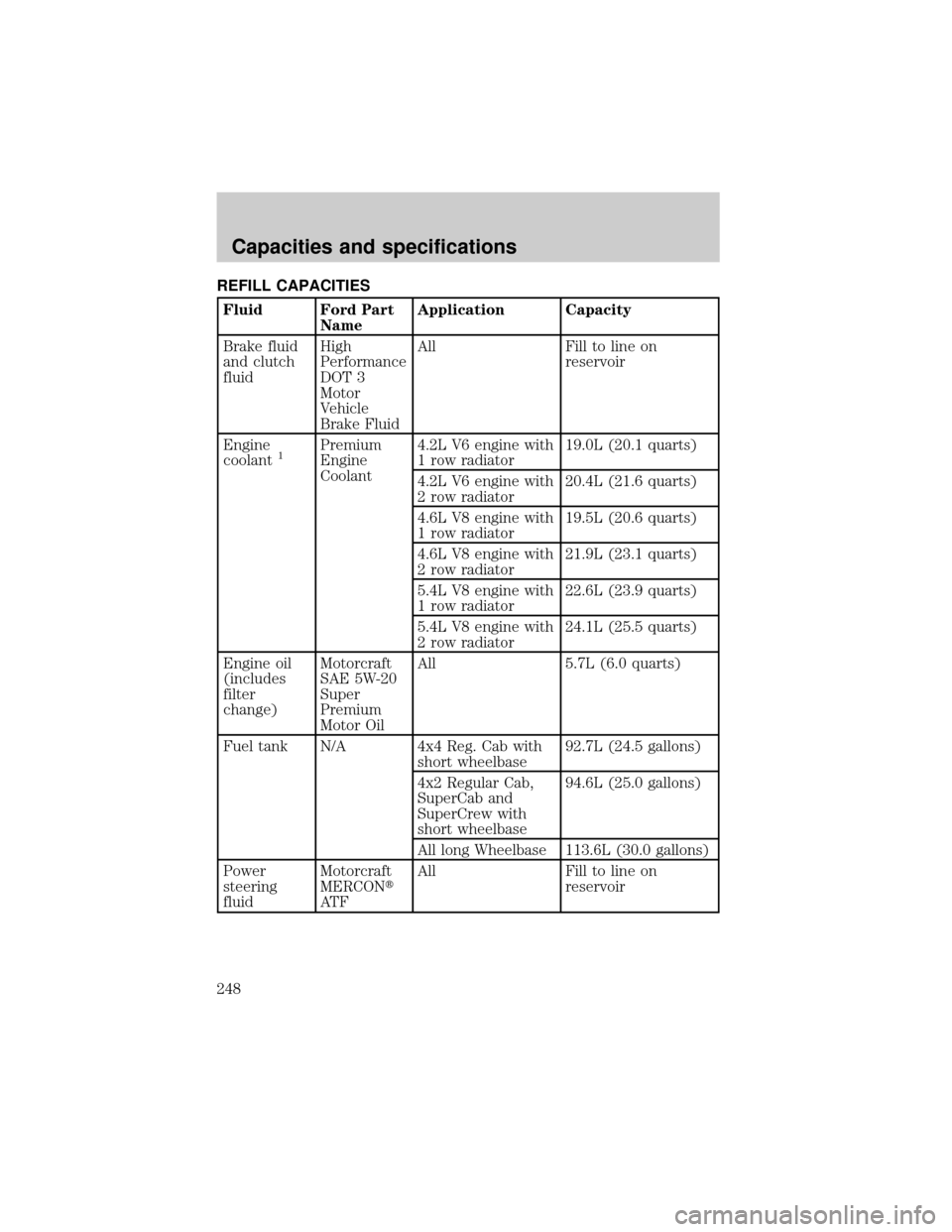
REFILL CAPACITIES
Fluid Ford Part
NameApplication Capacity
Brake fluid
and clutch
fluidHigh
Performance
DOT 3
Motor
Vehicle
Brake FluidAll Fill to line on
reservoir
Engine
coolant
1Premium
Engine
Coolant4.2L V6 engine with
1 row radiator19.0L (20.1 quarts)
4.2L V6 engine with
2 row radiator20.4L (21.6 quarts)
4.6L V8 engine with
1 row radiator19.5L (20.6 quarts)
4.6L V8 engine with
2 row radiator21.9L (23.1 quarts)
5.4L V8 engine with
1 row radiator22.6L (23.9 quarts)
5.4L V8 engine with
2 row radiator24.1L (25.5 quarts)
Engine oil
(includes
filter
change)Motorcraft
SAE 5W-20
Super
Premium
Motor OilAll 5.7L (6.0 quarts)
Fuel tank N/A 4x4 Reg. Cab with
short wheelbase92.7L (24.5 gallons)
4x2 Regular Cab,
SuperCab and
SuperCrew with
short wheelbase94.6L (25.0 gallons)
All long Wheelbase 113.6L (30.0 gallons)
Power
steering
fluidMotorcraft
MERCONt
AT FAll Fill to line on
reservoir
Capacities and specifications
248
Page 280 of 280
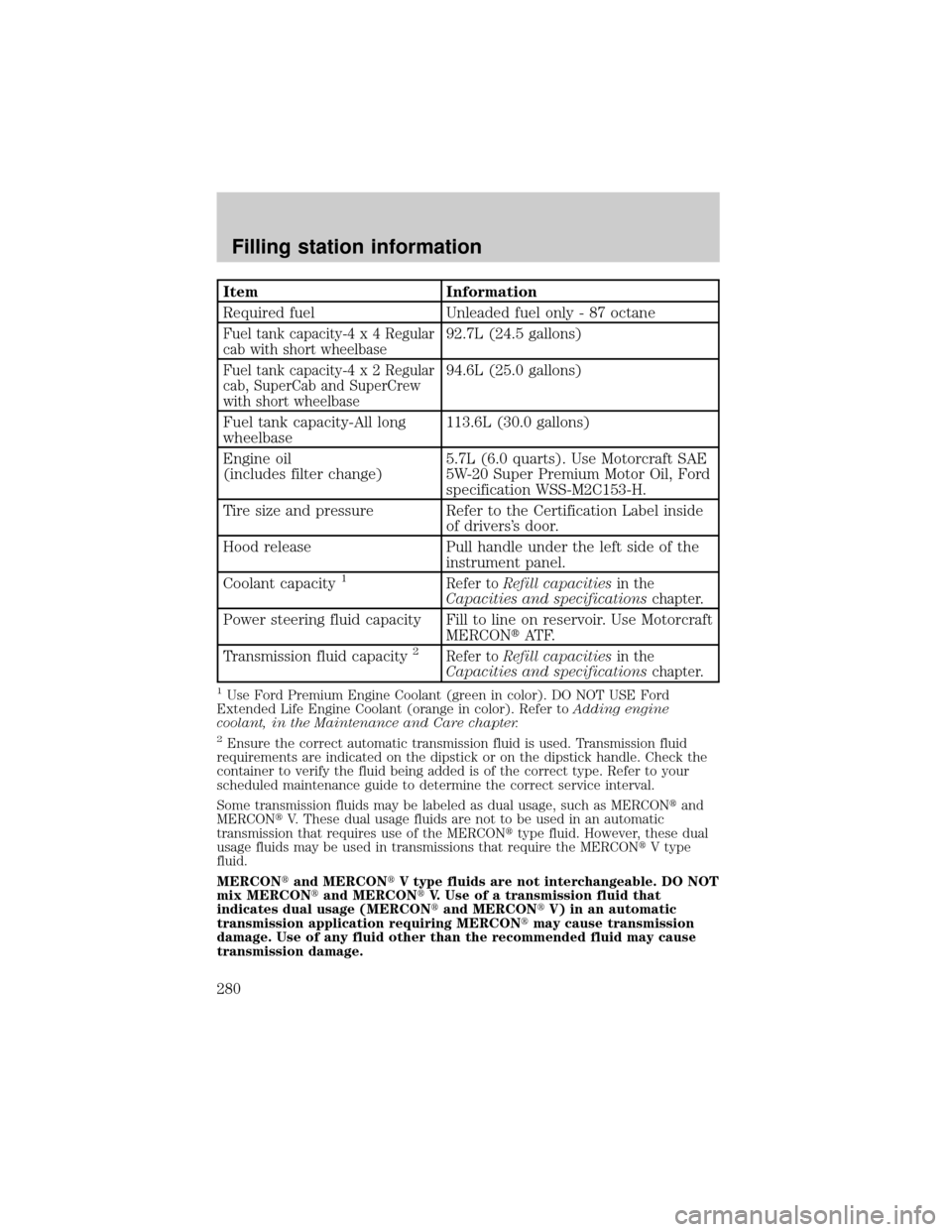
Item Information
Required fuel Unleaded fuel only - 87 octane
Fuel tank capacity-4 x 4 Regular
cab with short wheelbase92.7L (24.5 gallons)
Fuel tank capacity-4 x 2 Regular
cab, SuperCab and SuperCrew
with short wheelbase94.6L (25.0 gallons)
Fuel tank capacity-All long
wheelbase113.6L (30.0 gallons)
Engine oil
(includes filter change)5.7L (6.0 quarts). Use Motorcraft SAE
5W-20 Super Premium Motor Oil, Ford
specification WSS-M2C153-H.
Tire size and pressure Refer to the Certification Label inside
of drivers's door.
Hood release Pull handle under the left side of the
instrument panel.
Coolant capacity
1Refer toRefill capacitiesin the
Capacities and specificationschapter.
Power steering fluid capacity Fill to line on reservoir. Use Motorcraft
MERCONtAT F.
Transmission fluid capacity
2Refer toRefill capacitiesin the
Capacities and specificationschapter.
1Use Ford Premium Engine Coolant (green in color). DO NOT USE Ford
Extended Life Engine Coolant (orange in color). Refer toAdding engine
coolant, in the Maintenance and Care chapter.
2Ensure the correct automatic transmission fluid is used. Transmission fluid
requirements are indicated on the dipstick or on the dipstick handle. Check the
container to verify the fluid being added is of the correct type. Refer to your
scheduled maintenance guide to determine the correct service interval.
Some transmission fluids may be labeled as dual usage, such as MERCONtand
MERCONtV. These dual usage fluids are not to be used in an automatic
transmission that requires use of the MERCONttype fluid. However, these dual
usage fluids may be used in transmissions that require the MERCONtV type
fluid.
MERCONtand MERCONtV type fluids are not interchangeable. DO NOT
mix MERCONtand MERCONtV. Use of a transmission fluid that
indicates dual usage (MERCONtand MERCONtV) in an automatic
transmission application requiring MERCONtmay cause transmission
damage. Use of any fluid other than the recommended fluid may cause
transmission damage.
Filling station information
280