2000 FORD EXPLORER ABS
[x] Cancel search: ABSPage 176 of 296
Automatic transmissions may shift frequently while driving up steep
grades. Eliminate frequent shifting by shifting out of
(Overdrive) into
D (Drive).
Driving on snow and ice
An AWD vehicle has advantages over 2WD vehicles in snow and ice but
can skid like any other vehicle.
Avoid sudden applications of power and quick changes of direction on
snow and ice. Apply the accelerator slowly and steadily when starting
from a full stop.
When braking, apply the brakes as you normally would. In order to allow
the anti-lock brake system (ABS) to operate properly, keep steady
pressure on the brake pedal.
Allow more stopping distance and drive slower than usual. Consider
using one of the lower gears.
TRACTION-LOK AXLE (IF EQUIPPED)
This axle provides added traction on slippery surfaces, particularly when
one wheel is on a poor traction surface. Under normal conditions, the
Traction-Lok axle functions like a standard rear axle.
Extended use of other than the manufacturer's specified size tires on a
Traction-Lok rear axle could result in a permanent reduction in
effectiveness. This loss of effectiveness does not affect normal driving
and should not be noticeable to the driver.
To avoid injury, never run the engine with one wheel off the
ground, such as when changing a tire.
VEHICLE LOADING
Before loading a vehicle, familiarize yourself with the following terms:
²Base Curb Weight:Weight of the vehicle including any standard
equipment, fluids, lubricants, etc. It does not include passengers or
aftermarket equipment.
²Payload:Combined maximum allowable weight of cargo, passengers
and optional equipment. The payload equals the gross vehicle weight
rating minus base curb weight.
²GVW (Gross Vehicle Weight):Base curb weight plus payload
weight. The GVW is not a limit or a specification.
Driving
176
Page 194 of 296

The fuses are coded as follows:
Fuse/Relay
LocationFuse Amp
RatingPassenger Compartment Fuse
Panel Description
1 7.5A Power Mirror Switch, Power
Antenna, Memory Seat
2 7.5A Blower Motor Relay, Air Bag
Diagnostic Monitor
3 7.5A Left Stop/Turn Trailer Tow
Connector
4 10A Left Headlamp
5 10A Data Link Connector (DLC)
6 7.5A Rear Blower Motor (Without
EATC)
7 7.5A Right Stop/Turn Trailer Tow
Connector
8 10A Right Headlamp, Foglamp Relay
9 7.5A Brake Pedal Position Switch
10 7.5A Speed Control/Amplifier Assembly,
Generic electronic Module (GEM),
Shift Lock Actuator, Blend Door
Actuator, A/C - Heater Assembly,
Flasher, Overhead Console, Load
Leveling Module
11 7.5A Instrument Cluster
12 7.5A Washer Pump Relay, Rear Washer
Pump Relay
13 20A Brake Pedal Position Switch,
Brake Pressure Switch
14 10A 4 Wheel Anti-Lock Brake System
(4WABS) Module, 4WABS Main
Relay
15 7.5A Instrument Cluster
Roadside emergencies
194
Page 197 of 296

The high-current fuses are coded as follows:
Fuse/Relay
LocationFuse Amp
RatingPower Distribution Box
Description
1 60A** I/P Fuse Panel
2 40A** Blower Motor Relay
3 50A** 4 Wheel Anti-Lock Brake System
(4WABS) Module
4 30A** Power Windows, Power Moon
Roof, Power Seat
5 50A** Ignition Switch, Starter Relay
6 20A** Transfer Case Relay
7 Ð Not Used
8 20A** Air Suspension
9 40A** Air Suspension
10 30A** PCM Power Relay
1 10A* A/C Relay
2 30A* Heated Seats
3 30A* Heated Backlight
4 15A* Fog Lamps and Daytime Running
Lamps
5432110 9 8 7 612 11 10 9
876 5
432 1
14 15 13
211
9 6
10 87 5 41
2 3
175
MEGAFUSE
Roadside emergencies
197
Page 198 of 296

Fuse/Relay
LocationFuse Amp
RatingPower Distribution Box
Description
5 Ð Not Used
6 10A* Powertrain Control Module
7 30A* 4 Wheel Anti-Lock System
(4WABS) Module
8 15A* Rear Wiper Motor
9 20A* Fuel Pump Relay and RAP
Module
10 15A* Horn Relay
11 15A* Parklamps Relay and Mainlight
Switch
12 30A* Mainlight Switch and
Multifunction Switch
13 15A* Heated Oxygen Sensor, EGR
Vacuum Regulator, EVR Solenoid,
Camshaft Position (CMP) Sensor,
Canister Vent Solenoid
14 30A* Generator/Voltage Regulator
15 Ð Not Used
1 Ð Wiper Park Relay
2 Ð A/C Relay
3 Ð Wiper High/Low Relay
4 Ð PCM Power Relay
5 Ð Fuel Pump Relay
6 Ð Starter Relay
7 Ð Horn Relay
8 Ð Rear Wipe Down Relay
9 Ð Blower Motor Relay
10 Ð Rear Wipe Up Relay
1 Ð Not Used
1 Ð DRL Diode
2 Ð Electronic Engine Controls Diode
* Mini Fuses ** Maxi Fuses
Roadside emergencies
198
Page 245 of 296
²Avoid inhaling fuel vapors. Inhaling too much fuel vapor of any kind
can lead to eye and respiratory tract irritation. In severe cases,
excessive or prolonged breathing of fuel vapor can cause serious
illness and permanent injury.
²Avoid getting fuel liquid in your eyes. If fuel is splashed in the eyes,
remove contact lenses (if worn), flush with water for 15 minutes and
seek medical attention. Failure to seek proper medical attention could
lead to permanent injury.
²Fuels can also be harmful if absorbed through the skin. If fuel is
splashed on the skin and/or clothing, promptly remove contaminated
clothing and wash skin thoroughly with soap and water. Repeated or
prolonged skin contact with fuel liquid or vapor causes skin irritation.
²Be particularly careful if you are taking ªAntabuseº or other forms of
disulfiram for the treatment of alcoholism. Breathing gasoline vapors,
or skin contact could cause an adverse reaction. In sensitive
individuals, serious personal injury or sickness may result. If fuel is
splashed on the skin, promptly wash skin thoroughly with soap and
water. Consult a physician immediately if you experience an adverse
reaction.
When refueling always shut the engine off and never allow
sparks or open flames near the filler neck. Never smoke while
refueling. Fuel vapor is extremely hazardous under certain conditions.
Care should be taken to avoid inhaling excess fumes.
The flow of fuel through a fuel pump nozzle can produce static
electricity, which can cause a fire if fuel is pumped into an
ungrounded fuel container.
Use the following guidelines to avoid static build-up when filling an
ungrounded fuel container:
²Place approved fuel container on the ground.
²DO NOT fill a fuel container while it is in the vehicle.
²Keep the fuel pump nozzle in contact with the fuel container while
filling.
²DO NOT use a device that would hold the fuel pump handle in the fill
position.
Maintenance and care
245
Page 247 of 296
Many of the world's automakers
issued the World-wide Fuel Charter
that recommends gasoline
specifications to provide improved
performance and emission control
system protection for your vehicle.
Gasolines that meet the World-wide
Fuel Charter should be used when
available. Ask your fuel supplier
about gasolines that meet the
World-wide Fuel Charter. In Canada,
look for fuels that display theAuto Makers' Choiceylogo.
Cleaner air
Ford approves the use of reformulated ªcleaner-burningº gasolines to
improve air quality. These gasolines may contain oxygenates up to 10%
ethanol or 15% MTBE.
Running out of fuel
Avoid running out of fuel because this situation may have an adverse
affect on powertrain components.
If you have run out of fuel:
²You may need to cycle the ignition from OFF to ON several times after
refueling, to allow the fuel system to pump the fuel from the tank to
the engine.
²Your ªCheck Engineº indicator may come on. For more information on
the ªCheck Engineº indicator, refer to theInstrumentationchapter.
Fuel Filler Cap
Your fuel tank filler cap has an indexed design with a 1/8 turn on/off
feature.
When fueling your vehicle:
1. Turn the engine off.
2. Carefully turn the filler cap counterclockwise 1/8 of a turn until it
stops.
3. Pull to remove the cap from the fuel filler pipe.
4. To install the cap, align the tabs on the cap with the notches on the
filler pipe.
Maintenance and care
247
Page 255 of 296
If the bulb is accidentally touched, it should be cleaned with rubbing
alcohol before being used.
1. With the flat side of the new bulb's plastic base facing upward, insert
the glass end of the bulb into the lamp assembly. You may need to turn
the bulb left or right to align the grooves in the plastic base with the
tabs in the lamp assembly. When the grooves are aligned, push the bulb
into the lamp assembly until the plastic base contacts the rear of the
lamp assembly.
2. Install the bulb retaining ring over the plastic base until it contacts the
rear of the socket by rotating clockwise until you feel a ªstop.º
3. Install the electrical connector into the rear of the plastic base until it
snaps, locking it into position.
4. Turn the headlamps on and make sure they work properly. If the
headlamp was correctly aligned before you changed the bulb, you should
not need to align it again.
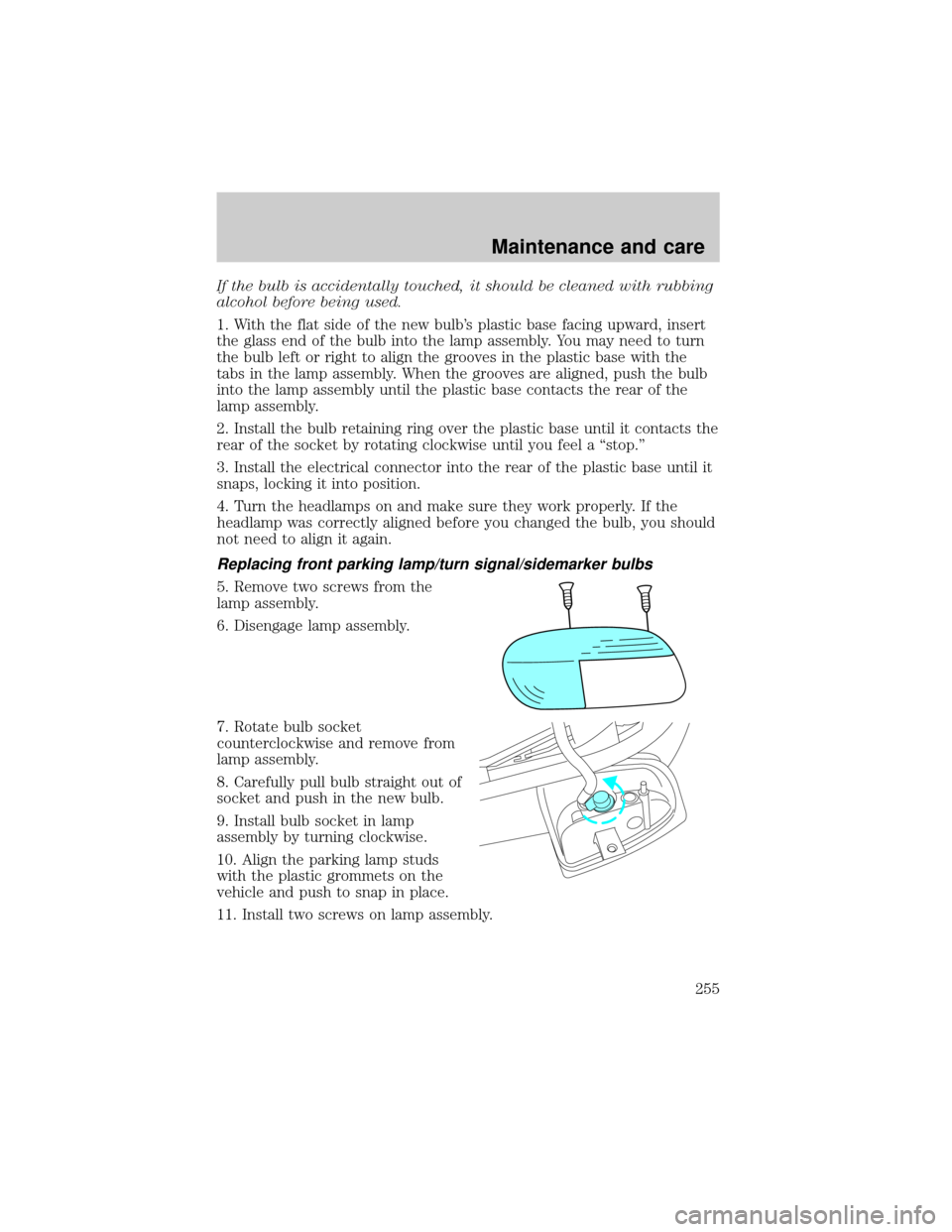
Replacing front parking lamp/turn signal/sidemarker bulbs
5. Remove two screws from the
lamp assembly.
6. Disengage lamp assembly.
7. Rotate bulb socket
counterclockwise and remove from
lamp assembly.
8. Carefully pull bulb straight out of
socket and push in the new bulb.
9. Install bulb socket in lamp
assembly by turning clockwise.
10. Align the parking lamp studs
with the plastic grommets on the
vehicle and push to snap in place.
11. Install two screws on lamp assembly.
Maintenance and care
255
Page 288 of 296

A
Air bag supplemental
restraint system ........135±136, 140
and child safety seats ............137
description ......................136, 140
disposal ....................................143
driver air bag ..................138, 141
indicator light ...........10, 139, 142
operation .........................138, 141
passenger air bag ...........138, 141
side air bag ..............................140
Air cleaner filter .......................266
Air conditioning ..........................22
automatic temperature
control system ..........................25
rear seat controls .....................31
Air suspension ...........................158
description ..............................158
warning light .............................12
All Wheel Drive (AWD),
driving off road .........................173
Ambulance packages ....................3
Antifreeze
(see Engine coolant) ................223
Anti-lock brake system
(see Brakes) ......................155±156
Anti-theft system
warning light .............................11
Armrests ....................................105
Audio system (see Radio) .........35
Automatic transmission
driving an automatic
overdrive .........................160, 163
fluid, adding ....................229, 231
fluid, checking ................229, 231
fluid, refill capacities ..............266fluid, specification ..................272
Auxiliary power point ...............104
Axle
lubricant specifications ..269, 272
refill capacities ........................266
traction lok ..............................176
B
Battery .......................................236
acid, treating emergencies .....236
charging system
warning light .............................11
jumping a disabled battery ....204
maintenance-free ....................236
replacement, specifications ...266
servicing ..................................236
voltage gauge ............................16
Belt minder ...............................131
Brakes ........................................155
anti-lock ...........................155±156
anti-lock brake system
(ABS) warning light .........10, 156
brake warning light ..................10
fluid, checking and adding ....221
fluid, refill capacities ..............266
fluid, specifications .........269, 272
lubricant specifications ..269, 272
parking ....................................156
shift interlock ..........................159
Break-in period .............................3
C
Capacities for refilling fluids ....266
Cargo area shade ......................106
Cargo cover ...............................106
CD changer .................................77
Index
288