Page 171 of 256
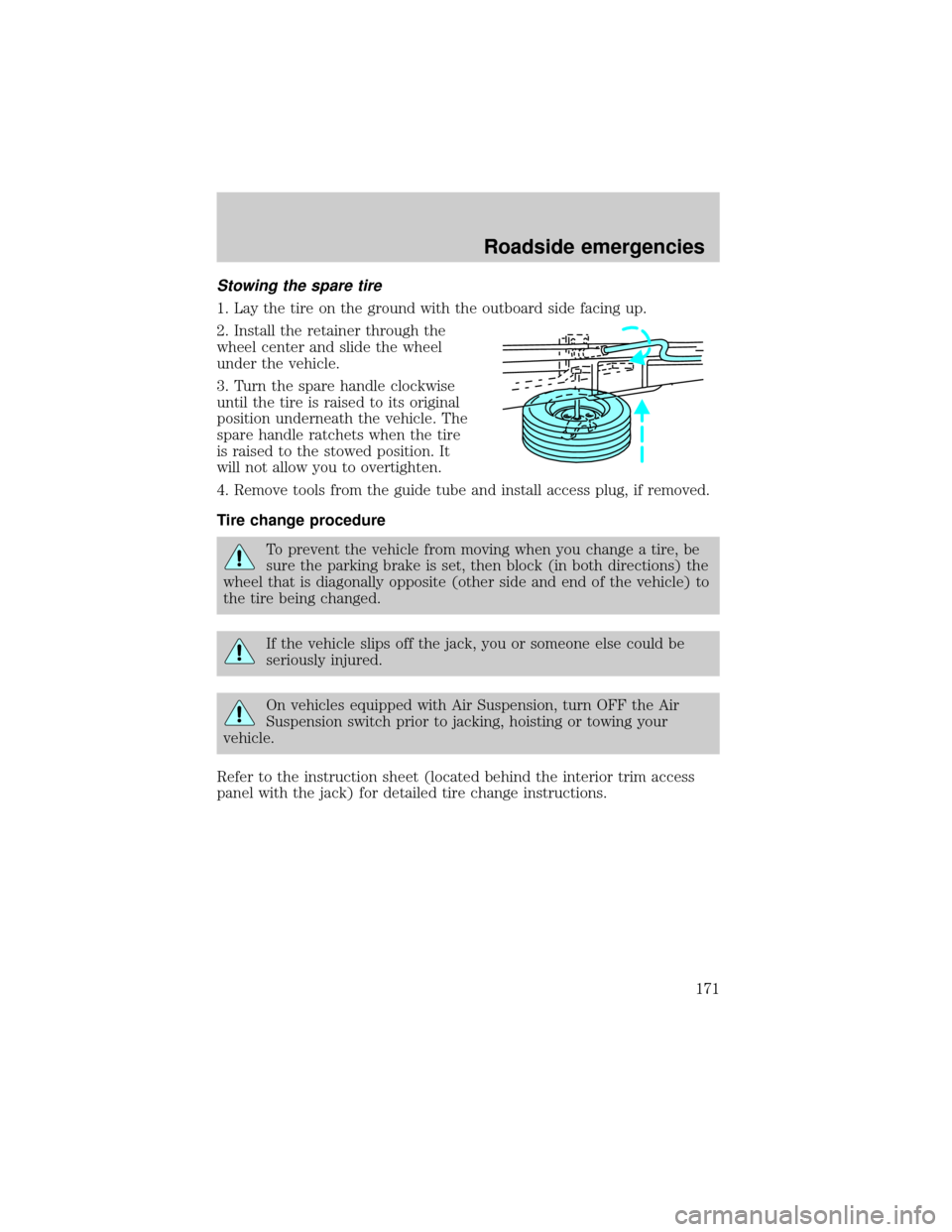
Stowing the spare tire
1. Lay the tire on the ground with the outboard side facing up.
2. Install the retainer through the
wheel center and slide the wheel
under the vehicle.
3. Turn the spare handle clockwise
until the tire is raised to its original
position underneath the vehicle. The
spare handle ratchets when the tire
is raised to the stowed position. It
will not allow you to overtighten.
4. Remove tools from the guide tube and install access plug, if removed.
Tire change procedure
To prevent the vehicle from moving when you change a tire, be
sure the parking brake is set, then block (in both directions) the
wheel that is diagonally opposite (other side and end of the vehicle) to
the tire being changed.
If the vehicle slips off the jack, you or someone else could be
seriously injured.
On vehicles equipped with Air Suspension, turn OFF the Air
Suspension switch prior to jacking, hoisting or towing your
vehicle.
Refer to the instruction sheet (located behind the interior trim access
panel with the jack) for detailed tire change instructions.
Roadside emergencies
171
Page 173 of 256
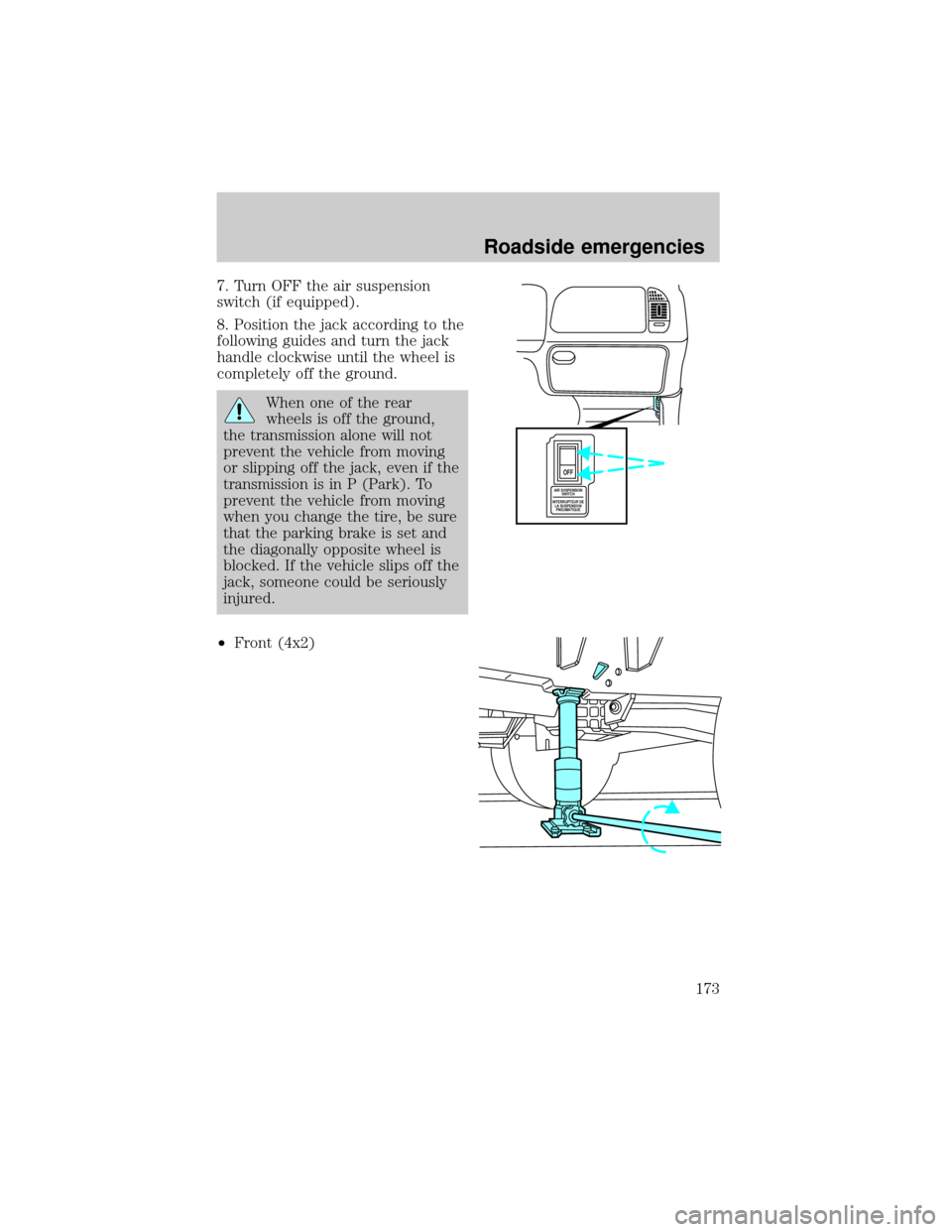
7. Turn OFF the air suspension
switch (if equipped).
8. Position the jack according to the
following guides and turn the jack
handle clockwise until the wheel is
completely off the ground.
When one of the rear
wheels is off the ground,
the transmission alone will not
prevent the vehicle from moving
or slipping off the jack, even if the
transmission is in P (Park). To
prevent the vehicle from moving
when you change the tire, be sure
that the parking brake is set and
the diagonally opposite wheel is
blocked. If the vehicle slips off the
jack, someone could be seriously
injured.
²Front (4x2)
AIR SUSPENSION
SWITCH
INTERRUPTEUR DE
LA SUSPENSION
PNEUMATIQUE
OFF
Roadside emergencies
173
Page 175 of 256
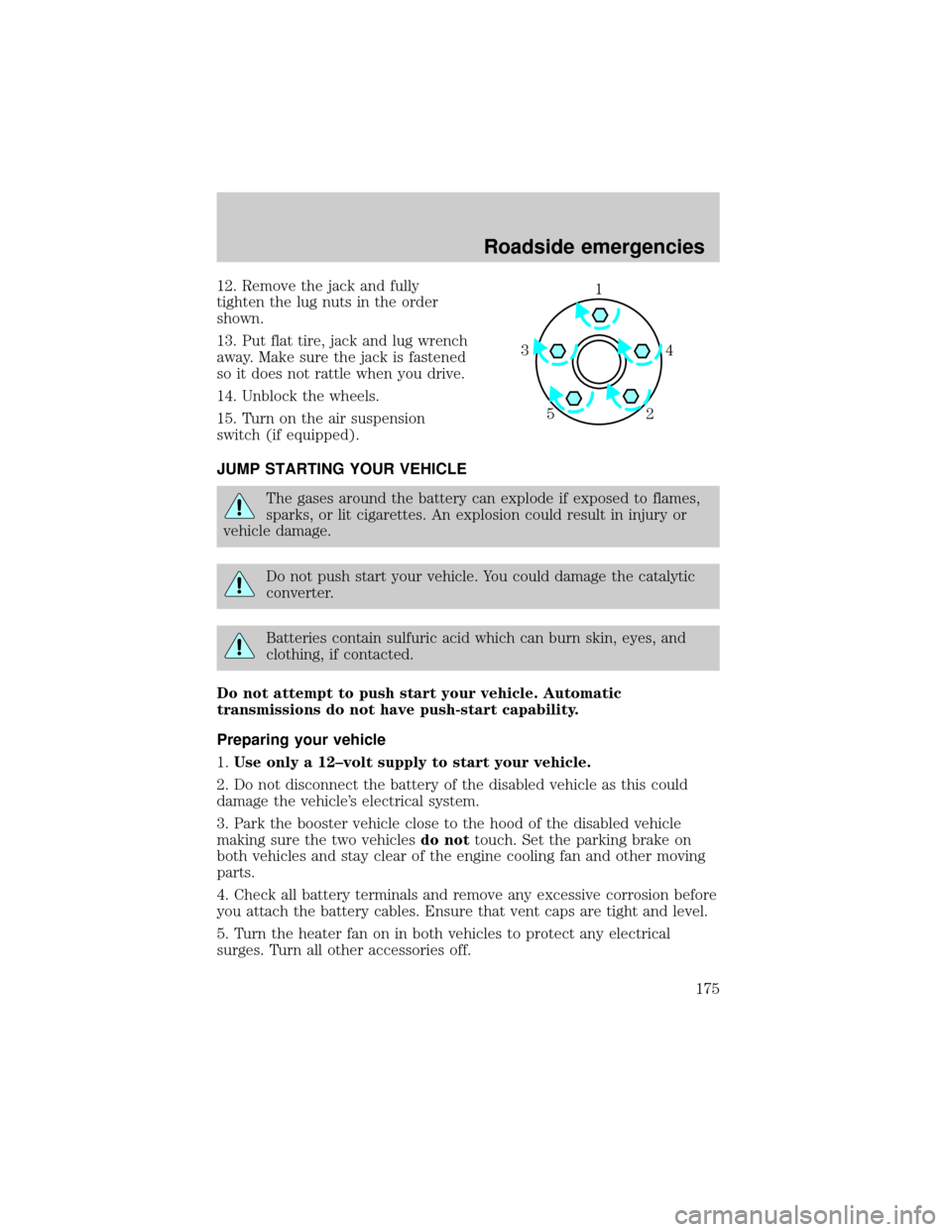
12. Remove the jack and fully
tighten the lug nuts in the order
shown.
13. Put flat tire, jack and lug wrench
away. Make sure the jack is fastened
so it does not rattle when you drive.
14. Unblock the wheels.
15. Turn on the air suspension
switch (if equipped).
JUMP STARTING YOUR VEHICLE
The gases around the battery can explode if exposed to flames,
sparks, or lit cigarettes. An explosion could result in injury or
vehicle damage.
Do not push start your vehicle. You could damage the catalytic
converter.
Batteries contain sulfuric acid which can burn skin, eyes, and
clothing, if contacted.
Do not attempt to push start your vehicle. Automatic
transmissions do not have push-start capability.
Preparing your vehicle
1.Use only a 12±volt supply to start your vehicle.
2. Do not disconnect the battery of the disabled vehicle as this could
damage the vehicle's electrical system.
3. Park the booster vehicle close to the hood of the disabled vehicle
making sure the two vehiclesdo nottouch. Set the parking brake on
both vehicles and stay clear of the engine cooling fan and other moving
parts.
4. Check all battery terminals and remove any excessive corrosion before
you attach the battery cables. Ensure that vent caps are tight and level.
5. Turn the heater fan on in both vehicles to protect any electrical
surges. Turn all other accessories off.
1
4 3
2 5
Roadside emergencies
175
Page 180 of 256
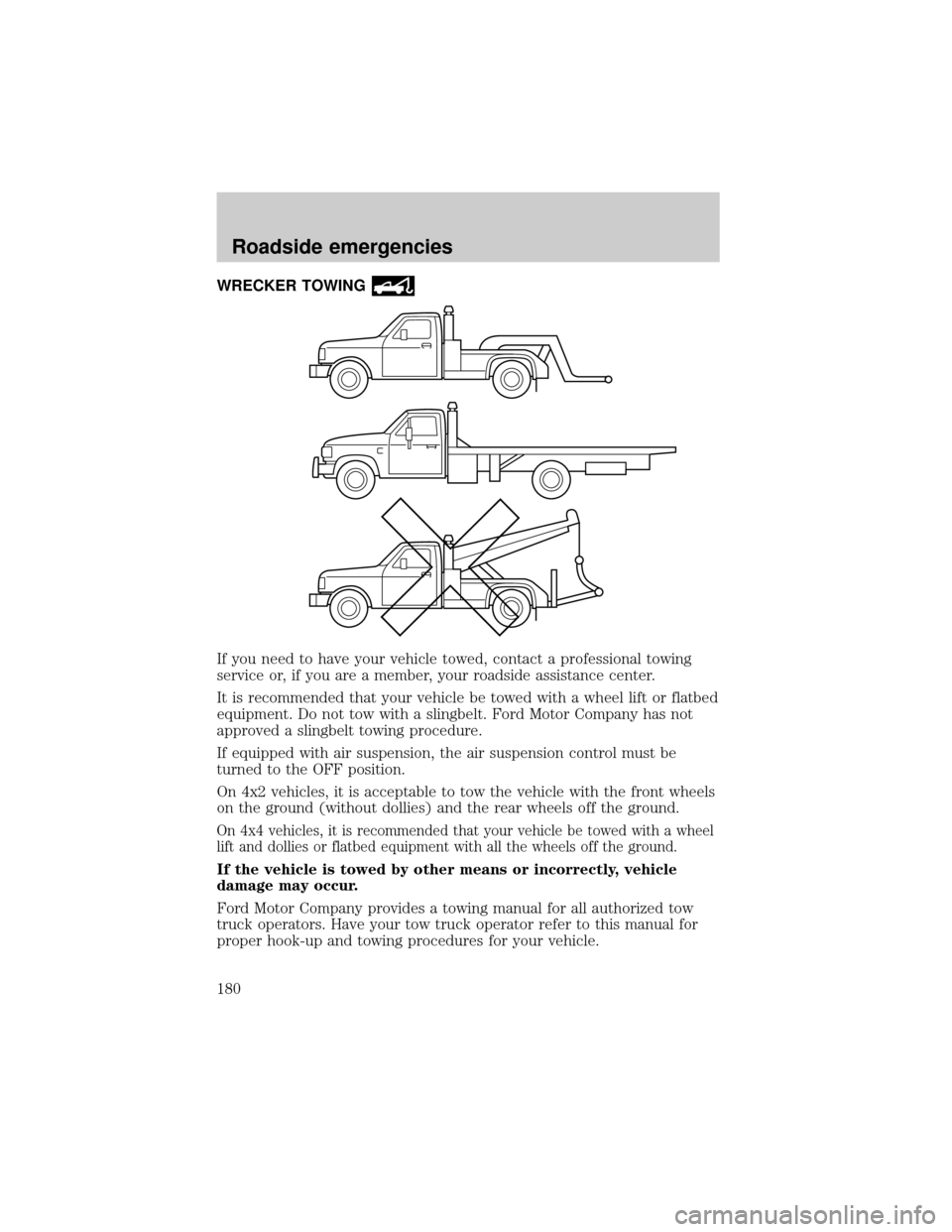
WRECKER TOWING
If you need to have your vehicle towed, contact a professional towing
service or, if you are a member, your roadside assistance center.
It is recommended that your vehicle be towed with a wheel lift or flatbed
equipment. Do not tow with a slingbelt. Ford Motor Company has not
approved a slingbelt towing procedure.
If equipped with air suspension, the air suspension control must be
turned to the OFF position.
On 4x2 vehicles, it is acceptable to tow the vehicle with the front wheels
on the ground (without dollies) and the rear wheels off the ground.
On 4x4 vehicles, it is recommended that your vehicle be towed with a wheel
lift and dollies or flatbed equipment with all the wheels off the ground.
If the vehicle is towed by other means or incorrectly, vehicle
damage may occur.
Ford Motor Company provides a towing manual for all authorized tow
truck operators. Have your tow truck operator refer to this manual for
proper hook-up and towing procedures for your vehicle.
Roadside emergencies
180
Page 205 of 256
Do not replace your tires with ªhigh performanceº tires or larger
size tires.
Failure to follow these precautions may adversely affect the
handling of the vehicle and make it easier for the driver to lose
control and roll over.
Tires that are larger or smaller than your vehicle's original tires may also
affect the accuracy of your speedometer.
SNOW TIRES AND CHAINS
Snow tires must be the same size and grade as the tires you
currently have on your vehicle.
The tires on your vehicle have all weather treads to provide traction in
rain and snow. However, in some climates, you may need to use snow
tires and chains.
Follow these guidelines when using snow tires and chains:
²Use only cable type chains offered by Ford as an accessory or
equivalent. SAE class ªSº or other conventional link type chains may
contact and cause damage to the vehicle's wheel house and/or body.
²Install chains securely, verifying that the chains do not touch any
wiring, brake lines or fuel lines.
²Drive cautiously. If you hear the chains rub or bang against your
vehicle, stop and re-tighten the chains. If this does not work, remove
the chains to prevent damage to your vehicle.
²If possible, avoid fully loading your vehicle.
²Remove the tire chains when they are no longer needed. Do not use
tire chains on dry roads.
²The suspension insulation and bumpers will help prevent vehicle
damage. Do not remove these components from your vehicle when
using snow tires and chains.
²Do not exceed 48 km/h (30 mph) with tire chains on your vehicle.
Maintenance and care
205
Page 226 of 256
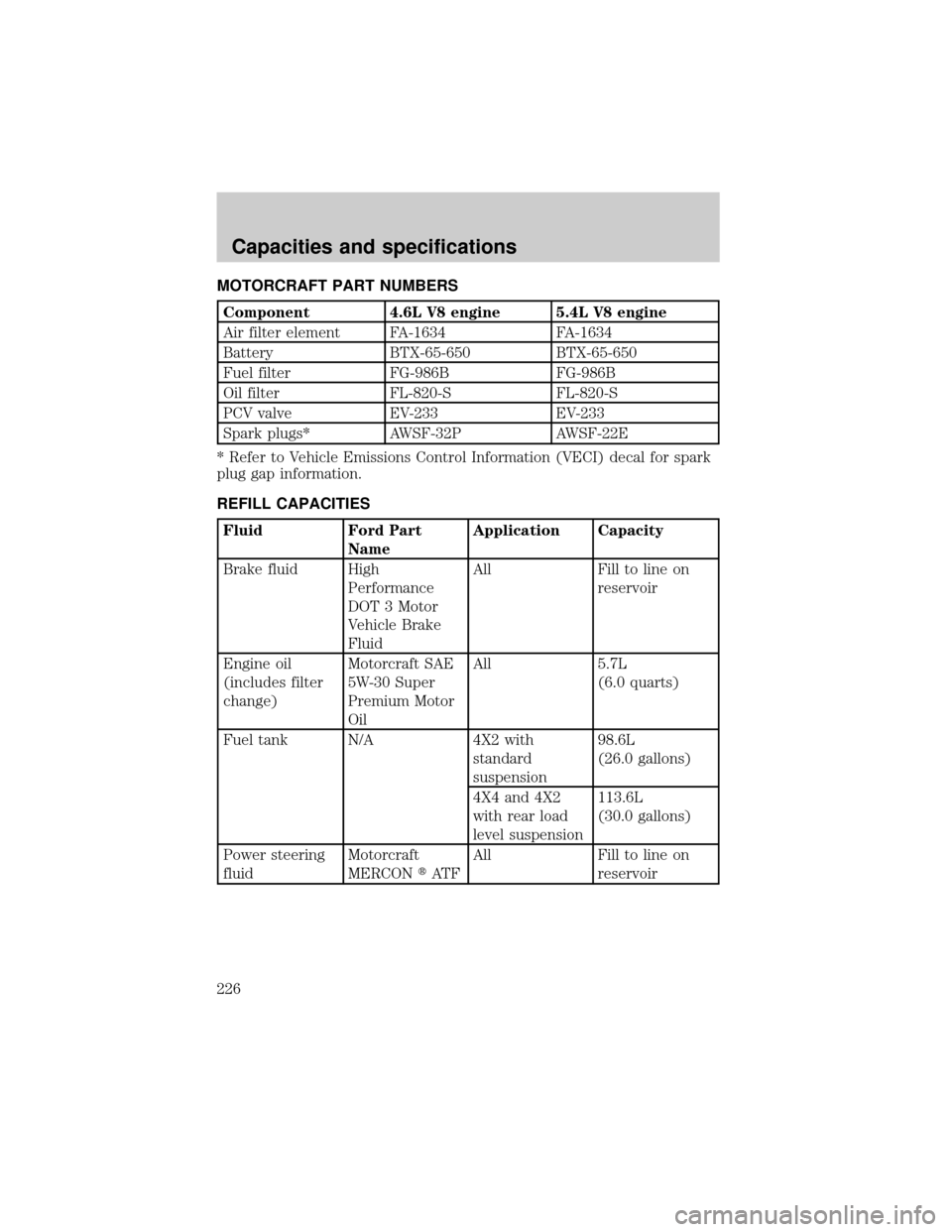
MOTORCRAFT PART NUMBERS
Component 4.6L V8 engine 5.4L V8 engine
Air filter element FA-1634 FA-1634
Battery BTX-65-650 BTX-65-650
Fuel filter FG-986B FG-986B
Oil filter FL-820-S FL-820-S
PCV valve EV-233 EV-233
Spark plugs* AWSF-32P AWSF-22E
* Refer to Vehicle Emissions Control Information (VECI) decal for spark
plug gap information.
REFILL CAPACITIES
Fluid Ford Part
NameApplication Capacity
Brake fluid High
Performance
DOT 3 Motor
Vehicle Brake
FluidAll Fill to line on
reservoir
Engine oil
(includes filter
change)Motorcraft SAE
5W-30 Super
Premium Motor
OilAll 5.7L
(6.0 quarts)
Fuel tank N/A 4X2 with
standard
suspension98.6L
(26.0 gallons)
4X4 and 4X2
with rear load
level suspension113.6L
(30.0 gallons)
Power steering
fluidMotorcraft
MERCONtAT FAll Fill to line on
reservoir
Capacities and specifications
226
Page 232 of 256
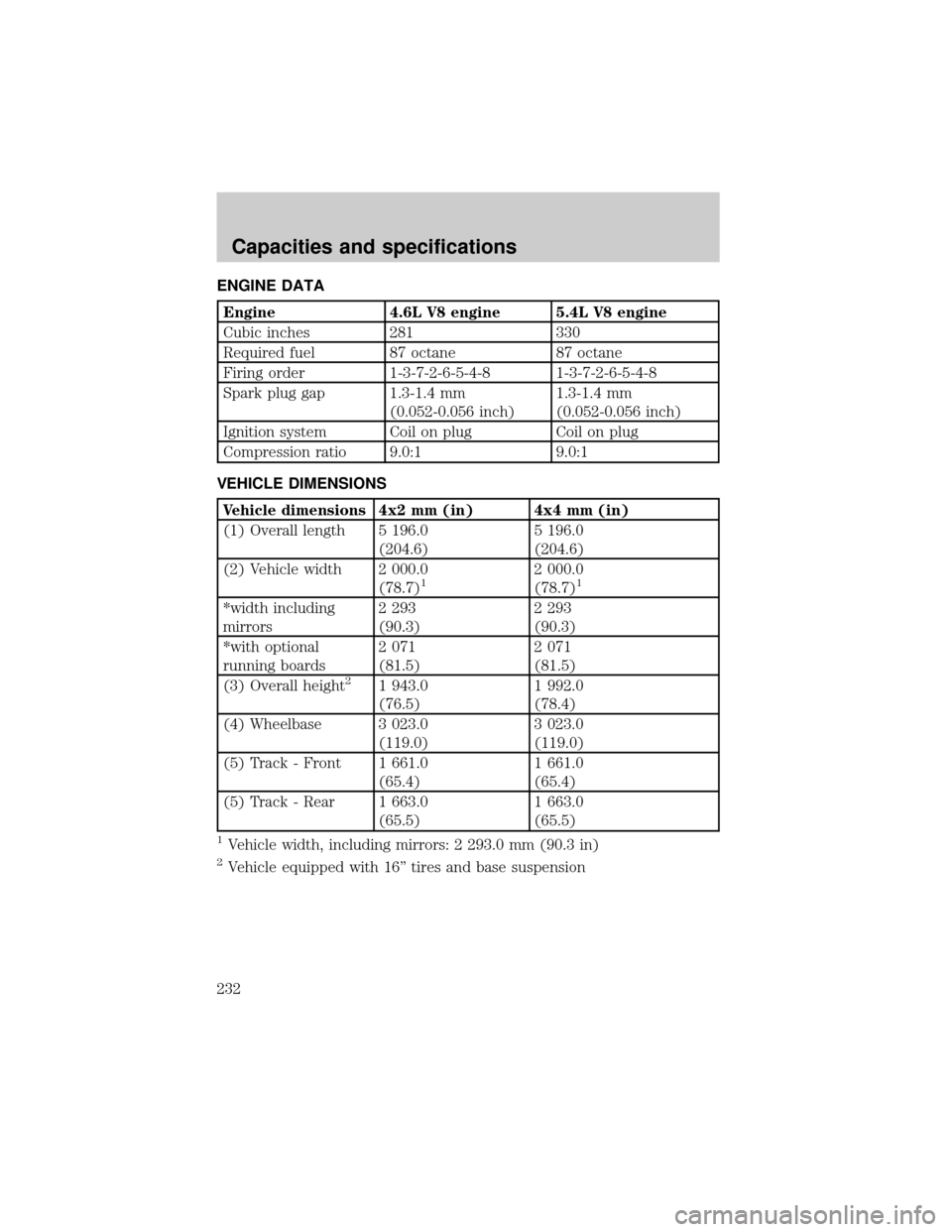
ENGINE DATA
Engine 4.6L V8 engine 5.4L V8 engine
Cubic inches 281 330
Required fuel 87 octane 87 octane
Firing order 1-3-7-2-6-5-4-8 1-3-7-2-6-5-4-8
Spark plug gap 1.3-1.4 mm
(0.052-0.056 inch)1.3-1.4 mm
(0.052-0.056 inch)
Ignition system Coil on plug Coil on plug
Compression ratio 9.0:1 9.0:1
VEHICLE DIMENSIONS
Vehicle dimensions 4x2 mm (in) 4x4 mm (in)
(1) Overall length 5 196.0
(204.6)5 196.0
(204.6)
(2) Vehicle width 2 000.0
(78.7)
12 000.0
(78.7)1
*width including
mirrors2 293
(90.3)2 293
(90.3)
*with optional
running boards2 071
(81.5)2 071
(81.5)
(3) Overall height
21 943.0
(76.5)1 992.0
(78.4)
(4) Wheelbase 3 023.0
(119.0)3 023.0
(119.0)
(5) Track - Front 1 661.0
(65.4)1 661.0
(65.4)
(5) Track - Rear 1 663.0
(65.5)1 663.0
(65.5)
1Vehicle width, including mirrors: 2 293.0 mm (90.3 in)
2Vehicle equipped with 16º tires and base suspension
Capacities and specifications
232
Page 248 of 256

Accessory delay ..........................78
Air bag supplemental
restraint system .................114,118
and child safety seats ............116
description .......................114,118
disposal .............................118,121
driver air bag ...................116,119
indicator light ...............9,118,120
operation ..........................116,119
passenger air bag ............116,119
side air bag ..............................118
Air cleaner filter .........199,200,226
Air conditioning ..........................51
automatic temperature
control system ..........................54
auxiliary heater and air
conditioner ................................60
Air suspension ...........................138
description ..............................138
warning light .............................12
Ambulance packages ....................3
Antifreeze
(see Engine coolant) ................187
Anti-lock brake system
(see Brakes) .......................134,135
Anti-theft system
warning light .............................11
Armrests ......................................94
Audio system (see Radio) .........25
Automatic transmission
driving an automatic
overdrive .................................142
fluid, adding ............................194
fluid, checking ........................194
fluid, refill capacities ..............226
fluid, specification ..................232
Auxiliary power point .................24
Axle
lubricant specifications ...229,232
refill capacities ........................226
traction lok ..............................139
Battery .......................................197acid, treating emergencies .....197
charging system
warning light .............................11
jumping a disabled battery ....175
maintenance-free ....................197
replacement, specifications ...226
servicing ..................................197
voltage gauge ............................16
Belt minder ...............................110
Brakes ........................................134
anti-lock ............................134,135
anti-lock brake system (ABS)
warning light ......................10,135
brake warning light ..................10
fluid, checking and adding ....186
fluid, refill capacities ..............226
fluid, specifications ..........229,232
lubricant specifications ...229,232
parking ....................................136
pedals (see Power
adjustable foot pedals) ............21
shift interlock ..........................141
Break-in period .............................3
Capacities for refilling fluids ....226
Cassette tape player ...................25
CD changer .................................47
Certification Label ....................234
Child safety restraints ..............122
child safety belts ....................122
Child safety seats ......................123
in front seat ............................124
in rear seat .......................124,127
tether anchorage hardware ...128
Cleaning your vehicle ...............221
engine compartment ..............222
exterior ....................................222
exterior lamps .........................223
instrument panel ....................224
instrument panel lens ............224
interior ..............................224,225
plastic parts ............................223
safety belts ..............................225
Index
248