2000 FORD ESCORT jump start
[x] Cancel search: jump startPage 105 of 200

GETTING ROADSIDE ASSISTANCE
To fully assist you should you have a vehicle concern, Ford offers a
complimentary roadside assistance program. This program is separate
from the New Vehicle Limited Warranty. The service is available:
²24±hours, seven days a week
²for the Basic warranty period (Canada) or New Vehicle Limited
Warranty period (U.S.) of three years or 60,000 km (36,000 miles),
whichever comes first on Ford and Mercury vehicles, and four years or
80,000 km (50,000 miles) on Lincoln vehicles
Roadside assistance will cover:
²changing a flat tire
²jump-starts
²lock-out assistance
²fuel delivery
²towing of your disabled vehicle to the nearest Ford dealership, or your
selling dealer if within 25 kms (15.5 miles) of the nearest Ford
Dealership (one tow per disablement). Even non-warranty related
tows, like accidents or getting stuck in the mud or snow, are covered
(some exclusions apply, such as impound towing or repossession).
Using roadside assistance
Complete the roadside assistance identification card and place it in your
wallet for quick reference. In the United States, this card is found in the
Owner Guide portfolio in the glove compartment in Ford vehicles and is
mailed to you if you own a Mercury or Lincoln. In Canada, it is found in
the Roadside Assistance book in the glove compartment.
To receive roadside assistance in the United States for Ford or Mercury
vehicles, call 1-800-241-3673 or if you own a Lincoln vehicle, call
1±800±521±4140. In Canada call 1±800±665±2006.
Should you need to arrange roadside assistance for yourself, Ford will
reimburse a reasonable amount. To obtain information about
reimbursement, call 1-800-241-3673 in the United States for Ford or
Mercury vehicles; or if you own a Lincoln vehicle, call 1±800±521±4140.
Call 1±800±665±2006 in Canada.
Roadside emergencies
105
Page 119 of 200
JUMP STARTING YOUR VEHICLE
The gases around the battery can explode if exposed to flames,
sparks, or lit cigarettes. An explosion could result in injury or
vehicle damage.
Do not push start your vehicle. You could damage the catalytic
converter.
Batteries contain sulfuric acid which can burn skin, eyes, and
clothing, if contacted.
Do not attempt to push start your vehicle. Automatic
transmissions do not have push-start capability.
Preparing your vehicle
1.Use only a 12±volt supply to start your vehicle.
2. Do not disconnect the battery of the disabled vehicle as this could
damage the vehicle's electrical system.
3. Park the booster vehicle close to the hood of the disabled vehicle
making sure the two vehiclesdo nottouch. Set the parking brake on
both vehicles and stay clear of the engine cooling fan and other moving
parts.
4. Check all battery terminals and remove any excessive corrosion before
you attach the battery cables. Ensure that vent caps are tight and level.
5. Turn the heater fan on in both vehicles to protect any electrical
surges. Turn all other accessories off.
Roadside emergencies
119
Page 122 of 200
Jump starting
1. Start the engine of the booster vehicle and run the engine at
moderately increased speed.
2. Start the engine of the disabled vehicle.
3. Once the disabled vehicle has been started, run both engines for an
additional three minutes before disconnecting the jumper cables.
Removing the jumper cables
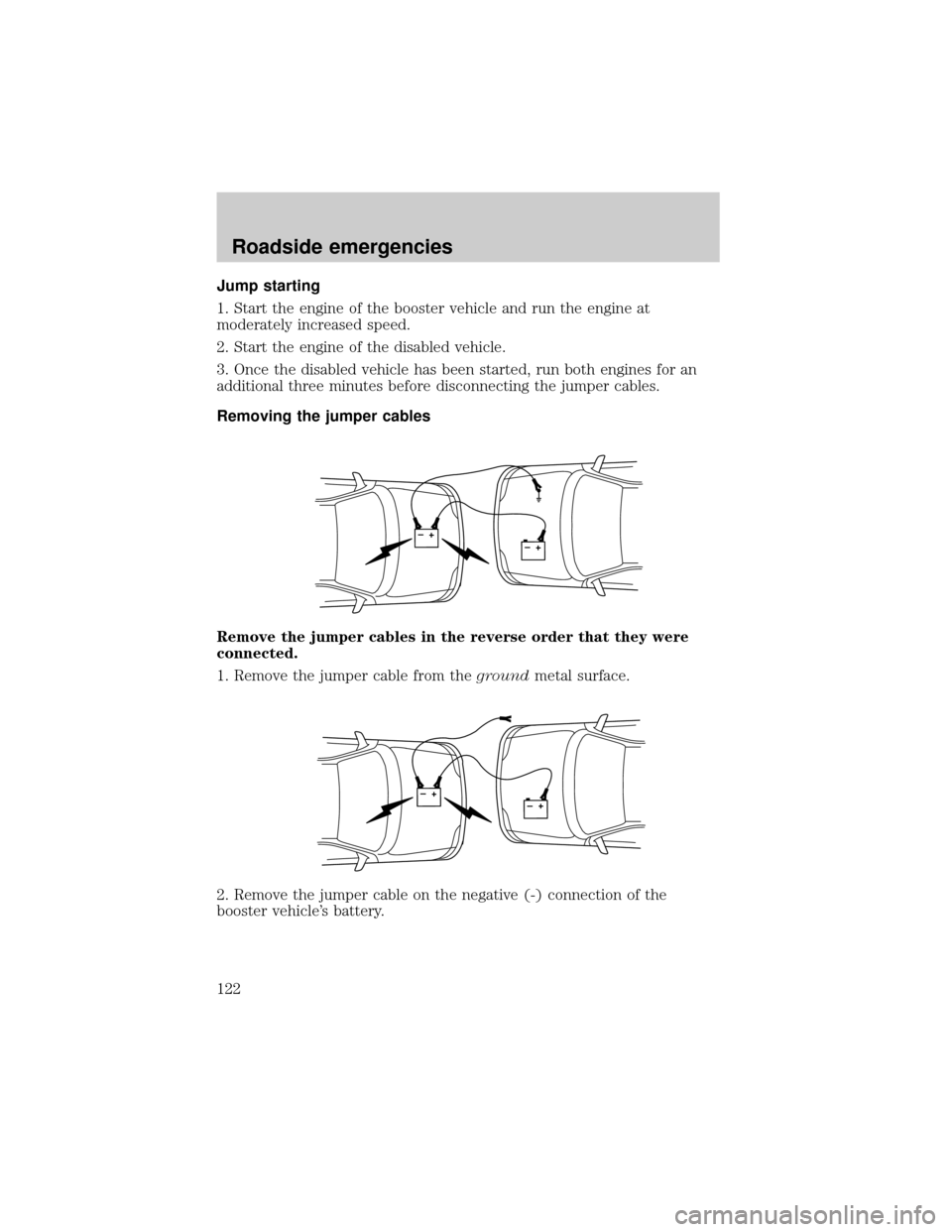
Remove the jumper cables in the reverse order that they were
connected.
1. Remove the jumper cable from thegroundmetal surface.
2. Remove the jumper cable on the negative (-) connection of the
booster vehicle's battery.
+–+–
+–+–
Roadside emergencies
122
Page 123 of 200
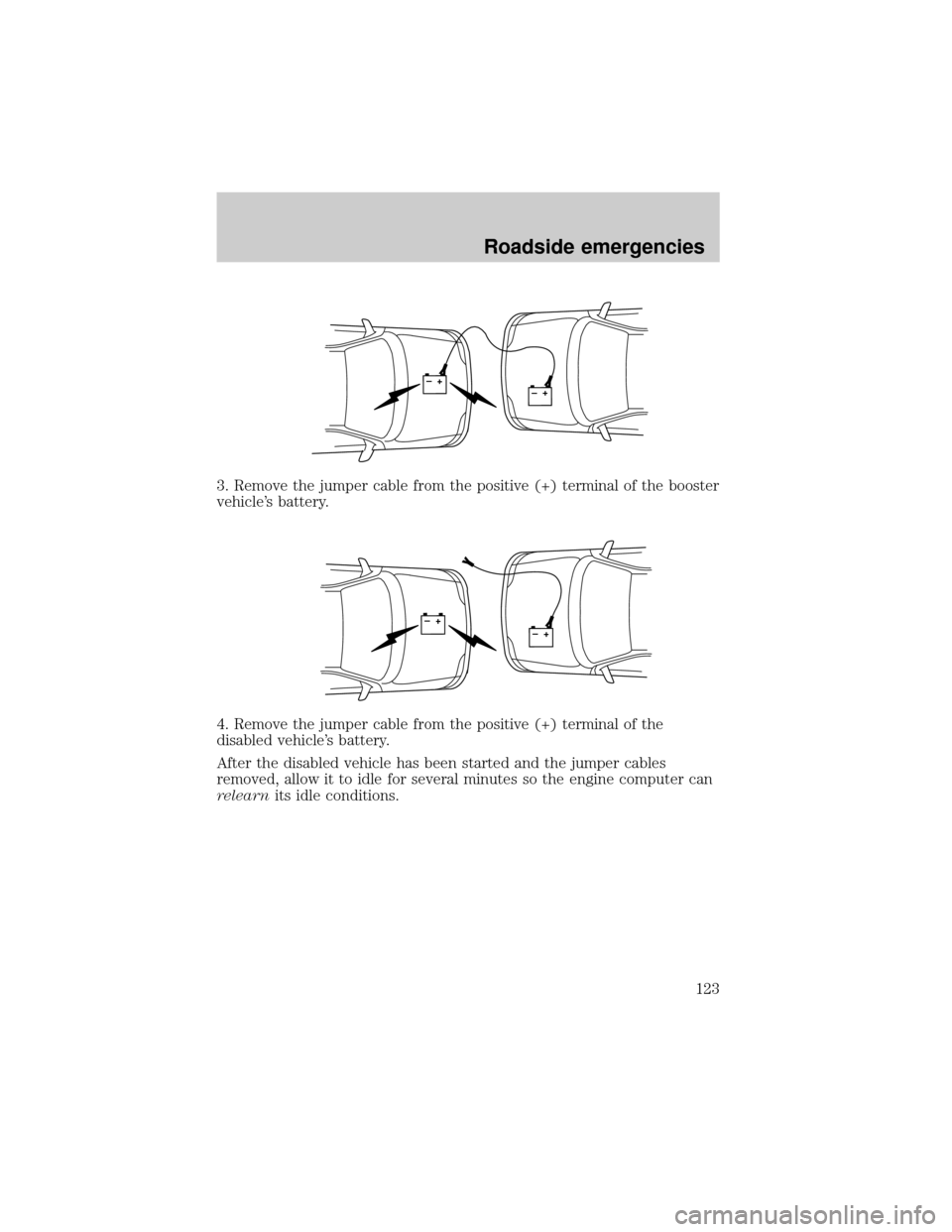
3. Remove the jumper cable from the positive (+) terminal of the booster
vehicle's battery.
4. Remove the jumper cable from the positive (+) terminal of the
disabled vehicle's battery.
After the disabled vehicle has been started and the jumper cables
removed, allow it to idle for several minutes so the engine computer can
relearnits idle conditions.
+–+–
+–+–
Roadside emergencies
123
Page 195 of 200

Coolant
checking and adding ..............137
refill capacities .................141,175
specifications ...................176,177
Cruise control
(see Speed control) ....................43
Customer Assistance ................105
Ford accessories
for your vehicle ......................189
Ford Extended
Service Plan ............................182
Getting assistance outside
the U.S. and Canada ..............188
Getting roadside assistance ...105
Getting the
service you need ....................182
Ordering additional
owner's literature ...................192
The Dispute
Settlement Board ...................185
Utilizing the Mediation/
Arbitration Program ...............188
Daytime running lamps
(see Lamps) ................................41
Defrost
rear window ..............................40
Dipstick
automati
c transmission fluid ................143
engine oil .................................132
Doors
lubricant specifications ..........176
Driving under special
conditions
through water .........................104
Emergencies, roadside
jump-starting ..........................119
Emission control system ..........161
Engine .................................177,178
check engine/
service engine soon light ...........9
cleaning ...................................172coolant .....................................137
idle speed control ...................146
lubrication
specifications ...................176,177
refill capacities ........................175
service points ...................130,131
starting after a collision .........106
Engine block heater ...................87
Engine oil ..................................132
checking and adding ..............132
dipstick ....................................132
filter, specifications .........134,175
recommendations ...................134
refill capacities ........................175
specifications ...................176,177
Exhaust fumes ............................88
Floor mats ...................................52
Fluid capacities .........................175
Foglamps .....................................42
Fuel ............................................153
calculating fuel economy .......158
cap ...........................................155
capacity ...................................175
choosing the right fuel ...........156
comparisons with EPA fuel
economy estimates .................161
detergent in fuel .....................157
filling your
vehicle with fuel .......153,155,158
filter, specifications .........158,175
fuel pump shut-off switch .....106
gauge .........................................13
improving fuel economy ........158
low fuel warning light ................8
octane rating .............156,177,178
quality ......................................157
running out of fuel .................157
safety information relating to
automotive fuels .....................153
Fuses ...................................108,110
Gas cap (see Fuel cap) ............155
Index
195
Page 196 of 200

Gas mileage
(see Fuel economy) .................158
Gauges ....................................12,13
engine coolant
temperature gauge ...................13
fuel gauge ..................................13
odometer ...................................14
speedometer .............................14
tachometer ................................15
trip odometer ............................14
GAWR
(Gross Axle Weight Rating) .....100
definition .................................100
driving with a heavy load ......100
location ....................................100
GVWR (Gross
Vehicle Weight Rating) .............100
calculating ...............................100
definition .................................100
driving with a heavy load ......100
location ....................................100
Hazard flashers .........................106
Head restraints ...........................60
Headlamps ...................................41
aiming ...............................168,169
bulb specifications ..................168
daytime running lights .............41
flash to pass ..............................42
high beam ............................11,42
replacing bulbs .......................163
turning on and off ....................41
warning chime ..........................12
Heating ........................................36
heater only system ...................36
heating and
air conditioning system ............37
Hood ..........................................129
Ignition ................................177,178
positions of the ignition ...........41
Infant seats (see Safety seats) ..78
Inspection/maintenance
(I/M) testing ..............................162Instrument panel ..........................8
cleaning ...................................173
cluster ...................................8,173
lighting up
panel and interior .....................16
location of components ..............8
Jump-starting your vehicle ......119
Keys
key in ignition chime ...............12
positions of the ignition ...........41
Lamps
bulb replacement
specifications chart ................168
cargo lamps ...............................16
daytime running light ...............41
fog lamps ...................................42
headlamps ..........................41,163
headlamps, flash to pass ..........42
instrument panel, dimming .....16
interior lamps ....................49,167
replacing bulbs ..163,165,166,167
Lane change indicator
(see Turn signal) ........................43
Lights, warning and indicator ......8
air bag ........................................10
anti-lock brakes (ABS) .......11,90
anti-theft ...................................11
brake ..........................................10
charging system ........................11
high beam .................................11
low fuel ........................................8
oil pressure ...............................12
safety belt .................................10
service engine soon ....................9
turn signal indicator .................11
Load limits .................................100
GAWR ......................................100
GVWR ......................................100
trailer towing ..........................100
Locks
childproof ..................................50
Lubricant specifications ....176,177
Index
196
Page 197 of 200

Manual transaxle .........................97
fluid capacities ........................175
lubricant specifications ..........177
reverse .......................................99
Mirrors
cleaning ...................................172
side view mirrors (power) .......17
Moon roof ....................................49
Motorcraft parts .................158,175
Octane rating ............................156
Odometer .....................................14
Oil (see Engine oil) ..................132
Panic alarm feature, remote
entry system ................................55
Parking brake ..............................90
Parts (see Motorcraft parts) ....175
Power distribution box
(see Fuses) ...............................113
Power door locks ........................50
Power steering ............................91
fluid, checking and adding ....142
fluid, refill capacity ................175
fluid, specifications ..........176,177
Radio ............................................18
Relays .................................108,115
Remote entry system ............53,55
illuminated entry ......................57
locking/unlocking doors ...........54
opening the trunk .....................55
panic alarm ...............................55
replacement/additional
transmitters ...............................56
replacing the batteries .............55
Roof rack ...................................104
Safety belts (see Safety
restraints) ................12,63,64,65,66
Safety defects, reporting ..........193
Safety restraints ...........63,64,65,66
belt minder ...............................68
cleaning the safety belts ...71,174
extension assembly ..................67
for adults .........................64,65,66for children ..........................76,77
lap belt ......................................66
warning light
and chime ...................10,12,67,68
Safety seats for children ............78
Seat belts
(see Safety restraints) ...............63
Seats ............................................60
child safety seats ......................78
cleaning ............................173,174
Servicing your vehicle ..............125
Spark plugs,
specifications ...............175,177,178
Specification chart,
lubricants ............................176,177
Speed control ..............................43
Speedometer ...............................14
Starting your vehicle .............84,87
jump starting ..........................119
Steering wheel
tilting .........................................47
Tachometer .................................15
Temperature control
(see Climate control) .................36
Tires ......................115,149,150,151
changing ...........................115,116
checking the pressure ............151
replacing ..................................152
rotating ....................................151
snow tires and chains ............152
tire grades ...............................150
treadwear ................................150
Towing .......................................151
wrecker ....................................124
Transaxle
automatic operation .................92
fluid, refill capacities ..............175
lubricant specifications ..........177
manual operation ......................97
Transmission
fluid, checking and adding
(automatic) .............................143
Index
197