2000 FORD ESCORT transmission
[x] Cancel search: transmissionPage 143 of 200
5. If the fluid is low, add fluid in small amounts, continuously checking
the level until it reaches the range between the MIN and MAX lines. Be
sure to put the cap back on the reservoir.
TRANSMISSION FLUID
Checking automatic transmission fluid
Refer to your Scheduled Maintenance Guide for scheduled intervals for
fluid checks and changes. Your transaxle does not consume fluid.
However, the fluid level should be checked if the transaxle is not working
properly, i.e., if the transaxle slips or shifts slowly or if you notice some
sign of fluid leakage.
Automatic transmission fluid expands when warmed. To obtain an
accurate fluid check, drive the vehicle until it is warmed up
(approximately 30 km [20 miles]). If your vehicle has been
operated for an extended period at high speeds, in city traffic
during hot weather or pulling a trailer, the vehicle should be
turned off for about 30 minutes to allow fluid to cool before
checking.
1. Drive the vehicle 30 km (20 miles) or until it reaches normal operating
temperature.
2. Park the vehicle on a level surface and engage the parking brake.
3. With the parking brake engaged and your foot on the brake pedal,
start the engine and move the gearshift lever through all of the gear
ranges. Allow sufficient time for each gear to engage.
4. Latch the gearshift lever in P (Park) and leave the engine running.
5. Remove the dipstick, wiping it clean with a clean, dry lint free rag. If
necessary, refer toIdentifying components in the engine compartment
in this chapter for the location of the dipstick.
6. Install the dipstick making sure it is fully seated in the filler tube.
7. Remove the dipstick and inspect the fluid level. The fluid should be in
the designated areas for normal operating temperature.
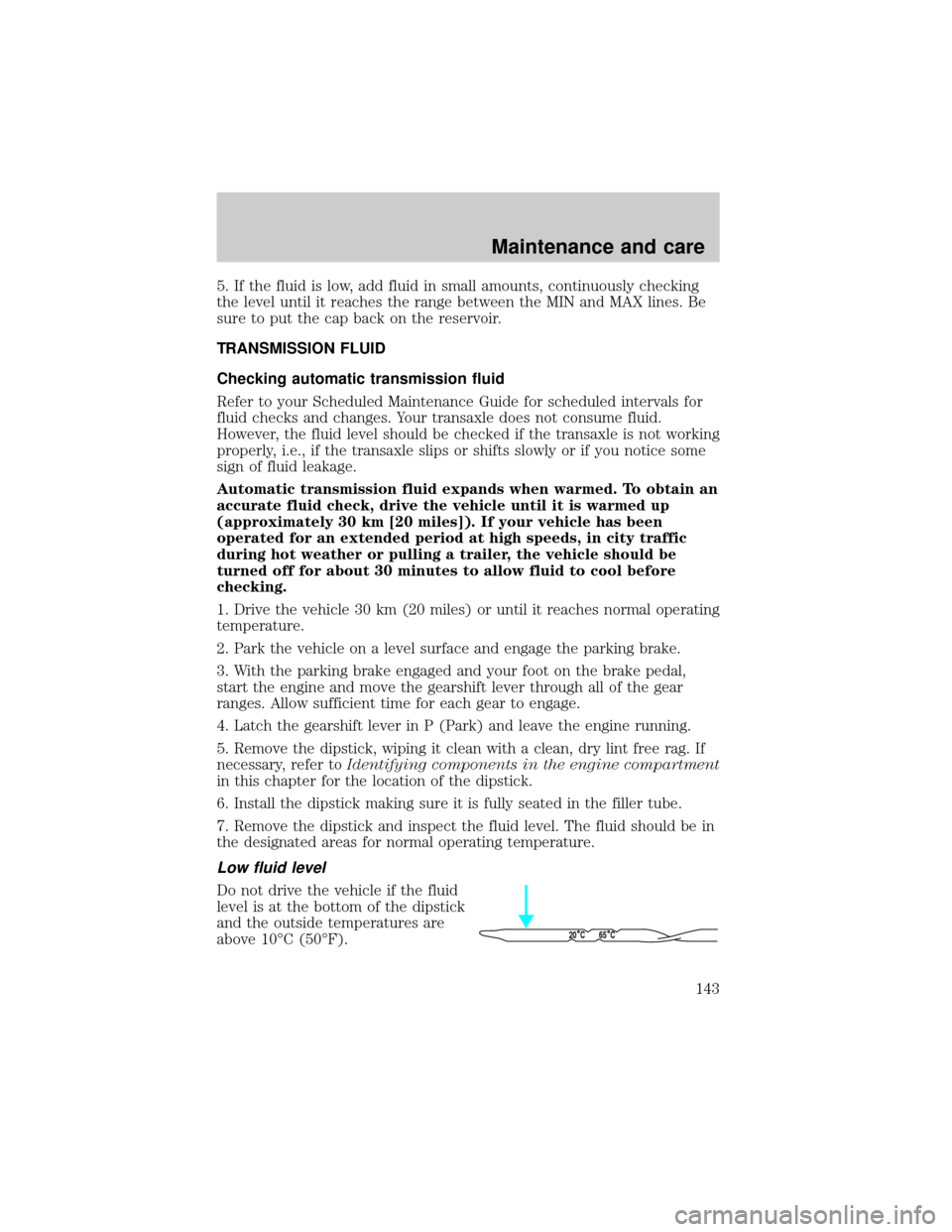
Low fluid level
Do not drive the vehicle if the fluid
level is at the bottom of the dipstick
and the outside temperatures are
above 10ÉC (50ÉF).
20 C65 C
Maintenance and care
143
Page 144 of 200
Correct fluid level
The transmission fluid should be checked at normal operating
temperatures 66ÉC-77ÉC (150ÉF-170ÉF) on a level surface. The normal
operating temperature can be reached after approximately 30 km (20
miles) of driving.
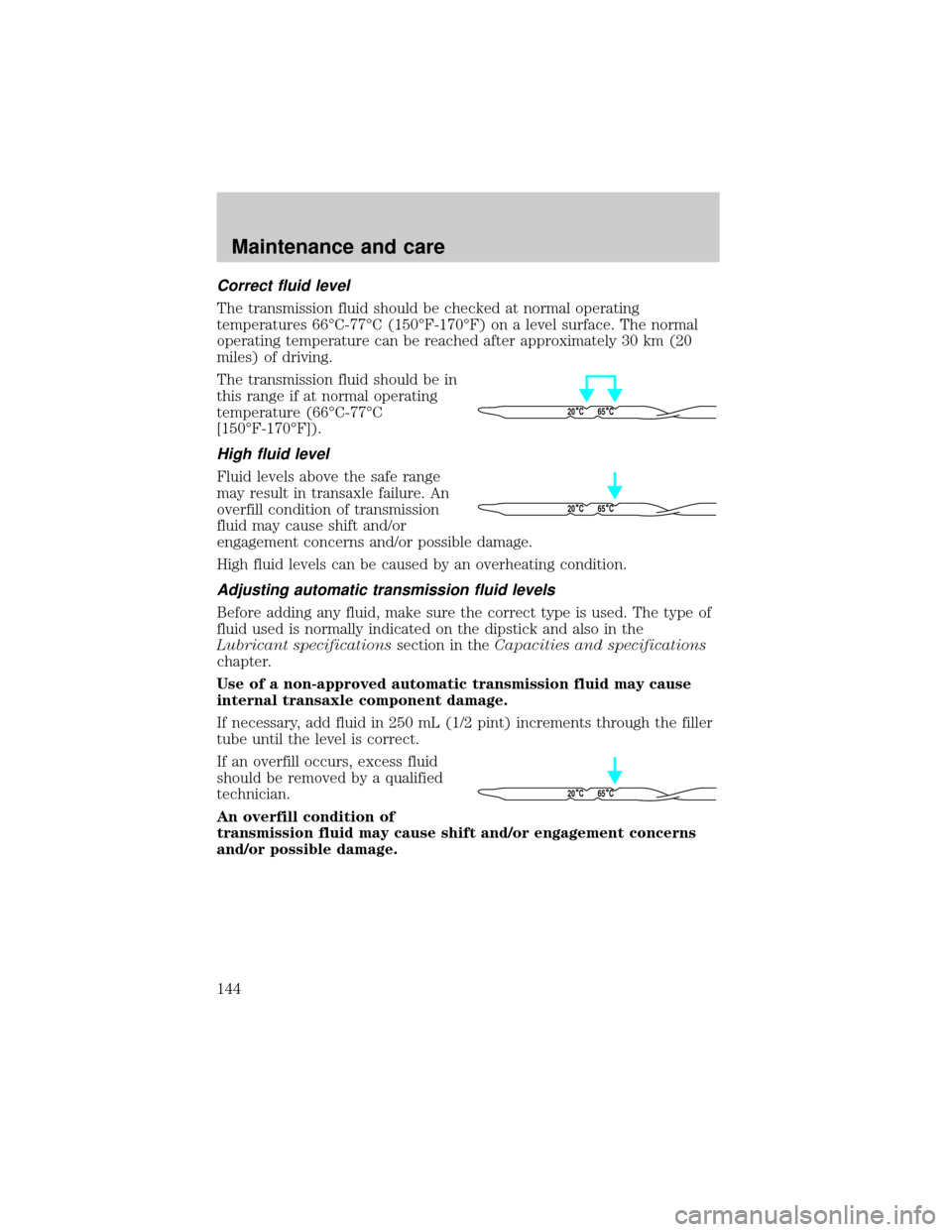
The transmission fluid should be in
this range if at normal operating
temperature (66ÉC-77ÉC
[150ÉF-170ÉF]).
High fluid level
Fluid levels above the safe range
may result in transaxle failure. An
overfill condition of transmission
fluid may cause shift and/or
engagement concerns and/or possible damage.
High fluid levels can be caused by an overheating condition.
Adjusting automatic transmission fluid levels
Before adding any fluid, make sure the correct type is used. The type of
fluid used is normally indicated on the dipstick and also in the
Lubricant specificationssection in theCapacities and specifications
chapter.
Use of a non-approved automatic transmission fluid may cause
internal transaxle component damage.
If necessary, add fluid in 250 mL (1/2 pint) increments through the filler
tube until the level is correct.
If an overfill occurs, excess fluid
should be removed by a qualified
technician.
An overfill condition of
transmission fluid may cause shift and/or engagement concerns
and/or possible damage.
20 C65 C
20 C65 C
20 C65 C
Maintenance and care
144
Page 145 of 200
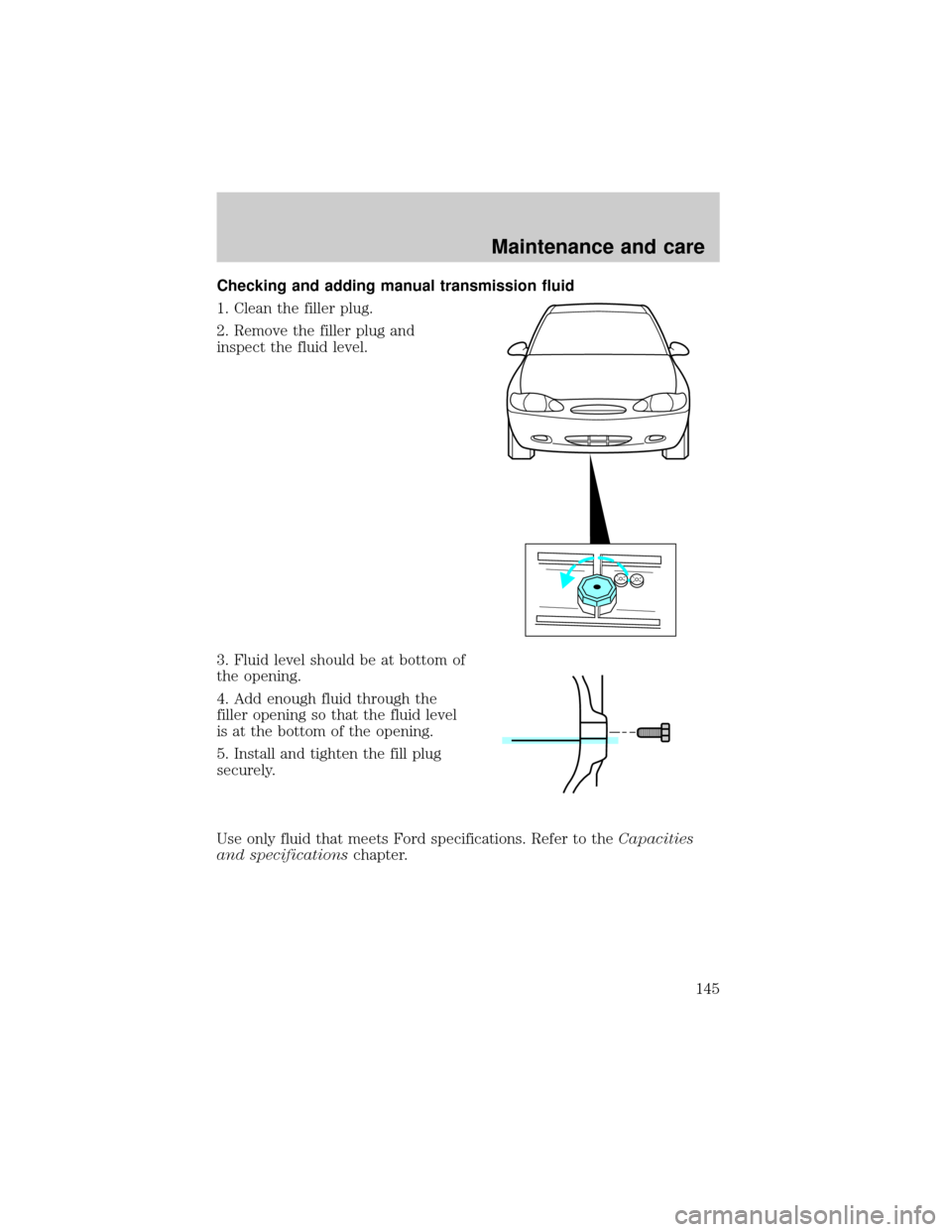
Checking and adding manual transmission fluid
1. Clean the filler plug.
2. Remove the filler plug and
inspect the fluid level.
3. Fluid level should be at bottom of
the opening.
4. Add enough fluid through the
filler opening so that the fluid level
is at the bottom of the opening.
5. Install and tighten the fill plug
securely.
Use only fluid that meets Ford specifications. Refer to theCapacities
and specificationschapter.
Maintenance and care
145
Page 161 of 200
²Fuel economy may decrease with lower temperatures during the first
12±16 km (8±10 miles) of driving.
²Driving on flat terrain offers improved fuel economy as compared to
driving on hilly terrain.
²Transmissions give their best fuel economy when operated in the top
cruise gear and with steady pressure on the gas pedal.
²Close windows for high speed driving.
EPA window sticker
Every new vehicle should have the EPA window sticker. Contact your
dealer if the window sticker is not supplied with your vehicle. The EPA
window sticker should be your guide for the fuel economy comparisons
with other vehicles.
It is important to note the box in the lower left corner of the window
sticker. These numbers represent the Range of L/100 km (MPG)
expected on the vehicle under optimum conditions. Your fuel economy
may vary depending upon the method of operation and conditions.
EMISSION CONTROL SYSTEM
Your vehicle is equipped with various emission control components and a
catalytic converter which will enable your vehicle to comply with
applicable exhaust emission standards. To make sure that the catalytic
converter and other emission control components continue to work
properly:
²Use only the specified fuel listed.
²Avoid running out of fuel.
²Do not turn off the ignition while your vehicle is moving, especially at
high speeds.
²Have the items listed in your Scheduled Maintenance Guide performed
according to the specified schedule.
The scheduled maintenance items listed in the Scheduled Maintenance
Guide are essential to the life and performance of your vehicle and to its
emissions system.
If other than Ford, Motorcraft or Ford-authorized parts are used for
maintenance replacements or for service of components affecting
emission control, such non-Ford parts should be equivalent to genuine
Ford Motor Company parts in performance and durability.
Maintenance and care
161
Page 176 of 200
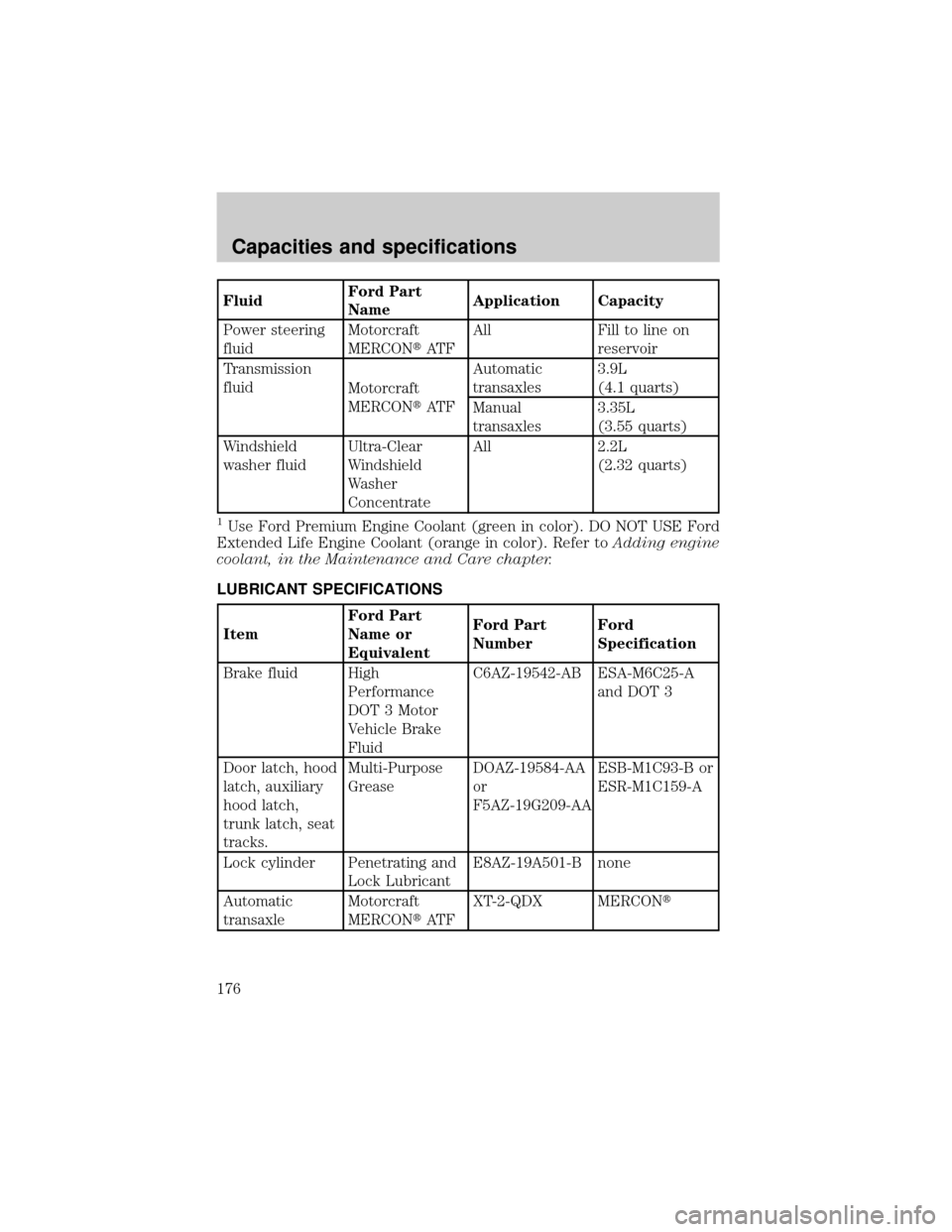
FluidFord Part
NameApplication Capacity
Power steering
fluidMotorcraft
MERCONtAT FAll Fill to line on
reservoir
Transmission
fluid
Motorcraft
MERCONtAT FAutomatic
transaxles3.9L
(4.1 quarts)
Manual
transaxles3.35L
(3.55 quarts)
Windshield
washer fluidUltra-Clear
Windshield
Washer
ConcentrateAll 2.2L
(2.32 quarts)
1Use Ford Premium Engine Coolant (green in color). DO NOT USE Ford
Extended Life Engine Coolant (orange in color). Refer toAdding engine
coolant, in the Maintenance and Care chapter.
LUBRICANT SPECIFICATIONS
ItemFord Part
Name or
EquivalentFord Part
NumberFord
Specification
Brake fluid High
Performance
DOT 3 Motor
Vehicle Brake
FluidC6AZ-19542-AB ESA-M6C25-A
and DOT 3
Door latch, hood
latch, auxiliary
hood latch,
trunk latch, seat
tracks.Multi-Purpose
GreaseDOAZ-19584-AA
or
F5AZ-19G209-AAESB-M1C93-B or
ESR-M1C159-A
Lock cylinder Penetrating and
Lock LubricantE8AZ-19A501-B none
Automatic
transaxleMotorcraft
MERCONtAT FXT-2-QDX MERCONt
Capacities and specifications
176
Page 181 of 200
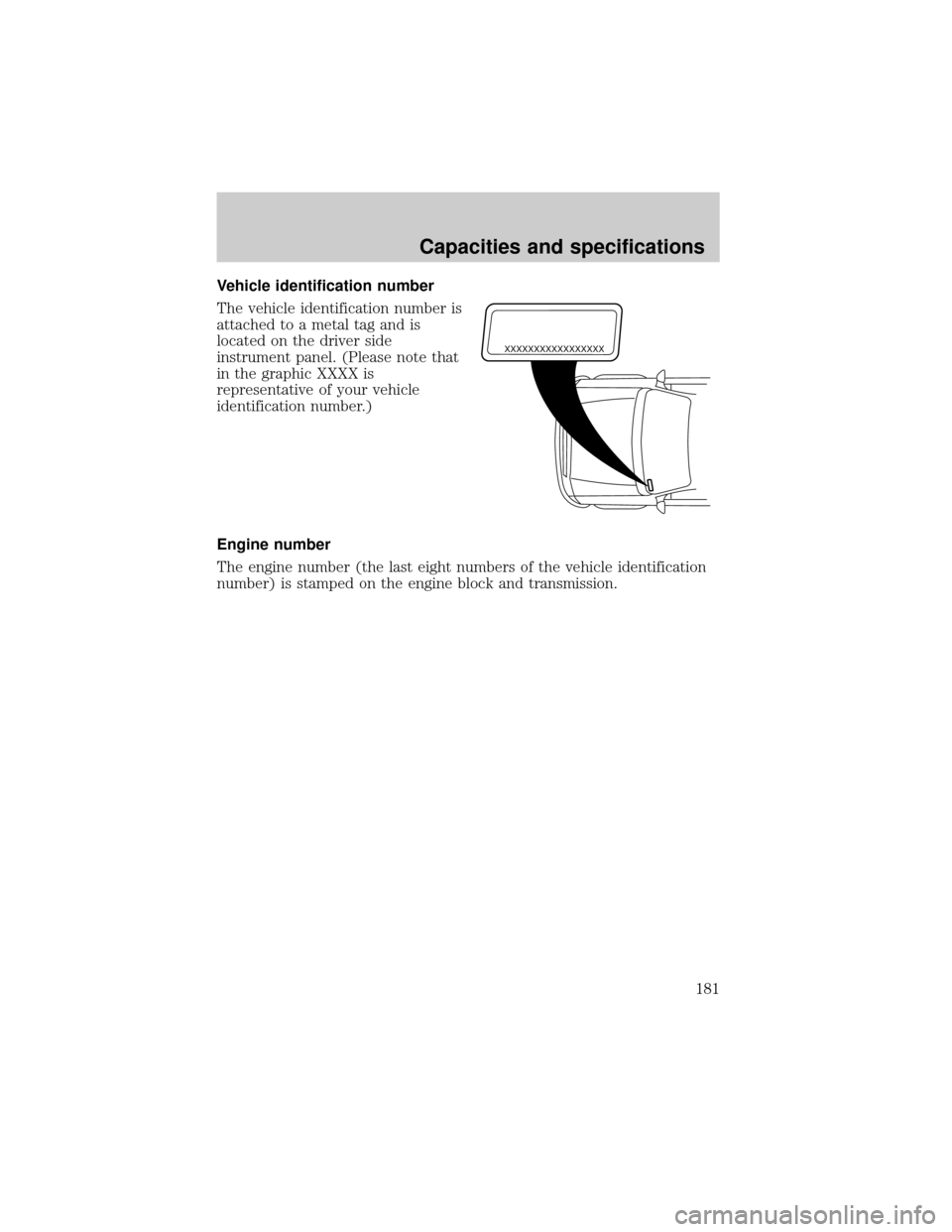
Vehicle identification number
The vehicle identification number is
attached to a metal tag and is
located on the driver side
instrument panel. (Please note that
in the graphic XXXX is
representative of your vehicle
identification number.)
Engine number
The engine number (the last eight numbers of the vehicle identification
number) is stamped on the engine block and transmission.
XXXXXXXXXXXXXXXXX
Capacities and specifications
181
Page 195 of 200

Coolant
checking and adding ..............137
refill capacities .................141,175
specifications ...................176,177
Cruise control
(see Speed control) ....................43
Customer Assistance ................105
Ford accessories
for your vehicle ......................189
Ford Extended
Service Plan ............................182
Getting assistance outside
the U.S. and Canada ..............188
Getting roadside assistance ...105
Getting the
service you need ....................182
Ordering additional
owner's literature ...................192
The Dispute
Settlement Board ...................185
Utilizing the Mediation/
Arbitration Program ...............188
Daytime running lamps
(see Lamps) ................................41
Defrost
rear window ..............................40
Dipstick
automati
c transmission fluid ................143
engine oil .................................132
Doors
lubricant specifications ..........176
Driving under special
conditions
through water .........................104
Emergencies, roadside
jump-starting ..........................119
Emission control system ..........161
Engine .................................177,178
check engine/
service engine soon light ...........9
cleaning ...................................172coolant .....................................137
idle speed control ...................146
lubrication
specifications ...................176,177
refill capacities ........................175
service points ...................130,131
starting after a collision .........106
Engine block heater ...................87
Engine oil ..................................132
checking and adding ..............132
dipstick ....................................132
filter, specifications .........134,175
recommendations ...................134
refill capacities ........................175
specifications ...................176,177
Exhaust fumes ............................88
Floor mats ...................................52
Fluid capacities .........................175
Foglamps .....................................42
Fuel ............................................153
calculating fuel economy .......158
cap ...........................................155
capacity ...................................175
choosing the right fuel ...........156
comparisons with EPA fuel
economy estimates .................161
detergent in fuel .....................157
filling your
vehicle with fuel .......153,155,158
filter, specifications .........158,175
fuel pump shut-off switch .....106
gauge .........................................13
improving fuel economy ........158
low fuel warning light ................8
octane rating .............156,177,178
quality ......................................157
running out of fuel .................157
safety information relating to
automotive fuels .....................153
Fuses ...................................108,110
Gas cap (see Fuel cap) ............155
Index
195
Page 197 of 200

Manual transaxle .........................97
fluid capacities ........................175
lubricant specifications ..........177
reverse .......................................99
Mirrors
cleaning ...................................172
side view mirrors (power) .......17
Moon roof ....................................49
Motorcraft parts .................158,175
Octane rating ............................156
Odometer .....................................14
Oil (see Engine oil) ..................132
Panic alarm feature, remote
entry system ................................55
Parking brake ..............................90
Parts (see Motorcraft parts) ....175
Power distribution box
(see Fuses) ...............................113
Power door locks ........................50
Power steering ............................91
fluid, checking and adding ....142
fluid, refill capacity ................175
fluid, specifications ..........176,177
Radio ............................................18
Relays .................................108,115
Remote entry system ............53,55
illuminated entry ......................57
locking/unlocking doors ...........54
opening the trunk .....................55
panic alarm ...............................55
replacement/additional
transmitters ...............................56
replacing the batteries .............55
Roof rack ...................................104
Safety belts (see Safety
restraints) ................12,63,64,65,66
Safety defects, reporting ..........193
Safety restraints ...........63,64,65,66
belt minder ...............................68
cleaning the safety belts ...71,174
extension assembly ..................67
for adults .........................64,65,66for children ..........................76,77
lap belt ......................................66
warning light
and chime ...................10,12,67,68
Safety seats for children ............78
Seat belts
(see Safety restraints) ...............63
Seats ............................................60
child safety seats ......................78
cleaning ............................173,174
Servicing your vehicle ..............125
Spark plugs,
specifications ...............175,177,178
Specification chart,
lubricants ............................176,177
Speed control ..............................43
Speedometer ...............................14
Starting your vehicle .............84,87
jump starting ..........................119
Steering wheel
tilting .........................................47
Tachometer .................................15
Temperature control
(see Climate control) .................36
Tires ......................115,149,150,151
changing ...........................115,116
checking the pressure ............151
replacing ..................................152
rotating ....................................151
snow tires and chains ............152
tire grades ...............................150
treadwear ................................150
Towing .......................................151
wrecker ....................................124
Transaxle
automatic operation .................92
fluid, refill capacities ..............175
lubricant specifications ..........177
manual operation ......................97
Transmission
fluid, checking and adding
(automatic) .............................143
Index
197