Page 177 of 224
SERVICING YOUR TIRES
Checking the tire pressure
•Use an accurate tire pressure gauge.
•Check the tire pressure when tires are cold, after the vehicle has been
parked for at least one hour or has been driven less than 5 km
(3 miles).
•Adjust tire pressure to recommended specifications found on the Tire
Pressure label.
Improperly inflated tires can affect vehicle handling and can fail
suddenly, possibly resulting in loss of vehicle control.
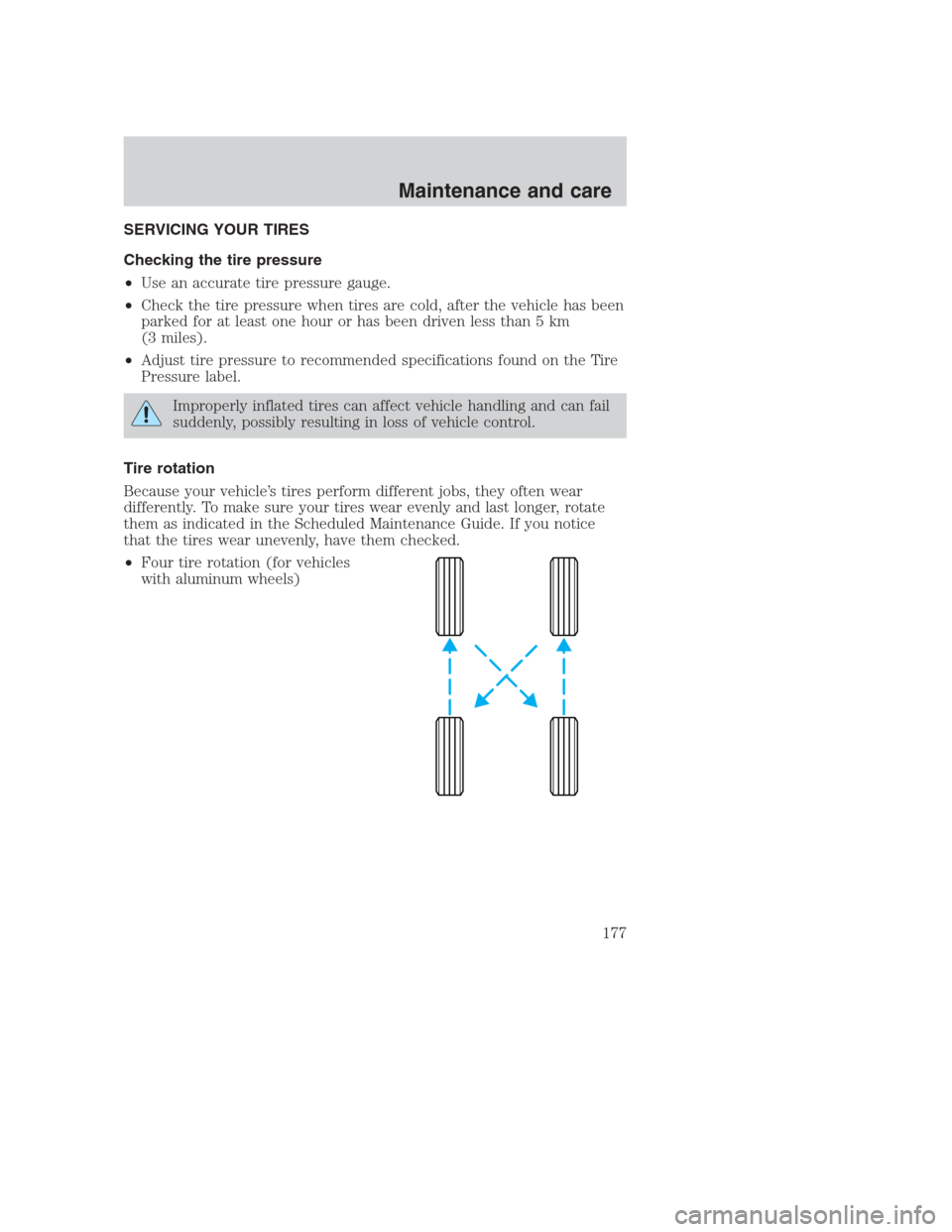
Tire rotation
Because your vehicle’s tires perform different jobs, they often wear
differently. To make sure your tires wear evenly and last longer, rotate
them as indicated in the Scheduled Maintenance Guide. If you notice
that the tires wear unevenly, have them checked.
•Four tire rotation (for vehicles
with aluminum wheels)
Maintenance and care
177
Page 179 of 224
Failure to follow these precautions may adversely affect the
handling of the vehicle and make it easier for the driver to lose
control and roll over.
Tires that are larger or smaller than your vehicle’s original tires may also
affect the accuracy of your speedometer.
SNOW TIRES AND CHAINS
Snow tires must be the same size and grade as the tires you
currently have on your vehicle.
The tires on your vehicle have all weather treads to provide traction in
rain and snow. However, in some climates, you may need to use snow
tires and chains. If you need to use chains, it is recommended that steel
wheels (of the same size and specifications) be used as chains may chip
aluminum wheels.
Follow these guidelines when using snow tires and chains:
•Use only SAE Class S chains.
•Install chains securely, verifying that the chains do not touch any
wiring, brake lines or fuel lines.
•Drive cautiously. If you hear the chains rub or bang against your
vehicle, stop and re-tighten the chains. If this does not work, remove
the chains to prevent damage to your vehicle.
•If possible, avoid fully loading your vehicle.
•Remove the tire chains when they are no longer needed. Do not use
tire chains on dry roads.
•The suspension insulation and bumpers will help prevent vehicle
damage. Do not remove these components from your vehicle when
using snow tires and chains.
WHAT YOU SHOULD KNOW ABOUT AUTOMOTIVE FUELS
Important safety precautions
Do not overfill the fuel tank. The pressure in an overfilled tank
may cause leakage and lead to fuel spray and fire.
Maintenance and care
179
Page 206 of 224
IDENTIFYING YOUR VEHICLE
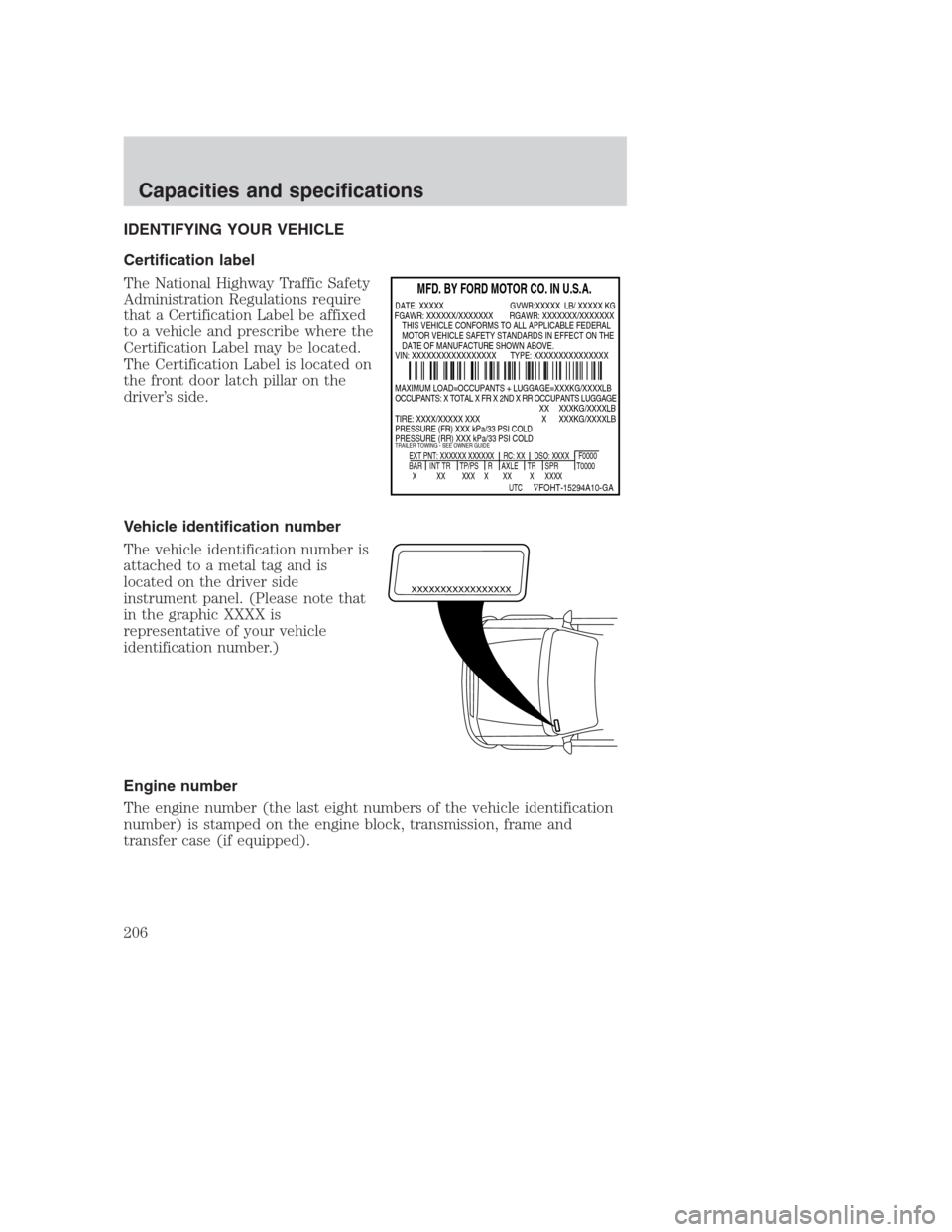
Certification label
The National Highway Traffic Safety
Administration Regulations require
that a Certification Label be affixed
to a vehicle and prescribe where the
Certification Label may be located.
The Certification Label is located on
the front door latch pillar on the
driver’s side.
Vehicle identification number
The vehicle identification number is
attached to a metal tag and is
located on the driver side
instrument panel. (Please note that
in the graphic XXXX is
representative of your vehicle
identification number.)
Engine number
The engine number (the last eight numbers of the vehicle identification
number) is stamped on the engine block, transmission, frame and
transfer case (if equipped).
MFD. BY FORD MOTOR CO. IN U.S.A.
EXT PNT: XXXXXX XXXXXX RC: XX DSO: XXXX F0000
BAR INT TR TP/PS R AXLE TR SPR T0000
X XX XXX X XX X XXXX
UTC
∇FOHT-15294A10-GA
MAXIMUM LOAD=OCCUPANTS + LUGGAGE=XXXKG/XXXXLB
OCCUPANTS: X TOTAL X FR X 2ND X RR OCCUPANTS LUGGAGE
XX XXXKG/XXXXLB
TIRE: XXXX/XXXXX XXX X XXXKG/XXXXLB
PRESSURE (FR) XXX kPa/33 PSI COLD
PRESSURE (RR) XXX kPa/33 PSI COLD
TRAILER TOWING - SEE OWNER GUIDE
DATE: XXXXX GVWR:XXXXX LB/ XXXXX KG
VIN: XXXXXXXXXXXXXXXXX TYPE: XXXXXXXXXXXXXXX FGAWR: XXXXXX/XXXXXXX RGAWR: XXXXXXX/XXXXXXX
THIS VEHICLE CONFORMS TO ALL APPLICABLE FEDERAL
MOTOR VEHICLE SAFETY STANDARDS IN EFFECT ON THE
DATE OF MANUFACTURE SHOWN ABOVE.
XXXXXXXXXXXXXXXXX
Capacities and specifications
206
Page 223 of 224
Specification chart,
lubricants ............................202,204
Speed control ..............................66
Speedometer ...............................16
Starting your vehicle .........118,120
jump starting ..........................148
Steering
speed sensitive .......................126
Steering wheel
tilting .........................................65
Tilt steering wheel ......................65
Tires ......................144,175,176,177
changing ...........................144,145
checking the pressure ............177
replacing ..................................178
rotating ....................................177
snow tires and chains ............179
tire grades ...............................176
treadwear ................................176
Towing ................................133,177
recreational towing .................135
trailer towing ..........................133
wrecker ....................................153
Traction control ........................125
off light ......................................13
Traction-lok rear axle ...............130
Transmission .............................127fluid, checking and adding
(automatic) .............................168
fluid, refill capacities ..............201
lubricant specifications ...202,204
Trip odometer .............................18
Trunk ...........................................90
remote release .....................76,83
Turn signal .............................11,64
Vehicle dimensions ...................204
Vehicle Identification
Number (VIN) ...........................206
Vehicle loading ..........................131
Ventilating your vehicle ...........121
Warning chimes ......................14,15
Warning lights (see Lights) .........8
Washer fluid ..............................161
Water, Driving through .............136
Windows
power .........................................76
Windshield washer
fluid and wipers
checking and adding fluid .....161
checking and cleaning ............174
operation ...................................64
replacing wiper blades ...........174
Wrecker towing .........................153
Index
223
Page 224 of 224
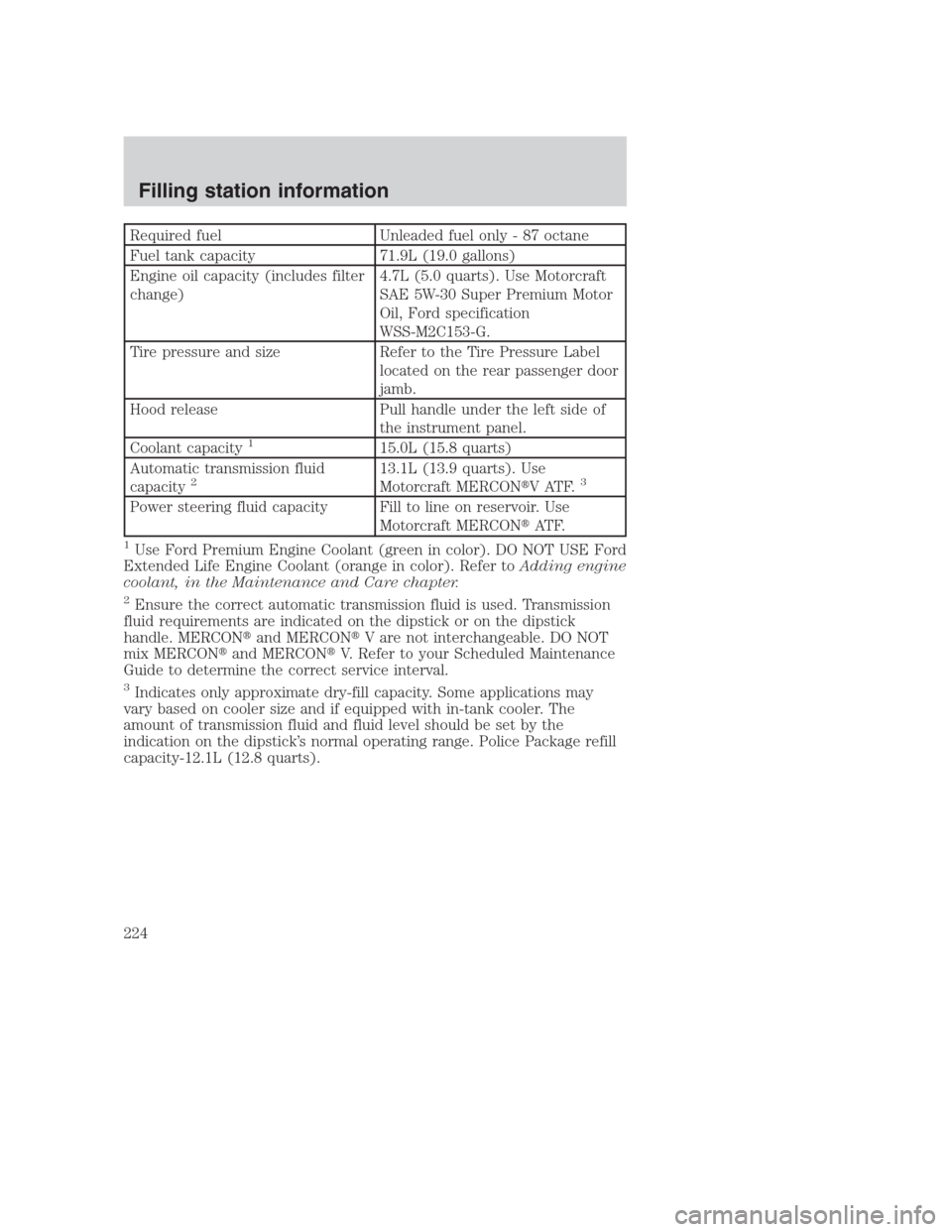
Required fuel Unleaded fuel only - 87 octane
Fuel tank capacity 71.9L (19.0 gallons)
Engine oil capacity (includes filter
change)4.7L (5.0 quarts). Use Motorcraft
SAE 5W-30 Super Premium Motor
Oil, Ford specification
WSS-M2C153-G.
Tire pressure and size Refer to the Tire Pressure Label
located on the rear passenger door
jamb.
Hood release Pull handle under the left side of
the instrument panel.
Coolant capacity
115.0L (15.8 quarts)
Automatic transmission fluid
capacity
213.1L (13.9 quarts). Use
Motorcraft MERCON�V ATF.3
Power steering fluid capacity Fill to line on reservoir. Use
Motorcraft MERCON�AT F.
1Use Ford Premium Engine Coolant (green in color). DO NOT USE Ford
Extended Life Engine Coolant (orange in color). Refer toAdding engine
coolant, in the Maintenance and Care chapter.
2Ensure the correct automatic transmission fluid is used. Transmission
fluid requirements are indicated on the dipstick or on the dipstick
handle. MERCON�and MERCON�V are not interchangeable. DO NOT
mix MERCON�and MERCON�V. Refer to your Scheduled Maintenance
Guide to determine the correct service interval.
3Indicates only approximate dry-fill capacity. Some applications may
vary based on cooler size and if equipped with in-tank cooler. The
amount of transmission fluid and fluid level should be set by the
indication on the dipstick’s normal operating range. Police Package refill
capacity-12.1L (12.8 quarts).
Filling station information
224