2000 FORD CROWN VICTORIA reset
[x] Cancel search: resetPage 54 of 224
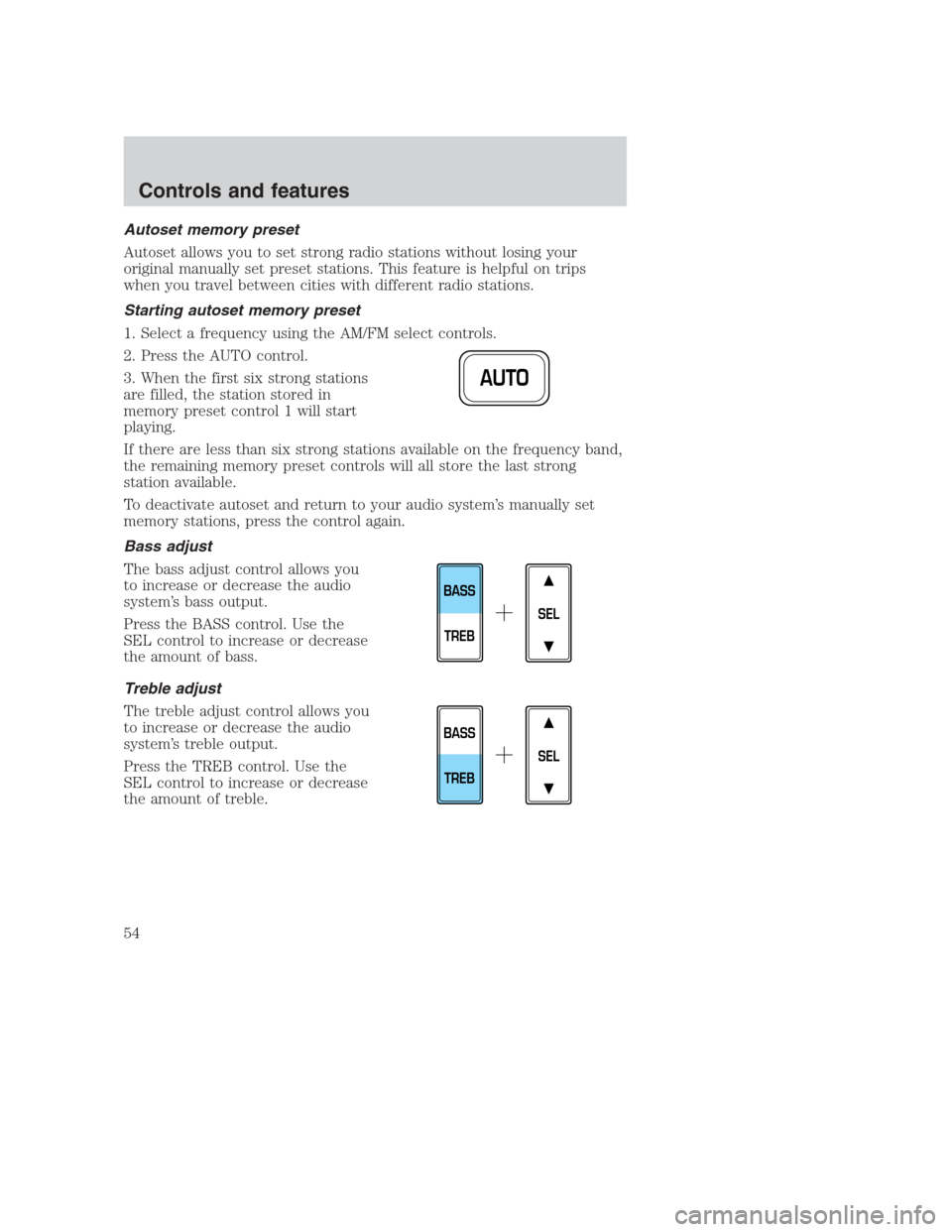
Autoset memory preset
Autoset allows you to set strong radio stations without losing your
original manually set preset stations. This feature is helpful on trips
when you travel between cities with different radio stations.
Starting autoset memory preset
1. Select a frequency using the AM/FM select controls.
2. Press the AUTO control.
3. When the first six strong stations
are filled, the station stored in
memory preset control 1 will start
playing.
If there are less than six strong stations available on the frequency band,
the remaining memory preset controls will all store the last strong
station available.
To deactivate autoset and return to your audio system’s manually set
memory stations, press the control again.
Bass adjust
The bass adjust control allows you
to increase or decrease the audio
system’s bass output.
Press the BASS control. Use the
SEL control to increase or decrease
the amount of bass.
Treble adjust
The treble adjust control allows you
to increase or decrease the audio
system’s treble output.
Press the TREB control. Use the
SEL control to increase or decrease
the amount of treble.
AUTO
SEL
BASS
TREB
SEL
BASS
TREB
Controls and features
54
Page 138 of 224
Roadside coverage beyond basic warranty
In the United States, you may purchase additional roadside assistance
coverage beyond this period through the Ford Auto Club by contacting
your Ford or Lincoln Mercury dealer.
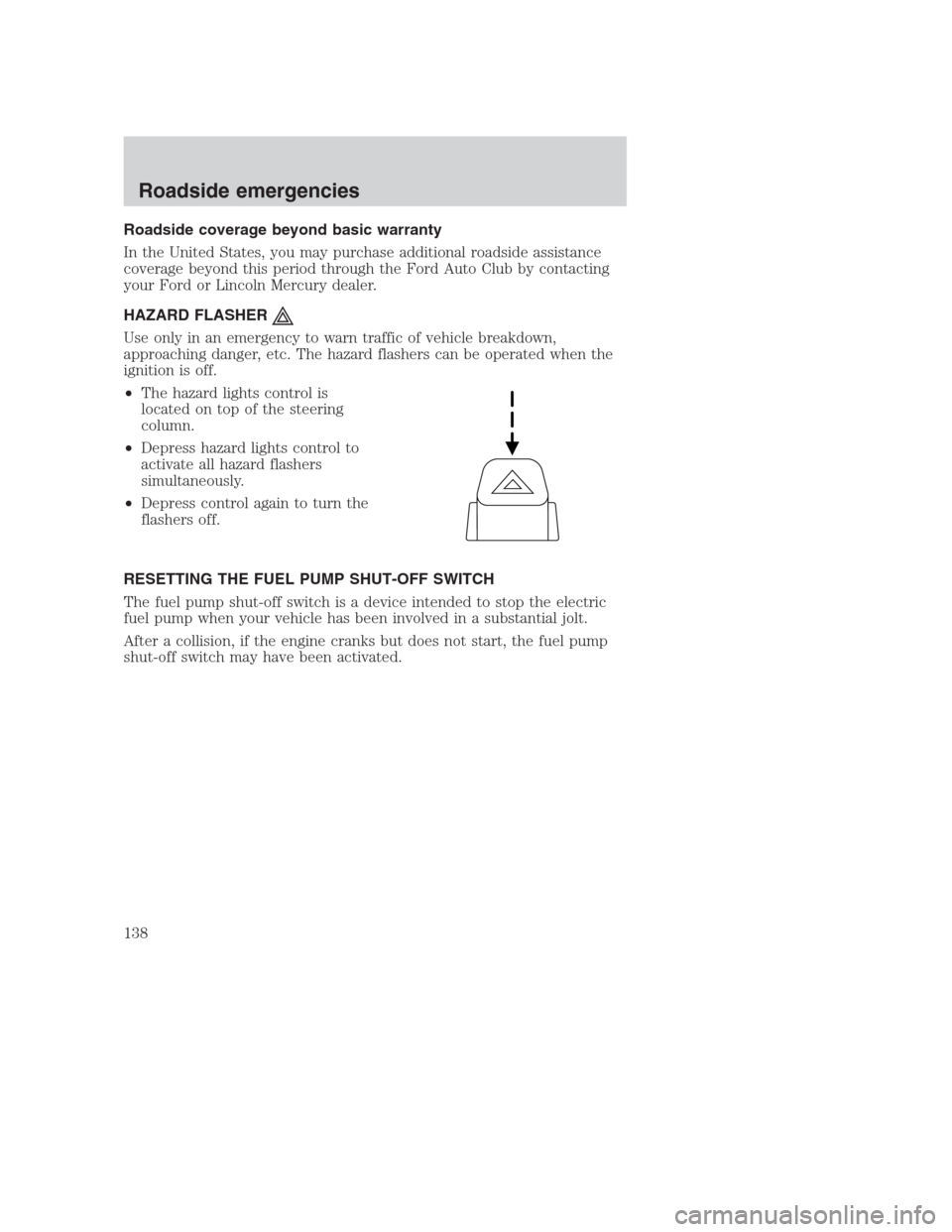
HAZARD FLASHER
Use only in an emergency to warn traffic of vehicle breakdown,
approaching danger, etc. The hazard flashers can be operated when the
ignition is off.
•The hazard lights control is
located on top of the steering
column.
•Depress hazard lights control to
activate all hazard flashers
simultaneously.
•Depress control again to turn the
flashers off.
RESETTING THE FUEL PUMP SHUT-OFF SWITCH
The fuel pump shut-off switch is a device intended to stop the electric
fuel pump when your vehicle has been involved in a substantial jolt.
After a collision, if the engine cranks but does not start, the fuel pump
shut-off switch may have been activated.
Roadside emergencies
138
Page 139 of 224
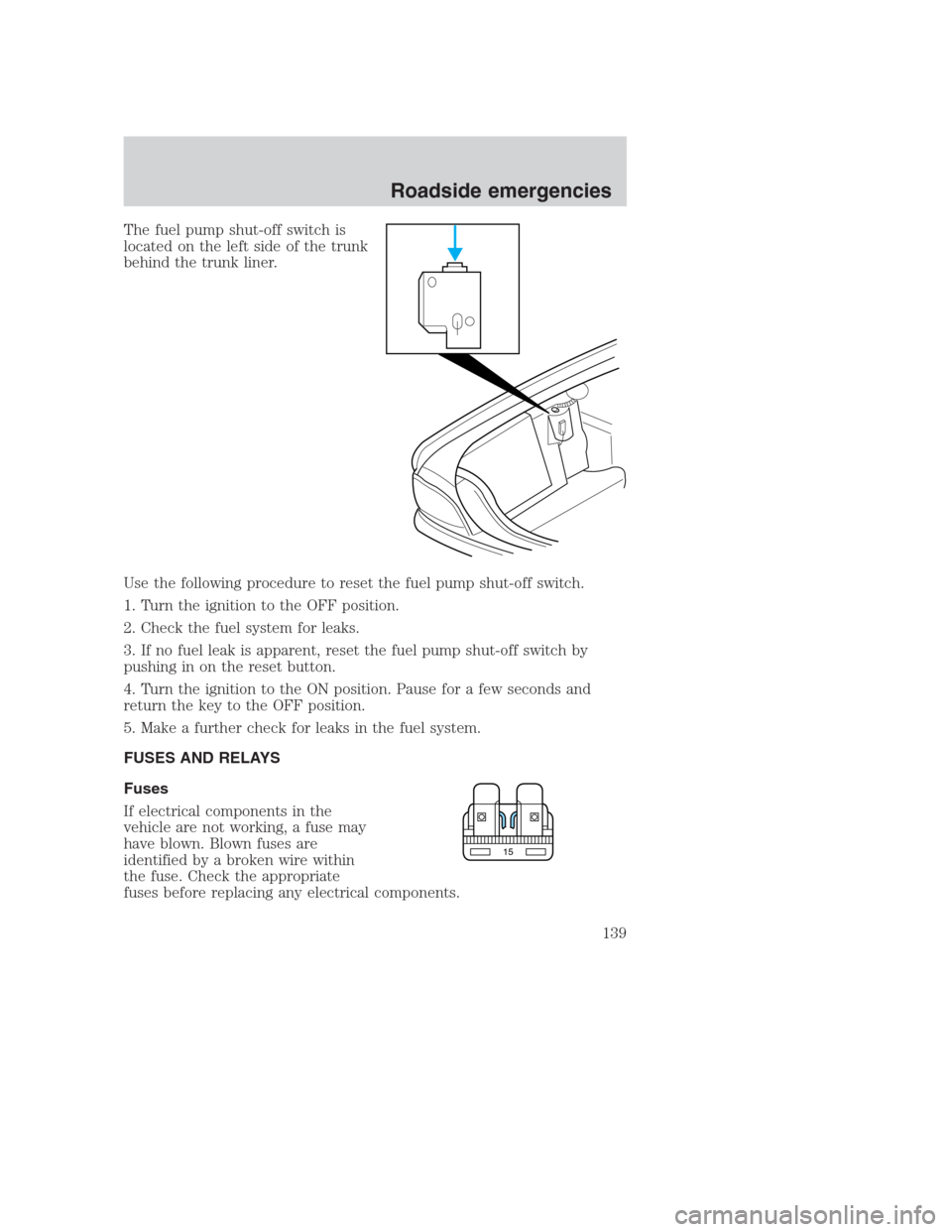
The fuel pump shut-off switch is
located on the left side of the trunk
behind the trunk liner.
Use the following procedure to reset the fuel pump shut-off switch.
1. Turn the ignition to the OFF position.
2. Check the fuel system for leaks.
3. If no fuel leak is apparent, reset the fuel pump shut-off switch by
pushing in on the reset button.
4. Turn the ignition to the ON position. Pause for a few seconds and
return the key to the OFF position.
5. Make a further check for leaks in the fuel system.
FUSES AND RELAYS
Fuses
If electrical components in the
vehicle are not working, a fuse may
have blown. Blown fuses are
identified by a broken wire within
the fuse. Check the appropriate
fuses before replacing any electrical components.
15
Roadside emergencies
139
Page 166 of 224
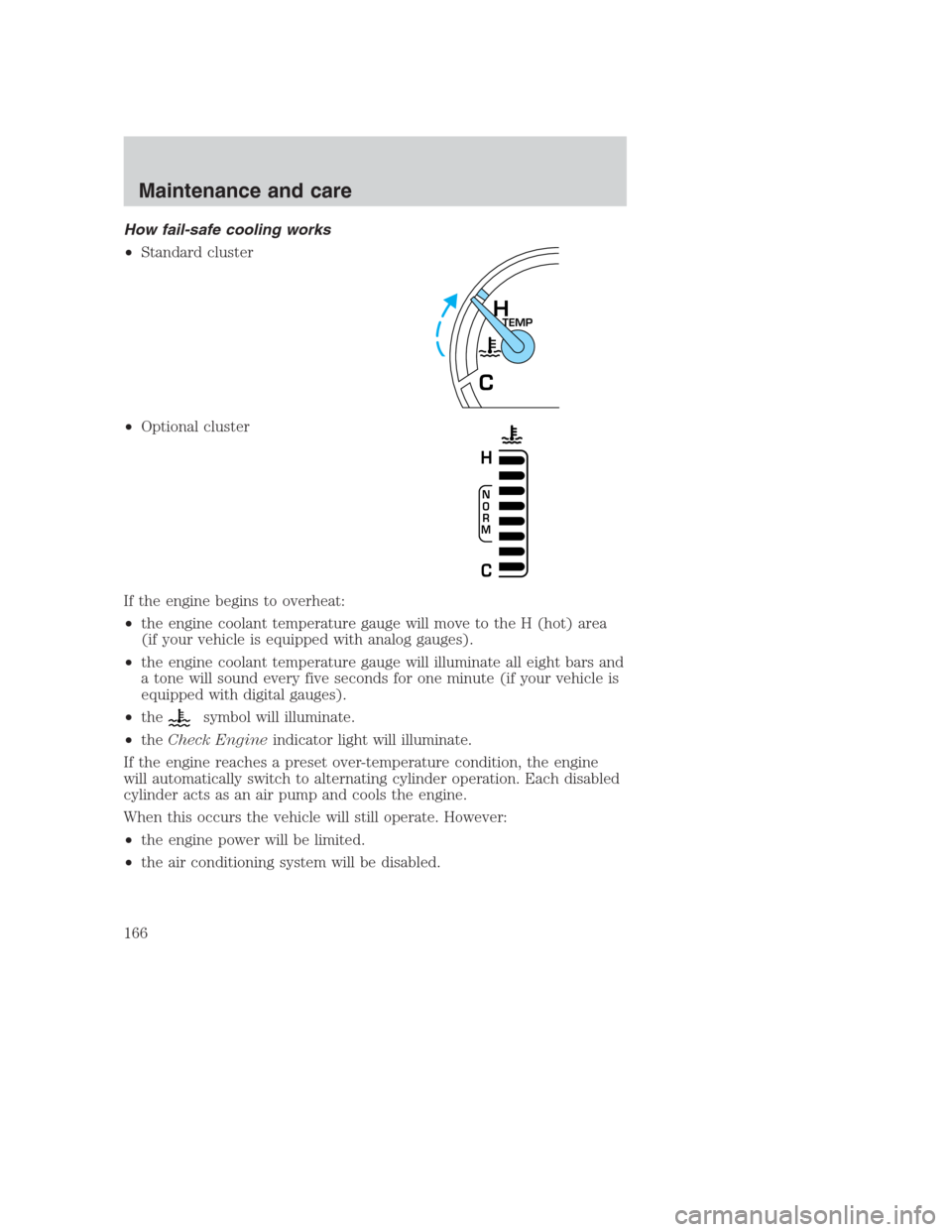
How fail-safe cooling works
•Standard cluster
•Optional cluster
If the engine begins to overheat:
•the engine coolant temperature gauge will move to the H (hot) area
(if your vehicle is equipped with analog gauges).
•the engine coolant temperature gauge will illuminate all eight bars and
a tone will sound every five seconds for one minute (if your vehicle is
equipped with digital gauges).
•the
symbol will illuminate.
•theCheck Engineindicator light will illuminate.
If the engine reaches a preset over-temperature condition, the engine
will automatically switch to alternating cylinder operation. Each disabled
cylinder acts as an air pump and cools the engine.
When this occurs the vehicle will still operate. However:
•the engine power will be limited.
•the air conditioning system will be disabled.
TEMPH
C
N
O
R
M
H
C
Maintenance and care
166
Page 172 of 224
When lifting a plastic-cased battery, excessive pressure on the
end walls could cause acid to flow through the vent caps,
resulting in personal injury and/or damage to the vehicle or battery.
Lift the battery with a battery carrier or with your hands on opposite
corners.
Keep batteries out of reach of children. Batteries contain sulfuric
acid. Avoid contact with skin, eyes or clothing. Shield your eyes
when working near the battery to protect against possible splashing of
acid solution. In case of acid contact with skin or eyes, flush
immediately with water for a minimum of 15 minutes and get prompt
medical attention. If acid is swallowed, call a physician immediately.
Because your vehicle’s engine is electronically controlled by a computer,
some control conditions are maintained by power from the battery. When
the battery is disconnected or a new battery is installed, the engine must
relearn its idle and fuel trim strategy for optimum driveability and
performance. To begin this process:
1. With the vehicle at a complete stop, set the parking brake.
2. Put the gearshift in P (Park), turn off all accessories and start the
engine.
3. Run the engine until it reaches normal operating temperature.
4. Allow the engine to idle for at least one minute.
5. Turn the A/C on and allow the engine to idle for at least one minute.
6. With your foot on the brake pedal and with the A/C on, put the
vehicle in D (Drive) and allow the engine to idle for at least one minute.
7. Drive the vehicle to complete the relearning process.
•The vehicle may need to be driven 16 km (10 miles) or more to
relearn the idle and fuel trim strategy.
•If you do not allow the engine to relearn its idle trim, the idle
quality of your vehicle may be adversely affected until the idle
trim is eventually relearned.
If the battery has been disconnected or a new battery has been installed,
the clock must be reset once the battery is reconnected.
Maintenance and care
172
Page 189 of 224
If the vehicle’s powertrain system or its battery has just been serviced,
the on-board diagnostics system is reset to a “not ready for I/M test”
condition. To ready the on-board diagnostics system for I/M testing, a
minimum of 30 minutes of city and highway driving is necessary as
described below:
•First, at least 10 minutes of driving on an expressway or highway.
•Next, at least 20 minutes driving in stop-and-go, city-type traffic with
at least four idle periods.
Allow the vehicle to sit for at least eight hours without starting the
engine. Then, start the engine and complete the above driving cycle. The
engine must warm up to its normal operating temperature. Once started,
do not turn off the engine until the above driving cycle is complete.
BULBS
Replacing exterior bulbs
Check the operation of the following lamps frequently:
•Headlamps
•Tail lamps
•Brakelamps
•High-mount brakelamp
•Turn signals
•Backup lamps
•License plate lamp
Do not remove lamp bulbs unless they will be replaced immediately. If a
bulb is removed for an extended period of time, contaminants may enter
the lamp housings and affect performance.
Replacing headlamp bulbs
To remove the headlamp bulb:
1. Make sure headlamp switch is in OFF position, then open the hood.
2. Remove the protective cover by turning the three knobs to the unlock
position.
Maintenance and care
189
Page 222 of 224
anti-lock brakes (ABS) .....11,123
brake ..........................................11
charging system ........................12
check engine ...............................9
high beam .................................11
low coolant ................................10
low fuel ........................................8
oil pressure ...............................12
overdrive off ..............................13
safety belt .................................10
speed control ............................70
traction control active ..............13
turn signal indicator .................11
Load limits .................................131
GAWR ......................................131
GVWR ......................................131
trailer towing ..........................131
Locks
autolock .....................................81
childproof ..................................79
doors ..........................................78
Lubricant specifications ....202,204
Lug nuts, anti-theft ...................147
Lumbar support, seats ...............96
Message center ...........................20
reset button ..............................20
select button .............................21
Mirrors
automatic dimming
rearview mirror .........................74
cleaning ...................................196
side view mirrors (power) .......78
Motorcraft parts .................184,201
Octane rating ............................183
Odometer .....................................17
Oil (see Engine oil) ..................157
Overdrive ..............................66,129
Panic alarm feature, remote
entry system ................................83
Parking brake ............................123
Parts (see Motorcraft parts) ....201Power distribution box
(see Fuses) ...............................142
Power door locks ...................78,81
Power steering ..........................126
fluid, checking and adding ....168
fluid, refill capacity ................201
fluid, specifications ..........202,204
Radio ............................................35
Relays .................................139,144
Remote entry system ............80,83
illuminated entry ......................83
locking/unlocking doors ...........80
opening the trunk .....................83
panic alarm ...............................83
replacement/additional
transmitters ...............................85
replacing the batteries .............84
Safety belts (see Safety
restraints) .........14,96,97,98,99,100
Safety defects, reporting ..........218
Safety restraints ....96,97,98,99,100
belt minder .............................102
cleaning the
safety belts .......................105,199
extension assembly ................101
for adults .........................97,98,99
for children ......................110,111
lap belt ....................................100
warning light
and chime ...............10,14,101,102
Safety seats for children ..........112
Seat belts
(see Safety restraints) ...............96
Seats ............................................92
child safety seats ....................112
cleaning ............................199,200
SecuriLock passive
anti-theft system ....................85,86
Servicing your vehicle ..............154
Spark plugs,
specifications ......................201,204
Special notice ................................3
Index
222